Table of Contents >> Show >> Hide
- Why Classical Art-Inspired Tattoos Hit So Hard
- Popular Classical Art Themes That Look Amazing As Tattoos
- Designing Your Own Classical Art-Inspired Tattoo
- Working With a Tattoo Artist on Your Fine Art Design
- Living With a Classical Art Tattoo
- Real-Life Stories and Experiences With Classical Art Tattoos
- Conclusion: Turning Your Skin Into a Curated Collection
If you’ve ever stood in a museum whispering, “I’d totally get that painting tattooed on me,”
congratulationsyou’re exactly the audience for classical art-inspired tattoos. These pieces
turn your skin into a moving gallery, where Botticelli, Van Gogh, Klimt, and Michelangelo
all share exhibition space with your everyday life. Inspired by viral collections like
Bored Panda’s roundup of 106 classical art tattoos, this guide walks you through what makes
fine art tattoos so special, which masterpieces translate best to ink, and how to plan a
design that feels personalnot just Pinterest-pretty.
Why Classical Art-Inspired Tattoos Hit So Hard
From gallery walls to your skin
Classical art already does the heavy lifting: it’s dramatic, emotional, beautifully composed,
and instantly recognizable. Tattoo artists simply (well, not simply) adapt that visual
storytelling to the contours of a body. Modern fine art tattoos borrow from Renaissance
realism, Baroque drama, Impressionist color, and modernist abstraction, then remix everything
into custom pieces that look like living, breathing canvases.
For many people, a classical art tattoo is also a shortcut to identity“I’m the person who
loves Van Gogh enough to wear his sunflowers forever,” or “I may look calm, but internally
I’m a full-on Caravaggio painting.” These designs speak to your taste, your values, and
sometimes your chaos, all in one image.
Symbolism with built-in depth
Unlike a random trendy symbol, classical artworks come loaded with centuries of meaning.
A Botticelli figure isn’t just a pretty woman; she can represent rebirth, beauty, and
the power of myth. Van Gogh’s swirling skies say something about turbulence, emotion,
and seeing the world differently. Michelangelo’s sculptures double as icons of resilience,
strength, and spiritual struggle. Fine art tattoos naturally feel “deeper” because the
source material has already been interpreted, argued over, and adored for ages.
Popular Classical Art Themes That Look Amazing As Tattoos
1. Renaissance icons: Da Vinci, Michelangelo, and Botticelli
Renaissance tattoos are the gateway drug for many fine art lovers. Designs often include:
-
Da Vinci sketches – The Vitruvian Man, anatomical drawings, or mechanical
designs translate beautifully into linework and geometric compositions on the forearm,
calf, or back. -
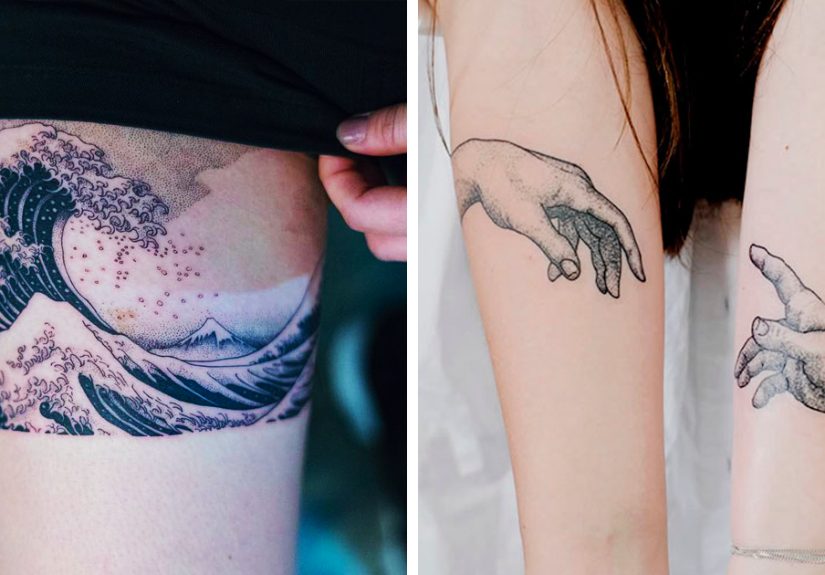
Michelangelo’s David or pietà-style figures – Hyper-realistic black-and-gray
sleeves based on sculpture capture rippling fabric, tense muscles, and dramatic shading. -
Botticelli’s goddesses – The Birth of Venus, Primavera, or the Three Graces
become elegant thigh, rib, or back pieces, with flowing hair and floral details that work
in color or muted tones.
These designs work for people who want something grand and timeless. Think: museum postcard
meets high-end realism studio.
2. Van Gogh, Monet, and painterly Impressionist tattoos
Impressionist-inspired tattoos lean into brushstroke texture and luminous color. Van Gogh’s
Starry Night, sunflower bouquets, self-portraits, and cottages show up constantly in
art tattoo roundups, often as upper-arm pieces or half-sleeves with swirling skies and bold
yellows and blues.
Monet’s water lilies, bridges, and gardens translate well for people who prefer softer color
palettes and dreamy scenes. These tattoos are perfect if you want something expressive,
emotional, and just a little bit messyin the best way.
3. Klimt, Picasso, and modernist mashups
If you’re drawn to bold shapes, pattern-heavy designs, or abstract faces, modernist artists
like Gustav Klimt and Pablo Picasso offer endless tattoo material. From Klimt’s gold-filled,
mosaic-like motifs to Picasso’s single-line faces, these designs look especially striking on
forearms, shoulders, and ribcages.
Many artists also create collage-style tattoos that mix classical portraits with contemporary
graphic elementsthink Roman busts combined with glitch effects, neon shapes, or handwritten
script. It’s a way to say, “Yes, I love old art. Also, I live on the internet.”
4. Sculptures, angels, and Baroque drama
Sculptural tattoos are huge with fans of dramatic, black-and-gray realism. Angelic figures,
chapel ceilings, and carved stone details wrap beautifully around arms, shoulders, and backs.
Baroque and Gothic-inspired tattoo pieces feature heavy shadows, ornate details, and theatrical
compositions that look like scenes pulled straight from cathedral ceilings or palace walls.
Designing Your Own Classical Art-Inspired Tattoo
Choose the artwork that actually means something to you
Start with a question: which piece of art follows you around? Maybe it’s the Klimt print in
your college dorm, the Van Gogh calendar at your first apartment, or the marble statue you
saw in person and couldn’t stop thinking about. That’s your best candidate. Tattoos that come
from personal stories age better than designs you picked because they performed well on
Instagram.
If you can’t commit to a full painting, pull out one meaningful detail:
- Just the eyes of David or the Mona Lisa.
- A single figure from a larger mythological scene.
- A fragment of a fresco framed with architectural lines or geometric shapes.
Pick a style that matches both the art and your taste
You don’t have to recreate the original piece pixel-for-pixel. Fine art lovers experiment
with a variety of tattoo styles:
-
Hyper-realistic – Ideal for portraits and sculptures where subtle shading
matters. -
Fine-line / micro-realism – Great for small, detailed designs based on
sketches or engravings. -
Neo-traditional – Uses bold outlines and saturated color, perfect for
Klimt, Van Gogh, or tarot-like compositions. -
Abstract / collage – Mixes brushstrokes, shapes, and text for a more
contemporary, editorial feel.
Placement ideas that showcase the art
Placement can make or break an art-inspired tattoo. A few popular options:
-
Upper arm & shoulder: Great for framed “gallery” pieces or sculptural
busts, with enough space for background detail. -
Forearm: Perfect for vertical panels inspired by tarot cards, stained glass,
or Cassatt-style vignettes. -
Back: The blank wall of your bodyideal for full scenes like The Creation
of Adam or sprawling Baroque compositions. - Thigh & calf: Excellent for long, flowing figures, columns, and angels.
Working With a Tattoo Artist on Your Fine Art Design
Do your homework (more than just scrolling)
Not every tattoo artist loves doing fine art tattoosand that’s okay. Look for portfolios
where you see:
- Strong linework and shading in portraits or statues.
- Comfort with realistic faces and hands (the hardest part to nail).
- Examples of work inspired by paintings or sculptures, not just flash sheets.
Many studios now specialize in Renaissance, Baroque, or fine-art realism, so don’t be shy
about traveling for the right artist. A classical piece is a big commitment; it deserves
someone obsessed with detail.
Talk about adaptation and copyright
Classical works that are centuries old are usually in the public domainwhich means your
artist can reference them freely. More modern paintings or unique reinterpretations may
require extra care; some artists prefer to use the artwork as inspiration rather than
as a direct copy, to respect the original creator’s style.
Bring high-quality reference images, but let your tattooist adjust the composition for
the body part, movement, and long-term readability. What looks perfect on a rectangular
canvas might need stronger contrast or simplified shapes to age well as a tattoo.
Color, black-and-gray, or something in between?
Color can capture the emotional punch of Van Gogh, Monet, or Matisse, but black-and-gray
offers that marble-sculpture, cathedral-fresco mood many classical tattoo fans love. Some
artists blend both approaches: grayscale figures with selective pops of gold, blue, or red
to highlight halos, garments, or background elements.
Living With a Classical Art Tattoo
Caring for your “museum piece”
Fine art tattoos are detail-heavy and often cover a large area, which means aftercare is
non-negotiable. Expect:
- Multiple sessions for big pieces like sleeves or back murals.
- Careful washing, moisturizing, and sun protection while the tattoo heals.
- Long-term SPF habits to keep tiny linework and subtle shading crisp.
Just like paintings fade in harsh light, tattoos can lose contrast and vibrancy without
protection. If you’re investing in a piece inspired by Old Masters, treat sunscreen like
part of the frame.
The emotional side of wearing fine art
Many people describe their classical art tattoos as anchorsvisual reminders of resilience,
creativity, or personal turning points. A Renaissance angel might mark surviving a difficult
season; a Van Gogh-inspired sleeve could represent finally embracing your own intensity and
sensitivity. These tattoos are more than aestheticthey’re ongoing conversations between you
and the art that shaped you.
Real-Life Stories and Experiences With Classical Art Tattoos
Spend five minutes in any tattoo studio that specializes in fine art and you’ll hear
stories that sound like museum tours mixed with therapy sessions. Clients walk in with
crumpled postcards from European trips, blurry photos from art textbooks, and saved
screenshots from Bored Panda’s classical tattoo roundups. They’re not just asking for
a design; they’re asking to carry a moment in time, or a version of themselves, forever.
One common story: the “museum epiphany” tattoo. Someone visits Florence, Rome, or Paris,
wanders into a gallery half out of jet lag, and then gets absolutely wrecked by a single
artwork. Maybe it’s standing under Michelangelo’s David, seeing the veins in the
marble and realizing how fragile and powerful the human body can be. Maybe it’s getting
lost in a wall of Van Gogh paintings and feeling strangely seen by that swirling, unstable
sky. Months or years later, that same person shows up at a studio saying, “I can’t stop
thinking about this piececan we put it on my arm?”
Another pattern shows up with people who, on paper, don’t look like “art people” at all:
mechanics with half-sleeves of Baroque angels, nurses with Klimt-inspired back pieces,
software engineers with minimalist linework versions of ancient statues. They talk about
how their tattoos surprise coworkers, patients, or family members. The art becomes a secret
handshakeother art lovers clock it instantly and jump into conversations about favorite
painters or museum recommendations.
There are also deeply personal reinterpretations. A client might take the pose of a
classical figuresay, a saint, goddess, or mythological heroand ask the artist to replace
the face with their own, or remove religious imagery in favor of something more grounded.
The result is a tattoo that lives between reverence and rebellion: a nod to the original
masterpiece, but unapologetically updated to fit modern values and identities.
Pain, oddly enough, becomes part of the narrative. People describe sitting for a long
realism sessionsix, seven, even eight hourswhile a Renaissance scene slowly appears on
their skin. By the time the session is over, they associate that art with endurance and
commitment. It’s no longer just something they love to look at; it’s something they’ve
earned. When strangers compliment the tattoo, what they’re really seeing is hours of
trust between client and artist, plus a lifetime of loving the source material.
And then there’s the quiet, everyday magic: catching a glimpse of your own arm in a
mirror and remembering that you once stood in front of a painting feeling small and
overwhelmedand now, that same image is literally part of you. For fine art lovers,
classical art-inspired tattoos are more than fandom. They’re proof that the works we
admire in hushed galleries can follow us into coffee shops, offices, subway cars, and
late-night grocery runs. The masterpieces don’t stay behind glass; they walk out with us.
Conclusion: Turning Your Skin Into a Curated Collection
Classical art-inspired tattoos sit at a sweet spot between nerdy and glamorous: you get
all the symbolism and history of museum masterpieces with all the swagger of modern ink.
Whether you’re drawn to quiet Renaissance sketches, explosive Van Gogh color, or moody
Baroque angels, there’s a way to make fine art tattoos feel uniquely yours.
Take your time choosing the artwork, find a tattoo artist who respects both the source
material and your story, and think about how the piece will agewith you and on you.
Do that, and you’ll end up with something better than a copy of a painting: a collaboration
between you, a contemporary tattooist, and an artist from another century. That’s not just
body artthat’s a lifelong, portable love letter to art itself.