Table of Contents >> Show >> Hide
- What the 2025 One Hertz Challenge Was Really About
- How the Atomic Decay Clock Works
- Why It Is Accurate but Not Precise
- Why This Is Not a “Real” Atomic Clock in the Metrology Sense
- Meanwhile, the Real Atomic Clock World Is Getting Ridiculously Good
- What the Build Gets Exactly Right
- The Built-In Limits Nobody Can Charm Away
- Why This Project Sticks in Your Head
- Experiences That Make the Idea Click
- Conclusion
If you have ever looked at a clock and thought, “This would be better if it behaved like a mildly haunted particle-physics experiment,” then the 2025 One Hertz Challenge delivered your kind of chaos. Among theing both scientifically elegant and gloriously unsettling: a clock driven by atomic decay.
At first glance, that sounds like overkill. Most of us use clocks that run on quartz crystals, batteries, wall outlets, or the vague social agreement that your phone probably knows what time it is. This build takes a stranger path. Instead of relying on a steady oscillator, it uses the random decay of americium-241 to generate timing events. That means the clock is not regular in the way we usually expect. It can tick early, tick late, or make you question whether time is a suggestion rather than a measurement. And yet, over long periods, it averages out surprisingly well.
That is exactly why the phrase accurate but not precise fits so perfectly. It is not just a catchy headline. It is the whole point of the build, the joke, and the lesson. This project turns one of science’s most important measurement distinctions into something you can hear from across the room.
What the 2025 One Hertz Challenge Was Really About
The One Hertz Challenge asked makers to create something that does its thing once per second. Simple prompt, wild results. A normal response would be an LED blink, a timer, or a clock circuit. A more ambitious response would be to ask, “What even counts as one per second?” That is where this atomic decay clock earns its nerd credentials.
The builder’s idea was not to force a perfectly even pulse every second. Instead, the goal was to produce an average rate of one event per second. In the language of radioactivity, that means aiming for one becquerel, or one radioactive decay per second on average. That sounds suspiciously close to one hertz, but the two are not the same thing. One hertz suggests a periodic signal: tick, tick, tick, every second like a disciplined metronome. One becquerel is a statistical average. The events happen randomly, and the timing between them follows the messy logic of quantum physics rather than the tidy rhythm of a pendulum.
So right away, the project lives in a delightful gray area. It satisfies the spirit of the challenge, but it does so with a wink, a Geiger-flavored soundtrack, and a reminder that nature does not always care about your preference for even spacing.
How the Atomic Decay Clock Works
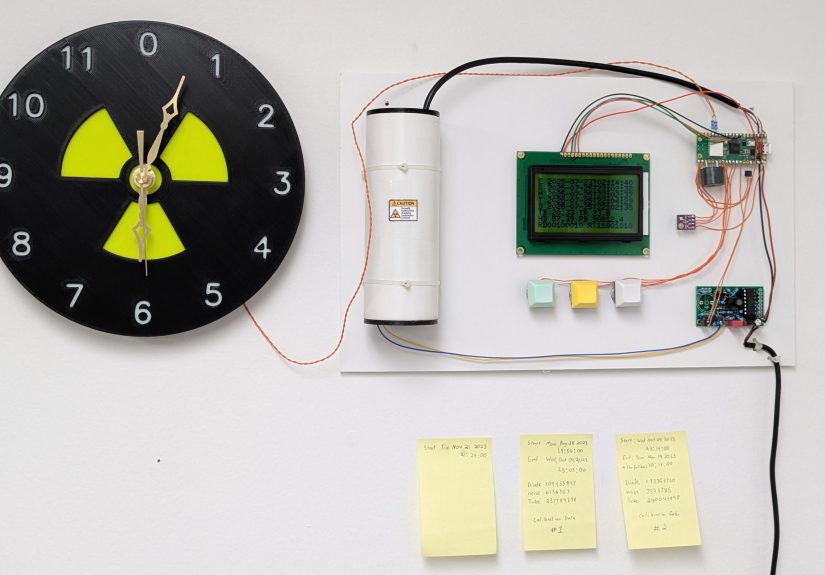
The build uses americium-241 as the radioactive source. Instead of blindly counting whatever radiation happens to show up, the system looks for a very specific signature. It uses a coincidence setup that detects an alpha particle and a characteristic gamma ray from the same decay event. That matters because background radiation is the party crasher of low-count-rate experiments. If you simply tried to detect one event per second with a loose setup, background counts would muscle their way into the signal and ruin the timebase.
To get around that, the builder configured two detectors so that a pulse is generated only when both relevant signals appear together. That is a much more selective way to identify the decay events that actually belong to the source. The geometry of the setup then gets tuned until the average coincidence rate lands around one event per second. That pulse is fed into a controller, which advances a loud analog-style clock.
And yes, that loud clock is a brilliant design decision. A regular display would show the concept. A physical ticking clock makes you feel the concept. This thing does not merely report the weirdness of probabilistic timekeeping. It performs it, like a tiny stage actor trained by nuclear statistics and possibly by Terry Pratchett.
Why It Is Accurate but Not Precise
Let’s put the key idea on the table without wrapping it in too much scientific bubble wrap.
Accuracy is about how close you get to the true value. Precision is about how tightly clustered the measurements are. A device can be accurate on average but wildly inconsistent from one moment to the next. That is this clock in a nutshell.
Over a long enough stretch, the decay rate averages out to roughly one event per second. In that sense, the clock is accurate. Its mean timing is close to the target. But second-to-second intervals are not uniform at all. Some ticks are too close together. Others take their sweet time. The spacing between events follows an exponential distribution rather than a clean one-second beat. So the clock is not precise in the everyday sense of being regular, even though it can still be remarkably faithful over the long haul.
An analogy helps. Imagine a basketball player taking free throws with a bizarre style. Some shots arc high, some are line drives, some bounce around the rim like they are auditioning for a sports documentary. If the player still sinks the expected number over many attempts, they are accurate. But if no two shots ever look the same, they are not precise. This clock plays the same game with time.
Short Timescales: Chaos in a Nice Suit
On a short timescale, the clock is gloriously unruly. The builder’s own logs show that individual tick intervals behave exactly the way radioactive decay says they should: randomly. That randomness is not a bug. It is the source material. If you watch the second hand expecting the visual comfort of a quartz clock, you will not get it. You will get something weirder: a device that keeps trying to sound decisive while constantly second-guessing itself.
That is why the project is sometimes compared to Lord Vetinari’s clock from Discworld, which used irregular ticking as a form of psychological warfare. A normal clock reassures you. This clock makes you feel like time is wearing clown shoes.
Long Timescales: Statistics to the Rescue
Zoom out, though, and the beauty appears. Radioactive decay is random in the moment, but the average behavior is stable and predictable. Count enough events, and the fluctuations start to wash out. This is the same reason radioactive decay can be used in serious science, from radiometric dating to calibrated measurements of activity. Random does not mean useless. It means you need to think statistically.
That is the heart of the build. The mean interval sits close to one second over time, even if the path to that average looks like it was planned by a caffeinated squirrel. The project logs note that an hour measured by the clock can wander by more than a minute, with a standard deviation around 60 seconds. That sounds terrible until you remember the math of counting statistics: when you count around 3,600 events, the square root of 3,600 is 60. In other words, the clock is behaving exactly like the physics says it should.
Why This Is Not a “Real” Atomic Clock in the Metrology Sense
Here is where the title needs a friendly correction. Calling it an atomic decay clock is fair and descriptive. Calling it an atomic clock in the formal timekeeping sense is more poetic than precise.
Real atomic clocks do not keep time by waiting for random nuclear events to happen. They keep time by locking onto an extremely stable and repeatable atomic transition frequency. The current definition of the second is based on a specific transition in cesium-133. Cesium clocks, rubidium clocks, and newer optical clocks work because atoms oscillate at known frequencies that can be counted with extraordinary regularity. That is periodic timekeeping, not probabilistic event counting.
This distinction matters. A true atomic clock is a masterclass in precision. Its whole job is to produce ticks that are as uniform as physics allows. A radioactive-decay clock does almost the opposite: it embraces fundamentally random timing and leans on averages to recover accuracy later.
That contrast is what makes the 2025 One Hertz Challenge entry so smart. It borrows atomic physics but flips the usual clockmaking goal on its head. Instead of asking, “How do I make every second identical?” it asks, “Can I still make a believable clock if every second is different?”
Meanwhile, the Real Atomic Clock World Is Getting Ridiculously Good
If this project is the scrappy philosopher-poet of timekeeping, official atomic clocks are the overachieving valedictorians who color-code their notes and somehow also have perfect posture. Modern cesium fountain clocks already anchor national and international time scales. Rubidium clocks quietly keep telecom systems and satellites on schedule. Optical clocks using strontium or ytterbium are even more extreme, dividing time into vastly finer ticks than cesium can manage.
In recent years, next-generation optical clocks have gotten so good that scientists are openly discussing whether the official second should eventually be redefined. That is not because today’s clocks are bad. It is because the new ones are absurdly good. They can detect tiny relativistic effects over small height differences, support navigation and synchronization technologies, and push tests of physics into territory that once sounded like science fiction.
And that is why the decay clock is so charming. It exists in the shadow of instruments so precise they make normal clocks look like sundials drawn with a crayon. Yet instead of trying to beat them, it makes a different point: timekeeping is not just about engineering perfection. It is also about understanding what your signal really means.
What the Build Gets Exactly Right
First, it turns a textbook distinction into a visceral experience. Plenty of people have heard the words accuracy and precision. Far fewer could explain them cleanly. This clock makes the difference unforgettable.
Second, it uses background rejection in a thoughtful way. The coincidence detection approach is not just clever; it is necessary. Without that selectivity, a one-becquerel target would drown in the ordinary radiation soup around us.
Third, it avoids the trap of making the science invisible. A lot of technically impressive projects end up looking like another box with another display. This one uses a physical clock face and audible ticks, which gives the physics a personality. It is part instrument, part demonstration, part art piece, and part prank on your nervous system.
Finally, it is honest. The build does not pretend to be more stable than it is. It leans into the randomness, documents the drift, and lets the statistics speak for themselves. In science and engineering, that kind of honesty is not just refreshing. It is the whole game.
The Built-In Limits Nobody Can Charm Away
Of course, the project has limits, and they are not cosmetic. Radioactive decay is random by nature, so no clever firmware trick is going to make individual seconds beautifully uniform without changing the concept. The source also decays over time. Americium-241 has a long half-life, but long is not the same as infinite, and the builder notes that the clock loses around 0.4 seconds per day as configured.
There is also the issue of practicality. If your job involves financial trades, GPS, telecommunications, or not missing a train, this should not be your reference clock. It is an educational and experimental object, not a replacement for UTC. It teaches the truth about time statistics, but it does not deliver the kind of polished regularity most people mean when they say they want a clock.
And then there is safety. Small amounts of americium are used safely in certain consumer smoke detectors when properly sealed and left alone. That should not be mistaken for an invitation to go harvesting radioactive material from household devices. The correct relationship with smoke detectors is simple: install them, test them, replace them when needed, and do not turn them into a weekend radiation salvage mission.
Why This Project Sticks in Your Head
The best hardware projects do more than function. They reshape how you think. This one does that beautifully. It reminds you that “one per second” can mean at least two different things: a perfectly periodic beat, or a random process whose average lands at one event per second. In music, those are very different drummers. In measurement science, they are different universes.
It also sneaks in a bigger lesson. People often talk about science as if it is only about getting cleaner, tighter, more exact numbers. But science is also about knowing what kind of uncertainty you have, where it comes from, and whether your result is meaningful despite the mess. This clock is a small, ticking monument to that idea.
Experiences That Make the Idea Click
Spend a little time around a concept like this, and the experience becomes as memorable as the physics. Even if you never build one yourself, you can almost imagine what it is like to have this clock in a room: the second hand lunging ahead, hesitating, then catching up as though time is being negotiated in real time. It would be funny for the first minute, unsettling by the fifth, and weirdly educational by the tenth.
That is because most of us do not experience randomness and time in the same object. We experience clocks as authority figures. They tell us when meetings start, when buses leave, when the pasta is done, and when we are officially late enough to begin making excuses. We expect a clock to sound confident. An atomic decay clock sounds honest instead. It says, “I can give you the truth on average, but I will not fake certainty in the short term.” That is a pretty radical personality for something hanging on the wall.
There is also a subtle psychological effect. A normal second hand disappears into the background because it is repetitive. The brain adapts. But a clock with irregular ticks keeps stealing your attention. You listen for the next tick because you cannot predict it exactly. In that sense, the project turns timekeeping into a live performance. It is not unlike listening to rain on a roof or popcorn in a pan: pattern exists, but not in the neat, grid-like way your planner would prefer.
For students, hobbyists, and science fans, that experience can be more valuable than a perfect display. You do not just learn that radioactive decay is random; you feel the consequence of that randomness. You see why an average can be trustworthy while individual events remain unruly. You understand, almost physically, why a detector reading has spread, why count rates fluctuate, and why “close to the truth” is not the same thing as “repeatable every time.”
There is also something charmingly rebellious about it. In a world obsessed with optimization, this clock dares to be gloriously non-uniform. It is still disciplined in the long run, but it refuses to perform regularity for comfort’s sake. That makes it a wonderful conversation piece. A quartz wall clock says, “I am here to help.” A radioactive decay clock says, “Let’s discuss statistics, uncertainty, and the fragile illusion that every second is born equal.”
And then there is the maker experience. Tuning a system like this must feel like balancing physics, electronics, and patience on the same tiny workbench. You are not merely assembling parts; you are negotiating with background radiation, detection thresholds, geometry, and probability itself. When it finally works, the victory is not that you made a perfect clock. It is that you made a truthful one. That is rarer, funnier, and in some ways more impressive.
Conclusion
The 2025 One Hertz Challenge atomic decay clock is memorable because it does not confuse cleverness with gimmickry. Under the hood, it is a genuine lesson in radiation detection, counting statistics, and measurement language. On the wall, it is a beautifully cursed clock. It is accurate enough to make a scientific point, imprecise enough to make you twitch, and smart enough to expose the gap between average truth and moment-to-moment order.
In a timekeeping landscape dominated by cesium fountains, rubidium workhorses, and optical clocks so polished they practically glow with self-esteem, this project goes in the opposite direction and somehow becomes more interesting because of it. It does not beat the best clocks on Earth. It does something harder for a piece of DIY hardware: it teaches a real scientific idea so clearly that once you understand it, you will never hear the word “precision” the same way again.