Table of Contents >> Show >> Hide
- Why We Keep Falling for Famous Fake Photos
- 24 Famous (And Fake) Photos That Fooled the World
- 1. The Monster Cat “Snowball”
- 2. “Helicopter Shark,” the Ultimate Email Forward
- 3. The “Tourist Guy” on Top of the World Trade Center
- 4. The Upside-Down Book Bush Photo
- 5. Political “Photoshop” Before Photoshop: Stalin’s Vanishing Enemies
- 6. The Cottingley Fairies
- 7. The Loch Ness Monster’s “Surgeon’s Photo”
- 8. Bigfoot in the Trees
- 9. The Hurricane Shark on the Freeway
- 10. Fake Space Photos and Cosmic Clickbait
- 11. The Iconic “Levitating Monk” and Gravity-Defying Stunts
- 12. The O.J. Simpson Time Magazine Cover
- 13. Airbrushed Crowds in Authoritarian Regimes
- 14. The “Too Perfect” Historical Crowd Photo
- 15. Deepfake Portraits of Politicians
- 16. The “Balenciaga Pope” and AI Fashion
- 17. Overly Dramatic Disaster Skies
- 18. “Before and After” Celebrity Photos That Never Were
- 19. The “Too Many Stars in the Sky” Photo
- 20. Ghost Photos and Double Exposures
- 21. The Overcrowded UFO Sky
- 22. The “Perfectly Timed” Animal Attack
- 23. “Historic” Memes That Never Happened
- 24. The AI-Generated “Historical Photo”
- How to Spot a Fake Photo Before You Share It
- of Real-World Experience with Fake Photos
If you’ve ever stared at a viral photo and thought, “There’s no way that’s real,” congratulations: you’re officially living in the 21st century. Between Photoshop, AI image generators, and people who have way too much time on their hands, famous fake photos spread faster than you can say “enhance the resolution.” But visual trickery is older than Instagram. For more than a century, photographers, propagandists, and bored pranksters have been staging, editing, and outright inventing images that fooled millions before finally being exposed as hoaxes.
This article takes a Cracked-style look at 24 famous (and very fake) photos, why they worked, and what they say about us. Think of it as media literacy with punchlines: a tour through cat hoaxes, shark attacks that never happened, communist “Photoshop,” fairy sightings, and more. By the end, you’ll never look at a “too perfect” picture the same way againand that’s kind of the point.
Why We Keep Falling for Famous Fake Photos
Before we dive into specific fake photos, it helps to understand why they go viral in the first place. Researchers and journalists who track visual misinformation point out a few repeat offenders: we’re more likely to believe images that confirm what we already think, that trigger strong emotions (awe, fear, anger, nostalgia), and that come with a neat, easy-to-share story.
Most photo hoaxes also borrow just enough reality to feel plausible. They show real places, real disasters, real celebrities, or real historical figures, with a tiny bit of digital magic sprinkled on top. Add a caption that sounds vaguely authoritative“National Geographic’s Photo of the Year,” “rare historical photo,” “banned by the government”and the fake image suddenly feels like secret knowledge you just have to share.
24 Famous (And Fake) Photos That Fooled the World
1. The Monster Cat “Snowball”
In the early 2000s, inboxes everywhere filled with a photo of a man holding a gigantic cat named Snowball, allegedly the result of farm-sized genetics and a love of table scraps. The cat looked roughly the size of a medium dog and was supposedly from a Canadian farm. In reality, the image was just a normal photo of a guy and his pet, stretched and composited in a basic editor. Even local news outlets ran the picture before the owner admitted it was digitally enlarged. The hoax works because we all kind of want enormous cats to exist; it’s comforting chaos.
2. “Helicopter Shark,” the Ultimate Email Forward
This classic viral photo shows a U.S. Coast Guard helicopter rescuing a man from a ladder as a great white shark leaps out of the water behind him. It circulated in chain emails as “National Geographic Photo of the Year,” which NatGeo had to publicly deny. Investigators later showed the shark was copied from a stock photo taken in South Africa and pasted into an unrelated military helicopter shot. It’s basically a Photoshop tribute to every shark movie ever madeand proof that adding a shark increases click-through rate by at least 300%.
3. The “Tourist Guy” on Top of the World Trade Center
Shortly after 9/11, a photo appeared online showing a tourist in a winter coat posing on the roof of the World Trade Center, with a hijacked airplane supposedly seconds from impact in the background. The date stamp read 9/11/01. People shared it as chilling “found footage” until skeptics noticed the wrong model of airplane and inconsistent weather. The same man’s face then started popping up in spoof photos at the Titanic, on the Hindenburg, and at other disasters. The original image was a dark joke, but the memes that followed turned “Tourist Guy” into a weird early-Internet in-joke about how easily people accept anything labeled “last photo before…”
4. The Upside-Down Book Bush Photo
A widely shared photo appears to show President George W. Bush holding a children’s book upside down during a classroom visit, supposedly proving he couldn’t read it. The image is edited from real footage of a school event; in the video, the book is right-side up. The doctored version flipped the book and froze that moment, turning a political opponent into a punchline. It’s a reminder that even low-effort edits can spread when they fit a narrative people are already eager to believe.
5. Political “Photoshop” Before Photoshop: Stalin’s Vanishing Enemies
Long before social media filters, Soviet leader Joseph Stalin used photo retouching as a political weapon. As rivals fell out of favoror off the mapthey also disappeared from official photographs. Censors literally scraped them out of prints or painted over them, replacing complex political reality with carefully edited group shots of Stalin and whichever allies remained loyal that week. Museum and journalism exhibits today show side-by-side comparisons of the original and altered photos, and they’re chilling: same scene, same riverbank, just fewer people allowed to exist.
6. The Cottingley Fairies
In 1917, two girls in Cottingley, England produced dreamy black-and-white photos of themselves surrounded by delicate fairies. The images captivated spiritualists and even convinced Sherlock Holmes author Sir Arthur Conan Doyle, who published them as evidence of the spirit world. Decades later, the women finally admitted the fairies were cardboard cutouts taken from a children’s book and propped up with hatpins. Early photographic experts had found “no sign of tampering,” which shows how technical analysis alone can miss the bigger picture: sometimes the lie is in what you choose to stage, not how you edit it.
7. The Loch Ness Monster’s “Surgeon’s Photo”
One of the most famous Nessie photos shows a long-necked creature poking out of a misty Scottish lake. Published in the 1930s and credited to a London surgeon, it became smoking-gun “proof” of the Loch Ness Monster. For decades, skeptics pointed out how convenient the framing was. In the 1990s, investigators finally revealed it was a small model mounted on a toy submarine, photographed up close. The monster was about a foot longless Kaiju, more bathtub toy.
8. Bigfoot in the Trees
From grainy forest shots to security-camera stills behind suburban fences, Bigfoot photos have a long tradition of being suspiciously blurry. Many “sightings” are just people in costumes or digital edits of wildlife photographs. One widely shared image of a hairy silhouette in the woods was later exposed as a cropped and darkened shot of a hunter in camouflage. The Bigfoot photo genre is less about solid evidence and more about the joy of asking “what if?”even when the answer is “what if…this is Photoshop.”
9. The Hurricane Shark on the Freeway
Every time a major hurricane hits, a suspiciously familiar image resurfaces: a shark supposedly cruising down a flooded highway or swimming next to a car. The background often changessometimes it’s a freeway in Texas, sometimes a street in Floridabut the shark is usually the same, lifted from a nature photo and composited into disaster footage. News outlets have repeatedly debunked these images, but they keep returning because they’re visually irresistible: nature’s chaos plus human infrastructure equals instant virality.
10. Fake Space Photos and Cosmic Clickbait
Space inspires awe, which makes it prime territory for fake images. Viral posts have miscaptioned artist’s renderings, simulations, and composite images as “real photos” from the James Webb Space Telescope or named them “NASA’s most powerful storm ever recorded on Jupiter.” In some cases, AI-generated nebulae or planets are shared as raw astronomy. Space agencies and science writers regularly publish corrections explaining that many breathtaking “photos” of distant galaxies are actually carefully processed data visualizations, not single snapshots.
11. The Iconic “Levitating Monk” and Gravity-Defying Stunts
Several viral “levitation” images show monks, gurus, or street magicians hovering in midair while meditating. Most are simple tricks: a hidden support rod, a rigid platform under the clothing, or clever cropping. Others are digital composites of multiple exposures. While they’re not historically important like some political photo hoaxes, they spread for the same reason: they present a mystery in a single frame and invite you to suspend disbelief for a secondor at least in the time it takes to hit “share.”
12. The O.J. Simpson Time Magazine Cover
One of the most controversial manipulated images in mainstream media appeared on the cover of Time magazine in 1994. The mugshot of O.J. Simpson was darkened and subtly retouched, giving it a more sinister look compared with the unaltered photo that simultaneously appeared on Newsweek. Critics argued that the edits reinforced racial stereotypes and blurred the line between documentation and editorializing. It wasn’t a “fake” in the sense of adding sharks or monsters, but it showed how powerful small changes to a real photo can be.
13. Airbrushed Crowds in Authoritarian Regimes
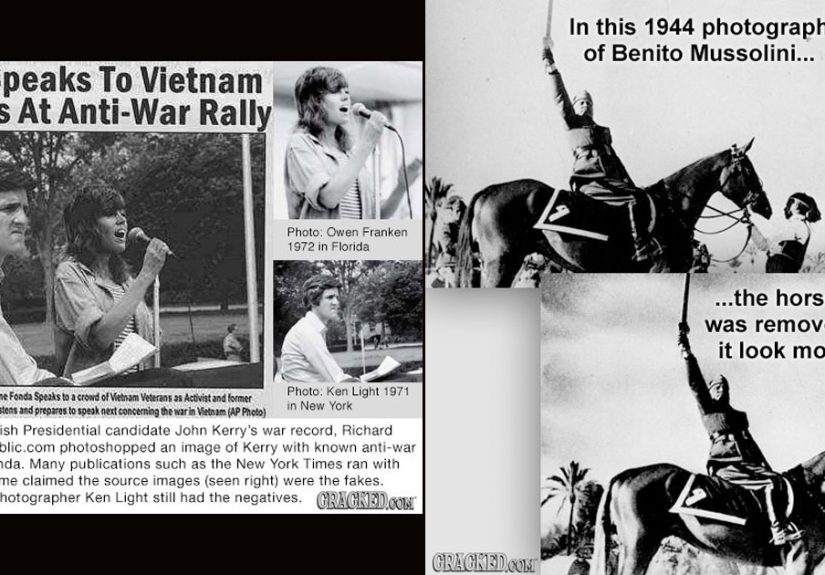
Stalin wasn’t the only leader to edit reality. Historians have documented similar airbrushing practices in the regimes of Mao, Hitler, and other dictators. Opponents were cropped out of parades, erased from balcony scenes, or replaced by more loyal supporters. These edits often went unnoticed at the time; regular people had no way to compare multiple versions of the same image. It’s essentially the analog version of deleting someone from your group chatonly with much deadlier consequences.
14. The “Too Perfect” Historical Crowd Photo
Viral posts sometimes share retro-looking “crowd” photos that are actually composites of a few figures duplicated over and over. Subtle cloning mistakesidentical faces, repeated hats, or synchronized posesgive them away. Modern forensic analysts use pixel-level pattern analysis to spot these tricks, but often the human eye can do it just as well: if the background looks like a video game texture, you’re probably not looking at a genuine historical snapshot.
15. Deepfake Portraits of Politicians
While traditional photo hoaxes involved cut-and-paste or airbrushing, newer fakes borrow from AI. Deepfake tools can generate ultra-realistic portraits of politicians doing or saying things they never did. Some viral “photos” claim to show leaders arrested, injured, or attending events that never happened. Fact-checkers now routinely analyze reflections, hand shapes, and text distortions to separate real candid shots from AI fabrications. The anxiety these images trigger“could this be real?”is part of their power.
16. The “Balenciaga Pope” and AI Fashion
In 2023, a wildly convincing image of Pope Francis in an oversized white puffer coat went viral. Many viewers assumed it was a real candid street photo until the creator admitted they’d used an AI image generator. The picture worked because it mixed a familiar figure with fashion that looked just plausible enoughafter all, celebrity priests are a thing. It marked a turning point in public awareness that AI-generated images can look “photographic” at a casual glance.
17. Overly Dramatic Disaster Skies
After major wildfires, volcanic eruptions, or city-wide blackouts, social feeds fill up with photos of apocalyptic skies: neon-orange sunsets, pitch-black noon scenes, or lightning storms that look suspiciously like movie posters. Some are real, but many are heavily edited or old images relabeled as new events. Many newsrooms now rely on reverse-image search and satellite data to verify whether a dramatic sky truly belongs to the disaster it’s attached to.
18. “Before and After” Celebrity Photos That Never Were
Weight-loss and plastic-surgery advertisements often rely on fake “before and after” photos. Sometimes they’re shot on the same day with different lighting and posture; other times, they paste a celebrity’s face onto a random body. Image experts have documented cases where both “before” and “after” figures were stock models, not real clients at all. The emotional hook“this could be you in 30 days”tempts people to accept the visuals without asking basic questions.
19. The “Too Many Stars in the Sky” Photo
Some of the most-shared night-sky photos online are composites or outright fabrications that feature impossible numbers of stars, galaxies, and meteors in a single frame. Astrophotographers and scientists frequently debunk these, pointing out that our atmosphere, camera sensors, and light pollution simply don’t allow for that level of detail in a single shot. But to the casual scroller, “unrealistically beautiful” is often a feature, not a bug.
20. Ghost Photos and Double Exposures
Long before digital editing, “spirit photographers” in the 19th and early 20th centuries used double exposures to show wispy “ghosts” hovering behind living subjects. Grieving families paid good money for portraits that seemed to show deceased relatives visiting from beyond. Photography historians have shown how these images were created by reusing plates or exposing the same film twice, but at the time, the emotional desire to see lost loved ones outweighed skepticism.
21. The Overcrowded UFO Sky
UFO photos fall into a familiar pattern: blurry lights, mysterious discs, and sometimes obvious household objects tossed into the air. Skeptical researchers have traced many iconic UFO images back to hubcaps, pie plates, or other props. Later, digital editing made it even easier to fake glowing saucers over cities. While government reports have confirmed that some unidentified aerial phenomena are still unexplained, many of the most dramatic “UFO over [insert city]” photos remain firmly in the hoax category.
22. The “Perfectly Timed” Animal Attack
A number of viral images show hikers being chased by bears, lions leaping at safari trucks, or crocodiles seconds away from biting someone’s leg. Many are composites of wildlife photography and vacation photos. What gives them away? Animals pasted at unrealistic angles, shadows that don’t match, and victims who look suspiciously calm for people about to become snacks. Wildlife photographers and fact-checkers have repeatedly pointed out these inconsistencies, but the thrill of danger keeps the images alive.
23. “Historic” Memes That Never Happened
Occasionally, a photo circulates with a deeply specific caption“Women in 1922 protesting the invention of coffee cups,” for examplethat has nothing to do with the actual image. The photo may be real, but the story attached to it is pure fiction. Historians and archivists have traced some of these shots to completely different events, from labor strikes to parades. The deception is subtle: the pixels are genuine, but the context is forged.
24. The AI-Generated “Historical Photo”
AI tools now make it easy to generate fake “historical” photos in sepia tones, complete with invented fashions and backdrops. Some are shared as jokes, but others are posted as supposed proof of lost inventions, secret experiments, or forgotten cultures. Experts warn that as these tools improve, distinguishing genuine archival photos from AI impostors will become harderespecially when images are low-resolution or stripped of metadata. Our best defense will be cross-checking with trusted archives, not just zooming in to look at the pixels.
How to Spot a Fake Photo Before You Share It
So what can you do the next time a shocking “must-see” photo hits your feed?
- Check the source. Is the image posted by a reputable news outlet, a random meme page, or a friend who still forwards chain emails?
- Look for reverse-image results. Tools that search by image often reveal older versions with different captions.
- Study the details. Lighting, shadows, reflections, and text on signs often betray copy-and-paste jobs.
- Beware of perfect timing. Photos that seem too dramatic are often staged or composited.
- Ask what the photo is trying to make you feel. Strong emotions (fear, outrage, awe) should trigger extra skepticism, not instant trust.
At this point, “famous fake photos” are almost their own art form. They reveal what we want to believe about the worldwhether it’s magical fairies, heroic sharks, or politicians confirming our worst suspicions. The images may be fake, but the feelings they tap into are very real.
of Real-World Experience with Fake Photos
Spend enough time around fake photos and you start to notice a pattern: the technology changes, but human behavior barely moves. In the email-forward era, people shared low-resolution JPEGs with subject lines like “UNBELIEVABLE!!!” Today it’s more likely to be a recycled meme on X or a screenshot in a family group chat, but the dynamic is the same. Someone sees an image that makes them feel somethingfear during a hurricane, wonder during an eclipse, vindication about a politicianand they share first, think later.
One of the most revealing experiences is watching the lifecycle of a single hoax image across different platforms. Take the hurricane shark photo. The first time it popped up, many people genuinely thought a shark had invaded a flooded freeway. Local journalists then wrote debunking articles, weather experts chimed in, and eventually the story was “common knowledge.” But a year later, during the next big storm, the same photo quietly returned with a fresh caption and thousands of new comments. For every person saying “this is fake,” there was someone else typing “wow, nature is healing/ending/terrifying.” The image doesn’t need to be believed by everyonejust enough people to keep its viral momentum going.
Another experience that changes how you see viral images is visiting photo exhibits that place famous fakes next to their originals. Exhibits about Stalin’s Russia, for example, lay out a series of official group photos where people literally disappear over time. Standing in front of those side-by-side prints, the idea of “the camera never lies” feels almost cute. The camera has always been willing to lie; it just needs someone to point it in a certain direction, or someone in a darkroom (or now, behind a screen) to rewrite the scene later.
Talking to friends and relatives about fake photos is also eye-opening. Everyone has a story of the time they confidently posted something that turned out to be bogusthe giant cat, the miracle diet transformation, the “rare historical photo” that was actually from a movie set. Most people aren’t trying to spread misinformation; they’re trying to share something cool, emotional, or conversation-starting. When they find out it’s fake, the reaction is usually embarrassment followed by, “Okay, now I’m double-checking everything.” At least until the next unbelievable image comes along.
The most constructive shift happening now is that more people understand verification as a normal part of using the internet, not just a nerdy hobby. Fact-checking sites, science outlets, and even social media tools make it easier to trace where an image came from. Some newsrooms maintain dedicated “visual forensics” teams whose job is to analyze shadows, metadata, and satellite images to confirm whether a viral photo matches the story being told about it.
Still, the responsibility doesn’t end with experts. Every share, retweet, or repost is essentially a tiny endorsement: “I think this is real enough to show other people.” One of the most valuable experiences you can cultivate is the habit of pausing before you give an image that little boost of credibility. Ask yourself: Do I know where this came from? Does it line up with other information? Would I be embarrassed if this turned out to be fake? If the answer to that last one is “yes,” it might be worth doing a quick search before you send it off into the world.
In the end, fake photos aren’t going anywhere. If anything, AI will make them easier to create and harder to debunk. But that doesn’t mean we’re doomed to live in a permanent fog of visual lies. It just means we have to treat images the way we already know to treat headlines: as starting points, not final answers. If we can bring a little Cracked.com energycuriosity, skepticism, and a sense of humorto the pictures we see every day, we’ll be a lot harder to fool.