Table of Contents >> Show >> Hide
- Before the 3 Ways: The MLA “Core Elements” Cheat Code
- Way #1: Cite a Short Story in a Book (Anthology or Collection)
- Way #2: Cite a Short Story in a Magazine, Journal, or Newspaper (Print or PDF)
- Way #3: Cite a Short Story Online (Website or Database)
- Putting It All Together: A Tiny “MLA Short Story Citation” Checklist
- Conclusion: MLA Short Story Citations Without the Headache
- Real-World Experiences: What Citing Short Stories in MLA Feels Like (500-ish Words)
Citing a short story in MLA sounds easy until you’re staring at your Works Cited like it’s a cryptic prophecy:
Do I italicize the story title? Do I put “pp.”? Why does MLA keep talking about containersam I moving houses?
Deep breath. MLA is actually pretty logical once you learn the three most common “homes” a short story lives in:
a book (often an anthology), a periodical (magazine/journal/newspaper), or the internet (website/database).
This guide breaks down three practical ways to cite short stories in MLA 9, with clean templates,
real-looking examples, and the little rules that save you from losing points (or dignity). You’ll learn how to build
a Works Cited entry, how to handle MLA in-text citations, and what to do when the story
has no page numbers (a.k.a. the online chaos era).
Before the 3 Ways: The MLA “Core Elements” Cheat Code
MLA 9 works best when you think in core elements. You’re not memorizing a million rulesyou’re collecting
details in a consistent order. The essentials you’ll use most for short stories are:
- Author
- Title of the short story (in quotation marks)
- Title of the container (the larger work that holds the storyoften italicized)
- Other contributors (like an editor)
- Publisher
- Publication date
- Location (page range for print; URL/DOI/permalink for online)
One big formatting reminder: In MLA, the short story title is in quotation marks, while the
book, magazine, journal, or website title is usually italicized.
Way #1: Cite a Short Story in a Book (Anthology or Collection)
This is the most common scenario in English classes: your short story appears inside a bookoften an anthology
edited by someone else. In MLA language, the story is the source, and the book is the container.
Your Works Cited entry starts with the short story’s author, then the story title, then the book details.
Works Cited Template (Story in an Anthology)
Format:
Author Last Name, First Name. “Title of Short Story.” Title of Book, edited by Editor First Name Last Name,
Publisher, Year, pp. page range.
Works Cited Example (Anthology)
Kincaid, Jamaica. “Girl.” The Vintage Book of Contemporary American Short Stories, edited by Tobias Wolff,
Vintage, 1994, pp. 306–07.
If the Story Is in a Single-Author Collection
Sometimes the book is a collection by one author (and there’s no editor listed). Easy: you just omit the editor line.
Format:
Author Last Name, First Name. “Title of Short Story.” Title of Book, Publisher, Year, pp. page range.
MLA In-Text Citation for a Print Story
MLA in-text citations usually follow the author-page style. Use the author’s last name and the page number.
No commas.
- Parenthetical: (Kincaid 306)
- Narrative: Kincaid describes the mother’s instructions as both practical and sharp (306).
Common Book/Anthology Mistakes (and Quick Fixes)
-
Mistake: Italicizing the short story title.
Fix: Story title in quotation marks; book title italicized. -
Mistake: Forgetting pp. before a page range in Works Cited.
Fix: Use pp. for ranges (pp. 306–07). (You do not use pp. in in-text citations.) -
Mistake: Adding the city of publication out of habit.
Fix: MLA generally doesn’t require city anymore except special cases (older or ambiguous publications).
Way #2: Cite a Short Story in a Magazine, Journal, or Newspaper (Print or PDF)
If the short story is published as fiction in a periodical, MLA treats it like an article with a few familiar moves:
story title in quotes, periodical title italicized, then the date (and volume/issue info for journals).
Works Cited Template (Magazine or Newspaper)
Format:
Author Last Name, First Name. “Title of Short Story.” Title of Periodical, Day Month Year, pp. page range.
Works Cited Template (Scholarly Journal)
Format:
Author Last Name, First Name. “Title of Short Story.” Journal Title, vol. #, no. #, Year, pp. page range.
Periodical In-Text Citations
In-text citations stay simple. If you have page numbers, cite them:
- Parenthetical: (AuthorLastName 18)
- Narrative: The narrator’s tone flips from playful to eerie mid-paragraph (18).
What If the Story Is a PDF With Stable Page Numbers?
If your short story is accessed as a PDF and it has stable page numbers, MLA lets you use those page numbers in the
in-text citation the same way you would with print.
Common Periodical Problems (AKA “Why Is There a Vol. and No One Told Me?”)
- Journals often require volume and issue. If the journal provides vol./no., include them.
- Newspapers and magazines usually emphasize the full date. Use Day Month Year when available.
- Page range goes in Works Cited. In-text citations typically use just the page you’re quoting (e.g., 18).
Way #3: Cite a Short Story Online (Website or Database)
Online short stories are everywhereliterary magazines, author websites, classroom PDFs, and library databases.
MLA still uses the same logic: author + story title + container + date + location. The main difference is that
your “location” becomes a URL, DOI, or stable permalink instead of page numbers.
Works Cited Template (Short Story on a Website)
Format:
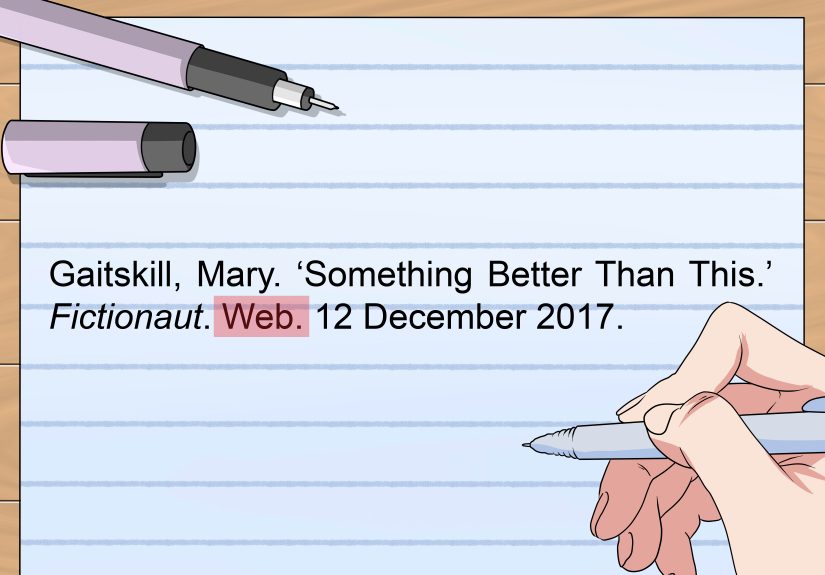
Author Last Name, First Name. “Title of Short Story.” Website Name, Day Month Year, URL.
Works Cited Template (Short Story in an Online Database)
Databases often create a second “container.” The story may be in a journal (first container) that you access through
a database (second container).
Format:
Author Last Name, First Name. “Title of Short Story.” Journal or Magazine Title, vol. #, no. #, Year,
pp. page range. Database Name, DOI or stable URL.
In-Text Citation for Online Stories (When Pages Disappear)
Here’s the rule that saves lives: if there are no page numbers, don’t invent them.
If you name the author in your sentence, you may not need anything more than the author’s nameespecially if the
source doesn’t offer stable numbering.
Option A: No Page Numbers, Author in the Sentence
In Shirley Jackson’s story, the townspeople treat tradition like a rule you’re not allowed to question.
Option B: No Page Numbers, Author Not in the Sentence
The townspeople treat tradition like a rule you’re not allowed to question (Jackson).
Option C: The Online Text Has Paragraph Numbers
Some online platforms number paragraphs. If paragraph numbers exist, you can cite them using par. or pars.
in place of page numbers.
- Example: (Jackson, par. 12)
- Example range: (Jackson, pars. 12–14)
Quick Rules for URLs, Access Dates, and “Do I Need All This?”
- Use a DOI when available (common in academic databases). If there’s no DOI, use a stable permalink.
- MLA doesn’t always require an access date, but some instructors prefer itespecially for content that changes.
- Don’t paste a mile-long tracking URL if a clean permalink exists. Choose the most stable “location” possible.
Putting It All Together: A Tiny “MLA Short Story Citation” Checklist
- Story title: quotation marks
- Container title (book/journal/website): italicized
- Works Cited pages: use pp. for page ranges
- In-text citations: author + page (no comma), OR author only if no pages
- Online with numbered paragraphs: use par./pars.
- Consistency: your in-text citation must match the first element of the Works Cited entry
Conclusion: MLA Short Story Citations Without the Headache
If you remember only one thing, make it this: MLA citations are built around where the short story lives.
If it’s in a book, cite the anthology/container details and page range. If it’s in a
periodical, cite the publication’s date (and vol./no. when relevant). If it’s
online, swap page range for a stable URL or DOIand don’t panic when page numbers vanish.
Master these three citation patterns and you’ll be able to cite nearly any short story in MLA 9cleanly, confidently,
and without bargaining with your printer at 1:58 a.m.
Real-World Experiences: What Citing Short Stories in MLA Feels Like (500-ish Words)
Most people don’t “learn MLA” in one heroic sitting. They learn it the way you learn to carry a tray of drinks:
awkwardly at first, then with increasing confidence, and occasionally with a splash of regret.
If you’ve ever tried to cite a short story five minutes before a deadline, you already know the emotional arc:
confidence → confusion → bargaining → triumph → tiny typo you notice after submitting.
One super common experience: you find a short story in a textbook anthology and assume the book is the main thing you’re citing.
Then your professor circles your Works Cited entry like it’s a crime scene and writes, “Cite the story, not the whole book.”
That’s the day “container” becomes your new favorite word. The story is the source; the anthology is the container.
Once that clicks, your citations suddenly feel less like magic spells and more like a recipe you can actually follow.
Another classic: you quote a line from an online literary magazine and reach for a page number… but there isn’t one.
Cue the internal monologue: “Should I count the paragraphs? Should I screenshot it? Should I simply move to a cabin and live off berries?”
The practical lesson is kinder: if the story has no page numbers, you don’t invent them. You use the author’s name,
and if the website provides paragraph numbers, you cite par. or pars.. If it doesn’t,
you keep the in-text citation simple and let your Works Cited entry do the heavy lifting.
Students also run into the “database double-container” situation: you access a story through a library database,
and suddenly you’re staring at two titles that both feel important. The experience here is realizing MLA isn’t trying
to make your life harderit’s trying to help your reader retrace your steps. That’s why you cite the journal/magazine
(where it was published) and the database (where you found it). Once you treat it like directions“published here,
accessed there”the format becomes surprisingly intuitive.
Finally, there’s the small but mighty victory of catching tiny MLA habits: story titles in quotation marks, containers italicized,
pp. only in Works Cited (not in-text), and no comma between author and page number.
These details feel picky until you’ve graded papers or had points deducted for themthen they feel like guardrails.
After a few assignments, you start spotting the pattern instantly, and citing short stories becomes less of a chore
and more of a quick final polish that makes your writing look professionally put together.