Table of Contents >> Show >> Hide
- Why These Illustrations Hit Such a Nerve
- 30 Ways These Illustrations Push Back Against the Female Rulebook
- 1. Body Hair Is Not a Moral Failure
- 2. Stretch Marks Are Evidence of Living, Not Damage
- 3. A Soft Stomach Does Not Need an Apology
- 4. Pimples Do Not Cancel Out Personhood
- 5. Clothes Are Sometimes the Problem
- 6. Thigh Rub Is Real
- 7. Breasts Do Not Exist for Symmetry Competitions
- 8. Exhaustion Is Not Unfeminine
- 9. Messiness Does Not Make a Woman Less Put Together
- 10. Periods Should Not Be Wrapped in Silence
- 11. Appetite Is Not a Character Flaw
- 12. Resting Is Productive Too
- 13. Aging Is Not a Beauty Emergency
- 14. Women Do Not Need to Be Small
- 15. “Pretty” Is Not the Highest Form of Value
- 16. Confidence Does Not Require Perfection
- 17. Hair Texture and Volume Do What They Want
- 18. Skin Texture Is Still Skin
- 19. Women Are Allowed to Be Angry
- 20. Saying No Is Not Rudeness
- 21. Sitting Comfortably Beats Looking Delicate
- 22. Women Do Not Need to Smile on Command
- 23. Romantic Standards Can Be Ridiculous Too
- 24. Women Are Not Required to Be Camera-Ready at All Times
- 25. Shame Around the Body Is Learned, Not Natural
- 26. Everyday Femininity Can Be Funny
- 27. Comfort Is a Legitimate Goal
- 28. You Can Love Your Body Without Loving Every Single Moment in It
- 29. Representation Changes the Mood in the Room
- 30. Existing Naturally Is Not Rebellion, but It Feels Like One
- What This Artist Understands About Modern Womanhood
- The Bigger Conversation Behind the 30 Illustrations
- Experiences Behind the Humor: Why So Many Women See Themselves in This Kind of Art
- Conclusion
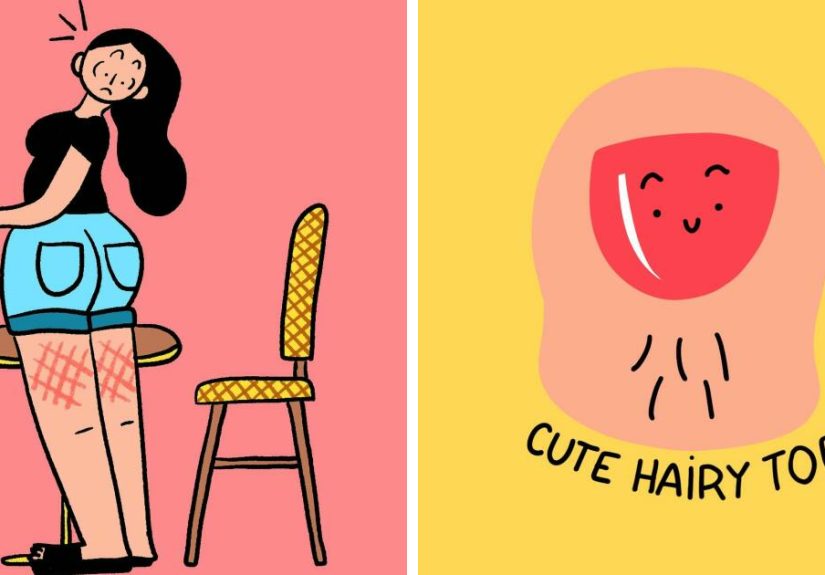
There are two kinds of art in the world: the kind that politely hangs on a wall and the kind that grabs beauty standards by the collar and asks, “Are you serious right now?” French illustrator Cécile Dormeau belongs firmly in the second camp. Her work feels playful at first glance, but the more you look, the sharper it gets. The women in her illustrations are not polished into cartoon perfection. They sweat, slouch, bloat, stretch, wrinkle, lounge, and exist without asking permission. In other words, they look human, which still feels oddly rebellious in a culture that keeps trying to market women as projects under construction.
That is exactly why these illustrations resonate. Society has handed women a never-ending checklist for generations: be attractive but effortless, confident but not intimidating, sexy but never “too much,” natural but somehow also poreless, hairless, ageless, and permanently camera-ready. It is an exhausting little circus. Dormeau’s art refuses to perform in it. Instead, she draws women as they actually live, and that honesty lands with the force of a truth bomb wrapped in bright colors.
The brilliance of this kind of illustration is not just that it challenges narrow beauty standards. It also makes room for humor. And humor matters. Sometimes the fastest way to expose a ridiculous rule is to laugh at it. A woman dealing with thigh rub, awkward clothing fits, period discomfort, or a bad skin day does not need another lecture about “fixing” herself. She needs the cultural volume turned down. Dormeau’s illustrations do that by treating so-called imperfections as normal details of life instead of emergency situations requiring a serum, a razor, a filter, and possibly a priest.
Why These Illustrations Hit Such a Nerve
What makes this body of work so powerful is that it does not rely on grand speeches. It works through everyday moments. That is where social pressure usually lives anyway, tucked inside the mundane. It is in the changing room mirror. It is in the panic before a beach day. It is in the way a shirt fits differently on an actual body than it did on the mannequin. It is in the assumption that women should always look composed, even while navigating hormones, stress, fatigue, or the simple crime of having skin that behaves like skin.
These illustrations push back against the fantasy that femininity must always appear neat, delicate, and curated. They remind viewers that a woman does not become less worthy because she has body hair, stretch marks, breakouts, bloating, a soft stomach, uneven proportions, or the audacity to take up space. The message is not “all women should look one specific natural way,” either. It is broader and smarter than that. The message is that women should not have to contort themselves to deserve dignity.
30 Ways These Illustrations Push Back Against the Female Rulebook
1. Body Hair Is Not a Moral Failure
One of the loudest beauty rules says women should be as hairless as dolphins in good lighting. These illustrations laugh at that idea and remind us that hair grows on human bodies. Shocking news, apparently.
2. Stretch Marks Are Evidence of Living, Not Damage
Society loves to frame stretch marks as flaws to erase. Art like this reframes them as ordinary texture, part of the visual language of a body that has changed, grown, healed, and lived through real time.
3. A Soft Stomach Does Not Need an Apology
Not every female silhouette is meant to resemble a marble statue or a wellness ad. A belly can be round, soft, relaxed, or bloated and still belong to a woman who is fully at home in herself.
4. Pimples Do Not Cancel Out Personhood
Women are often taught to treat acne like a personal failure instead of a normal skin condition. These illustrations take the drama out of breakouts and put perspective back in.
5. Clothes Are Sometimes the Problem
Fashion often pretends every body is built from the same template. Dormeau’s visual humor points out that weird shirt fits, awkward seams, and strange cuts are not rare accidents. They are daily reality.
6. Thigh Rub Is Real
There is a special category of female experience that involves favorite pants losing the battle at the inner thigh. Glamorous? No. Relatable? Extremely. That is precisely why it belongs in art.
7. Breasts Do Not Exist for Symmetry Competitions
Real bodies are not manufactured like decorative pillows. Unevenness is normal, but women are still taught to see it as a defect. These illustrations strip away that weird expectation.
8. Exhaustion Is Not Unfeminine
Women are expected to look luminous even when life is chewing through their energy. Seeing tiredness depicted honestly feels radical because it says fatigue is not ugliness. It is reality.
9. Messiness Does Not Make a Woman Less Put Together
Flyaways, smudged makeup, laundry chaos, and “I tried” energy all belong to actual life. Not every woman wants to appear as if she emerged from a scented cloud with perfect posture.
10. Periods Should Not Be Wrapped in Silence
Society has long treated menstruation like a public relations disaster. Honest illustrations cut through the taboo and remind everyone that periods are biological reality, not a secret scandal.
11. Appetite Is Not a Character Flaw
Women are often expected to eat delicately, as though surviving on sparkling water and vibes. Art that shows women enjoying food without shame quietly demolishes that absurd performance.
12. Resting Is Productive Too
Women are praised for doing everything for everyone until they collapse gracefully, of course. Illustrations that celebrate lounging, napping, and doing absolutely nothing challenge that martyr script.
13. Aging Is Not a Beauty Emergency
Fine lines, texture, shifting shape, and changing skin are treated like enemies in a war nobody signed up for. These illustrations remind viewers that growing older is not a failure of maintenance.
14. Women Do Not Need to Be Small
There is a long social tradition of encouraging women to shrink physically, emotionally, and socially. This art pushes back by letting women be expansive, comfortable, and visibly present.
15. “Pretty” Is Not the Highest Form of Value
A woman can be funny, tired, brilliant, irritated, messy, bold, or completely uninterested in being decorative. These illustrations suggest that personhood outranks prettiness every time.
16. Confidence Does Not Require Perfection
Popular culture often implies confidence comes after the glow-up. Dormeau’s visual world offers a better idea: confidence can exist in the middle of awkwardness, softness, and imperfection.
17. Hair Texture and Volume Do What They Want
Female grooming expectations can feel like a full-time internship with no pay. Art that embraces frizz, tangles, and wild hair energy exposes how unrealistic “effortless beauty” really is.
18. Skin Texture Is Still Skin
Pores, bumps, scars, dryness, redness, and uneven tone are common, yet women are trained to see filtered skin as the default. These illustrations pull the conversation back to the real world.
19. Women Are Allowed to Be Angry
One of the oldest rules in the book says women should stay agreeable, no matter what. Honest feminist illustration makes space for irritation, rage, and refusal without turning women into villains.
20. Saying No Is Not Rudeness
Women are often socialized to be accommodating even when uncomfortable. Visual storytelling that centers boundaries helps normalize the idea that self-protection is not impolite.
21. Sitting Comfortably Beats Looking Delicate
Crossed ankles and composed poses may photograph well, but real people sit weird. They sprawl, curl up, lean sideways, and exist in bodies that prefer comfort over presentation.
22. Women Do Not Need to Smile on Command
Somewhere along the line, women got assigned public mood management. These illustrations resist that nonsense by allowing female faces to be neutral, serious, bored, annoyed, or deeply unimpressed.
23. Romantic Standards Can Be Ridiculous Too
Society hands heterosexual couples a strange costume department of rules about height, appearance, roles, and behavior. Art that pokes fun at those rules reveals how silly they really are.
24. Women Are Not Required to Be Camera-Ready at All Times
There is enormous pressure to remain aesthetically presentable in every casual moment. These illustrations reject the idea that womanhood is a nonstop photo shoot.
25. Shame Around the Body Is Learned, Not Natural
Many women are not born hating ordinary features. They are trained into it. By drawing those same features casually and joyfully, the art interrupts that training.
26. Everyday Femininity Can Be Funny
Humor is part of the rebellion here. The illustrations do not ask women to stand in solemn silence under the weight of expectations. They wink, laugh, and call the bluff.
27. Comfort Is a Legitimate Goal
Women are often expected to prioritize style, desirability, and etiquette over physical ease. A body choosing comfort over performance is a small act of resistance with excellent footwear implications.
28. You Can Love Your Body Without Loving Every Single Moment in It
Body acceptance is not constant bliss. Some days are bloated, sore, sweaty, or awkward. These illustrations leave room for honesty without collapsing into self-loathing.
29. Representation Changes the Mood in the Room
When women see ordinary bodies shown without mockery or pity, the emotional temperature shifts. Suddenly the body is not a problem to solve. It is simply a body to live in.
30. Existing Naturally Is Not Rebellion, but It Feels Like One
That may be the sharpest point of all. These illustrations are not outrageous because women are outrageous. They feel radical because the standards are that narrow.
What This Artist Understands About Modern Womanhood
Dormeau’s work gets attention because it understands a quiet truth: many women are not tired of their bodies so much as they are tired of the commentary attached to their bodies. There is always some invisible panel of judges ready to grade appearance, age, weight, grooming, motherhood, sexuality, clothing, or attitude. Even “positive” beauty culture can be exhausting when it still assumes a woman’s main project is how she looks.
These illustrations break that pattern. They place women back inside their own lives instead of presenting them as objects for review. That shift matters. It transforms the female body from display piece to lived-in home. It also helps explain why the art feels both funny and freeing. When a woman recognizes herself in a scene she was taught to hide, the effect can be oddly emotional. Not dramatic movie-trailer emotional. More like a private internal, “Oh thank goodness, it’s not just me.”
And that is the real social power of illustrations like these. They normalize what shame tries to isolate. They make space for women to feel seen outside the polished script. In a media environment crowded with edited photos, trend cycles, and impossible aesthetic expectations, that kind of honesty is not small. It is oxygen.
The Bigger Conversation Behind the 30 Illustrations
These images are not only about beauty. They are about permission. Permission to be visible without being perfected. Permission to age without panic. Permission to have a body that fluctuates, leaks, grows hair, leaves marks, gets tired, and still deserves tenderness. Permission to define femininity more broadly than the internet’s mood board of the week.
That is why this artist’s work feels so current. Women are increasingly rejecting the idea that empowerment must look polished. Plenty of people are done with the exhausting cycle of hiding, correcting, and minimizing ordinary features just to pass some imaginary inspection. The appetite now is for representation that is witty, emotionally intelligent, and recognizably real.
In that sense, these 30 illustrations do more than defy society’s standards for women. They expose how flimsy those standards were to begin with. Once you see them clearly, they stop looking powerful and start looking what they really are: arbitrary rules with great marketing and terrible emotional consequences.
Experiences Behind the Humor: Why So Many Women See Themselves in This Kind of Art
For many women, the connection to illustrations like these starts early and quietly. It might begin in a department store dressing room with fluorescent lighting that should honestly be investigated by Congress. It might happen at school, when a harmless comment about body hair or weight lodges in the brain and lives there rent-free for years. It might show up during puberty, when the body changes faster than confidence can keep up. A lot of women learn very young that the world is paying attention to their appearance, even before they know what to do with that information.
Then adulthood arrives with even more rules, because apparently the memo was incomplete. Suddenly there are expectations about how to dress for work without looking too plain or too noticeable. There are rules about when to wear makeup and how much of it counts as “natural,” which is a funny term considering how much effort it often requires. There are moments when a woman simply wants to run errands in peace and instead finds herself wondering whether she looks tired, frizzy, bloated, pale, too casual, too loud, or not put together enough for a random trip to buy toothpaste.
That is why honest illustration can feel like such a relief. It reflects the tiny, daily negotiations women make with appearance culture. The decision to shave or not shave. The calculation over whether a shirt is flattering or merely aggressive. The frustration of discovering that an outfit designed on a theoretical body does something completely different on a real one. The annoyance of breakouts before an important event. The irritation of thigh chafing in summer. The deeply personal choice of whether to hide stretch marks, show them, ignore them, or forget they are even there until swim season brings society’s nonsense back to the surface.
There is also the emotional side. Many women know what it feels like to be told, directly or indirectly, that confidence should come after improvement. Lose the weight first. Fix the skin first. Smooth the hair first. Dress better first. Be younger, smaller, shinier, calmer, prettier, and then perhaps you may enjoy your own existence. Art like Dormeau’s flips that equation. It suggests a far more humane approach: maybe a woman does not need to earn comfort in her body by passing a beauty exam nobody can actually win.
That is what gives these illustrations staying power. They are not just clever drawings. They mirror lived experience. They validate the awkward, funny, mildly infuriating reality of moving through the world in a female body while society keeps handing out contradictory instructions. And in doing so, they offer something many women do not get enough of: recognition without judgment. Sometimes that is the most radical gift art can give.
Conclusion
Cécile Dormeau’s illustrations work because they understand something polished media often forgets: women do not need more pressure to become acceptable versions of themselves. They need room to exist as they already are. These 30 illustrations are funny, sharp, and culturally timely, but they are also generous. They make everyday womanhood visible without turning it into a punchline. In a world obsessed with correction, that kind of art feels less like decoration and more like a public service.