Table of Contents >> Show >> Hide
Getting a tattoo in a foreign language is the adult version of ordering “something authentic” off a menu you can’t read:
bold, optimistic… and occasionally you end up with “extra spicy regret” and a side of confusion.
The idea is romanticink that looks elegant, meaningful, worldly. The reality (at least on the internet) is that bilingual
friends keep running into tattoos that were meant to say “Strength” but actually announce “Microwave Settings.”
And because tattoos are forever (or at least “until you pay a small fortune for laser removal”), these translation fails hit different.
This article pulls together patterns reported by major U.S. outlets and pop-culture sites, plus translator and tattoo-community
commentary, to show how these mistakes happen, why native readers can’t help but laugh, and how you can avoid becoming the next
“what does it say?” cautionary tale.
Why Foreign-Language Tattoos Go Off the Rails
1) Translation isn’t word-swappingit’s meaning-swapping
People assume languages are like LEGO: you pop out “Live,” snap in “Vivir,” and boomphilosophy.
But a lot of meaning lives in grammar, word order, idioms, and cultural context. A phrase that sounds deep in English can sound
like a fortune cookie written by a toaster in another language.
2) Writing systems are not fonts (and “pretty characters” aren’t decorations)
Chinese characters, Japanese kanji, Arabic script, Devanagari, Cyrillicthese aren’t decorative shapes. One stroke, one dot,
or one flipped mark can change the meaning… or turn the whole thing into nonsense. Sometimes the tattoo isn’t “wrong,” it’s
simply unreadable to any actual speaker.
3) Machine translation is brave, confident, and frequently incorrect
Online translators can be helpful for travel. They are not reliable enough for permanent body art. They struggle with nuance,
slang, grammar, and phrases that don’t translate literally. And if you feed a translator a single English word like “freedom,”
you might get a phrase that means “free of charge” or “complimentary” instead of “liberty.”
4) Tattoos add extra failure points: stencils, spacing, mirroring, and “close enough” lettering
Even if the translation is correct, a stencil can be flipped, a line can be missing, or the artist can unintentionally change
a character while “cleaning it up.” In some scripts, spacing mistakes can turn two words into one new (and very wrong) word.
34 Tattoo Choices That Made Fluent Readers Snort-Laugh
Below are 34 real-world-style scenarios that repeatedly pop up in translator communities, tattoo forums, and viral compilations.
Think of these as “the greatest hits of translation regret”not to shame anyone, but to help you laugh and learn.
- The “One Word Virtue” Trap: You wanted “Strength.” Your tattoo says something closer to “Strong-ish” or “Sturdy Object,”
because a single character doesn’t always carry the poetic weight you think it does. - The “Soup Problem”: You ask for a character that means “faith” or “peace.” A fluent reader sees “broth,” “stew,” or “noodle soup.”
Congratulationsyour spiritual journey is now lunch. - Alphabet-by-Character (a.k.a. “Gibberish Font”): Someone sold you a chart that matches letters to Chinese characters.
Native readers don’t see your namethey see random unrelated words that don’t form a sentence. It’s like tattooing “QZP” in English and calling it poetry. - “I Used Google Translate” Energy: The grammar is technically words, but it reads like a robot giving a TED Talk after three batteries died.
- Vertical vs. Horizontal Chaos: The phrase was meant to be read one direction, but it’s inked another way.
Now it’s either scrambled or says something weird when read properly. - Mirrored Script: Someone copied the stencil from a mirror photo. Native readers can tell immediately.
It’s the linguistic version of wearing your shirt inside-outforever. - “Seven Rings” Turns Into “Grill”: A famous pop-culture moment made the point: combining characters can create a totally different word.
What you intended as a title or concept becomes a literal household object. - Random Kanji Salad: Three characters you picked because they “look cool” don’t form a phrase.
To readers, it’s like tattooing “Lamp Bicycle Tuesday.” - Mixed Writing Systems, Mixed Results: You combined kanji with the wrong kana, or used letters that don’t belong together.
It’s readable… but it screams “I don’t know how this language works.” - Traditional vs. Simplified Mix-Up: You used a version of a character from one system and another from a different system.
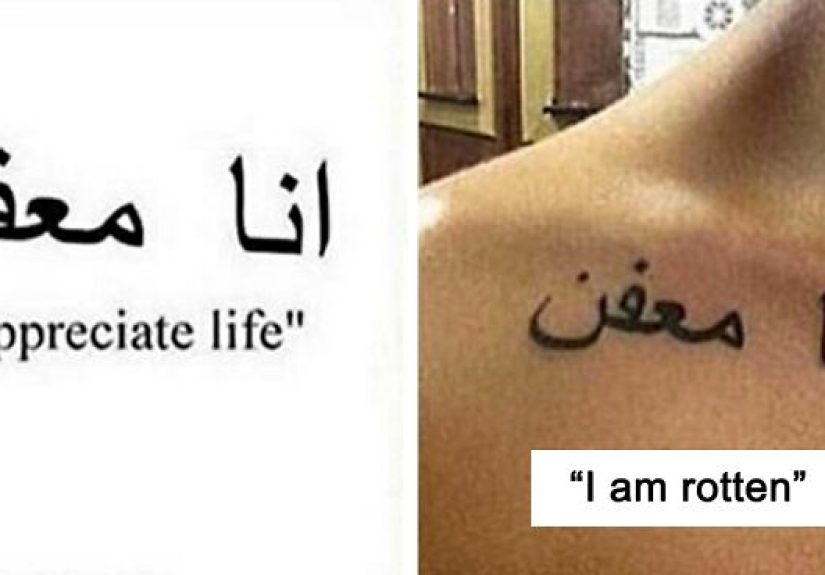
It’s like writing half your tattoo in cursive and half in emoji. - Arabic Letters That Don’t Connect: Arabic script changes shape depending on position. If you ink isolated forms, it looks broken
like writing English with every letter floating separately and backwards. - Arabic Word Order Face-Plant: The words are correct, but the order is wrong, turning “I love my family” into something closer to
“My family love I,” which sounds like a caveman wrote your feelings. - Hebrew Without Context: Hebrew is often written without vowels. Without context, your tattoo can be ambiguous or misread.
Fluent readers squint, then guess, then laugh because it could mean three different things. - Hebrew Letter Confusion: Two letters look similar to learners. One wrong letter and your meaningful word becomes a totally different
wordor nonsense. - Latin That Sounds Like a Spell From a Discount Wizard: Latin is highly inflected. Swap a case ending, and your “I conquer myself”
becomes “I am conquered by… a chair,” metaphorically speaking. - “Memento Mori” Misspelled: One of the most common Latin tattoo concepts gets botched into a different word entirely.
Latin readers immediately spot itand they cannot unsee it. - Italian Phrase, One Extra Letter, Infinite Regret: A very popular “live without regrets” idea has famously been misspelled in the wild.
The irony is so strong it practically deserves its own tattoo. - French Without Accents: Missing accents can change meaning or make the word look “off” to fluent readers.
It’s like writing “definately” in English and insisting it’s classy. - Spanish Without the Ñ: That tiny squiggle can matter. Without it, you might turn an innocent word into a different oneor at least
something that makes native speakers wince. - Portuguese False Friends: You think you’re tattooing a romantic word you saw online. To natives, it’s awkward, outdated, or means
something else in everyday speech. - Russian “Cool Letters” That Spell Nothing: Cyrillic is not a cosplay kit for English. Swapping letters because they “look right” creates
nonsense that Russians read like “IKEA assembly instructions.” - Russian Grammar Ambush: You got the dictionary form of a word, but you needed a different case.
Now your tattoo reads like a broken street sign. - Korean Hangul Syllable Soup: Hangul blocks are built from letters in a specific order. Random blocks can be pronounceable but meaningless
like naming your child “Blorpt.” - Japanese “Love” That’s Actually a Name or a Brand: You meant a concept. You got a proper noun, a product term, or a vibe that reads
like “Live Laugh Costco.” - Sanskrit/Devanagari Spacing Errors: One missing mark changes the sound and meaning. People who can read it notice instantly,
because it’s the difference between “peace” and “pea-soup,” spiritually speaking. - “Deep Quote” That’s Actually a Bad Translation of a Movie Line: It sounded profound in English. In the target language,
it’s clunky, unnatural, and obviously translated. - Wrong Register: You wanted poetic. You got something that sounds like a corporate slogan or a warning label.
Native readers feel emotional whiplash. - Unintended Insult: One character or accent makes your “warrior” tattoo read closer to “loser” or “weirdo.”
Friends who read it hesitate… then burst out laughing because what else can they do? - Homophones Strike Again: You picked the wrong version of a sound-alike word. In some languages, that’s a completely different meaning
like tattooing “their” when you meant “there.” - “Name Translation” Gone Wild: Instead of transliteration (sound), you got a literal meaning or a random dictionary word.
Your name “Grace” becomes “free favor,” or your name “Mark” becomes “scratch.” - Overly Literal “I Am…” Phrases: In English, “I am enough” is a vibe. In some languages, the direct translation is grammatically strange
or sounds like you’re filling out a form. - Calligraphy Style Mismatch: The words are correct, but the style is oddlike using a children’s handwriting font for a solemn proverb.
Fluent readers don’t laugh at the language; they laugh at the mood. - Bad Line Breaks: The phrase is split across lines in a way that changes how it’s read.
What should be “honor and courage” becomes “honor… and then, abruptly… cabbage.” - The “Friend Who Swore They Were Fluent”: They were not fluent. They were “confident.”
And your tattoo is now a permanent reminder that confidence is not a credential.
How to Avoid Becoming a Translation Meme
Get a human translatorpreferably two
If you’re putting a language you don’t speak on your body, pay a professional translator or consult a native speaker who actually reads and writes it daily.
Better yet: get a second opinion. Tattoos are permanent; your verification process should be, too.
Choose phrases real people actually say
Instead of translating an English quote, find an authentic phrase from the target language with a similar meaning.
Idioms and proverbs exist for a reasonthey’re how a culture naturally expresses an idea.
Ask for the correct script, register, and layout
Some scripts read right-to-left, some top-to-bottom, and some have stylistic rules that matter.
Ask about spacing, line breaks, punctuation, and whether it should be a single character, a two-character compound, or a full phrase.
Proof the stencil like it’s a contract
Don’t just glance. Zoom in. Compare to the verified reference. Check every stroke, dot, accent, and mark.
If the artist redraws anything, re-verify. “Close enough” is how people end up with a tattoo that means “refrigerator.”
Skip novelty fonts and “character charts”
If a website offers a “Chinese alphabet,” back away slowly. That’s not how Chinese works.
And if a font makes a script look “cooler” but less readable, you’re trading authenticity for confusion.
If You Already Have a Foreign-Language Tattoo Fail
First: breathe. You’re not a bad person. You’re just a person with an unexpectedly hilarious story.
Second: you have options.
- Own it: Some people keep the “wrong” tattoo as a life lesson, a travel story, or a reminder not to take themselves too seriously.
- Fix it: Depending on the script, a skilled artist can add strokes or characters to correct meaning (but get the correction verified).
- Cover it: A cover-up can turn text into a larger design where the original becomes invisible.
- Laser it: It’s not fun, but it’s possible. If the meaning is offensive or truly upsetting, removal can be the cleanest reset.
Extra: Real-World Experiences People Share About Foreign-Language Tattoo Fails (500+ Words)
If you hang around tattoo studios, translation communities, or even that one friend group where everyone has at least one “I was young” story,
you start noticing the same plotline over and over: someone wants a meaningful word in a language they admire, they do a quick search,
they trust a screenshot, and thenmonths or years latera fluent speaker reads it out loud and the room explodes.
One common “experience pattern” comes from bilingual friends who get pulled into emergency tattoo consults.
It usually starts with a text that reads, “Hey… you speak Japanese, right? Does this say ‘courage’?”
And the bilingual friend has to decide whether to be honest immediately or gently ask, “How attached are you to the concept of ‘courage,’
and how open are you to the concept of ‘discount poultry’?”
Tattoo artists also share a similar rhythmespecially artists who work in cities with diverse communities.
Many of them want clients to succeed. They’ll ask for references, suggest alternate layouts, and recommend consulting a native speaker.
But some clients show up with a single low-resolution image and the confidence of someone who watched half a language-learning video once.
The artist can copy what’s provided, but if the reference is wrong, the result is wrongbeautifully, permanently wrong.
Then there’s the “tourist souvenir tattoo” experience: people get ink while traveling and choose a local script because it feels authentic.
Sometimes it’s done carefully with help from locals. But when it’s rushed, the translation can slide into “menu-item energy.”
Travelers may not realize that the phrase they picked is awkward, overly formal, or not something anyone would ever say about themselves.
It’s the equivalent of tattooing “Sincerely yours, Customer Service” in English and calling it a love poem.
The funniest stories (and the most painful) often involve “helpful” intermediariesfriends of friends, online sellers, or random commenters.
People will swear a phrase means “family forever,” but a fluent reader sees it means something like “familyforever tired.”
Or the tattoo uses a character that’s technically real, but the combination is weird, like wearing a tuxedo with flip-flops.
If there’s one lesson that shows up in almost every shared experience, it’s this: the internet will always find out.
Social media has turned foreign-language tattoos into a kind of public pop quiz. Years ago, you could get a mysterious script tattoo and
live in blissful ambiguity. Now you post a picture, and within minutes someone is in your comments like,
“Bestie… that says ‘low quality coal.’”
But here’s the hopeful part: lots of people turn the mistake into something meaningful anyway.
Some add new ink that reframes the old text. Some make it a joke and a reminder not to take themselves too seriously.
And some treat it like a personal folklorean origin story with a moral: verify before you permanent-ify.
Conclusion
Foreign-language tattoos can be beautiful when they’re done with respect, accuracy, and a little patience.
But when they’re rushedor powered by blind trust in machine translationthey become comedy gold for anyone who can read them.
If you’re thinking about getting one, here’s the simplest rule: translate it twice, confirm it three times, and stencil-check it like your skin depends on it
(because it literally does). Your future selfand every bilingual person you’ll ever meetwill thank you.