Table of Contents >> Show >> Hide
- Why Setting Matters in Storytelling
- 1. Ground the Reader in Time and Place Right Away
- 2. Use Sensory Details to Make the Place Feel Alive
- 3. Filter the Setting Through Your Character’s Point of View
- 4. Make the Setting Work for Mood, Conflict, and Theme
- Common Mistakes When Describing Setting
- Final Thoughts
- Writer Experiences: What Usually Happens When You Start Revising Setting
- SEO Tags
Some writers treat setting like a piece of thrift-store furniture: it is technically in the room, but nobody is impressed. That is a mistake. In fiction, setting is not wallpaper. It is weather, pressure, memory, mood, history, and sometimes the reason your character makes a terrible decision before breakfast. A story’s setting tells readers where they are, when they are, what kind of world they have stepped into, and how that world feels on the skin.
If you want readers to believe your story, you need more than a location pin and a vague mention of “a dark night.” You need a place that feels inhabited. You need a setting that nudges the plot, reflects emotion, and gives your scenes texture. The good news is that you do not need ten paragraphs about curtains fluttering like tragic poetry. You just need the right details in the right places.
Below are four effective ways to describe the setting in a story without turning your prose into a decorative throw pillow. These techniques will help you create vivid scenes, stronger atmosphere, and a more immersive reading experience.
Why Setting Matters in Storytelling
Before we get to the methods, let’s clear something up: setting is not only the place where a story happens. It also includes time period, season, weather, culture, social environment, and the emotional texture of a scene. A kitchen in 1952 rural Oklahoma does not feel the same as a kitchen in present-day Brooklyn, even if both contain a table, a stove, and somebody regretting a life choice.
Strong setting description helps readers do three things. First, it orients them. Second, it deepens mood and tone. Third, it reveals something about character, conflict, or theme. The best setting descriptions are not random. They are purposeful. They make the story feel anchored instead of floating in a white void where characters apparently exist in a cosmic warehouse.
1. Ground the Reader in Time and Place Right Away
The first job of setting description is simple: help the reader understand where and when the scene is happening. This does not mean dumping an encyclopedia entry into your opening paragraph. It means offering concrete clues early enough that the reader does not have to guess whether the scene is unfolding in a medieval village, a suburban cul-de-sac, or a spaceship with emotional damage.
Use specific details instead of generic labels
“A small town” is vague. “A town with one traffic light, a shuttered movie theater, and a diner that still served pie at six in the morning” is more useful. Specific details create a mental image quickly. Readers do not need every fact at once, but they do need enough signals to feel oriented.
Instead of saying, “It was winter,” you might write, “The snow had hardened into gray ridges along the curb, and every mailbox on the street wore a crooked cap of ice.” That gives readers season, condition, and mood in one shot.
Slip in context naturally
Context works best when it arrives through action. A character pulling sand out of their shoes suggests a beach town. A train rattling overhead suggests a city. A coal stove that takes forever to heat the room hints at time period and class without waving a sign that says, “Attention, reader: historical detail incoming.”
Example: Instead of writing, “The story takes place in New Orleans during summer,” try: “By noon the New Orleans heat had turned the porch rail slick, and the air smelled like rain, river water, and something frying three houses down.”
This kind of opening grounds the reader fast. It also sounds like a story instead of a geography worksheet.
2. Use Sensory Details to Make the Place Feel Alive
If setting is only visual, it often feels flat. Real places are noisy, textured, smelly, and sometimes deeply rude. Readers connect more strongly when setting description uses multiple senses. The trick is to choose sensory details that matter instead of tossing in every possible smell, sound, and surface like you are filling a gift basket.
Go beyond what the eye can see
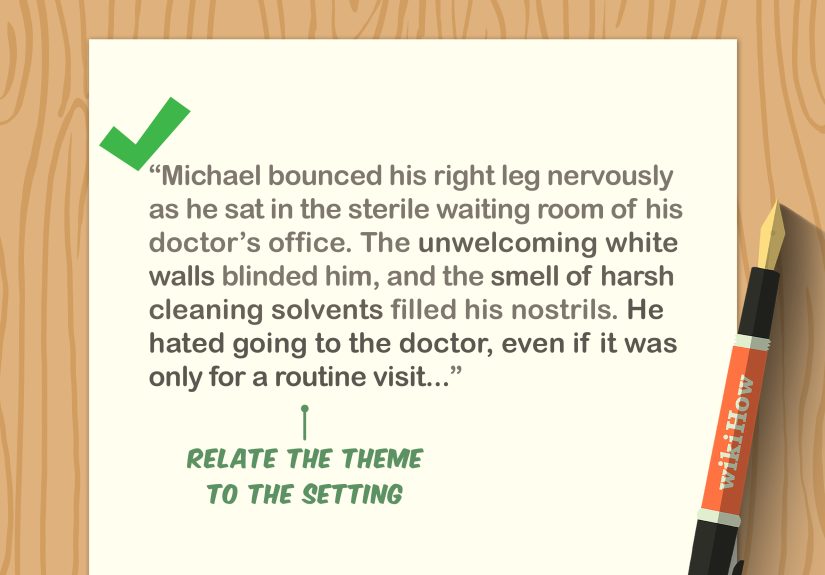
Many writers default to sight because it seems easiest. But a memorable setting often depends on sound, temperature, texture, and smell. The buzz of fluorescent lights in a hospital hallway can feel more unsettling than the color of the walls. The sticky handle of a diner menu can tell us more about a place than a long description of the booths.
Think about how a location behaves. Does the floor creak? Does the wind carry salt? Does the subway platform smell like wet concrete and burnt metal? These details help create an immersive story setting because they activate the reader’s imagination more fully.
Choose details with purpose
Not every sensory detail deserves a speaking role. The goal is not to describe everything. The goal is to select the details that create a dominant impression. A courtroom might be defined by the scrape of chairs, the hum of old air conditioning, and the stale odor of paper. A carnival might be all sugar, grease, bright bulbs, and the metallic squeal of rides that look one loose bolt away from the evening news.
Example: “The apartment smelled faintly of bleach and old onions, and the radiator clicked like it had something personal against winter.”
That sentence gives us physical setting, atmosphere, and a little personality. It also avoids the blandness of “The apartment was old.”
Do not overload the paragraph
Writers sometimes hear “use sensory detail” and produce six lines of purple prose that read like a candle catalog. Resist that urge. Strong descriptive writing is selective. A few sharp details usually outperform a mountain of adjectives.
3. Filter the Setting Through Your Character’s Point of View
This is where setting description stops being decorative and starts becoming story. A place should not feel objective in the way a security camera sees it. It should feel filtered through the character who experiences it. Two people can walk into the same room and notice completely different things.
Let emotion shape what gets described
A nervous character might notice exits, locked windows, and the distance to the door. A grieving character might fixate on dust, silence, or objects left untouched. A child might notice colors and sounds. A contractor might notice bad tile work and a ceiling crack that spells future expenses.
This is one of the best ways to describe the setting in a story because it deepens both place and character at the same time. Readers learn not only what the environment looks like, but also how the protagonist interprets it.
Example: A luxury hotel can be described in two ways:
Neutral version: “The lobby was large, elegant, and full of marble.”
POV version: “Elena stepped onto the marble floor and immediately regretted her shoes, which squeaked loud enough to sound like public humiliation in four-star acoustics.”
The second version does more than describe a lobby. It reveals class anxiety, character voice, and emotional tension. Same room. Better story.
Use setting to reveal attitude and bias
A setting can feel welcoming, threatening, ridiculous, sacred, or exhausting depending on who is looking at it. That subjectivity is useful. It gives your prose voice. It also keeps your setting description from sounding like a brochure written by a very serious robot.
When writing from a close point of view, ask: what would this character actually notice first, and why? Their answer is usually more interesting than yours.
4. Make the Setting Work for Mood, Conflict, and Theme
The strongest settings do more than sit there looking descriptive. They participate. They support atmosphere, create obstacles, reinforce theme, and sometimes act like a silent character in the story. If your setting never influences anything, it may be underemployed.
Use setting to build mood
Mood is the emotional effect created for the reader. Setting plays a huge role in this. A bus stop at midnight under a flickering streetlamp creates a different emotional charge than a crowded farmers market at noon. Weather, lighting, architecture, noise, and space all influence atmosphere.
For a suspenseful scene, tight corridors, poor visibility, and interrupted sound can increase tension. For a nostalgic scene, warm light, familiar objects, and seasonal cues may create emotional softness. The point is not to announce the mood. It is to let the environment produce it.
Use setting to create conflict
Setting can make life harder for characters, which is excellent news for your plot. A flooded road delays an escape. A tiny apartment heightens family tension. A rigid social setting, such as a strict boarding school or conservative town, can create emotional and moral pressure even when nobody is throwing punches.
Physical place and social environment both matter. Sometimes the real antagonist is not a villain in a cape. Sometimes it is August in Arizona, a church basement full of gossip, or a neighborhood where everyone knows your business before you do.
Use setting as symbolism without being dramatic about it
Setting can echo theme when handled subtly. A decaying house might reflect a family in decline. A rapidly changing city might mirror a character’s loss of identity. A wide open desert might amplify freedom for one character and loneliness for another. Symbolism works best when it grows naturally from the scene instead of arriving with a marching band.
Example: If your story is about isolation, you might set a key scene in a rural motel where the ice machine is broken, the highway is almost empty, and the neon sign buzzes like a tired insect. The place itself reinforces what the story is saying.
Common Mistakes When Describing Setting
Giving too much description at once
A giant block of setting detail can stall the story. Sprinkle description through action, dialogue, and internal thought so the scene keeps moving.
Using generic details
“It was a nice day” and “the room was messy” do not do much. Replace broad labels with precise images that readers can picture.
Ignoring character perspective
If your setting sounds detached from the people in the scene, it may feel lifeless. Description should be connected to experience, not just appearance.
Describing things that do not matter
Readers do not need a complete inventory unless the inventory itself is meaningful. Focus on details that build mood, reveal character, or support the plot.
Final Thoughts
Learning how to describe the setting in a story is really about learning how to make place matter. Good setting description does not stop the narrative. It strengthens it. It tells readers where they are, what kind of emotional weather they are walking into, and why this scene could only happen here.
If you remember nothing else, remember this: ground the reader, use sensory detail, filter everything through character, and make the setting pull its weight. That is how a story world starts to feel lived in rather than assembled. A strong setting does not merely surround the action. It helps create the action.
And that, thankfully, is much more interesting than writing, “It was a dark and stormy night,” unless your goal is to wake up every high school English teacher in a five-mile radius.
Writer Experiences: What Usually Happens When You Start Revising Setting
One of the most common experiences writers have with setting is realizing, usually halfway through a draft, that their characters seem to be talking in a vacuum. The dialogue may work, the conflict may be solid, and the pacing may even look respectable, but nobody knows whether the scene is happening in a kitchen, a parking lot, or the emotional waiting room of the universe. That discovery is painful, but useful. It teaches writers that setting is not an accessory added at the end. It is part of the scene’s structure.
Another common experience is overcorrecting. Once writers understand that setting matters, they sometimes respond by describing everything in sight. Suddenly every room has twelve objects, every sidewalk has a complete weather report, and every tree gets its own résumé. This usually happens because the writer is trying hard to be vivid. The lesson that follows is important: readers do not need more description; they need better description. A single strong detail often does more work than a paragraph of average ones.
Writers also learn that setting becomes easier when they stop thinking like tourists and start thinking like residents. A tourist notices landmarks. A resident notices the broken gate, the bus that is always late, the smell near the laundromat after rain, and the fact that the deli owner never closes before a storm. Those details feel lived in. They create authenticity because they suggest familiarity rather than performance.
Many writers discover that point of view solves half their setting problems. Instead of asking, “How do I describe this room?” they begin asking, “What would this character notice in this room?” That shift changes everything. A teenager grounded for a month notices a window as an escape route. A tired mother notices toys underfoot and a dish left in the sink. A burglar notices shadows, locks, and whether the dog bowl is full. The setting becomes specific because the observer is specific.
There is also the experience of discovering that setting can rescue weak scenes. A conversation that feels flat in a generic office may become alive in a crowded county fair, a stalled elevator, or a church fellowship hall after a funeral. The place adds pressure, texture, interruption, and subtext. Suddenly the scene has friction. This is one of the most exciting revisions a writer can make, because it proves that setting is not just descriptive. It is strategic.
Finally, many writers come to understand that the best setting details are often the ones tied to emotion. Readers remember places not because every lamp was described, but because the room felt oppressive, comforting, haunted, hopeful, or strange. In the end, setting works when readers feel they have been somewhere, not when they have merely been informed that a couch existed in the vicinity.