Table of Contents >> Show >> Hide
- What “Pure Street Photography” is really curating
- Why these street shots feel “captivating” instead of merely “nice”
- A guided tour of the collection’s “street photography flavors”
- How to shoot street photos with this kind of impact
- Legal and ethical basics for street photography in the United States
- Editing the story: how curation turns 40 images into a journey
- Field Notes: of Street Photography “Experience” (The Real-World Part)
- Conclusion: Why this PSP-curated set sticks with you
Street photography is basically improv theaterexcept nobody rehearsed, nobody got a script, and the lighting is whatever the sun decided to do that day.
One second you’re just walking to get coffee, the next second a cat strolls into the frame like it’s the director, a stranger’s shadow lines up with a
billboard face, and the whole sidewalk accidentally becomes a punchline.
That’s why curated collections like Bored Panda’s roundup of 40 captivating street shots hit so hard: they compress a thousand
“nothing to see here” moments into a scroll that keeps saying, “Actually… look closer.” The photos featured through the
Pure Street Photography community don’t just show streetsthey show stories hiding in plain sight.
What “Pure Street Photography” is really curating
Pure Street Photography (often shortened to PSP) is built around a simple, demanding idea: candid images of public life should feel honest, intentional,
and alive. The platform grew out of a curated approach (not just a “post anything with a hashtag” free-for-all), and it’s closely associated with the
founders Dimpy Bhalotia and Kamal Kumaar Rao. The origin story matters because it explains the vibe of the collection: the goal isn’t to show off
expensive cameras; it’s to spotlight timing, observation, and human (or feline) weirdness.
In the Bored Panda feature, Bhalotia describes how audience response helped her identify which images resonated, then use that feedback loop to refine a
stronger body of workan approach she later wanted other photographers to experience as well. That “curation as a training tool” is basically PSP’s secret
sauce: it rewards photographs that communicate, not just photographs that look technically correct.
Why these street shots feel “captivating” instead of merely “nice”
Plenty of photos are sharp. Plenty are well exposed. Plenty have pretty colors. And yet… your thumb still keeps scrolling. Captivating street photography
usually stacks three ingredients:
- Timing (the moment is fleeting, and the photographer actually caught it)
- Design (the frame has structurelayers, geometry, light, repetition)
- Meaning (a story, a joke, a tension, a little human truth)
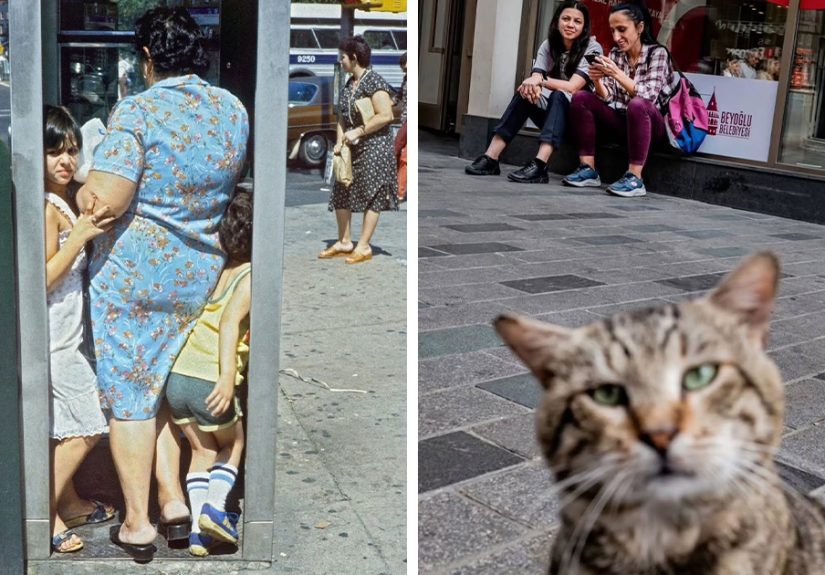
The PSP-curated set leans hard into that trio. You can see it right from the opening image described in the post: a curious cat in the foreground while
two women sit in the background (photo by Anton Panchenkov). That’s not just “cat on street.” It’s a layered scene with a built-in narrative:
the cat looks like it owns the city, and the humans are just extras.
The “decisive moment” is alive and well (and still doesn’t care about your nerves)
Street photography has long celebrated the idea of a decisive momentwhen composition and meaning click into place at the same time. What’s modern in this
PSP collection is how that concept shows up in everyday comedy and micro-drama. A cat photobombing a kissing couple (photo by Natali Voitek) is a perfect
example: romance tries to take center stage, but the street (and its furry citizens) steals the spotlight.
Layering: the frame has foreground, middle, backgroundand attitude
Layering is one of the fastest ways to make street photography feel like a story rather than a snapshot. When the foreground is doing one thing and the
background is doing another, viewers get to “read” the frame. In this set, multiple images lean into layered scenes: a child perched on shoulders holding
a cardboard sign in a busy cityscape (photo by Jenny Sowry) feels like social commentary and visual rhythm at once.
Repetition and geometry: when the street turns into a design studio
One of the most striking descriptions in the Bored Panda lineup is a uniformed officer walking through rows of identical parked cars (photo by John Van
Hasselt). That’s the street doing what streets do best: creating patterns you don’t notice until someone frames them. Repetition becomes the subject,
and the lone figure becomes the punctuation mark.
Reflections and self-awareness: street photography winks back
Street photography loves reflections because they turn one reality into two. The collection includes a famous kind of reflective storytelling associated
with Vivian Maierdescribed in the post as a reflection of a photographer, a vintage car, and two women inside a building. That’s street photography doing
its magic trick: it’s documentary, but it’s also a puzzle.
A guided tour of the collection’s “street photography flavors”
The Bored Panda headline says “40,” but what you’re really getting is variety. The shots don’t all chase the same mood. Instead, they cluster into a few
delicious categorieslike a sampler platter where every bite is either meaningful or mildly chaotic.
1) Animal cameos (a.k.a. the street’s unofficial mascots)
Street photography is supposed to be about public life, and animals are absolutely part of thatespecially when they behave like tiny celebrities who
didn’t sign any contracts. The collection includes multiple animal-centered scenes: a boy holding a black cat on his shoulder with a cyclist in the
background (photo by Paul McCain) and even a man walking a cat on a leash near a waterfront with the Bay Bridge behind him (photo by Linda True).
If you’ve ever wondered whether street photography can be both cinematic and adorable, the answer is yesand apparently cats know it.
2) Human comedy (where strangers accidentally collaborate)
Street humor isn’t “manufactured.” It’s alignmentgesture meets timing meets context. A glance, a posture, an oddly placed sign, a background character
doing something that changes the entire meaning of the frame. The charm of this PSP-curated set is that it doesn’t force jokes; it notices them. When a
photo makes you laugh, it’s usually because the photographer was patient enough to wait for the street to deliver the punchline.
3) Quiet documentary moments (where nothing “big” happens, but everything matters)
Not every captivating street shot is loud. Some are slow-burn photographspeople sitting on steps, waiting, resting, watching. These frames tend to be
about environment and mood: the way buildings loom, the way light falls, the way a city holds a person. That’s the documentary heart of street
photography: everyday life, unfiltered, but still composed.
4) Winter, weather, and atmosphere (the free production design)
Weather is the street’s most dramatic costume department. A scene with cats playing in snow (photo by Juha Metso) isn’t just “cute”snow changes the
entire visual language. It simplifies backgrounds, brightens shadows, and makes motion feel more vivid. Rain and snow can turn normal sidewalks into
reflective stages. Street photographers don’t “control” weatherthey adapt to it like it’s a moody co-director.
How to shoot street photos with this kind of impact
If these images make you want to grab your camera and sprint outside (please don’t sprint; you’ll miss the moments), the good news is you don’t need a
complicated setup. Many well-known street photography guides emphasize the same practical habits: stay nimble, anticipate action, and keep your camera
settings simple enough that your brain can focus on people and light.
Carry less. Blend more. Look longer.
Gear guides from major U.S. camera retailers often recommend leaving the big bag behind. A smaller setup helps you move, react, and look less like a
roaming electronics store. Street photography rewards presence: the less you fuss with gear, the more you notice gestures, timing, and relationships
inside the frame.
“Work the scene” instead of hunting for one magic click
Practical street photography advice from popular U.S.-read publications often repeats a tough truth: the first frame is rarely the best frame. If you see
a promising sceneinteresting light, strong background, a flow of peoplestay put and shoot variations. Small changes (a head turn, a step forward, a
background figure entering the right spot) can upgrade a photo from “fine” to “wow.”
Use settings that protect the moment
When photographing people in motion, you generally want shutter speeds that freeze subtle movement (faces, hands, stride). Many street photographers keep
things simple with aperture priority, choosing an aperture that gives enough depth of field for the scene, while letting the camera handle the rest.
The point isn’t to worship settings; it’s to avoid losing a once-only moment because you were busy negotiating with your ISO.
Compose for layers: foreground interest + subject + context
Want more “captivating” frames? Give viewers more to discover. Layering can be as easy as shooting through something (a window, a crowd, a doorway),
letting a foreground element frame the scene. The PSP collection’s described images are full of this energy: animals in the foreground, people in the
background, reflections that fuse two worlds, repeating lines that lead your eye.
Legal and ethical basics for street photography in the United States
Street photography in the U.S. benefits from strong free speech protections, but “legal” and “wise” aren’t identical twins. A few grounded principles are
worth remembering:
-
In public spaces, you can generally photograph what is plainly visible. That includes police performing official duties in public,
though you should avoid interfering and follow lawful orders related to safety and access. - Private property is different. Stores, restaurants, and many indoor spaces can set rules and ask you to stop or leave.
-
Model releases are usually about commercial advertising use. Editorial, artistic, and documentary uses generally operate differently
than using someone’s likeness to sell a product. -
Ethics matter even when you’re “allowed.” Photographing someone in distress, a vulnerable situation, or a private moment can be legal
in some contexts and still feel exploitative. Aim for humanity, not humiliation.
Think of ethics as your internal editor. The best street photographers don’t just ask, “Can I take this photo?” They also ask, “Should I?”
That mindset tends to produce better work anywaybecause it forces you to look for meaning rather than cheap shots.
Editing the story: how curation turns 40 images into a journey
A strong street photography collection isn’t only about individual bangers; it’s about rhythm. Humor next to quiet. People next to patterns. A wide scene
next to a tight detail. The PSP-curated feel is consistent: each photo has a “hook,” but the hooks aren’t identical. That variety keeps the viewer alert.
It’s like a playlist where every song is good, but not every song is the same tempo.
If you’re building your own series, steal this approach (politely): edit for variety, then sequence for flow. Don’t include five photos that do the same
trick. Include one great reflection, one great pattern, one great gesture, one great moment of tenderness, one great moment of absurdity. Let your viewer
breathe. Then surprise them again.
Field Notes: of Street Photography “Experience” (The Real-World Part)
Here’s what street photography often feels like when you actually do itbecause the internet makes it look like you just step outside and the universe
hands you cinematic moments on a silver platter. In reality, it’s more like: you step outside, the universe hands you a parking meter and a gust of wind,
and you earn the cinematic moment by not giving up.
First comes the awkwardness. Your camera suddenly feels louder than a marching band, even if it’s mirrorless and whisper-quiet. You become intensely
aware of your hands, your posture, your facial expressionlike you’re an undercover agent who forgot the secret handshake. Most people who start street
photography aren’t afraid of the technical side; they’re afraid of being noticed. The funny twist is that the more you practice, the less you “take”
photos and the more you simply exist with a camera. Your body relaxes. Your eye gets sharper. You learn that confidence is mostly repetition.
Then you discover patiencereal patience, not the “I waited 30 seconds” version. You find a spot with good light, a strong background, and interesting
foot traffic, and you wait for the right person to enter the frame. Sometimes nobody does. Sometimes three almost-right moments happen in a row, and you
don’t press the shutter because you can feel it’s not quite there yet. Other times you shoot, you think you nailed it, and later you realize a street
sign perfectly sliced through your subject’s head like a cartoon guillotine. Street photography humbles you on a schedule.
You also learn the emotional rhythm of “missed shots.” The perfect alignment happens while your lens cap is still on (classic). Or your autofocus grabs a
background pole instead of the face. Or you’re adjusting exposure and the moment evaporates. At first, missing shots feels tragic. Later, it feels
normal. Eventually, it feels usefulbecause you start anticipating. You begin reading body language like a weather forecast: that person is about to turn,
that couple is about to laugh, that kid is about to bolt forward, that dog is about to do something dog-ish. You get better not because your camera gets
better, but because your attention does.
Conversations happen too. Not always, but enough. Sometimes someone notices and smiles. Sometimes someone looks confused. Occasionally someone asks what
you’re doing, and you learn that a calm, friendly explanation goes a long way. If you treat people like humans instead of “subjects,” most interactions
land gently. And when someone doesn’t want a photo taken, you learn an important professional skill: you respect it and move on. Your portfolio is not
worth a stranger’s bad day.
Finally, you realize the street is generousbut only to those who keep showing up. The “captivating” moments in collections like PSP’s aren’t luck alone.
They’re the result of looking longer than most people look, returning to places, learning light, learning timing, and staying curious about ordinary life.
The street isn’t a studio. It’s a living, unscripted world. Your job is to be ready when it briefly turns into art.
Conclusion: Why this PSP-curated set sticks with you
Bored Panda’s “40 captivating street shots” curated through Pure Street Photography works because it celebrates what street photography does at its best:
it notices the extraordinary inside the ordinary. Whether it’s a cat stealing a scene, a repeating pattern turning a parking lot into graphic design, or a
reflection turning reality into a riddle, the common thread is attention. These images reward viewers who slow downand they inspire photographers to do
the same.
If you want to create photos like this, start with one small mission: walk one neighborhood and look for one story. Not “a pretty shot.”
A story. Then do it again. The street will eventually meet you halfwayusually when you least expect it, and almost never when you’re in a hurry.