Table of Contents >> Show >> Hide
- How to Choose the Right Board Game for Your Kid
- Best Board Games for Young Kids (Ages 3–6)
- Best Board Games for Early Elementary (Ages 6–8)
- Best Board Games for Big Kids (Ages 8–12)
- Best Cooperative Games Kids and Adults Both Enjoy
- Best Educational Board Games for Kids
- Best Fast & Silly Party Games for Kids
- Best All-Ages Family Board Games Kids Can Grow Into
- How to Make Family Game Night Actually Happen
- Real-Life Experiences with the Best Board Games for Kids
If you’ve ever tried to play “Go Fish” with a 4-year-old who keeps licking the cards, you know that not every game is a hit. The best board games for kids in 2024 do more than just fill a rainy afternoonthey sneak in skills like reading, math, teamwork, and emotional regulation, all while making your kids giggle so hard they forget about screens for a while.
To build this list of the best kids’ board games for 2024, we pulled ideas from parenting blogs, homeschool resources, family-gaming sites, and education-focused lists across the U.S., then cross-checked them with what families actually say they play on repeat. You’ll find a mix of fast-and-silly, calm-and-cozy, and smart-and-strategic games that work for toddlers through tweensand that won’t make adults dread family game night.
How to Choose the Right Board Game for Your Kid
Before we dive into the top 45 board games for kids, it helps to keep a few things in mind when you’re shopping or wrapping something for a birthday party:
- Age & attention span: Games like Hoot Owl Hoot! and Sneaky, Snacky Squirrel are great for preschoolers, while older kids may crave the strategy of Catan Junior or Ticket to Ride: First Journey.
- Play time: For tired weeknights, look for 10–20 minute games. Save the longer, epic adventures for Saturday evenings.
- Reading level: Some games are language-light and rely more on symbols or colors; others require full-on reading and rule interpretation.
- Competition vs. cooperation: If “someone flipped the board again” is a common phrase at your house, cooperative games can be a relationship-saver.
- Replay value: The best kids’ board games feel different every time you play, thanks to variable setups, dice, or card combinations.
With that in mind, here are the 45 best board games for kids in 2024, organized loosely by age and play style so you can find the perfect fit fast.
Best Board Games for Young Kids (Ages 3–6)
1. Candy Land
Best for: First-time gamers and preschoolers
Candy Land remains a classic because there’s zero reading and almost no strategyjust color recognition and taking turns. Kids practice counting spaces, handling disappointment (oh hi, Molasses Swamp), and cheering for other players. It’s simple, but for a 3-year-old, moving that little gingerbread person feels like magic.
2. Chutes and Ladders
Best for: Learning numbers and cause and effect
This is a great early-math game: kids spin, count spaces, and then celebrate ladders while groaning at chutes. It’s a light way to talk about consequences (climb when you help, slide when you cause trouble) without a lecture.
3. Hoot Owl Hoot!
Best for: Cooperative play and color matching
In Hoot Owl Hoot!, players work together to help owls fly back to their nest before the sun comes up. There’s no “winner” and “loser” hereeither everyone gets the owls home or everyone tries again. That cooperative play style is especially good for competitive siblings.
4. Sneaky, Snacky Squirrel
Best for: Fine motor skills and color practice
A chunky squirrel-shaped “tweezer,” tiny acorns, and a spinner make this game a preschool favorite. Kids practice pinching, matching colors, andimportantlywaiting patiently for their turn without diving across the table for fallen acorns.
5. Zingo!
Best for: Pre-reading skills and quick play
Zingo! is like bingo with a satisfying tile dispenser that kids love to operate. Matching pictures and words helps with early literacy, and the fast rounds make it perfect for “just one more game” before bed.
6. Outfoxed!
Best for: First mystery and deduction game
This cooperative whodunit has kids work together to figure out which fox stole the pie. They roll dice, collect clues, and use a neat decoder to rule out suspects. It introduces logic and deduction in a gentle, silly way.
7. Feed the Woozle
Best for: Wiggly kids who need to move
In this co-op game, kids scoop pretend snacks (like “chocolate-covered flies”) and wobble across the room to feed the Woozle while doing actions like marching or spinning. It doubles as a movement break on long indoor days.
Best Board Games for Early Elementary (Ages 6–8)
8. Guess Who?
Best for: Deductive reasoning and yes/no questions
Kids flip down characters based on questions like “Does your person wear glasses?” It’s fast, portable, and encourages kids to think about efficient questions rather than guessing randomly.
9. Trouble
Best for: Dice counting and friendly competition
The Pop-O-Matic bubble is the real star here. Kids learn simple tacticswhen to advance a piece, when to send a sibling back homeand practice being good sports when someone pops exactly the number they need.
10. Sorry!
Best for: Light strategy and teaching “it’s just a game”
Sorry! looks simple, but it sneaks in strategy as kids decide which pawn to move and when to knock others back to start. It’s also perfect for practicing phrases like, “I’m not mad at you, I’m mad at the card.”
11. Ticket to Ride: First Journey
Best for: Intro to strategy games
This kid-friendly version of the popular train game shortens play time and simplifies rules while keeping the fun of building train routes across the map. Kids learn planning, spatial reasoning, and how delicious it feels to complete a long route just before someone else does.
12. Catan Junior
Best for: Resource management basics
Catan Junior trims down the trading and building of classic Catan into a pirate-themed game that kids can understand. It’s a perfect bridge between simple roll-and-move games and “big kid” board games.
13. Sleeping Queens
Best for: Simple math and memory
Designed by a child, this card game asks players to wake snoozing queens with number-based plays while dodging knights and dragons. Kids get sneaky practice with addition and pattern recognition while plotting to steal the Queen of Pancakes.
14. Spot It!
Best for: Visual perception and reflexes
Every pair of cards has exactly one picture in common, and finding it fast is strangely addictive. There are themed versions for younger kids, but even adults end up shouting, “Snowman! I see the snowman!”
15. Sushi Go!
Best for: Quick rounds and pattern scoring
This adorable card-drafting game has players collect sets of sushi to score points. Kids learn to think a turn ahead and balance risk: do you go for a big-tempura combo or grab the pudding before someone else hoards it?
Best Board Games for Big Kids (Ages 8–12)
16. Ticket to Ride (Original)
Best for: Families ready for deeper strategy
The full version of Ticket to Ride adds more complex routes and long-term planning. Older kids love blocking each other’s tracks (in a loving way… mostly) and plotting how to connect distant cities before their train cards run out.
17. Azul
Best for: Pattern building and planning ahead
In Azul, players draft colorful tiles to decorate a wall, trying to balance immediate points with long-term bonuses. It’s calming, tactile, and secretly excellent for teaching planning and spatial reasoning.
18. King of Tokyo
Best for: Dice chucking and light “battle” fun
Giant monsters roll dice, stomp the city, and occasionally stomp each other. It’s a hit with kids who like a little cartoony chaos, but the simple rules mean nobody is flipping through a rulebook between turns.
19. Codenames: Pictures
Best for: Vocabulary, creativity, and teamwork
Instead of reading words, kids use quirky pictures to guess which images their teammate is hinting at with a single clue. It’s an excellent family game because grown-ups and kids often spot completely different associations.
20. Dixit
Best for: Storytelling and imagination
Each round, one player gives a clue about a surreal illustration; everyone else secretly plays a card that could match. Then players vote on which picture belonged to the storyteller. It’s basically creative writing in card form, without any homework vibes.
21. Dragonwood
Best for: Probability and risk-taking
Players collect sets of adventurer cards to “stomp,” “scream,” or “strike” creatures in the forest. The dice and probabilities encourage kids to think about the odds without realizing they’re doing math.
22. Labyrinth
Best for: Spatial thinking and planning
The board shifts every turn as players slide maze tiles, opening paths for themselves and closing them for others. It’s tactile, visual, and different every game.
23. King Domino
Best for: Gentle strategy and tile drafting
Kids draft domino-like tiles to build the most efficient little kingdom. They must balance immediate points with future placement, all in a breezy 15–20 minutes.
24. Unstable Unicorns: Kids Edition (or family-friendly variant)
Best for: Kids who love silly, slightly chaotic games
Unicorns, action cards, and a little bit of “take that” keep tweens laughing. It’s a good stepping stone toward more complex card games.
Best Cooperative Games Kids and Adults Both Enjoy
Cooperative games are huge right now, and for good reasonthey swap “I win, you lose” for “we’re in this together.” That can make family game night a lot calmer while still staying exciting.
25. Pandemic: Hot Zone
Best for: Older kids who like teamwork and tension
This family-friendly version of Pandemic shrinks the map and rules so you can learn quickly and play in under 30 minutes. Players work together to treat outbreaks and collect sets of cards before time runs out.
26. Forbidden Island
Best for: Intro to cooperative strategy
Players race around a sinking island, shoring up tiles and grabbing treasures before the whole thing disappears under the waves. It teaches planning, role specialization, and the joy (and agony) of tough group decisions.
27. Zombie Kids Evolution
Best for: Campaign-style play with kids
In this lighthearted school-versus-zombies game, players unlock new powers and stickers over repeated plays. It’s perfect if your kids love the idea of a game that “remembers” what they’ve done.
28. The Fairy Game
Best for: Gentle fantasy and shared goals
Designed by the same folks who made Hoot Owl Hoot!, this game has players cooperate to grow flowers and beat Mr. Winter. Parents often report that it’s fun enough to pull out even when the kids aren’t begging for it.
29. Mysterium Kids
Best for: Creative communication
Instead of talking, a ghost player uses sound clues on a little drum to help others guess the right card. It’s weird, funny, and surprisingly good at building listening skills.
Best Educational Board Games for Kids
Not every “educational” game is funbut when you get the balance right, kids beg to practice math or spelling without realizing they’re technically studying.
30. Sum Swamp
Best for: Early math facts
Sum Swamp has kids rolling dice, adding or subtracting, and racing through a cartoon swamp. The constant equations make it better practice than a worksheet, and the “odds vs. evens” spaces introduce number concepts.
31. Prime Climb
Best for: Older elementary math
The colorful board and clever multiplication rules help kids see patterns in numbers. It’s especially useful for kids who “get” the basics but need to deepen number sense.
32. Scrabble Junior
Best for: Spelling and vocabulary
A simplified board with word outlines lets early readers match letters, while the flip side plays more like classic Scrabble for bigger kids. It grows with your child, which is always a win for your budget.
33. Robot Turtles
Best for: Coding concepts
Players “program” turtles with directional cards to reach gems. There’s no screen, just the mental process of thinking in sequences and debugging when your turtle bonks into a wall.
34. Blokus
Best for: Geometry and spatial reasoning
Bright, Tetris-like pieces must touch at the corners but never along edges. The rules are simple, but fitting your shapes on the board becomes a brain-burning puzzle, especially when other players block your plans.
35. Hedbanz
Best for: Critical thinking and vocabulary
Kids wear a card on their head and ask yes/no questions to figure out what they are. It’s hilarious (“Am I… a house cat with a job?”) and it strengthens categorizing and question-asking skills.
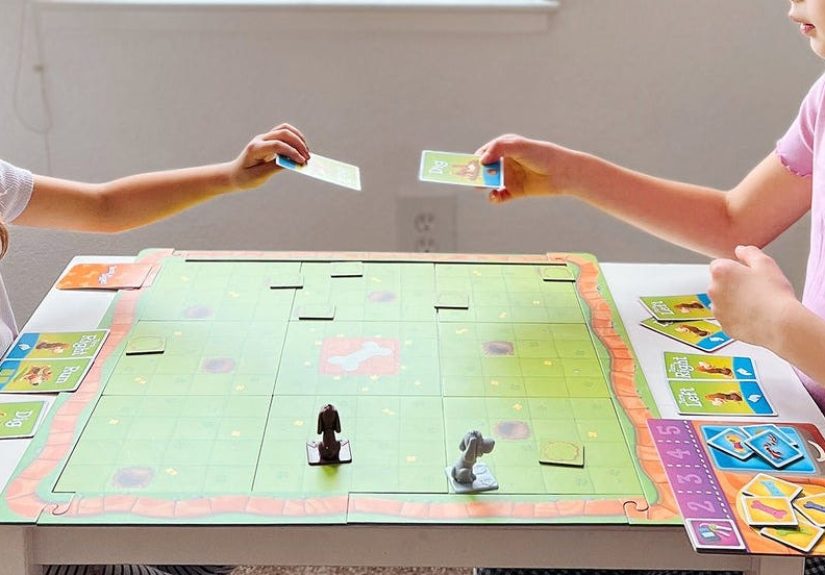
Best Fast & Silly Party Games for Kids
36. Taco Cat Goat Cheese Pizza
Best for: High-energy groups
This lightning-fast card-slapping game is basically chaos in a box. Players chant the title words as they flip cards; when the picture matches the spoken word, everyone slams the pile. Expect shrieks of laughter and at least one dramatic slow-motion hand reach.
37. Exploding Kittens
Best for: Kids who like absurd humor
In this wildly popular card game, players try to avoid drawing exploding kittens while using cards like “TacoCat” and “Hairy Potato Cat” to sabotage others. It’s quick, portable, and ideal for kids who find the word “butt” endlessly funny.
38. Throw Throw Burrito
Best for: Active kids and big spaces
Part card game, part dodgeball, this game has players collecting sets while occasionally ducking squishy foam burritos. It’s best played in a room where nothing fragile can be brokenand where everyone is okay with a little cardio.
39. Tapple
Best for: Word retrieval and quick thinking
Kids race against a timer to shout out words in a category and slap down corresponding letters on a circular device. It’s a great vocabulary booster and works well across age gaps because younger kids can handle easy categories while older kids get tougher ones.
40. Hues and Cues
Best for: Color perception and communication
Players give one- or two-word clues to help others guess a specific color on a huge grid. It sparks fascinating conversations about how different people perceive “mint,” “seafoam,” or “dusty rose,” and it scales well for big family gatherings.
Best All-Ages Family Board Games Kids Can Grow Into
41. Carcassonne
Best for: Tile-laying and gentle strategy
Players place tiles to build roads, cities, and fields, dropping meeples to claim features. Younger kids enjoy matching pictures and making “pretty maps,” while older players get competitive about scoring.
42. Qwirkle
Best for: Matching colors and shapes
With no reading required, Qwirkle is a great bridge between young and older players. You build lines of tiles based on shared color or shape, earning big points when you complete a six-tile “qwirkle.”
43. Blended Space: My Little Scythe
Best for: Older kids curious about “big box” games
This kid-friendly adaptation of the heavy strategy game Scythe simplifies rules into a colorful world of animal friends. Kids explore, deliver gems and apples, and complete quests while learning more advanced board game structure.
44. Crossbows & Catapults: Fortress War
Best for: Hands-on kids who love building
This modern revival of the ’80s favorite lets kids build tiny fortresses and literally launch projectiles at them using spring-loaded siege weapons. It’s part engineering, part target practice, and all spectacleperfect for holiday mornings when you want a game that feels like a toy.
45. Pikit
Best for: Fast dice battles and repeat plays
Often highlighted as a standout family game, Pikit blends monster battling with quick, snappy dice turns. Games are short, making it easy to say, “best two out of three,” and the light rules mean kids can teach grandparents instead of the other way around.
How to Make Family Game Night Actually Happen
Buying one (or three) of the best board games for kids is only half the battle. The trick is weaving them into your week so they’re as normal as brushing teeth. Parents who host regular family game nights recommend putting it on the calendar, rotating who picks the game, and keeping snacks easy so nobody is stuck in the kitchen while everyone else is shouting about unicorns and zombies.
Try starting with short, low-stress gamesZingo!, Outfoxed!, Sum Swampso that younger kids build stamina and positive associations. As they get older, gradually introduce longer, more strategic games like Ticket to Ride or Forbidden Island. Rotating between cooperative and competitive games helps, too: co-op games can reset the mood after a particularly “spicy” round of Sorry!
Most importantly, model good sportsmanship. Celebrate clever plays from your kids, admit when they beat you fair and square, and don’t be afraid to call a break if energy goes off the rails. The goal isn’t to crown a championit’s to create a shared family ritual that your kids will remember long after the game pieces go missing.
Real-Life Experiences with the Best Board Games for Kids
Lists are great, but what really sells the best board games for kids is how they feel around an actual kitchen table. Here are some lived-in, honest experiences that can help you picture how these games might play out in your own home.
Starting with the “Easy Wins”
Many families find that their first successful game nights revolve around just one or two simple games. Candy Land or Sneaky, Snacky Squirrel are classics for a reason: you can sit down with a preschooler, skim the rules in under a minute, and start playing. That matters when you’re competing with the instant gratification of tablets and streaming shows.
Parents often report that these games become part of the bedtime routine: one story, one quick game, then teeth and pajamas. The game gives kids a sense of control (“I get to choose the color!”), which can make transitioning to bedtime smoother. When the game ends with laughter instead of tears, everyone heads to bed in a better mood.
When Siblings Have Very Different Ages
If you’ve got a 5-year-old and an 11-year-old, finding shared activities can feel impossible. This is where games like Ticket to Ride: First Journey, Qwirkle, and Carcassonne shine. Younger kids can focus on matching colors, placing tiles, or building simple routes, while older siblings lean into deeper strategy.
One clever trick many families use is letting the youngest player team up with an adult or older sibling. They make decisions together, whispering about which tile to choose or which route to block, so nobody feels left out. Over time, younger kids get more confident and eventually want their own “seat at the table” as a full player.
Cooperative Games as Relationship Repair
Competitive games can bring out the best and the worst in kids. After a tense round of Sorry! or Exploding Kittens, emotions might run high. Switching to a cooperative gamelike Hoot Owl Hoot!, Forbidden Island, or The Fairy Gamecan reset the mood.
In co-op games, every small success feels shared: “We saved the island!” or “We all got the owls home before sunrise!” Kids who struggle with losing get to feel the thrill of a group victory, and you can model helpful phrases like, “What does our team need next?” instead of “How do I stop you from winning?” Over time, that mindset can spill over into chores, school projects, and playground play.
Using Board Games as Stealth Learning Tools
Parents who homeschool or who just want to support school learning at home often lean hard on games like Sum Swamp, Prime Climb, Robot Turtles, and Scrabble Junior. It’s not about turning every moment into a lessonit’s about giving kids more “reps” with skills like counting, spelling, or strategic thinking in a low-pressure setting.
For example, a child who groans at a page of math problems may happily race through dozens of additions while moving their swamp creature around the board. A reluctant reader might work eagerly to spell words in Scrabble Junior because the letters now “do something.” When learning feels like play, kids naturally stay engaged longer.
Building Traditions Around Game Night
Some of the most powerful benefits of board games have nothing to do with the games themselves. Families often build small rituals around game night: choosing a special snack, playing a specific music playlist, or lighting a cozy candle. Those cues tell everyone, “This is our time together.”
Over time, a particular game can become “your” family game. Maybe every New Year’s Eve you play King of Tokyo and shout “Happy New Year!” each time someone becomes the new King. Maybe Friday nights are for two quick rounds of Sushi Go! and silly sushi puns. These traditions can anchor kids emotionally, giving them something steady to look forward to even when school or life feels unpredictable.
Letting Kids Take the Lead
As kids get older, letting them read the rules, teach a new game, or track the score can be incredibly empowering. A child who struggles with reading aloud in class might feel proud explaining the turn structure of Pikit or the scoring of Azul to visiting grandparents.
When you hand the rulebook over and become a learner instead of the teacher, you send a powerful message: “I trust you, and I think you’re capable.” And honestly, it’s pretty nice to sit back with your snacks while your 10-year-old confidently says, “Okay, everyonehere’s how we play.”
However you structure it, the real magic of these 45 best board games for kids in 2024 is simple: they create regular pockets of joy, connection, and shared stories in a world that often feels rushed and distracted. Whether you’re herding owls, launching burritos, or quietly building train routes across a cardboard map, you’re doing much more than just passing the timeyou’re building a family culture, one turn at a time.