Table of Contents >> Show >> Hide
- Why changing statements into questions matters
- Way 1: Flip the helping verb in front of the subject (inversion)
- Way 2: Use “do-support” (Do/Does/Did) for simple present and simple past
- Way 3: Add a “WH-” question word to ask for specific information
- Way 4: Turn it into a tag question (for confirmation)
- Way 5: Use an indirect question to sound more polite (or more formal)
- Bonus mini-move: The “You’re coming?” conversational question
- Common pitfalls when you convert a statement to a question
- Conclusion
- Real-world experiences: what practicing these 5 ways looks like (and why it sticks)
Turning a statement into a question is one of those English skills that looks simple until you’re staring at a sentence like
“You finished the report” and your brain goes, “Cool… but how do I make it ask-y?”
The good news: English question formation isn’t random. It’s more like a set of reliable “moves” you can use depending on what kind of verb you’ve got
(a helping verb, a main verb, a modal, etc.) and what kind of answer you want (yes/no, details, confirmation, politeness).
Below are five practical ways to change a statement to a questioneach with clear steps, plenty of examples, and a few “watch out for that banana peel”
notes so you don’t slip into common mistakes.
Why changing statements into questions matters
Questions do more than “get information.” They can soften a request, check understanding, invite a conversation, or challenge an idea without starting a verbal
cage match. In writing, questions can add voice and rhythm. In speaking, they can keep you from sounding like a robot reading a spreadsheet out loud
(no offense to spreadsheetsthey’re doing their best).
Way 1: Flip the helping verb in front of the subject (inversion)
If your statement already has a helping verb (also called an auxiliary verb), you’re in luck. You can usually form a question by swapping the positions of
the auxiliary verb and the subject.
Works great with: be, have, and other auxiliaries
- Statement: She is ready. Question: Is she ready?
- Statement: They are moving. Question: Are they moving?
- Statement: He has finished. Question: Has he finished?
- Statement: We were invited. Question: Were we invited?
Works great with: modal verbs (can, will, should, might, etc.)
- Statement: You can join us. Question: Can you join us?
- Statement: She will call later. Question: Will she call later?
- Statement: They should leave now. Question: Should they leave now?
Quick checklist
- Find the first helping verb in the statement (is/are/was/were, have/has/had, can/will/should, etc.).
- Move it in front of the subject.
- Keep everything else in the same order.
- Add a question mark if it’s a direct question.
Common mistake: adding do when you already have an auxiliary.
✅ “Are you going?”
❌ “Do are you going?” (English just filed a complaint.)
Way 2: Use “do-support” (Do/Does/Did) for simple present and simple past
If your statement has a normal main verb (like like, work, want, need) and no helping verb, English usually brings in
do, does, or did to form a question. This is a super common method for changing a statement to a yes/no question.
Step-by-step
- Choose do (I/you/we/they), does (he/she/it), or did (past).
- Put it in front of the subject.
- Change the main verb to its base form (no -s, no past tense).
Examples (simple present)
- Statement: You need help. → Question: Do you need help?
- Statement: He likes coffee. → Question: Does he like coffee?
- Statement: It works well. → Question: Does it work well?
Examples (simple past)
- Statement: They visited Chicago. → Question: Did they visit Chicago?
- Statement: She called you. → Question: Did she call you?
Common mistake: keeping the past tense after did.
✅ “Did you go?”
❌ “Did you went?” (Double past = double trouble.)
Way 3: Add a “WH-” question word to ask for specific information
Yes/no questions are useful, but sometimes you want details. That’s where who, what, when, where, why, and how
(plus friends like which, how many, how much) come in.
Pattern A: WH-word + helping verb (or do/does/did) + subject + base verb
Use this when the WH-word is asking about something that is not the subject.
- Statement: You met her yesterday. → Question: When did you meet her?
- Statement: They live in Seattle. → Question: Where do they live?
- Statement: He chose that option. → Question: Which option did he choose?
Pattern B: WH-word as the subject (often no do/does/did)
This is the sneaky one. If the WH-word is the subject (“who did the thing?”), you typically don’t use do-support in simple present/past.
- Statement: Maria called you. → Question: Who called you?
- Statement: The storm damaged the roof. → Question: What damaged the roof?
Quick tip: If you can answer with a person/thing as the “doer,” it’s probably a subject question:
“Who called?” (Answer: Maria.) Not “Who did Maria call?” (Different question, different structure.)
Way 4: Turn it into a tag question (for confirmation)
Tag questions are like conversational “receipts.” You’re mostly making a statement, but you’re also asking the listener to confirm it.
They’re common in American English when you want agreement, reassurance, or a gentle nudge.
Basic pattern
- Positive statement + negative tag
- Negative statement + positive tag
Examples with helping verbs/modals
- You are coming, aren’t you?
- She can drive, can’t she?
- They have finished, haven’t they?
Examples with main verbs (use do/does/did in the tag)
- He likes pizza, doesn’t he?
- You went already, didn’t you?
Meaning depends on tone: With rising intonation, it can sound like a real question (“You’re coming, aren’t you?”).
With falling intonation, it can sound like “We both know this is true” (“You’re coming, aren’t you.”).
Way 5: Use an indirect question to sound more polite (or more formal)
Sometimes you want to ask a question without sounding like you’re interrogating someone under a desk lamp.
Indirect questions let you soften the approachespecially in emails, workplace conversations, customer service,
and “I want something from you but I also want you to like me” situations.
Common polite starters
- Could you tell me…
- Do you know…
- Would you mind telling me…
- I was wondering…
Examples: direct vs. indirect
- Direct: Where is the conference room?
Indirect: Do you know where the conference room is? - Direct: Did you finish the report?
Indirect: Could you tell me if you finished the report? - Direct: When does the meeting start?
Indirect: I was wondering when the meeting starts.
Punctuation note (this matters in writing)
If the whole sentence is a question (“Could you tell me…?”), use a question mark.
But if it’s an indirect question inside a statement (“I was wondering…”), it usually ends with a period.
- Could you tell me where the file is?
- I was wondering where the file is.
Bonus mini-move: The “You’re coming?” conversational question
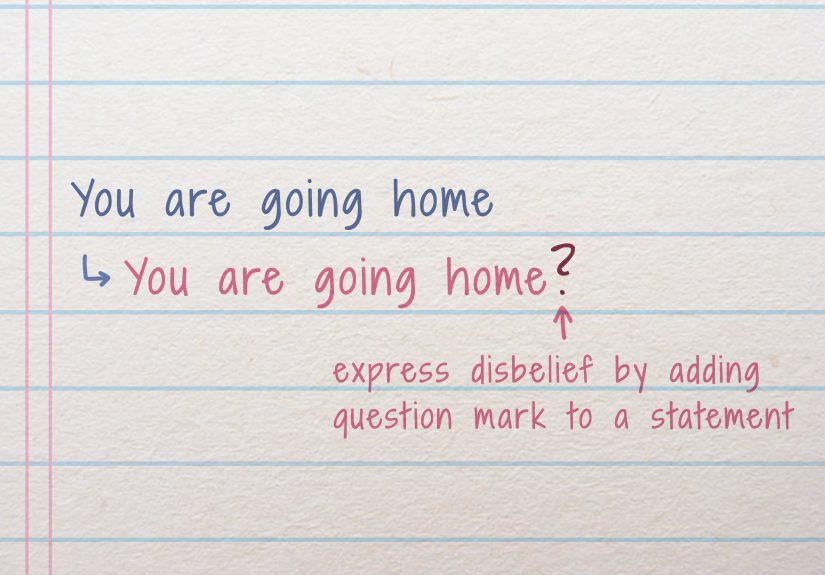
In casual speech, Americans sometimes turn a statement into a question just by using rising intonation:
“You’re coming?” “We’re good?” “That’s your final answer?”
It’s common in conversation, but it can be ambiguous in formal writingso use it intentionally.
Common pitfalls when you convert a statement to a question
- Double-auxiliary syndrome: Don’t stack helpers (“Do are you…”).
- Wrong verb form after do/does/did: Use the base verb (“Does he like…?” not “likes”).
- Mixing up WH subject vs. WH object: “Who called?” vs. “Who did you call?”
- Punctuation slips: Direct questions take a question mark; many indirect questions don’t.
Conclusion
If you remember just one idea, make it this: English questions are built around the “operator” at the frontan auxiliary verb, a modal, or
do/does/did when no auxiliary is available. From there, you can choose your style:
straight yes/no questions, information questions with WH-words, friendly tag questions, or indirect questions that feel more polite.
The best part? Once you can switch statements into questions smoothly, your writing gets clearer, your conversation gets easier,
and your emails stop sounding like they were written by a passive-aggressive toaster.
Real-world experiences: what practicing these 5 ways looks like (and why it sticks)
The fastest way to get comfortable changing statements into questions is to practice in situations where you actually need questionsnot in a vacuum, but
in real communication. In classrooms, workplaces, and everyday conversations, people tend to reuse the same question patterns over and over. Once you notice
that, question formation stops being “grammar homework” and starts feeling like a tool you can reach for automatically.
One common experience is the “meeting moment.” Someone says, “We need to finalize this today,” and what you really want is clarity without sounding confrontational.
If you’ve practiced inversion and do-support, you can respond with a clean question that matches the tense:
“Do we need to finalize it today, or can it wait until tomorrow?” That one sentence does three jobs: it confirms the timeline, invites options,
and keeps the tone professional. Indirect questions show up here tooespecially when you’re asking someone with more authority:
“Could you clarify whether we’re finalizing today?” It lands softer, but it still gets the point.
Another real-life pattern happens when people write emails. Statements can sound like commands even when you don’t mean them to.
“You sent the attachment” reads like an accusation; “Did you send the attachment?” is neutral; and
“Could you let me know if you sent the attachment?” is polite and calm. After you’ve rewritten a few email lines this way, you start to feel
the difference in tone immediately. It’s like discovering that punctuation has emotional impact (because it does).
Then there’s the “customer service voice,” which basically runs on indirect questions and tag questions. When you’re trying to help someone without blaming them,
you’ll hear questions like: “Do you know what error message you’re seeing?” or “You tried restarting it already, didn’t you?”
Tag questions are especially useful when you believe something is true but want confirmation without forcing the other person into a defensive answer.
Used well, they feel collaborative. Used poorly, they can feel sarcasticso tone matters more than people think.
In casual conversation, the fastest growth usually comes from listening for patterns: “You’re serious?” “We’re still on for tonight?”
“That’s the new policy?” These “statement-shaped questions” are everywhere in American English, and once you start hearing them, you can practice them naturally.
The key is knowing when to switch to a more formal structureespecially in writing. A text message can survive “You’re coming?” but a business proposal usually can’t.
Finally, practicing WH-questions tends to reveal the biggest “aha” moment: sometimes you don’t need do/does/did at all.
People regularly trip over “Who did call you?” when the correct subject question is “Who called you?”
Once you’ve corrected that a few times in real speechasking about who said what, who emailed whom, who broke the printer (again)it starts to stick.
You don’t memorize rules; you build instinct.
If you want a simple practice routine, try this: take five statements from your day (a headline, a Slack message, a reminder, anything) and convert each into
all five question styles. It takes five minutes, and it trains flexibility. Soon you’ll be able to choose the best question form for the moment
direct, detailed, polite, or just “I’m 90% sure, but confirm it for my peace of mind.”