Table of Contents >> Show >> Hide
- Why street art is the perfect way to tell uncomfortable truths
- From cute pandas to climate panic: what these 64 street art pieces are really about
- Iconic “uncomfortable truth” street art examples
- How cities are turning into outdoor truth galleries
- How to read street art without missing the point
- What it’s like to encounter uncomfortable street art in person
Walk through almost any big city today and you’ll find that the sharpest political commentary
doesn’t always live in newspapers or think pieces – it’s sprayed across brick walls, tucked
under highway overpasses, and wrapped around the corners of abandoned factories. These
powerful street art pieces don’t just “look cool.” They shout about climate change, call out
systemic racism, drag consumerism, and poke holes in the stories we tell ourselves to feel
comfortable.
The viral spirit behind “64 Powerful Street Art Pieces That Tell The Uncomfortable Truth”
is exactly that: a visual mixtape of murals and graffiti that refuse to be polite. Drawing on
examples from cities around the world – and on coverage from outlets like Bored Panda,
DeMilked, and other design and culture sites that have been cataloguing environmental and
political graffiti for years – this kind of gallery shows how paint,
paste-ups, and stencils can do the work of a thousand opinion columns.
Why street art is the perfect way to tell uncomfortable truths
Street art sits in a strange but powerful place between protest, design, vandalism, and
storytelling. It’s free, it’s public, and you can’t “opt out” of seeing it by closing a browser
tab. Contemporary art scholars have argued that public art is a lifeline, especially when it
highlights climate justice, racial inequality, and economic exploitation .
When an artist bombs a wall with a polar bear on a melting ice cube or a migrant family
pressed against a barbed-wire border, they’re essentially hijacking the city’s attention.
Political street art, in particular, leans into intersectionality – showing how gender, race,
class, and the environment are tangled together . A single mural might connect fossil
fuels to war, or food waste to poverty, or police violence to housing injustice. That’s why
so many of the “uncomfortable truth” pieces feel dense: every symbol is doing double or
triple duty.
Humor is often part of the strategy, too. Banksy is the most famous example – his
darkly funny rats, riot police, and balloon girls soften your defenses just long enough for
the message to slip in . You chuckle, then you realize the joke is on all of us.
From cute pandas to climate panic: what these 64 street art pieces are really about
If you scroll through a Bored Panda–style street art roundup, you’ll notice a few recurring
themes. They’re not random; they’re the big pressure points of our era.
1. Climate change, drawn in bright colors
Environmental street art has become its own global language. Some pieces take the subtle
route: a penguin made of plastic bottles, or a tree that’s half vibrant leaves, half blackened
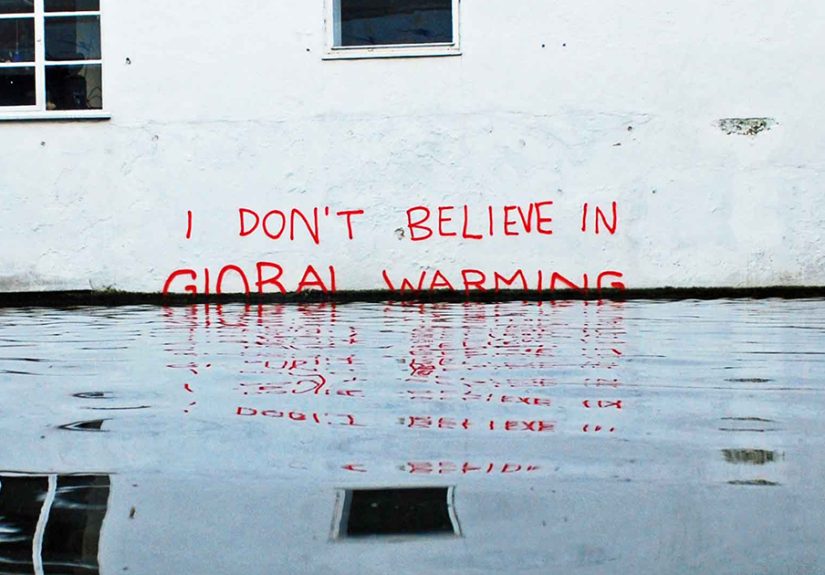
skeleton. Others are brutally direct. One famous Banksy work reads “I DON’T BELIEVE IN
GLOBAL WARMING,” with the text half submerged in water, so that the denial itself is
literally sinking .
Other murals show the planet going “down the drain” or forests swallowed by industrial
smoke, turning overflowing drains and cracked walls into part of the composition . Their
power lies in the fact that they’re not tucked away in galleries – they’re painted in working
neighborhoods, near schools, under freeways. If you didn’t come to the climate crisis, the
climate crisis came to you.
Organized campaigns have embraced this power. Street Art for Mankind, for instance,
has partnered with the United Nations and cities like Houston to create huge murals tied
to ecosystem restoration, child protection, and the Sustainable Development Goals .
These walls aren’t just backdrops for selfies; they’re meant as daily reminders that the
clock is ticking.
2. Inequality written across the walls
Another cluster of “uncomfortable” pieces targets inequality. Many murals highlight the
gap between shiny, advertised lifestyles and the realities of poverty, racism, and migration.
Contemporary political art often depicts overlapping struggles – from racial injustice to
economic exploitation – as parts of the same system .
You’ll see businessmen with credit cards for heads, families balancing on the edge of a
collapsing house, or children trying to study under streetlights because their homes don’t
have electricity. These images echo the real conversations happening in the art world about
who gets paid, who gets collected, and whose stories are erased .
Youth organizations in U.S. cities, such as community art programs in the Bronx, have
used murals to address “climate justice” – specifically, how pollution and lack of green
space hit low-income communities hardest . Those pieces talk about asthma, highways,
food deserts, and heat islands without needing a single word of text.
3. War, borders, and the violence we try not to see
Street art also goes where foreign policy press conferences can’t. Banksy’s famous work
on the West Bank barrier wall, for instance, imagines children digging through concrete
to reach blue skies or idyllic beaches on the other side . It’s a visual gut punch: you
don’t need to read a think tank report to understand the longing for freedom and the
cruelty of separation.
Anti-war murals in Europe and North America echo the same themes – soldiers with
flowers instead of guns, doves wearing bulletproof vests, or drones painted to look like
consumer products. These images call out the way conflict, profit, and everyday life are
woven together, and they do it in alleys where people actually live, not just in curated
museum halls.
Iconic “uncomfortable truth” street art examples
A full list of 64 specific works would read like a world tour, but a few standout categories
show how different artists approach the same hard questions.
Climate murals that refuse to let us look away
In cities like Glasgow, murals created around major climate summits show lush ecosystems
melting into scenes of flood and fire, with slogans like “OUR CLIMATE IS CHANGING”
arched across railway arches and canal walls . Young people have been at the center of
many of these campaigns; competitions run by universities and climate institutes have
invited children and students to design murals envisioning greener futures, later scaled up
by professional artists .
In the U.S., Houston has embraced large-scale public art tied to ecosystem restoration,
with walls featuring native species, threatened wetlands, and clean energy imagery. These
pieces are explicitly meant to “trigger action” on environmental protection, not just
beautify a district .
Banksy’s visual one-liners
Any discussion of street art and uncomfortable truths eventually circles back to Banksy.
Beyond “I Don’t Believe in Global Warming,” his portfolio includes children playing with
riot shields, protestors throwing bouquets instead of Molotov cocktails, and rats wielding
paint rollers and slogans. Critics have noted how his works blend humor with sharp
commentary on topics like surveillance, consumerism, and state violence .
Even when a new Banksy piece, like the recent lighthouse mural in Marseille, isn’t overtly
political, it still sparks big questions about hope, identity, and what we choose to see in
each other . That ambiguity is part of why his work travels so well: it invites
projection, then pulls the rug out from under you.
Three-dimensional protests
Street art isn’t limited to paint. French artist James Colomina, for example, installs vivid
red human figures in public spaces – including a sculpture of a person floating face down
in an Amsterdam canal holding a flag that reads “I’m fine,” and a child painting a higher
waterline on a wall . The message is painfully clear: we’re pretending everything is okay
while the water quite literally rises around us.
These installations share DNA with murals about rising seas and burning forests. They
expose the disconnect between our “normal” routines and the emergency unfolding in the
background – which is exactly the kind of uncomfortable truth many people would rather
ignore.
How cities are turning into outdoor truth galleries
Once upon a time, city governments treated graffiti purely as a problem to be scrubbed
away. Today, many municipalities actively commission street art and murals – especially
when they’re tied to social issues, tourism, or neighborhood revitalization.
Downtown Houston is a good case study. Over the last decade, a coordinated effort by
local artists, nonprofits, and city agencies has transformed blank parking lot walls into
a dense cluster of murals . A campaign branded “Big Art. Bigger Change.” has helped
bring in artists whose work touches on justice, climate, and community resilience. The
result is part open-air gallery, part civic pep talk: visitors can literally walk from one
uncomfortable conversation to the next.
Similar initiatives, often linked to global efforts like the UN Decade on Ecosystem
Restoration, use murals as anchor points for education programs and walking tours. You
might see a bright, kid-designed mural about biodiversity and then scan a QR code to
learn more about local conservation work . In that sense, the 64 “powerful pieces”
you might scroll past online are also embedded in a much larger ecosystem of activism.
How to read street art without missing the point
You don’t need an art history degree to understand street art, but a few habits can help
you get more out of it – especially when it’s poking at difficult topics.
- Look at the whole scene, not just the wall. Is the mural facing a busy road, a school,
a luxury condo, or a factory? Often the location is part of the message, especially for
pieces about pollution, gentrification, or policing. - Pay attention to small details. Logos, barcodes, animal species, even brand colors are
often used as shorthand for bigger systems – fossil fuels, fast fashion, tech surveillance,
and so on. - Consider who gets represented – and who doesn’t. Many activist murals deliberately center
children, migrants, women, or Indigenous communities, pushing back against their
historical invisibility in mainstream media . - Notice your own reaction. Discomfort, guilt, anger, or defensiveness are signals that the
piece hit a nerve. Street art isn’t trying to make everyone happy; it’s trying to make
everyone think.
When you bring that kind of curiosity to a collection of dozens of murals – whether in
real life or in a Bored Panda gallery – you start to see patterns. The “uncomfortable
truth” isn’t just that climate change is real or inequality is bad. It’s that our everyday
choices, our cities, and our comfort are wrapped up in those crises.
What it’s like to encounter uncomfortable street art in person
Reading about powerful street art online is one thing. Standing in front of it is another
experience entirely. People often describe the first time they stumble onto a big, gut-level
mural as a kind of emotional ambush: they’re on the way to work, coffee in one hand,
phone in the other, when a wall suddenly demands they think about melting ice caps or
migrant children.
Imagine turning a corner in a warehouse district and finding a five-story-tall figure
holding a drowning city in a glass of water. Up close, you can see the brushstrokes and
drips, the way the artist used the building’s windows as part of the image, the small
handwritten dedication at the bottom to communities already losing their homes to
floods. That scale matters. It’s hard to shrug off the climate crisis when it towers over
you like that.
The audio track of the city becomes part of the artwork, too. You might hear buses
hissing by, kids leaving school, a delivery truck idling under a “CLIMATE JUSTICE NOW”
slogan. On a hot day, a mural about rising temperatures doesn’t feel theoretical; the
sidewalk is literally radiating heat back at you. That physical context turns abstract
issues into something your body understands immediately.
In many neighborhoods, these murals become informal gathering spots. People stop to
take photos, argue about the message, or explain the imagery to their kids. Street art
organizations in cities like Houston, New York, and Los Angeles often build on this by
organizing walking tours or community paint days where residents can meet the artists,
hear the stories behind the walls, and even help fill in sections of color .
Suddenly the piece isn’t just something done “to” the neighborhood; it’s something
the neighborhood owns.
Of course, that doesn’t mean everyone loves what the mural says. Uncomfortable truth
is… well, uncomfortable. A piece criticizing police brutality, for example, might get tagged
over or spark heated debates at local council meetings. An anti-consumerism stencil
painted near a luxury shopping district might mysteriously disappear overnight. These
conflicts are part of the life cycle of street art. The wall becomes a battleground of
ideas, and the layers of paint start to record that history.
For many viewers, the most powerful experiences are personal and quiet. Someone who
grew up breathing polluted air in a fenced-in neighborhood might feel seen for the first
time by a mural about asthma and highways. A person who has lost a family member to
war might stop in front of an anti-war stencil and feel less alone. A teenager who has
never thought of themselves as “an environmentalist” might look up at a mural of young
people defending a forest and suddenly imagine a different future for their own life.
When you stack 64 of these experiences together – whether in a single city or in a
global online gallery – you start to see why street art matters. It’s not just background
decoration or Instagram fodder. It’s a messy, colorful, sometimes funny, sometimes
heartbreaking way of telling the truth in public, where everyone has to walk past it.
That’s the real power behind “64 Powerful Street Art Pieces That Tell The Uncomfortable
Truth”: they remind us that the streets themselves are talking. The only question is
whether we’re willing to listen.