Table of Contents >> Show >> Hide
- From Medieval Pot to Holiday Showstopper
- How Christmas Pudding Became “British”
- Victorians, Dickens, and the Invention of Tradition
- The Imperial Dessert, Officially
- After Empire: Why Christmas Pudding Still Matters
- Experiences Related to Christmas Pudding: What the Dessert Feels Like Up Close
- Conclusion
- SEO Tags
If there were ever a dessert that arrived at the table wearing a fur coat, a crown, and a slightly smug expression, it would be Christmas pudding. Dark, dense, boozy, and dramatically set on fire, it has long been presented as the ultimate British holiday finale. But that image is only half the story. Christmas pudding may look like the most traditional thing in the room, yet its history is gloriously messy. It began as something closer to survival food than celebration food, turned into a Victorian star through literature and ritual, and eventually became a culinary symbol of Britain’s imperial reach.
In other words, this is not just a dessert story. It is a story about trade, class, religion, monarchy, labor, colonial power, and the curious national habit of turning a cannonball of dried fruit into a beloved Christmas icon. And yes, it is also a story about a dish called plum pudding that usually contains no plums. British food history does enjoy a prank.
From Medieval Pot to Holiday Showstopper
Before it was dessert, it was practicality
The earliest ancestors of Christmas pudding were not the sweet, glossy rounds we know today. They were closer to pottage: thick, savory-sweet mixtures of meat, grains, dried fruit, spices, and broth. In medieval England, cooks were less interested in dessert as a separate course than in making food that lasted, filled stomachs, and survived winter. Meat, fat, dried fruit, and spice were useful ingredients because they preserved well and packed in calories. Nobody was calling it cozy content. It was simply dinner doing its job.
Early versions of plum pottage and figgy mixtures often included beef or mutton along with dried fruits and wine. Over time, these mixtures became firmer. Some were stuffed into animal casings or stomach linings, which helps explain why the word “pudding” once had stronger ties to sausage than to anything soft and spoonable. That older culinary logic still lingers in Britain, where “pudding” can mean dessert in general, while certain puddings remain firmly savory.
Why plum pudding has no plums
The name confuses modern readers because the word plum did not always mean the fresh purple fruit sitting in today’s produce aisle. In older British usage, “plum” could refer broadly to dried fruits such as raisins, currants, and prunes. So a plum pudding was not a plum-forward dessert in the modern sense; it was a dried-fruit pudding. The same goes for figgy pudding, which may or may not have included figs depending on the recipe, the era, and whether the cook was feeling strict or merely festive.
By the 16th and 17th centuries, the dish had become sweeter and less meaty. As sugar, spice, and alcohol became more available, the pudding shifted from savory winter fuel toward celebratory indulgence. That transformation matters. It tells us that Christmas pudding was not born as a timeless national treasure. It was shaped by changing access to ingredients, expanding trade networks, and the slow democratization of foods that had once been luxuries.
How Christmas Pudding Became “British”
Religion, monarchy, and a little political drama
By the 17th century, plum pudding had become strongly associated with Christmas. That was enough to get it caught in one of England’s favorite hobbies: culture war. Puritan leader Oliver Cromwell and his allies objected to Christmas revelry, and festive customs, including plum pudding, were suppressed as overly indulgent and suspiciously un-Puritan. When the monarchy was restored in 1660, Christmas customs came roaring back, and the pudding returned with them. One dessert, one regime change. Not every dish can claim that kind of résumé.
In the 18th century, plum pudding grew in prestige. George I was even nicknamed the “pudding king” after reports that he requested it for a royal Christmas banquet. Whether that title was affectionate, mocking, or both, it shows how visibly the pudding had entered public life. It was no longer just a household preparation. It was becoming part of the symbolic language of British celebration.
The empire enters the pudding basin
Here is where the story gets richer, darker, and far more revealing. Christmas pudding became “national” partly because so many of its hallmark ingredients arrived from beyond Britain. Raisins and currants, citrus peel, cinnamon, cloves, nutmeg, sugar, and spirits all depended on long-distance commerce. Some came from regions beyond the empire; many arrived through imperial trade and colonial systems. By the 18th and 19th centuries, a pudding on a British table often represented a whole geography of extraction and exchange.
Sugar is especially important. As cane sugar became cheaper and more widely available in Britain, puddings became sweeter, richer, and more accessible to a broader public. But that affordability did not appear by holiday magic. It was entangled with plantation economies and the labor of enslaved people in the Caribbean. So when we call Christmas pudding an imperial dessert, we are not just being clever. The sweetness itself was part of empire’s material history.
That is the paradox at the heart of the dish. It was performed as comfortingly British, even homey, yet it depended on imported ingredients and global systems of power. The pudding sat in the center of the table like a patriotic paperweight while quietly containing a map of trade routes, colonial agriculture, and unequal labor relations. Britain did not simply make the pudding. Britain assembled it from the world.
Victorians, Dickens, and the Invention of Tradition
The pudding becomes a star
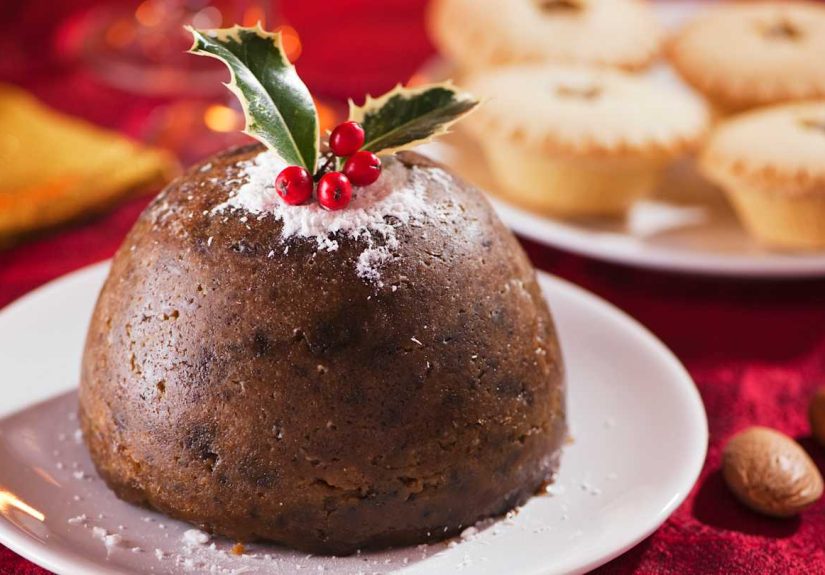
If medieval cooks built the foundation and imperial trade stocked the pantry, the Victorians supplied the spotlight. The 19th century transformed Christmas pudding from an old dish into a holiday icon. Charles Dickens helped enormously. In A Christmas Carol, Mrs. Cratchit brings in the pudding “like a speckled cannonball,” blazing with brandy and crowned with holly. It is one of the great food entrances in literature. Dickens did not invent Christmas pudding, but he gave it cinematic glow long before cinema got involved.
Victorian culture loved rituals, symbols, and domestic pageantry, and the pudding was perfect for all three. It could be made weeks in advance, aged for flavor, steamed for hours, and then presented with maximum ceremony. A holly sprig on top made it instantly seasonal. Flaming brandy made it theatrical. Coins tucked into the mixture turned dessert into a game. Suddenly the pudding was not just something you ate. It was something you anticipated, discussed, stirred, wished over, and dramatically carried into the dining room while trying not to set the curtains on fire.
Stir-Up Sunday and the family performance
The ritual of making Christmas pudding also gained emotional weight in the Victorian period and beyond. Stir-Up Sunday, observed weeks before Christmas, became the traditional day for mixing the pudding. Family members were invited to take turns stirring the batter and making a wish. Some households favored 13 ingredients to symbolize Jesus and the 12 apostles. Others insisted on stirring east to west to honor the journey of the Magi. Whether strictly religious, vaguely superstitious, or mostly just an excuse to involve the children, these customs helped transform a recipe into a family ceremony.
And it was labor-intensive. Victorian puddings did not come from a cheerful plastic tub. Raisins had to be prepared, suet chopped, crumbs made, sugar grated, spices measured, and cloths tied. This was a dessert built on work, patience, and planning. Its long preparation time helped make it feel important. The wait itself became part of the flavor.
The Imperial Dessert, Officially
When the pudding became propaganda
By the early 20th century, Christmas pudding had become more than tradition. It became messaging. After World War I, imperial advocates looked for ways to sell the British Empire to consumers as a cooperative economic family rather than a purely political structure. Christmas pudding was perfect for the job: beloved, recognizable, richly symbolic, and already made from ingredients associated with far-flung territories.
In the 1920s, campaigns promoted “Empire Pudding” or “Empire Christmas Pudding” made from ingredients sourced across Britain’s imperial world. The idea was deliciously strategic. Instead of French brandy, use rum from Jamaica or brandy from imperial sources. Use dried fruit from Australia or South Africa, spices from India or Ceylon, butter from New Zealand, wheat from Canada. The message was clear: the empire feeds the nation, and the nation should buy from the empire.
The most striking version came when King George V’s Christmas pudding recipe was promoted with ingredients sourced from across the empire. Scholars have described this as an effort to present empire as a peaceful commercial civilization, gathered harmoniously into a single bowl under royal blessing. It was marketing, monarchy, and geopolitics disguised as dessert. The pudding was no longer merely a food. It was a soft-power fruit grenade.
A symbol with a shadow
That imperial symbolism matters because it reveals how food can naturalize power. Christmas pudding seemed cozy, familiar, and festive, which made it an ideal vehicle for turning empire into something domestic and emotionally appealing. The empire was not shown as conquest or extraction. It was shown as raisins, spice, citrus peel, and holiday warmth. One could almost forget the violence behind the supply chain while admiring the brandy flames.
That does not mean families who made pudding were performing ideology at the mixing bowl. Most were simply making what they knew, wanted, or could afford. But the broader cultural framing of the dish absolutely shifted. Christmas pudding became one of the ways Britain imagined its global reach as normal, nourishing, and even sentimental.
After Empire: Why Christmas Pudding Still Matters
Decolonization did not end the pudding’s story. It continued to travel, adapt, and survive in places shaped by British rule. In the Caribbean, the British steamed pudding tradition evolved into black cake, a richer, darker holiday staple infused with rum, molasses, and local variations. In other former colonies and diaspora communities, Christmas pudding remained part heirloom, part adaptation, part argument with history.
Back in Britain, the pudding endured because it carried emotional weight far beyond its ingredients. People joke that half the country claims not to like it, and yet many still feel Christmas would look incomplete without it. That contradiction tells you everything. Christmas pudding is no longer just about flavor. It is about continuity, family ritual, literary memory, and the strange power of foods that feel older than the people eating them.
It is also a reminder that national dishes are rarely as native as they pretend to be. Christmas pudding may be one of Britain’s most iconic desserts, but it is also one of its most globally entangled. The dried fruit, the sugar, the spice, the spirits, the symbolism, the colonial afterlives: all of it turns a seemingly old-fashioned holiday dish into a compact history of Britain’s relationship with the wider world.
So yes, Christmas pudding is traditional. But it is not simple. It is what happens when medieval preservation techniques, royal endorsement, Victorian sentiment, imperial trade, colonial labor, and holiday theatrics all agree to share a plate. No wonder it needs brandy. That is a lot to process in one bite.
Experiences Related to Christmas Pudding: What the Dessert Feels Like Up Close
If you want to understand Christmas pudding beyond the history books, imagine the experience of meeting it in real life. Not on a recipe blog. Not as a photograph with perfect lighting and a tasteful dusting of powdered sugar. Actual Christmas pudding is sensory theater. It begins before Christmas, often weeks before, when a kitchen fills with the smell of currants, citrus peel, stout, rum, nutmeg, cinnamon, and suet. The mixture looks heavy and vaguely suspicious, like fruitcake got serious and joined Parliament. But then someone stirs it, another person sneaks a taste, and suddenly the whole thing stops looking odd and starts feeling ceremonial.
That is one of the most interesting experiences tied to the pudding: anticipation. This is not a dessert you usually whip up in a burst of chaotic optimism on December 24. It asks for planning. It asks for waiting. It asks you to trust that something dark, sticky, and not particularly glamorous will mellow into magnificence. Families who grew up with it often remember that waiting almost as vividly as the eating. The pudding sits in a cupboard like a tiny edible time capsule, and every few days someone checks on it with the seriousness of an archivist.
Then there is the moment of arrival. A proper Christmas pudding does not enter quietly. It is carried in with all the dignity of a visiting dignitary, often decorated with holly and sometimes set aflame with brandy. For a few seconds, dessert becomes a public event. People clap. Children stare. At least one adult gets nervous about nearby fabric. The room smells warm, sweet, and a little sharp from the alcohol. Even people who swear they do not like Christmas pudding tend to respect the entrance. It is hard to be casual about a flaming dessert.
The eating itself is another experience entirely. The texture is dense but tender, rich with chopped fruit and spice, sometimes softened by cream, custard, or brandy butter. One bite can feel deeply comforting or wildly overwhelming depending on your preferences and how generous the cook was with the booze. For some, it tastes like Christmas concentrated into a single spoonful. For others, it tastes like a raisin-based challenge from history. Both reactions are honest. Christmas pudding is not really trying to be universally lovable. It is trying to be memorable, and on that front it rarely fails.
Perhaps the most lasting experience, though, is emotional rather than culinary. Christmas pudding tends to gather stories. People remember who stirred it, who hid the coin, who always asked for an extra spoon of custard, who pretended to hate it but still took a slice every year. In families shaped by migration or colonial history, the pudding can carry even more layers: adaptation, resistance, inheritance, and reinvention. A Caribbean black cake, an Australian holiday variation, or a modern version with bourbon and cranberries can all feel connected to the old pudding while also pushing back against it. That is why the dessert endures. It is not static. It is portable memory in steamed form.
And maybe that is the most honest way to describe the experience of Christmas pudding. It is never just dessert. It is atmosphere, argument, nostalgia, performance, and history served warm.
Conclusion
Christmas pudding earned its place in British holiday mythology, but not because it sprang fully formed from some ancient, snow-dusted national tradition. It became iconic through change: from pottage to pudding, from meat to sweet, from feast food to family ritual, from domestic favorite to imperial symbol. The dish is delicious evidence that “traditional” foods are often built from movement, trade, adaptation, and power.
That is what makes Christmas pudding such a fascinating subject. It is both sentimental and political, local and global, comic and serious. It sits at the Christmas table like a harmless old relic, when in fact it contains centuries of history in every dark, sticky slice. Britain may call it a national dessert, but the pudding’s passport is crowded.