Table of Contents >> Show >> Hide
- What “GSM Base Station” Really Means (Minus the Telecom Acronyms Explosion)
- Why Software-Defined Radio Changes the Game
- The Core Components of an SDR-Based GSM Base Station
- How It Works End-to-End: A High-Level Walkthrough
- Engineering Realities: What Breaks First (and Why)
- Security, Ethics, and the Elephant in the Room
- Legal and Compliance in the United States (Yes, This Deserves Its Own Section)
- Where SDR-Based GSM Base Stations Shine
- A Smart Project Checklist (Conceptual, Not a Recipe)
- Real-World Experiences: What Builders Learn the Hard Way (500+ Words)
- Wrap-Up
- SEO Tags
Building a GSM base station used to mean “buy a rack of telecom gear, call your accountant, and then cry softly.”
Today, with a software-defined radio (SDR) and the right software stack, a surprisingly large chunk of
“cell tower behavior” can run on a normal computer. Your phone doesn’t care if the network is backed by a carrier-grade
cabinet or a lab benchif the radio looks legitimate and the protocol behaves, it’ll try to camp on it like it found free Wi-Fi.
This article explains what a GSM base station looks like when you build it with SDR, how the pieces fit together,
what engineering problems show up first (spoiler: clocks), and why the legal/compliance side in the U.S. deserves as much attention
as the code.
What “GSM Base Station” Really Means (Minus the Telecom Acronyms Explosion)
GSM is the classic 2G cellular standard. A “base station” in GSM-land is the radio side of the network that talks to phones over the air.
In traditional deployments, that radio node is only one part of a bigger system that also handles authentication, call routing, SMS,
mobility, and billing.
The classic GSM split
- Radio access (RAN): the part that transmits and receives signals to phones (the BTS side).
- Control and switching (core): the part that authenticates subscribers and routes voice/SMS/data (MSC/HLR/AuC, etc.).
In many SDR-based setups, you’ll see “collapsed” designs where multiple roles are bundled into one software suite for labs and testing.
That’s not because telecom engineers suddenly hate modularityit’s because carrying an entire carrier network into your spare bedroom
is frowned upon by both physics and common sense.
Why Software-Defined Radio Changes the Game
In an SDR, the “radio personality” lives in software. Instead of fixed-function hardware that only speaks one standard,
you use a flexible RF front end plus digital signal processing to generate and decode the waveforms. That means the same device can
support wildly different projectsFM demod today, GSM tomorrow, radar experiments on the weekendassuming you have enough bandwidth,
compute, and caffeine.
A GSM base station with SDR typically works like this: the SDR converts radio signals into IQ samples, software turns those samples into
bits, and a protocol stack turns those bits into “phone network behavior.” If everything lines uptiming, frequency accuracy, and protocol rules
your handset sees a network and tries to join.
The Core Components of an SDR-Based GSM Base Station
1) SDR hardware (the RF muscle)
Your SDR is the bridge between the messy analog world (RF) and the tidy digital world (samples). In practice, you pick hardware based on:
- Frequency coverage: can it tune where you’re allowed to operate?
- Bandwidth: enough for your channel needs plus comfortable margins.
- Clock quality: stability matters more than beginners expect.
- Interface: USB, Ethernet, or PCIe impacts latency and throughput.
- TX/RX chain: filtering, gain range, and spurious performance.
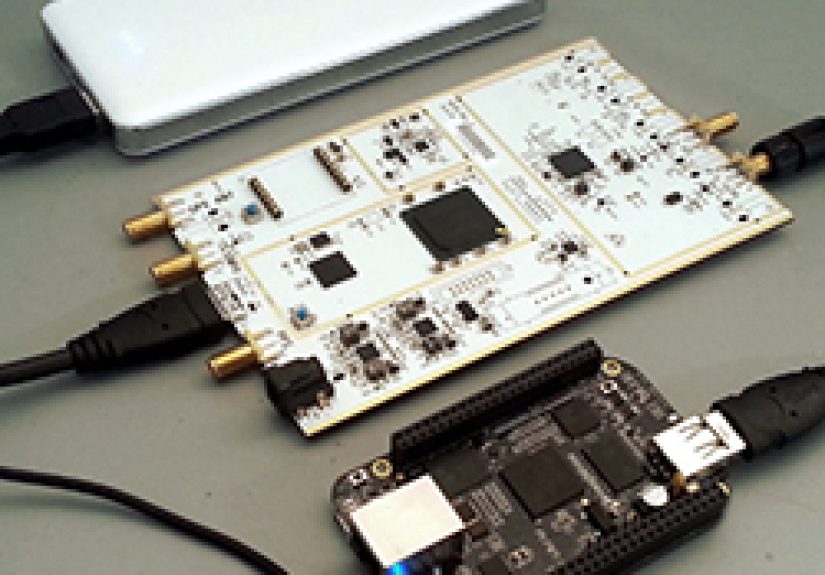
Hardware families like the USRP line are popular in research because they pair an RF front end with onboard FPGA resources and a mature driver ecosystem.
Some models are “bus-powered and convenient,” others are “networked and serious,” and a few are “this thing has more RF bandwidth than my attention span.”
2) Drivers and streaming (how samples move)
GSM is timing-sensitive, so the plumbing matters. A typical workflow uses a driver layer to control the SDR (center frequency, gains, sample rates),
stream IQ samples to the host, and optionally leverage FPGA capabilities. On USRP-style devices, the UHD driver family is a common bridge between the
hardware and higher-level frameworks.
Above that driver layer, many engineers use signal-processing frameworks such as GNU Radio for prototyping and instrumentationespecially when they need
to visualize spectra, validate filtering, or build custom blocks around the cellular stack.
3) The GSM stack (where “cellular behavior” lives)
The GSM protocol stack is the rulebook your phone expects. In SDR-based projects, you’ll typically encounter stacks that implement the lower GSM layers
and connect upward into a “core” function set.
One historically prominent example is OpenBTS, which implements the GSM air interface and, notably, can treat GSM handsets as SIP endpointsso calls and SMS can be bridged into VoIP-style infrastructure.
Other open-source approaches exist in the broader ecosystem, often using separate components for BTS, transceiver control, and core network services.
4) VoIP/PBX integration (optional, but often hilarious)
If your project routes voice via SIP, you’ll often pair the GSM stack with a PBX or SIP server. Tools like Asterisk show up frequently in lab networks
because they’re mature, flexible, and have been battle-tested in the “someone changed one config file and now nothing works” tradition.
The integration concept is simple: the GSM side provides “this handset identity is calling that handset identity,” and the SIP/PBX side decides how
to route the call. The reality is also simple: you will spend a day debugging a single mismatch in numbering format and learn new emotional dimensions.
How It Works End-to-End: A High-Level Walkthrough
Let’s keep this safely high-level and concept-focused. An SDR GSM base station typically goes through a chain like:
- Broadcast: the base station advertises a cell identity and system info so phones can discover it.
- Attach / registration: a phone requests to join; the network handles identity, policy, and (if used) authentication.
- Services: voice calls, SMS, and/or data sessions are established through the network logic.
- Mobility basics: signal measurements, paging, and channel assignment rules keep things usable as conditions change.
In traditional carrier networks, many of these functions are distributed across dedicated nodes. In an SDR lab setup, they may be collapsed into a single host
with software components talking over localhost. That’s convenient for experimentation, but it also means your CPU scheduler suddenly becomes part of your “radio design.”
Congratulationsyour operating system is now a member of the telecom team.
Engineering Realities: What Breaks First (and Why)
Clock stability and frequency accuracy
GSM is not forgiving when your frequency reference wanders. Phones expect carriers to be where they claim to be. If your SDR’s oscillator drifts,
you may see flaky registration, weird audio artifacts, or phones that “see” your cell but refuse to stay. This is why external references and disciplined clocks
show up in serious lab rigs. It’s not glamourit’s math.
RF hygiene: filtering, spurs, and “oops, I radiated that”
SDRs are flexible, but the analog world is stubborn. Harmonics, images, and spurious emissions don’t care about your beautifully commented code.
Proper filtering, sane gain staging, and thoughtful antenna setups are the difference between a clean lab experiment and a spectrum crime scene.
Latency, buffering, and the tyranny of real time
Streaming IQ samples requires consistent throughput. USB dropouts, overloaded CPUs, or mis-sized buffers can cause underflows/overflows that manifest as
RF glitches. GSM timing structures don’t politely pause while your laptop decides to index photos.
Capacity and expectations
A research-grade GSM base station is not a carrier macrocell. Even when everything is tuned correctly, you should think “testbed,” not “replace Verizon.”
Small-scale networks are fantastic for controlled experimentationprotocol research, feature testing, education, and niche deploymentsbut they’re not magic.
Security, Ethics, and the Elephant in the Room
GSM is famous for teaching the security community hard lessons: legacy ciphers, downgrade risks, and the real-world possibility of rogue base stations.
That history is exactly why SDR-based cellular testbeds are valuable for defensive research and training.
But it also means this topic attracts the wrong kind of curiosity. So here’s the responsible framing:
- Build for controlled environments: lab setups, shielded enclosures, and authorized frequencies.
- Test with your own devices and consent: never involve unsuspecting users.
- Focus on defense: measurement, detection, protocol hardening, and compliance testing.
If your goal is to learn, research, or validate systems safely, SDR-based GSM can be a powerful educational platform.
If your goal is to trick other people’s phones, that’s not “research”it’s a fast track to legal trouble and professional shame.
Legal and Compliance in the United States (Yes, This Deserves Its Own Section)
A GSM base station is a radio transmitter. In the U.S., transmitting is regulated. The short version is:
you generally can’t operate radio transmitters without proper authorization unless an explicit exception applies.
Why “Part 15” is not your get-out-of-jail-free card
FCC Part 15 governs certain low-power devices that can operate without an individual licensebut it’s a tightly defined regime with specific technical
requirements, and it does not magically cover “I built a cellular base station.” If you’re not operating under the rules for that part, the operation
must be licensed (or otherwise authorized).
Experimental authorization is the normal research path
For real over-the-air experimentation, the U.S. framework includes experimental licensing (commonly discussed under “Part 5” and related rules),
designed for experimentation in the radio art and certain research activities. If you’re doing legitimate R&D, this is the lane many organizations use.
The practical compliance mindset
- Assume you need authorization unless you are clearly inside an exception.
- Prevent harmful interference: shielding, attenuators, dummy loads, and controlled test spaces matter.
- Document everything: configuration, test plan, and RF measurements.
- When in doubt, talk to professionals: regulatory counsel and RF compliance experts exist for a reason.
In other words: if you can’t explain why your transmission is authorized, you probably shouldn’t be transmitting.
Where SDR-Based GSM Base Stations Shine
Education and training
Want to teach cellular concepts without buying a museum-grade BTS? SDR-based GSM lets students observe real signaling,
paging, attach procedures, and SMS/voice routing in a controlled environment. It’s a hands-on way to turn abstract diagrams into real packets.
Research testbeds
Cellular research often needs repeatability: same channel conditions, same network behavior, same traffic patterns. SDR makes it easier to build test scenarios,
instrument them, and iterate quicklyespecially when you need to capture measurements at multiple layers.
Niche private deployments (with the right approvals)
In certain legitimate casesremote sites, industrial facilities, emergency/temporary communicationsprivate cellular can make sense.
GSM specifically may be used for legacy devices or constrained applications, but modern private networks often gravitate to newer standards.
Still, the architectural lessons learned from GSM (timing, mobility, RF planning) transfer to later generations.
A Smart Project Checklist (Conceptual, Not a Recipe)
If you’re planning an SDR GSM base station project for lawful research or education, think in layers:
- Goal: What are you provingcoverage? protocol behavior? voice/SMS integration? RF performance?
- Authorization: What legal basis allows transmission, if any? What controls prevent interference?
- Hardware: Does the SDR meet frequency, bandwidth, and stability needs?
- RF chain: What filtering, attenuation, and antenna setup keep emissions clean and contained?
- Software stack: Which BTS/core approach fits your use case, and how will you monitor it?
- Observability: Logs, spectrum monitoring, packet tracing, and repeatable test cases.
Treat it like building a tiny network, not just “running a program.” Radios have a way of turning small assumptions into big problems
and then laughing quietly while you troubleshoot.
Real-World Experiences: What Builders Learn the Hard Way (500+ Words)
Here’s what people commonly report when they move from “I understand SDR in theory” to “my phone is staring at my network like it’s suspicious.”
Consider this a tour of the emotional terraintold with love, because everyone ends up here eventually.
The first time your phone “sees” your cell
There’s a special thrill the first time a handset displays your network name. It feels like you summoned a tiny telecom universe out of thin air.
Then you realize the phone sees your cell for three seconds, disappears, and reappears like it’s playing peekaboo. That’s usually the moment you learn
the difference between “broadcasting something” and “broadcasting it accurately enough for a commercial phone to trust it.”
Debugging: Is it RF, software, or your life choices?
SDR GSM troubleshooting often starts with the classic three-way blame triangle:
(1) RF chain issues (gain too hot, filtering too weak, frequency reference drifting),
(2) host performance (CPU spikes, I/O bottlenecks, buffer underruns),
or (3) protocol/config mismatches (the phone expects one thing, your stack does another).
The annoying part is that all three can produce the same symptom: “the phone refuses to cooperate.”
The fun part is that once you instrument properlyspectrum views, logs, and repeatable testsyou can usually isolate the problem quickly.
The unfun part is that “properly” is learned through at least one long evening.
Clock drama: the invisible villain
Many builders remember the day they finally stop treating the clock source as an afterthought.
On paper, “a few parts per million” doesn’t sound dramatic. In practice, small frequency errors can turn a stable cell into a flaky one.
The experience is almost comedic: you’ll tweak software parameters for hours, then swap or discipline the reference clock and suddenly the whole system
behaves like it just got a software update from the gods. This is also where people develop a healthy respect for terms like “holdover,” “GPSDO,”
and “phase noise,” and start saying things like, “I can’t tonight, I’m calibrating.”
The SIP/PBX rabbit hole
When you bridge GSM identities into SIP, the first basic tests often work: registration, an echo test, maybe a simple call route.
Then you add real dialing between devices and discover a delightful truth: telephony is a museum of formats.
Numbers get normalized, prefixed, rewritten, and occasionally mangled by a single missing rule.
People who love clean engineering sometimes meet their match hereand come out the other side with a deeper appreciation for dial plans,
call detail records, and why telecom folks look so calm in crises.
The “containment” mindset becomes real
Finally, there’s the practical experience of learning to treat RF like a substance you contain, not a vibe you emit.
Responsible builders talk about the moment they started thinking like: “How do I ensure this never escapes my test environment?”
That can mean working in shielded spaces, using attenuators and dummy loads during early bring-up, validating emissions on a spectrum analyzer,
and building habits that look boring but keep everyone safe. It’s not glamorous, but it’s professionaland it’s what separates legitimate experimentation
from reckless interference.
Taken together, these experiences are why SDR-based GSM is such a powerful learning tool: it forces you to blend RF engineering, real-time computing,
and telecom protocols into one coherent system. When it works, it’s deeply satisfying. When it doesn’t, it still teaches you more than a dozen slide decks.
Wrap-Up
A GSM base station with software-defined radio is equal parts radio engineering, software architecture, and disciplined experimentation.
The SDR makes the hardware flexible, the GSM stack makes phones understand you, and the real-world success comes down to timing, clean RF practices,
observability, and compliance.
If you approach it as a lawful, controlled testbeddesigned to learn, measure, and validateyou’ll get a compact platform that teaches you how cellular networks
really behave under the hood. And you’ll also gain a new appreciation for why carrier engineers deserve nice chairs.