Table of Contents >> Show >> Hide
- What “Shoulder Width” Actually Means (Because People Mean Different Things)
- Average Shoulder Width in the U.S. (Real Numbers, Not Vibes)
- Why Shoulder Width Varies So Much
- How to Measure Shoulder Width (3 Reliable Methods)
- Common Mistakes (That Make Your Number Weird)
- How to Use Your Shoulder Width in Real Life
- Quick FAQ
- Conclusion
- SEO Tags
Your shoulders are basically your body’s coat hangers. They hold up shirts, backpacks, suit jackets, andif we’re being honestyour confidence on Zoom calls.
So it makes sense to wonder: what’s an average shoulder width, and how do you measure yours without turning it into a full-contact sport with a tape measure?
In this guide, we’ll break down real U.S.-based measurement data (the kind engineers, health researchers, and clothing companies actually use),
explain the different “shoulder widths” people mean, and show you a few foolproof methods to measure your own.
You’ll also get practical tips for using your number to buy better-fitting clothesand avoid the classic “my shirt is doing that weird tent thing” situation.
What “Shoulder Width” Actually Means (Because People Mean Different Things)
If you’ve ever searched “shoulder width chart” and immediately regretted it, here’s why: shoulder width isn’t just one measurement.
There are at least three common definitions, and they’re not interchangeable.
1) Biacromial breadth (bone-to-bone)
This is the most “official” measurement in anthropometry (human body measurement). It’s the distance from the bony tip of one shoulder
to the bony tip of the otherspecifically, the acromion on each side. Think: “skeleton width,” not “gym pump width.”
2) Bideltoid / upper-arm breadth (muscle-to-muscle)
This is the widest point across the shoulders including soft tissuedeltoids, upper arms, and whatever else you’ve been feeding at lunch.
It’s often larger than biacromial breadth and matters for things like seat and workspace clearance.
3) Garment shoulder width (seam-to-seam)
Clothing brands often talk about “shoulder” as the distance between shoulder seams on a shirt or jacket.
This is useful for shopping, but it’s not the same as your body’s bone-to-bone width.
If you measure your body and compare it directly to garment specs without context, you may end up sizing like you’re dressing a different person.
Average Shoulder Width in the U.S. (Real Numbers, Not Vibes)
The most-cited U.S. population benchmarks come from large national surveys that measured people consistently using anatomical landmarks.
A widely used reference for adults is biacromial breadth.
Here’s a clear snapshot of typical U.S. adult shoulder width (biacromial breadth) for ages 20+.
Measurements are shown in both centimeters and inches (1 inch = 2.54 cm).
| Group (U.S. adults 20+) | Average (Mean) | Middle (Approx. 50th percentile) | Typical Range (5th–95th percentile) |
|---|---|---|---|
| Men | 41.1 cm (16.2 in) | 41.1 cm (16.2 in) | 37.3–45.0 cm (14.7–17.7 in) |
| Women | 36.7 cm (14.4 in) | 36.6 cm (14.4 in) | 33.4–40.3 cm (13.1–15.9 in) |
A couple of important notes before anyone starts side-eyeing their tape measure:
- “Average” is not “ideal.” Shoulder width varies naturally with height, body frame, sex, age, and genetics.
- These numbers are for biacromial breadthbone-to-bonenot shirt seam-to-seam.
- Distribution matters: plenty of people land outside the “typical range” and are perfectly normal humans.
Does shoulder width change with age?
In national data, average biacromial breadth tends to be slightly higher in early adulthood and a bit lower in older ages.
That doesn’t mean your bones are shrinking like a sad balloonit’s more about posture, spinal changes, and body composition shifts over time.
Why Shoulder Width Varies So Much
Two people can be the same height and still have very different shoulder widths. Here’s what usually drives the difference:
Frame and genetics
Some people are built like a doorway, some like a sleek sports car. Skeletal frame is heavily genetic, and that’s a big piece of shoulder breadth.
Height (but not perfectly)
Taller people often have broader shoulders on average, but there’s no “one ratio fits all.” That’s why good sizing systems use multiple measurements.
Muscle and soft tissue
If you’re measuring “across the delts,” training can make a noticeable difference. If you’re measuring biacromial breadth (bone landmarks),
training won’t move your acromionbut it can change how shirts fit across your upper back and sleeves.
Posture
Rounded shoulders and forward head posture can make you look narrower from the frontand can also mess with measurements if you’re hunched during the process.
The tape measure does not care about your desk job. It will report what you give it.
How to Measure Shoulder Width (3 Reliable Methods)
If you want the most accurate shoulder width measurement, grab a flexible tape measure andideallya friend who can follow directions.
If you’re going solo, don’t worry; we’ve got you.
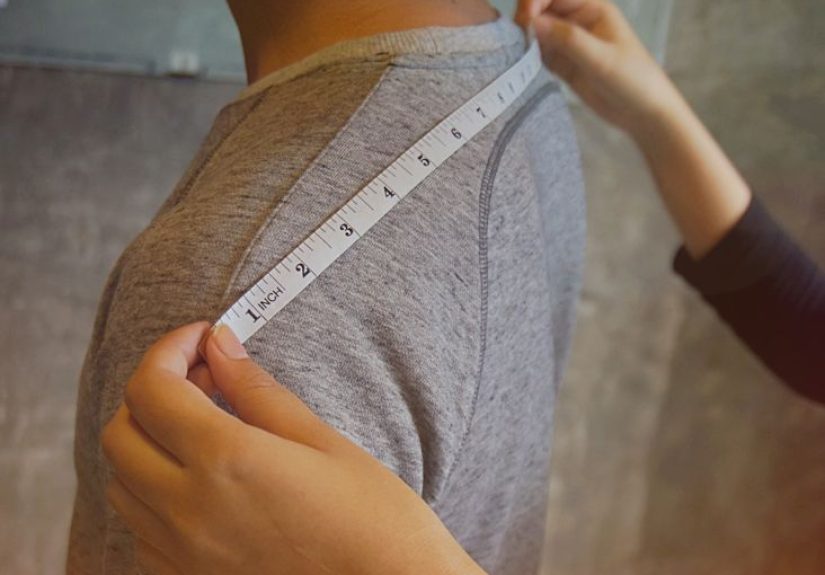
Method 1: Biacromial breadth (best for body measurement)
- Stand naturally with arms relaxed at your sides. No flexing. No “lat spread.” Just you.
- Find the acromion on each shoulder. It’s the bony point at the top/outer edge of your shoulder near where the collarbone meets the shoulder blade.
(If you press around gently, you’ll feel a firm “corner.” That’s your landmark.) - Have your helper measure straight across your back from one acromion to the other.
The tape should follow the natural slope of your shoulders, not droop across your shoulder blades. - Record the measurement to the nearest 1/8 inch or 0.5 cm.
- Repeat once and average the two results. If the numbers aren’t close, your helper may be measuring two different points.
Pro tip: If you’re not sure you found the right spot, shrug once, relax, then feel for the bony tip again.
The goal is consistent landmarks, not the absolute widest possible number.
Method 2: Shirt/jacket shoulder (best for shopping)
If your goal is better fit for shirts, jackets, or suits, measuring a garment you already love can be more useful than measuring your bones.
- Lay a well-fitting shirt or jacket flat on a table.
- Smooth it gently (don’t stretch it like you’re prepping dough).
- Measure from shoulder seam to shoulder seam across the backright where the sleeve meets the body.
That’s your garment shoulder width. - Use this number to compare with size charts or product specs labeled “shoulder” or “yoke.”
(Different brands label differently, so always read what they mean by “shoulder.”)
Method 3: Solo wall method (when you’re alone and determined)
- Stand with your back to a wall in a relaxed posture.
- Using small pieces of tape or sticky notes, mark the wall at the outer bony tips of your shoulders (you’ll need to feel the acromion).
- Step away and measure the distance between the two marks.
This method isn’t perfectlandmarking yourself is trickybut it’s surprisingly decent if you’re careful and repeat the measurement.
Common Mistakes (That Make Your Number Weird)
- Measuring around the shoulders like it’s a circumference. Shoulder width is across, not around.
- Measuring too low across the shoulder blades instead of at the bony tips.
- Measuring too high along the neck slope (that’s a different measurement).
- Shrugging or flexing. Your shoulders should be relaxed, not auditioning for an action movie poster.
- Comparing body width to garment width without understanding ease and construction.
How to Use Your Shoulder Width in Real Life
Clothing fit (shirts, suits, jackets)
If you remember one thing, make it this: shoulder fit is hard to alter.
Tailors can adjust waist and sleeve length more easily than they can rebuild shoulders. If shoulder seams hang off your shoulder, you’ll look sloppy.
If they sit too far in, you’ll feel restricted and the fabric can pull and wrinkle.
Backpacks and straps
People with broader shoulders often struggle with straps that sit too close to the neck, chafing or slipping.
Look for backpacks with adjustable sternum straps and wider strap spacing, and don’t ignore torso lengthshoulders don’t carry the whole story.
Workouts and expectations
You can build deltoids and upper back, improving the appearance of width and the classic shoulder-to-waist “V” shape,
but you can’t “train” your skeletal biacromial breadth. The good news: style, posture, and smart training can make a big difference in how your shoulders look and how clothes sit.
Quick FAQ
Is wingspan the same as shoulder width?
Nope. Wingspan includes arm length, which can vary wildly even among people with the same shoulder breadth.
What if my measurement is way different from the average shoulder width?
First, re-measure. If it’s still different, congratulations: you’re a normal human with a unique body.
Use the number for practical decisions (like clothing fit), not as a judgment score.
What’s the best measurement for online shopping?
For shirts and jackets, the garment seam-to-seam shoulder from a favorite item is often the most helpful.
For body comparisons and general reference, use biacromial breadth.
Conclusion
Average shoulder width is a useful reference point, but it’s not a rulebook.
For U.S. adults, bone-to-bone shoulder breadth (biacromial breadth) averages around 16.2 inches for men and 14.4 inches for women,
with plenty of natural variation.
The real win is measuring correctly and using the right “shoulder width” for your goal:
bone-to-bone for body reference, seam-to-seam for clothing fit, and muscle-to-muscle for space and gear considerations.
Once you know which number you need, shopping and sizing gets a lot less frustratingand your shoulders can go back to their main job: holding up your life.
Bonus: Real-World Shoulder Width Experiences (So You Don’t Learn the Hard Way)
If you’ve ever ordered a jacket online and felt like you accidentally bought armor, you’re not alone. Shoulder width is one of those measurements that
reveals itself dramaticallyusually five minutes before you’re supposed to leave the house.
One common experience: the “seam cliff” problem. A shirt can fit your chest and waist perfectly, but if the shoulder seams sit an inch past your
shoulder tips, the sleeves start drooping, the upper body looks boxy, and suddenly your arms appear to begin somewhere near your ribs. People often blame
“bad sizing,” but it’s usually a shoulder mismatch. The fix is simple: prioritize shoulder seam placement first, then tailor everything else if needed.
Then there’s the suit rental roulette. Rental sizing often leans on chest measurement and jacket length, and shoulder width can get treated like a side quest.
That’s why some people look sharp from the front but feel like they can’t reach for a door handle without the back panel fighting them. A quick shoulder check in the mirror
helps: the seam should end right at your shoulder tipno sagging, no pulling, no “accordion wrinkles” near the sleeve head.
Backpacks create their own shoulder stories. Folks with broader shoulders often notice straps rubbing the neck or sliding outward, especially with minimalist designs.
The experience usually goes like this: “This bag looks cool,” then “Why does it feel like it’s trying to garrote me?” then “Oh.”
Wider strap spacing, an adjustable sternum strap, and a well-fitted torso length usually solve itbecause comfort is a feature, not a personality trait.
Gym-goers meet shoulder width in a different way: the mirror math. Building delts and upper back can make you look wider (and help shirts drape better),
but it doesn’t change your bone landmarks. People sometimes measure across the deltoids one day, then measure bone-to-bone the next day and wonder why their “progress”
vanished overnight. The lesson: pick one measurement definition and stick to it. If you want a “visual width” metric, track a consistent muscle-based measurement.
If you want an anatomical reference, track biacromial breadth.
Finally, there’s the everyday posture surprise. Plenty of people measure narrower than expected because they’re slightly hunched from screens and steering wheels.
When they stand tallshoulders relaxed, chest openthe measurement often increases a bit and clothes suddenly sit better. It’s not magic. It’s alignment.
(Annoyingly, your mom was right about standing up straight.)
Bottom line: shoulder width becomes “real” the moment it affects comfort, fit, and movement. Measure it once, measure it correctly,
and you’ll save yourself a lot of returns, adjustments, and awkward sleeve angles in photos.