Table of Contents >> Show >> Hide
- From Nuclear Catastrophe to “What If We Reused This?”
- The First Modern Solar Project Near the Plant
- A New Solar Station Launched in the Exclusion Zone
- Yes, the War Changed the Chernobyl Conversation
- The Big Idea: “Brownfield Solar,” Chernobyl Edition
- How Much Power Could Chernobyl Solar Really Produce?
- What This Symbolism Actually Means (Without the Cheesy Poster)
- Conclusion: The Sunlight Isn’t Forgetting the PastIt’s Outworking It
- Experiences: What the “Solar Chernobyl” Story Feels Like Up Close (About )
Chernobyl used to be shorthand for “please don’t let that happen again.” For decades, the site was defined by what went wrong in 1986an explosion, a fire, and a radioactive legacy that forced entire cities to pack up and vanish overnight. But history has a strange habit of leaving behind usable infrastructure, even when the original purpose is gone. Today, Chernobyl is slowly collecting a new identity: not as a humming nuclear powerhouse, but as a place where clean electricity can be made safelythis time with sunlight.
That’s not a feel-good metaphor. Solar panels have been installed near the decommissioned plant, and newer projects have been launched inside the broader exclusion zone. The irony is real, but so is the logic. The area has transmission lines, substations, secured access, and large stretches of land that can’t be used for farming or housing. If you’re looking for a place to build renewable energy without competing with neighborhoods or cropland, Chernobyl is an unlikely candidate that starts to make a lot of sense.
From Nuclear Catastrophe to “What If We Reused This?”
First, a reality check: Chernobyl is not “back” as a nuclear plant. The reactors were shut down long ago, and the site is managed as a decommissioned facility with ongoing safety and monitoring needs. The infamous Reactor 4 remains under a massive protective structure (often called the New Safe Confinement), designed to keep radioactive material contained while cleanup and dismantling continue.
So where does solar come in? In the most practical way possible: the site already has grid connections and electrical infrastructure that once carried gigawatts. Even a modest solar installation can feed power into the grid and support on-site operationslighting, monitoring equipment, administrative buildingswhile helping Ukraine add domestic generation capacity.
Why build solar here at all?
- Grid access is already there. Transmission lines and substations exist because this was a major power hub.
- Land-use conflict is low. Much of the area isn’t suitable for housing or agriculture, so solar doesn’t displace communities or farmland.
- Solar construction can be “light-touch.” Projects can be designed to minimize soil disturbance, which matters in contaminated zones.
- Security and controlled access already exist. It’s a restricted area with established proceduresimportant for both safety and project logistics.
The First Modern Solar Project Near the Plant
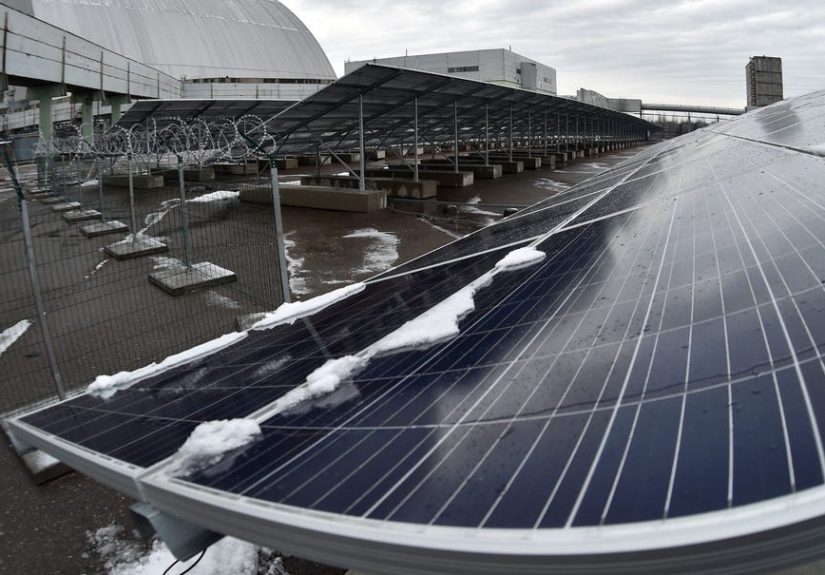
The headline-worthy turning point came when a solar facility was built close to the decommissioned nuclear plant complex. Early projects were small by utility-scale standardsthink “symbolic but functional,” not “powering half the country.” One widely reported pilot installation was around 1 megawatt, built near the plant’s core facilities and connected to the Ukrainian grid.
If 1 megawatt sounds tiny, that’s because it iscompared with what nuclear once produced here. But it’s also enough to be real. At that scale, you can power essential operations and contribute meaningful electricity locally. More importantly, the project demonstrated that solar can be deployed in the exclusion zone under strict safety controls, using engineering choices that limit exposure and reduce environmental disruption.
What makes solar engineering different in a restricted zone?
Building anything near contaminated land requires a “leave it alone as much as possible” mindset. Solar helps because it can be installed with:
- Minimal excavation (depending on design, foundations can avoid deep digging).
- Clearly defined work windows with radiation monitoring and controlled site access.
- Maintenance patterns that are predictable and relatively low-frequency compared with many industrial facilities.
None of this means “no risk.” It means risks are managed through planning, monitoring, and strict protocolsjust like the rest of the work that happens in and around the Chernobyl site today.
A New Solar Station Launched in the Exclusion Zone
The story didn’t stop with one pilot project. In April 2025, officials inaugurated another solar power station in the Chornobyl (Chernobyl) exclusion zonereported at roughly 0.8 megawatts. On paper, that’s still small. In context, it’s a sign of persistence: Ukraine continuing to add generation where it can, even while its energy infrastructure faces extraordinary pressure.
This newer project is also a reminder that “clean energy” isn’t just about climate goals. It’s about resilience. Solar projects can be modular, repairable, and built in phases. And the exclusion zone, ironically, offers space and existing grid pathways that can support additional renewable buildoutif conditions allow.
Why “small” projects matter right now
- They’re faster to deploy. Smaller stations can move from planning to operation more quickly.
- They can support critical site needs. The decommissioned plant still requires power for monitoring and safety systems.
- They create a blueprint. Every completed project clarifies what’s feasible, what’s expensive, and what’s risky.
Yes, the War Changed the Chernobyl Conversation
Any discussion of Chernobyl in the 2020s has to include security. The site’s safety depends on stable power, monitoring equipment, trained staff, and the integrity of protective structures. Reports in 2025 highlighted damage to the New Safe Confinement after a drone strike and the urgency of repair and restoration work. Even when radiation readings remain stable, damage to containment infrastructure is not something you file under “fine, probably.”
So does it still make sense to invest in solar there? It canbecause the logic of reuse (existing grid, available land, controlled access) remains. But the risk calculus is real, and it’s not just about engineering. It’s about geopolitics, site security, and long-term maintenance under uncertain conditions.
The Big Idea: “Brownfield Solar,” Chernobyl Edition
In the United States, there’s a well-established concept that helps explain why solar at Chernobyl isn’t as bizarre as it sounds: building renewable energy on contaminated or previously industrial land instead of pristine open space. Think landfills, former mines, and cleaned-up industrial propertiesplaces with limited alternative uses but good potential for energy generation.
U.S. agencies have encouraged this kind of development for years because it can reduce conflicts over land use while turning “problem sites” into productive assets. The Chernobyl exclusion zone is an extreme case, but the underlying principle is familiar: if the land is already restricted, and the grid is nearby, renewable energy can be a smart form of reuse.
What “brownfield-style” thinking gets right
- It protects higher-value land. You’re not paving over farmland or wildlife habitat to chase sunlight.
- It can leverage existing infrastructure. Roads, substations, and transmission lines already exist.
- It can be politically and socially easier. Fewer neighbors means fewer conflicts (though Chernobyl has its own sensitivities).
How Much Power Could Chernobyl Solar Really Produce?
Let’s separate what exists from what’s imagined. What exists (publicly reported) has been in the megawatt to sub-megawatt range for specific stationsreal, grid-connected, but not enormous. What’s imagined has ranged much bigger in various proposals over the years: tens, hundreds, even thousands of megawatts across parts of the broader exclusion zone.
Technically, large-scale solar is possible in northern Ukraine if you have:
- enough suitable land areas that won’t be disturbed dangerously,
- financing and insurance structures investors can live with,
- grid upgrades where needed, and
- stable conditions for long-term operations.
The constraint isn’t sunlight. It’s everything else: safety rules, long-term security, construction logistics, and the reality that utility-scale solar is a business that wants predictability. Chernobyl offers unique advantages, but it also comes with a risk profile that makes investors reach for the antacids.
What This Symbolism Actually Means (Without the Cheesy Poster)
Solar at Chernobyl is powerful as a symbol because it flips the script. The site that once represented the terrifying side of energy now hosts technology associated with cleaner power and a lower operational risk footprint. But the symbolism only matters because the project is practical: it makes electricity, uses existing infrastructure, and supports a country that has strong reasons to diversify and harden its energy system.
The best way to read the story is not “Chernobyl is healed.” It’s “Chernobyl is being managedand parts of it can be repurposed.” That’s a different kind of hope: not a reset button, but a careful, engineered pivot.
Conclusion: The Sunlight Isn’t Forgetting the PastIt’s Outworking It
Chernobyl will always be a place where energy history took a brutal turn. But it’s also a place with roads, wires, substations, and a workforce that knows what high-stakes infrastructure looks like. Solar projects there won’t erase what happened in 1986, and they won’t magically solve Ukraine’s energy challenges. What they can do is prove a point: even the most infamous industrial landscapes can be repurposed for something safer, cleaner, and usefulif the work is done carefully, transparently, and with respect for the risks that still exist.
Experiences: What the “Solar Chernobyl” Story Feels Like Up Close (About )
If you’ve only seen Chernobyl through documentaries, the HBO miniseries buzz, or haunting photos of Pripyat’s empty apartments, it’s easy to imagine the whole zone as a frozen apocalypse set. The realitywhen access is permitted and conditions are safeis more procedural and oddly administrative. You don’t just “roll up to Chernobyl.” You enter through checkpoints. You follow routes. You’re told where to step and where not to. It’s less “urban exploration” and more “airport security, but the souvenir is existential dread.”
Visitors who toured the zone in the late 2010s and early 2020s often described the same emotional whiplash: nature reclaiming buildings while warning signs remind you the ground still carries history in its dust. A birch tree grows through a cracked stairwell. Moss climbs a wall. Somewhere nearby, a radiation monitor quietly does its job. And thenalmost comically modernrows of solar panels catch the sun like mirrors, clean geometry laid over a place defined by chaos.
The solar installations themselves don’t look “post-apocalyptic.” They look like solar: metal frames, angled modules, tidy cabling, inverters and electrical gear that could sit on any industrial site. That normality is the point. It’s not a monument; it’s infrastructure. And that contrast can hit harder than the ruins. You’re looking at a landscape that once produced enormous power at terrifying cost, and now it’s producing a much smaller amount of electricity in the most mundane way possiblesilently, patiently, photon by photon.
For workers, the experience is less cinematic and more technical. The zone is a workplace with rules. Time-on-site can be managed. Exposure is monitored. Tasks are planned to reduce unnecessary contact with contaminated materials. In that context, solar has a certain “good coworker” vibe: it doesn’t demand constant fuel deliveries, it doesn’t create combustion exhaust, and it doesn’t require deep digging every time you expand a system. You install, you connect, you monitor, you maintain. You let the sun do the heavy lifting.
And then there’s the psychological layer. Chernobyl is a reminder that energy systems have consequencesdesign choices, training, oversight, and politics can matter as much as engineering. Seeing solar there can feel like a quiet rebuttal to fatalism. Not because it’s perfect, and not because it makes everything okay, but because it shows a different relationship with power: one that is incremental, distributed, and easier to shut down safely if conditions deteriorate.
The most honest “experience” of Solar Chernobyl might be this: you don’t leave thinking the past is gone. You leave thinking the future can be built anywaycarefully, cautiously, and with better habits than before.