Table of Contents >> Show >> Hide
- Why Toilet Paper Rolls Work So Well for Spring Decor
- Quick Prep, Safety, and “Please Don’t Glue Your Sleeve to the Table” Tips
- The Signature Project: Paper Roll Spring Bloom Wreath
- Five More Spring Decor Ideas Using Toilet Paper Rolls
- How to Make It Look “Spring” (Not “Recycling Bin Chic”)
- Keeping Your Decor Looking Good All Season
- Experience Notes: What You’ll Learn After Your First Paper-Roll Spring Project (500+ Words)
- Wrap-Up: Your Spring Decor, Upcycled and Unbothered
Spring decor has two main vibes: “freshly bloomed and fabulous” and “why did I just spend $42 on faux tulips?” Today, we’re choosing a third option: cute, cheerful spring decorations made from toilet paper rolls (aka the cardboard tubes you were about to toss). With a little paint, a little glue, and a tiny bit of “trust the process,” those humble tubes can turn into wreaths, garlands, table accents, and wall art that look surprisingly boutique.
This guide gives you one signature project (a spring bloom wreath that always gets compliments) plus a handful of quick spin-offs for shelves, tables, and entryways. It’s friendly for beginners, adaptable for kids (with supervision for sharp tools and hot glue), and absolutely perfect for anyone who enjoys the thrill of turning “trash” into “Wait… you MADE that?”
Why Toilet Paper Rolls Work So Well for Spring Decor
Cardboard tubes are basically the craft world’s version of a blank canvasexcept you don’t feel guilty if you mess up, because you can just grab another roll. They’re lightweight, easy to cut into shapes, and they take paint, paper, and glue like they were born for it. Spring decor is also full of repeated shapespetals, leaves, honeycomb patternsso tubes shine because you can slice them into uniform rings and build dimensional designs fast.
Best of all
- Cost: Usually free (or close to it).
- Look: 3D texture that reads “artisan” more than “arts-and-crafts hour.”
- Eco points: Upcycling is a small, satisfying way to reduce waste.
Quick Prep, Safety, and “Please Don’t Glue Your Sleeve to the Table” Tips
1) Start with clean, dry tubes
If your rolls have been living their best life in a bathroom cabinet, relocate them to a clean bin before crafting. Use only dry, intact cardboard (no damp spots). If you want extra peace of mind, you can lightly wipe the outside with a barely damp cloth and let it dry completely before painting. Paper towel tubes also work and give you bigger petals and bolder shapes.
2) Choose your adhesive like you choose your friends: reliable under pressure
- Tacky craft glue: Great for paper-on-cardboard and slower, adjustable placement.
- Hot glue: Fast and strong for building 3D shapes (adult supervision recommended).
- Decoupage medium: Useful for sealing and finishing (especially if you collage with paper).
3) Basic tools that make everything easier
- Sharp scissors (and a craft knife + cutting mat for clean cuts, optional)
- Ruler and pencil (for consistent ring widths)
- Clothespins or binder clips (help hold glued petals while they set)
- Paintbrushes or sponge brushes
Safety note: If kids are helping, keep sharp blades and hot glue in grown-up hands. Let kids do the fun parts: painting, arranging, decorating, and naming the wreath like it’s a celebrity (“Bloomoncé,” anyone?).
The Signature Project: Paper Roll Spring Bloom Wreath
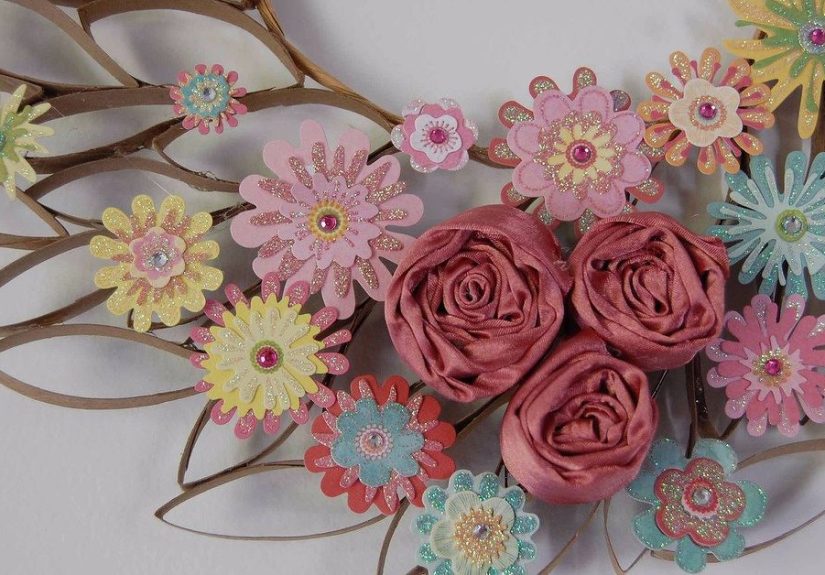
This is the “main character” craft: a dimensional floral wreath made from paper-roll petals. It looks fancy, it’s lightweight, and you can customize it for any spring themepastels, wildflowers, modern neutrals, cottagecore, you name it.
Materials
- 10–18 toilet paper rolls (more if you like a fuller wreath)
- Cardboard for the wreath base (shipping box cardboard works well)
- Acrylic craft paint (white + 2–4 spring colors)
- Glue (hot glue and/or tacky glue)
- Optional: decoupage medium, scrapbook paper, tissue paper, buttons, pom-poms, beads, ribbon
- Optional greenery: faux leaves, paper leaves, or felt leaves
Step 1: Make a sturdy wreath base
- Draw two circles on cardboard: one large outer circle and one smaller inner circle.
- Cut out the donut shape (this is your wreath form).
- If the cardboard is thin, glue two donut shapes together for extra strength.
Pro tip: A wider ring (about 2–3 inches thick) gives you more surface area for flowers and looks more balanced on a door.
Step 2: Cut paper-roll rings (the petal factory)
- Flatten a tube slightly (not a full pancakemore like “gentle handshake”).
- Measure and mark ring widths: ½ inch for small petals, ¾ inch for medium petals, 1 inch for bold petals.
- Cut rings and stack them by size.
Consistency matters. If you cut rings all over the place, your flowers may look less “spring bloom” and more “modern art in a windstorm.” Still cutejust a different category.
Step 3: Turn rings into petals
- Pinch each ring into an almond shape and crease it so it holds.
- Make a pile of petals before you start gluing (future you will be grateful).
Step 4: Build your flowers
Choose 2–3 flower styles so your wreath has variety without becoming chaotic.
Easy 5-petal bloom
- Arrange five petals in a circle.
- Glue petal tips together first, then reinforce at the base.
- Add a center: a pom-pom, button, bead cluster, or a tight spiral of paper.
Dahlia-style layered bloom
- Make one flower with larger petals (outer layer).
- Glue a smaller flower on top (inner layer).
- Finish with a contrasting center (gold bead, pearl button, or painted dot cluster).
Cherry blossom “airy” bloom
- Use slimmer ½-inch petals.
- Make 4-petal flowers and space them a bit more loosely.
- Use tiny centers (seed beads or small dots of paint).
Step 5: Paint (or wrap) for a polished finish
You have two great options:
- Painted look: Prime with a quick white coat first, then add your spring colors. Pastels pop more evenly over white.
- Wrapped/collaged look: Cover petals with scrapbook paper or tissue paper using decoupage medium, then seal on top.
Let everything dry fully before assemblywet paint plus glue equals slip-and-slide crafting.
Step 6: Arrange before you glue (the “design first” rule)
- Lay your wreath base flat.
- Place your largest flowers first as anchors (think 3 or 5 big blooms).
- Fill gaps with medium flowers, then small flowers.
- Add leaves last to soften edges and make it feel “springy.”
Design shortcut: Use a simple color flowlight to dark, or warm to cool. It looks intentional even if you made it while wearing mismatched socks.
Step 7: Glue it down and finish
- Glue the flowers to the base, pressing for a few seconds each.
- Add a ribbon loop to the back for hanging.
- Optional: add tiny accents (mini butterflies, paper bees, or a painted monogram).
Five More Spring Decor Ideas Using Toilet Paper Rolls
Once you’ve made your first paper-roll flowers, you’ll start seeing tubes everywhere like a crafty superhero with extremely specific powers.
1) 3D Spring Wall Art (Framed Flower Grid)
Make 9–16 small flowers in coordinating colors and glue them in a neat grid on a piece of cardstock or cardboard. Pop it into a frame (or glue it to a canvas). This works especially well with monochrome paletteslike all blush tones, or white-and-green “modern farmhouse spring.”
2) Butterfly Place Cards for a Spring Table
Cut a tube into 1-inch rings. Pinch two rings into wings and glue them together in the center. Add a small strip of paper as the body. Write names on tiny tags and attach. It’s an easy way to make brunch feel like an event, even if it’s just you and a bagel.
3) Honeycomb “Bee Happy” Mini Shelf Decor
Cut rings about ¾ inch wide and glue them side-by-side into a honeycomb cluster (like a little hex wall). Paint it warm yellow and add a couple of paper bees. It’s playful, springy, and looks great propped on a mantel or bookshelf.
4) Spring Garland (Flowers + Leaves + “Just Enough Whimsy”)
Make small flowers and leaves, then string them on twine with mini clothespins. Keep it light and airyalternate flower, leaf, flower, leaf. Hang it over a window, mirror, or entryway. If you want extra charm, mix in paper tags with simple words like “hello spring” or “bloom.”
5) LED Luminary Wrap (No Open Flames, Please)
Slice the tube down the side so it opens like a cuff. Cut simple petal or leaf cutouts, paint it, and wrap it around a glass jar with an LED tealight inside. The cutouts cast soft shapes and the whole thing feels cozy without being “holiday-specific.”
How to Make It Look “Spring” (Not “Recycling Bin Chic”)
Pick one of these foolproof palettes
- Classic pastels: blush, mint, butter yellow, sky blue
- Wildflower brights: coral, teal, sunny yellow, leaf green
- Modern neutral spring: ivory, sage, tan, soft gray + one accent color
Add texture on purpose
- Use tissue paper + decoupage medium for a soft, petal-like finish.
- Dry-brush paint lightly to show subtle cardboard texture (it can look like “handmade” in a good way).
- Add mixed centers: buttons, beads, rolled paper spirals, or tiny pom-poms.
Let negative space breathe
If you cram flowers edge-to-edge, the wreath can look heavy. Leaving a few small gaps (especially near the inner circle) makes it feel lighterlike spring itself.
Keeping Your Decor Looking Good All Season
- Keep it dry: Cardboard and humidity are not besties.
- Seal if needed: A thin coat of decoupage medium can help protect paint and paper finishes.
- Store smart: Put wreaths in a box with tissue paper so petals don’t get crushed.
Experience Notes: What You’ll Learn After Your First Paper-Roll Spring Project (500+ Words)
If you’ve never crafted with toilet paper rolls before, your first reaction might be, “This is either going to be adorable or I’m going to end up hot-gluing my dignity to the kitchen table.” Totally normal. The good news is that paper-roll crafts have a very friendly learning curve: the first few petals might look a little wonky, but by petal number ten you’ll be making them in your sleep (or at least while binge-watching something you “put on for background”).
The first real-life surprise: cutting rings evenly is the secret sauce. People often assume paint is what makes a project look polished, but it’s actually consistency. When your rings are roughly the same width, your flowers instantly look more intentional. A quick hack many crafters use is making a “measure guide” on a scrap of cardboardmark ½ inch and ¾ inch linesso you can hold it next to the tube and cut faster without re-measuring every time.
The second surprise: cardboard has opinions about paint. If you paint straight onto brown cardboard with a light pastel, the color can look dull or uneven. That’s why a simple white base coat feels like magic. It’s not about being fancy; it’s about giving those spring colors a clean stage to perform on. And yes, you’ll probably discover that sponge brushes are faster for base coats, while small paintbrushes are better for edges and touch-ups.
The third surprise: glue strings are basically the craft version of glitteronce they exist, they appear everywhere. Hot glue can leave those wispy “spiderweb” strands between petals. The easiest fix is to wait until the glue cools, then gently pull the strings away (or wrap them around your finger like you’re collecting evidence). Some people keep a toothpick nearby to tidy up glue in tight corners. Also, clothespins can be unexpectedly helpful: clip petals together while the glue sets so you’re not holding five pieces at once like a stressed-out octopus.
The fourth surprise: arrangement matters more than perfection. When you lay flowers on the wreath base before gluing, you get to play with balance: big flowers as anchors, medium ones as bridges, small ones as fillers. A common experience is thinking you need “more stuff” when the wreath looks unfinishedthen realizing you just needed a few leaves or a better color flow. Leaves are the great unifiers. They hide little gaps, soften harsh edges, and make the whole thing feel botanical instead of geometric.
The fifth surprise: your crafting environment will leave its signature. If you craft near a sunny window, your paint dries faster (nice), but you might also get tiny dust or pet hair stuck in the finish (less nice). If you craft at the kitchen table, you’ll discover that the same space can hold dinner plates, homework, and a suspicious number of cardboard ringssometimes simultaneously. The “real” crafting experience is learning to embrace small imperfections as proof it’s handmade, while still using a few smart tricks (even ring cuts, white base coat, pre-arranging) to keep it looking intentionally stylish.
And honestly? There’s something ridiculously satisfying about walking past your spring wreath and remembering it used to be a pile of tubes. It’s practical creativity: you used what you had, made something pretty, and didn’t need a designer budget to get that “fresh season” feeling. That’s the kind of spring energy worth keeping.
Wrap-Up: Your Spring Decor, Upcycled and Unbothered
A DIY toilet paper roll craft spring decor idea isn’t just a cute weekend projectit’s a repeatable formula. Cut tubes into shapes, build a few simple components (flowers, leaves, honeycomb, butterflies), and assemble them into decor that fits your home’s style. Start with the wreath if you want maximum impact, then use leftover petals to make a matching garland or wall art. Spring is all about new beginnings, and apparently, cardboard tubes are having their glow-up era.