Table of Contents >> Show >> Hide
- What Is an Embossed Aluminum Arrow Sign?
- Why Aluminum Is the Go-To Material
- Where Embossed Arrow Signs Work Best
- Design Features That Actually Matter
- Compliance: When the Rules Matter
- How to Choose the Right Embossed Arrow Sign
- Common Mistakes to Avoid
- Are Embossed Aluminum Arrow Signs Worth It?
- Real-World Experiences With Embossed Aluminum Arrow Signs
- Conclusion
Some signs whisper. An embossed aluminum arrow sign does not. It points, it pops, and it tells people where to go without making them stop for a three-minute philosophical debate in the parking lot. That is the magic of a good directional sign: it saves time, reduces confusion, and makes a place feel organized before anyone even walks through the door.
Embossed aluminum arrow signs are especially popular because they combine two things people love: durability and clarity. Aluminum is lightweight, weather-friendly, and built for hard-working spaces. Embossing adds dimension, which gives the arrow more visual punch than a flat face alone. Whether the sign is guiding drivers to visitor parking, directing guests toward an entrance, or moving foot traffic through a warehouse, the format is practical, professional, and surprisingly versatile.
This guide breaks down what embossed aluminum arrow signs are, why businesses choose them, where they work best, and what to look for before buying or designing one. If you have ever wanted a sign that says, “Please go this way” without sounding bossy, you are in the right place.
What Is an Embossed Aluminum Arrow Sign?
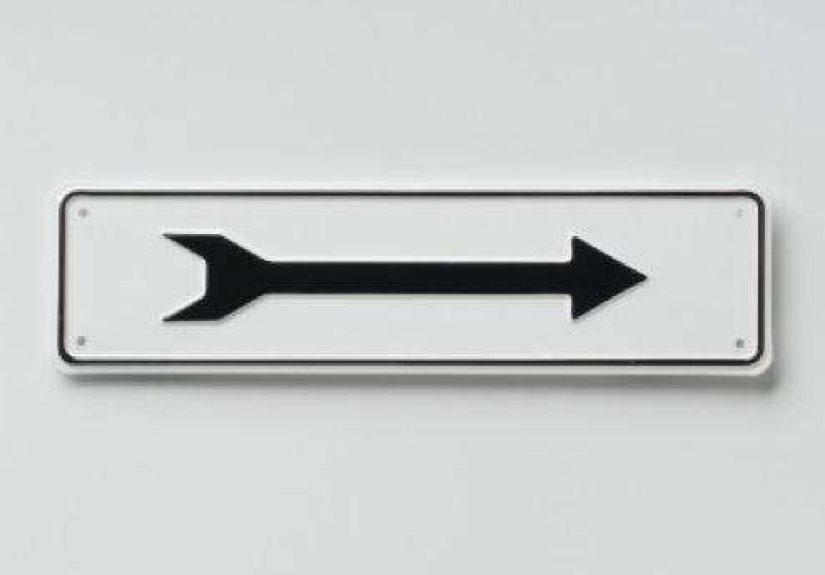
An embossed aluminum arrow sign is a metal sign with a directional arrow that is physically raised above the surface instead of appearing only as flat print. In simple terms, the sign face has dimension. That raised profile helps the arrow stand out visually, especially when light hits it from the side and creates natural shadow lines.
This matters more than it may seem. A flat printed sign can absolutely do the job, but embossing gives the arrow a more substantial, architectural look. It often feels more permanent, more intentional, and more premium. That makes embossed arrow signs a smart choice for places that want both function and polish, such as office parks, schools, hospitals, campuses, factories, municipal buildings, private roads, and parking areas.
Embossed vs. Flat vs. Engraved
These formats get mixed up all the time, so let us clear the runway:
- Embossed means the design is raised above the face.
- Debossed means the design is pressed into the surface.
- Engraved means material is cut away to create the design.
- Flat printed means the graphic sits on the face with no physical depth.
For arrow signs, embossing is attractive because the directional symbol becomes easier to notice at a glance. And in the world of wayfinding, “at a glance” is the whole ballgame.
Why Aluminum Is the Go-To Material
If sign materials were contestants in a talent show, aluminum would be the annoyingly good one that sings, dances, and also somehow knows tax law. It performs well in a wide range of environments, which is why it is so common in outdoor signage.
One of aluminum’s biggest strengths is corrosion resistance. That is a major reason it shows up in traffic, industrial, and outdoor identification products. Compared with heavier metals, it is easier to handle, easier to mount, and less likely to become a rust-streaked disappointment after a season of rain and sun. For directional arrow signs, that balance of low weight and long-term durability is a huge win.
Aluminum also works nicely with reflective films, protective coatings, and formed or embossed faces. In other words, it plays well with others. If your arrow sign needs to be readable in daylight, visible in low light, and strong enough to live outside without drama, aluminum is a dependable choice.
Why Businesses Prefer It
- Weather resistance: Great for outdoor use in rain, sun, wind, and temperature swings.
- Low maintenance: It does not demand constant touch-ups like some other materials.
- Professional appearance: Clean edges and metal construction make the sign look serious, not flimsy.
- Easy fabrication: It can be cut, mounted, coated, and finished in multiple ways.
- Long service life: When paired with quality coatings or reflective films, it is built to last.
Where Embossed Arrow Signs Work Best
The beauty of an arrow sign is that it does not need to say much to be useful. A well-placed arrow reduces hesitation, keeps traffic moving, and makes people feel like the property was designed by someone who has actually met a human being before.
Parking Lots and Garages
This is the natural home of the aluminum arrow sign. Directional arrows can guide drivers to entrances, exits, visitor parking, employee lots, loading zones, ADA parking areas, or office drop-off points. Reflective finishes are especially valuable here because many garages and lot entrances are dim even in broad daylight.
Campuses and Large Facilities
Schools, hospitals, business parks, and apartment communities often need a family of wayfinding signs rather than one lonely sign doing all the work. Embossed aluminum arrows fit nicely into those systems because they can look polished enough for public-facing spaces while still holding up outdoors.
Warehouses and Industrial Sites
In high-traffic operations, arrow signs help direct forklifts, delivery drivers, contractors, visitors, and pedestrians. When paired with bold contrast and reflective surfaces, they can improve traffic flow and reduce the chance of wrong turns in places where wrong turns are expensive.
Retail and Hospitality
Think entrance arrows, pickup arrows, curbside signs, event parking arrows, and “this way to check-in” signs. These signs do more than direct movement; they shape the customer experience. Nobody writes a glowing review that says, “I adored wandering in circles for ten minutes.”
Design Features That Actually Matter
A good arrow sign is not just about the arrow. It is about contrast, placement, finish, size, and readability. Great signs feel obvious. Bad signs make people squint, slow down, and question their life choices.
Arrow Shape and Orientation
The arrow should be unmistakable. Straight arrows, left arrows, right arrows, double arrows, and diagonal arrows all serve different purposes. If the site is open to public travel or functions like a roadway, the arrow style may need to follow recognized traffic standards rather than a decorative design. For private facility use, there is more flexibility, but clarity still wins over creativity every time.
Color Contrast
High contrast matters. Common combinations include black on yellow, white on green, white on red, blue on white, or black on white. The right combination depends on the use case. A regulatory-style arrow may look different from a hospitality wayfinding arrow, but both need to be readable from the expected distance.
Reflective or Non-Reflective Face
Not every arrow sign needs a reflective face. Indoor corridors, well-lit lobbies, and covered hallways may be perfectly fine with non-reflective aluminum. But if the sign sits outdoors, in a garage, near a driveway, or anywhere traffic moves after dark, reflective material is usually the smarter choice.
Commercial sign sellers commonly offer several reflectivity levels. Engineer-grade reflective is often selected for everyday parking and facility applications. High-intensity reflective steps up visibility for darker, more demanding environments. In short: the darker the setting and the faster the movement, the more reflectivity matters.
Thickness and Rigidity
For directional traffic and parking signs, solid aluminum around the heavier end of commercial sign construction is common because it resists bending better and feels more substantial once mounted. Thinner composite panels may work for decorative or lighter-duty installations, but post-mounted outdoor arrow signs usually benefit from a sturdier substrate.
Mounting Options
Mounting details are not glamorous, but they are where many sign projects go to trip over their own shoelaces. Common options include pre-drilled holes, centered side holes, corner holes, post-mount holes, wall screws, standoffs, or adhesive systems for lighter interior applications. Some arrow signs are designed with hole placement that lets the sign rotate so the arrow can point in multiple directions during installation. Handy? Very.
Compliance: When the Rules Matter
This is the part where design meets reality. If your embossed aluminum arrow sign is being used on a public roadway, a site roadway open to public travel, or in a regulated traffic environment, it may need to follow the MUTCD rather than your favorite design instinct. The MUTCD is the national standard for traffic control devices on streets, highways, pedestrian facilities, and site roadways open to public travel.
That does not mean every arrow sign on every property must be a textbook traffic sign. But it does mean there is a difference between:
- a traffic-control arrow sign used in regulated roadway conditions, and
- a general directional arrow sign used for facility wayfinding.
The distinction matters. Some commercial aluminum arrow signs are sold as MUTCD-compliant products for roadway or parking control. Others are general-purpose directional signs that look similar but are not certified to the same standard. If the sign is guiding vehicles in a setting with public-safety implications, verify compliance before ordering.
What About ADA?
For interior spaces, ADA rules can come into play. Directional and informational signs typically must meet visual requirements, though they are not always required to be tactile in the same way identification signs are. So if you are specifying an embossed aluminum arrow sign inside a building, you should not assume that “raised” automatically equals “ADA-compliant.” Accessibility depends on the sign type, location, and purpose, not just whether something sticks up from the surface.
How to Choose the Right Embossed Arrow Sign
There is no single best sign for every job, but there is a best sign for your job. Ask these questions before ordering:
1. Who needs to see it?
Drivers, pedestrians, delivery crews, patients, shoppers, or employees all move differently and read signs from different distances. A tiny arrow that works in a hallway can be laughably inadequate in a parking lot.
2. Where will it live?
Outdoor roadside edge? Covered garage wall? Office lobby? Loading dock? The environment determines whether you need reflective sheeting, a UV-protective layer, thicker aluminum, or corrosion-focused hardware.
3. Is this a code-driven sign or a wayfinding sign?
If it serves traffic control, check MUTCD relevance. If it serves interior direction, check ADA requirements. If it is simply helping visitors find the right door, you likely have more creative freedom.
4. Does the sign need text too?
Sometimes the arrow alone is enough. Other times, it should be paired with words like “Office,” “Entrance,” “Visitor Parking,” “Shipping,” or “Check-In.” Combining text with the arrow can reduce ambiguity and speed up decision-making.
5. How permanent should it feel?
Embossed aluminum is a smart choice when you want a sign that feels built-in rather than temporary. It is especially useful for locations with repeat traffic patterns or long-term wayfinding needs.
Common Mistakes to Avoid
- Choosing style over legibility: Fancy arrows are fun until nobody knows where to turn.
- Using non-reflective signs in dark areas: If visibility is poor, your sign should not also be shy.
- Ignoring mounting height and angle: A perfect sign in the wrong place is just modern art.
- Assuming all aluminum signs are equal: Thickness, finish, coatings, and compliance vary.
- Skipping the standards check: Similar-looking signs can have very different intended uses.
Are Embossed Aluminum Arrow Signs Worth It?
In many cases, yes. They offer a strong mix of durability, visibility, and visual quality. Compared with flimsier materials, aluminum is more dependable outdoors. Compared with flat graphics, embossing adds presence. And compared with sign systems that confuse people, a simple arrow often solves the problem with glorious efficiency.
These signs are especially worth considering when you need direction that lasts: parking guidance, facility navigation, entry routing, industrial flow, or branded wayfinding that still feels sturdy enough to survive weather, traffic, and the occasional encounter with a hurried maintenance cart.
At their best, embossed aluminum arrow signs do not just tell people where to go. They make movement easier, properties safer, and businesses more polished. Not bad for a piece of metal with a pointy opinion.
Real-World Experiences With Embossed Aluminum Arrow Signs
Talk to people who actually use embossed aluminum arrow signs, and a pattern shows up fast: nobody gets excited about directional signage until they have lived without it. Then suddenly that humble arrow becomes the hero of the property.
For business owners, one of the most common experiences is realizing how much confusion a small sign can prevent. A clinic may install a few embossed aluminum arrows to direct patients from overflow parking to the correct entrance. Before the signs, patients wandered into staff-only doors, called the front desk from the wrong side of the building, or arrived already annoyed. After the signs went up, the building did not change, but the experience did. The route felt obvious. And obvious is a beautiful thing in wayfinding.
Property managers often talk about durability first. Temporary plastic signs may work for a season, but sun, rain, wind, and daily wear have a talent for turning “temporary” into “tragic.” Embossed aluminum signs feel more permanent from day one. They stay flatter, cleaner, and more readable. Even better, they tend to look intentional rather than improvised, which matters when the goal is to make a site feel organized and professional.
Installers usually notice the practical stuff: mounting holes, substrate rigidity, reflectivity, and how forgiving the sign is during setup. A good arrow sign is not a diva. It mounts cleanly, aligns easily, and remains readable without endless fussing. Some signs can even be rotated depending on hole placement, which makes field adjustments much easier when the original plan collides with an actual wall, post, or curb. Reality loves to rewrite blueprints.
Facilities teams also appreciate how these signs reduce repetitive questions. “Where is visitor parking?” “Which entrance is receiving?” “Where do deliveries go?” Every one of those questions costs staff time. A durable arrow sign quietly answers them all day long without asking for coffee breaks or PTO.
There is also a brand perception angle that should not be ignored. In customer-facing settings, embossed aluminum signs can look cleaner and more established than flimsy substitutes. A hotel, office park, school, or event venue may not think of a directional arrow as part of its branding, but visitors absolutely absorb those visual cues. Crisp, durable signage says the place is managed. Crooked, faded signage says the opposite.
Of course, experience also teaches a few lessons. The biggest one is this: placement beats enthusiasm. Even the nicest embossed arrow sign will fail if it appears too late, sits too low, blends into the background, or points to a route that still feels uncertain. The best results come from treating signage as part of a journey rather than a decoration. Put the sign where decisions happen, not where confusion has already won.
In the end, most real-world feedback sounds refreshingly simple. People like embossed aluminum arrow signs because they work, last, and look like they belong. They survive weather, improve traffic flow, and help places feel more put together. That is not flashy. But in signage, useful beats flashy every time.
Conclusion
Embossed aluminum arrow signs are one of those rare products that manage to be practical, durable, and visually sharp at the same time. They help people move with confidence, they hold up in demanding environments, and they can fit everything from industrial sites to polished commercial properties. Choose the right size, finish, reflectivity, and compliance level, and you get a sign that does its job for years without begging for attention.
And really, that is the dream. A sign that points people in the right direction, survives the weather, and never starts drama.