Table of Contents >> Show >> Hide
- Who Is Chaim Machlev (DotsToLines)?
- What Makes His Geometric Line Tattoos Instantly Recognizable
- Why These Tattoos Feel Like They’re Moving
- The DotsToLines Process: Collaboration Over Cookie-Cutters
- Signature Themes You’ll See in His Geometric Linework
- If You Want the “Elegant Flow” Look: Practical Considerations
- Conclusion
- SEO Tags
php-templateCopy code
Some tattoos sit on skin like stickers. Chaim Machlev’s work (better known as DotsToLines) does the opposite: it behaves like it always lived therelike your shoulder blade simply forgot to mention it had a secret blueprint. His geometric line tattoos don’t just “fit” the body; they follow it, stretch with it, and occasionally make you wonder if your anatomy came with a user manual you never received.
If you’ve ever seen a sleeve that looks like modern architecture took a yoga class, or a torso piece that turns ribs into a gentle optical illusion, there’s a good chance you’ve met Machlev’s style already. Let’s break down what makes his minimalist geometric tattoos feel so aliveand what to know if you’re chasing that “clean lines, big impact” look for yourself.
Who Is Chaim Machlev (DotsToLines)?
Machlev’s origin story is not the classic “I started drawing at age five and never stopped.” Multiple interviews describe him coming from an IT background and discovering his creative direction laterafter getting tattooed and realizing something important was missing. He’s talked about leaving his old life behind, moving to Berlin with basically a backpack and determination, and learning by jumping straight into tattooing real people (Berlin punks included) while he built skill and confidence. Today, he’s based between Los Angeles and Berlin and is widely recognized for large-scale geometric linework that adapts to the body.
That “IT-to-ink” arc matters because you can see it in the work: part precision engineer, part poetic minimalist. In one interview, he even describes having a spiritual, flowing side and a computer-oriented sidetwo impulses that show up as strict geometry that still feels organic.
What Makes His Geometric Line Tattoos Instantly Recognizable
1) The line is the headline (and the shading is politely optional)
Machlev is famous for using clean black linesoften supported by dotsrather than leaning on heavy shading or color. It’s not “simple” so much as “surgically intentional.” Even when a piece looks complex, the vocabulary stays tight: arcs, grids, parallel runs, mandala-like symmetry, and negative space doing a surprising amount of work.
2) The body isn’t the canvas; it’s the co-author
A lot of geometric tattoos start as a design first and a placement second. Machlev flips that. He’s emphasized that he works with body structuretreating the body as the motifso the tattoo becomes a kind of wearable geometry that highlights movement instead of fighting it. Think less “paste-on pattern,” more “built-in circuitry.”
3) “Flow” isn’t a vibeit’s a technical decision
Art outlets have long described how his pieces can span an arm, leg, or back, and sometimes even continue from one body part to another. That continuity is the point: the design follows how you actually move through the worldreaching, twisting, breathing, existing dramatically while holding groceries.
Why These Tattoos Feel Like They’re Moving
The “movement” effect in Machlev’s geometric linework usually comes from three tricksnone of which require loudness:
- Rhythm: repeated lines spaced just enough to create visual vibration.
- Contour mapping: lines that echo muscle groups and bone structure, so the design flexes with you.
- Optical illusion: bold curves or loops placed to distort (in a good way) how the eye reads the torso or limb.
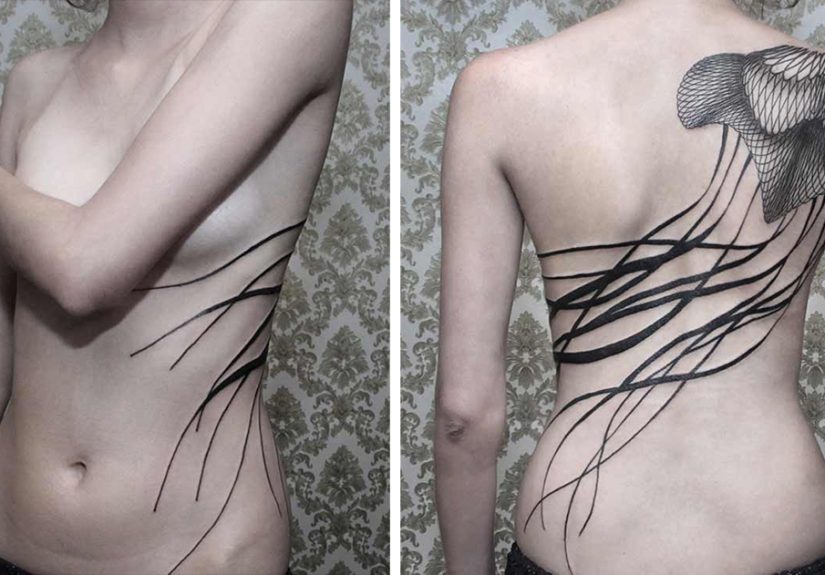
He’s written about designing tattoos that challenge perceptionusing bold curved black line to create the illusion of a continuous loop, where anatomy appears to “fold” into itself. In his telling, the magic isn’t in intricate textures; it’s in clean, deliberate line placed to interact with the body’s natural shape.
That illusion mindset shows up elsewhere too. A decade-old write-up likened his geometry to cardiograph spikesan apt comparison when you see those pulse-like peaks and valleys running across a chest or down a forearm.
The DotsToLines Process: Collaboration Over Cookie-Cutters
No “one stencil fits all”
One of the most consistent notes across coverage: Machlev’s process is highly individualized. In GQ, he explains that he doesn’t sketch in advance because every body is different; he needs to observe how a person moves, and the collaboration/design ceremony is part of what makes it work. A platform that books artists describes his approach similarly: designs are created together in-session, according to the client’s body structure, with each piece intended to be unique.
Freehand, on purpose
Another art magazine notes that even if the tattoos look “digitized,” he draws the image freehand before making it permanent. That matters because freehand design is one of the fastest ways to ensure lines actually flow with anatomy rather than fighting it.
Minimalism is harder than it looks (and he leans into that)
Machlev has talked about how minimal work leaves nowhere to hide: if one element doesn’t work, the whole piece can fall apart. In another interview, he describes tattooing as inherently “risky” because the medium is a living, breathing personand perfection isn’t fully possibleso part of the art is embracing imperfection while still aiming for extreme accuracy. That tension (control vs. humanity) is basically the DotsToLines brand.
Signature Themes You’ll See in His Geometric Linework
Even when the exact motif changes, Machlev’s tattoos tend to orbit a few recognizable themes:
- Abstract geometry: intersecting lines, arcs, and grids that read like modern design.
- Sacred-geometry-adjacent balance: symmetry and mandala-like structures without feeling like a textbook diagram.
- Two-part compositions: designs that connect shoulder to chest, arm to torso, or mirror left/right sides to emphasize unity.
- Optical illusion tattoos: pieces designed to “change” as the body shifts, especially across the torso.
Mainstream coverage has also pointed out that his style can work over existing tattooscreating pieces that look beautiful drawn atop older ink (a “blast-over” effect in spirit, even when the aesthetic stays minimalist).
If You Want the “Elegant Flow” Look: Practical Considerations
Choose placement like you’re choosing choreography
Geometric line tattoos live or die by placement. Areas that bend and stretch (elbows, knees, stomach) can make the design more dynamic, but they also demand smarter line direction so the piece still reads cleanly when you move. If your goal is that “it’s always been there” feeling, think in terms of body landmarks: collarbone lines, spine alignment, shoulder caps, and the natural taper of forearms and calves.
Pick an artist who can prove their linework ages well
Clean linework tattoos are unforgiving: a shaky hand doesn’t get rescued by color gradients. When you’re vetting artists for geometric tattoos or minimalist blackwork, look for healed photos, consistent line weight, smooth curves, and evidence they understand how designs wrap around limbs (not just how they look in a flat Instagram crop). Machlev’s reputation is built on that body-first discipline.
Aftercare matters more than your opinion about aftercare
A new tattoo is essentially an open woundhundreds of tiny puncturesand friction, sweat, and germy surfaces can interfere with healing. Health sources commonly recommend waiting at least 48 hours before strenuous exercise and heavy sweating, with full healing taking weeks; they also warn about friction from clothing/equipment and exposure risks in gyms.
Fitness outlets echo that caution and add nuance: gentle movement might be fine sooner for some people, but intense cardio, contact sports, and swimming are commonly flagged as higher risk. In a Peloton interview, Machlev notes that lines and dots generally heal faster than fully shaded or colored areas, but bigger, bendy-area tattoos may require weeks of workout modificationsand both tattoo and dermatology voices emphasize avoiding rubbing and heavy sweating on fresh ink.
Conclusion
Chaim Machlev’s geometric line tattoos work because they respect the body instead of trying to dominate it. The designs are minimalist but not “small.” They’re precise but not cold. And the best pieces don’t just decorate a limbthey map movement, emphasize structure, and make geometry feel weirdly human. If you’re drawn to abstract line tattoos, optical illusion blackwork, or anatomy-first geometric sleeves, DotsToLines is a masterclass in how restraint can still hit like a mic drop (quietly, in black ink).
Extended Experiences: What It Feels Like to Live With Flowing Geometric Ink
People who chase this style often describe the experience less like “getting a picture” and more like “getting a design problem solved on their body.” The first surprise is how much time gets spent looking before any ink happens. With flow-based geometric tattoos, the artist is reading posture, shoulder rotation, how you naturally stand, and how the design should behave when you lift your arm or twist your torso. That can feel oddly intimatelike a tailor’s fitting, if the tailor used a needle in a completely different way. It also explains why some clients show up with a big plan and leave with something different (and usually better).
Then there’s the “minimalism paradox.” From across the room, a Machlev-style piece can look effortless: clean lines, lots of breathing space, no heavy shading. Up close, it’s a different story. Straight lines aren’t actually straight on a living body; they curve with muscle and warp around bone. So the session can feel meticuloussmall adjustments, careful pacing, and an almost architectural obsession with alignment. Clients often report that the finished tattoo looks more complex than it felt during the process, because the complexity is hidden in proportion, spacing, and how the lines land on the body’s contours.
The emotional part tends to sneak up on people later. Abstract geometric tattoos don’t always come with a literal meaning (“this is my dog, but in polygon form”). Instead, the meaning evolves. A flowing line across the shoulder might start as “I love the aesthetic,” then slowly become “this is the moment I finally chose my body on purpose,” or “this is my reset button,” or “this is the reminder that I can change without falling apart.” Machlev himself has pointed out that abstract work makes it easier to adapt meaning over timeand that tattoos can become a way to reconnect with your body rather than constantly trying to “fix” it.
Practically speaking, the first week can be the most annoying partespecially for active people. You’re suddenly negotiating with your own habits: looser clothes to reduce friction, skipping the sweaty workouts you love, and treating “don’t touch it” like a competitive sport you didn’t train for. Plenty of people say the hardest moment is day three, when the tattoo starts to feel tight or itchy and your brain suggests “maybe just a little scratch.” (Your brain is lying. Your brain is always lying.) Health guidance frequently reminds people that exercise too soon adds friction, sweat, stretching, and germ exposurenone of which help a fresh tattoo heal cleanly.
The best part, though, is how these tattoos “activate” in normal life. Someone will catch their reflection while reaching overhead and notice the lines suddenly align into a new shape. Or they’ll realize the design looks calmer when they’re relaxed and more energetic when they’re moving fast. That’s the unique reward of body-flow geometry: it doesn’t just sit there. It participates. And once you’ve lived with a tattoo that feels like it was engineered for your movement, it’s hard to go back to designs that feel like they were printed for a flat surface.