Table of Contents >> Show >> Hide
- Why Kainchi Bazaar Matters
- A Quick Look at the Long History of Scissors
- How Scissors Are Made by Hand in Kainchi Bazaar
- What Makes Meerut’s Handmade Scissors Different
- The Hard Truth Behind the Craft
- Why the Bazaar Is Under Pressure
- Why Handmade Scissors Still Matter
- Experiences From the World of Kainchi Bazaar
Most people treat scissors like background characters. They live in kitchen drawers, sewing kits, barber stations, and school desks, quietly doing their job until someone says, “Who took the good pair?” But in Meerut, India, scissors are not minor household props. They are history, livelihood, family inheritance, neighborhood identity, and a stubborn piece of industrial craft that refuses to disappear.
At the center of that story is Kainchi Bazaar, the city’s famous scissors market. This is not the sort of place where shiny machines hum behind glass walls and marketing teams whisper phrases like “precision lifestyle cutting solutions.” It is a place where steel is heated, hammered, drilled, ground, polished, fitted, and sharpened by hand. The work is repetitive, risky, and deeply skilled. A single pair of scissors can pass through many hands before it ever makes its first clean snip.
That is what makes Kainchi Bazaar so fascinating. In an age of cheap imports and disposable tools, Meerut’s artisans still produce scissors the old-fashioned way: with recycled metal, practiced judgment, and a close relationship between the maker’s hand and the blade’s final feel. The result is not just a tool. It is a small piece of working culture forged in heat and noise.
Why Kainchi Bazaar Matters
Meerut’s connection to scissors goes back centuries. The city’s scissor trade is often described as being roughly 350 years old, and local tradition links its beginnings to a blacksmith who adapted blades into a cutting tool for leatherwork. Over time, that practical invention grew into a dense cluster of workshops, traders, and families who specialized in making scissors for homes, tailors, electricians, barbers, and industrial users. In modern profiles of the bazaar, the industry has been described as supporting tens of thousands of livelihoods and operating through hundreds of small facilities.
That scale is important, because Kainchi Bazaar is not merely a charming craft corner. It is a full working ecosystem. Some makers shape blades. Others cast or fit handles. Others drill, grind, polish, assemble, tune, sharpen, inspect, or sell. In other words, this is not one artisan heroically making one perfect scissor from start to finish while dramatic music plays in the background. It is a distributed craft economy, where expertise is split into stages and passed from station to station.
That structure also explains why handmade scissors from Meerut feel different from mass-produced pairs. Modern factory scissors are usually designed for speed, uniformity, and price. Kainchi Bazaar scissors are designed around labor, experience, and repairability. Many local makers still argue that a properly made pair can be sharpened and used for years rather than tossed at the first sign of dullness. That old-school durability is part of the appeal.
A Quick Look at the Long History of Scissors
Before zooming in on Meerut, it helps to remember that scissors are ancient tools. Variations of scissors date back to the Bronze Age, and pivoted designs were used in multiple parts of the ancient world. Large-scale steel scissor production came much later, once metalworking became more refined and standardized. That long timeline matters because it reminds us that scissors have always sat at the intersection of metallurgy and everyday life.
In simpler terms, scissors are humble, but they are not simple. They require two edges, a pivot, blade alignment, controlled tension, and geometry that allows the blades to meet correctly along the cut. Get any of those details wrong and the result is a tool that folds paper instead of cutting it, chews fabric, pinches hair, or makes users say words not suitable for a family craft blog.
How Scissors Are Made by Hand in Kainchi Bazaar
1. Scrap Steel Becomes a Starting Point
The process often begins with recycled iron or steel scrap. In reported accounts from Meerut, makers describe collecting scrap metal and sending it to a furnace so blade material can be prepared. That detail gives Kainchi Bazaar scissors an almost beautifully practical origin story: yesterday’s discarded metal becomes tomorrow’s household tool.
Using scrap does not mean the work is casual. Blade making still depends on choosing workable metal, heating it correctly, and shaping it with consistency. In metalworking, heat treatment is what changes steel’s properties, helping it become harder, tougher, and more useful as a cutting edge. Forging and thermal processing matter because the final blade must resist wear while still surviving daily use. A scissor blade that is too soft dulls quickly; one that is too brittle risks chipping or failing. The sweet spot lives in process control, not wishful thinking.
2. Forging, Shaping, and Rough Forming
Once the metal is prepared, the blade blank is shaped. In handmade production, that can involve molding, hammering, and rough forming by hand. Forging is especially important because compressing hot metal improves strength and helps create a more reliable structure. This is the stage where the scissor starts to look like a scissor instead of an argument between a blacksmith and a pile of steel.
The two halves are shaped separately. The outline of the blade is established, excess material is removed, and the piece is refined until it is ready for more precise work. In a machine-first factory, this might happen through automated cutting and stamping. In Kainchi Bazaar, much of that identity still comes from manual operations, which is why two pairs of scissors can feel related but not completely identical.
3. Handles, Holes, and the Pivot
Many Meerut scissors are known for their brass handles, which add both character and durability. After blade sections are prepared, the handle components are fixed, and holes are drilled for the pivot screw that will eventually join the two halves. This sounds like a small step, but it is actually a make-or-break moment.
The pivot is the heart of the tool. Too loose, and the blades separate and fold material instead of slicing it. Too tight, and the scissors feel stiff, tiring, and awkward. A good pivot allows controlled contact between the blades while keeping movement smooth. This is one reason handmade scissors can feel so satisfying: someone has physically tuned that motion rather than leaving it entirely to automated tolerance.
4. Grinding, Edge Work, and Surface Finishing
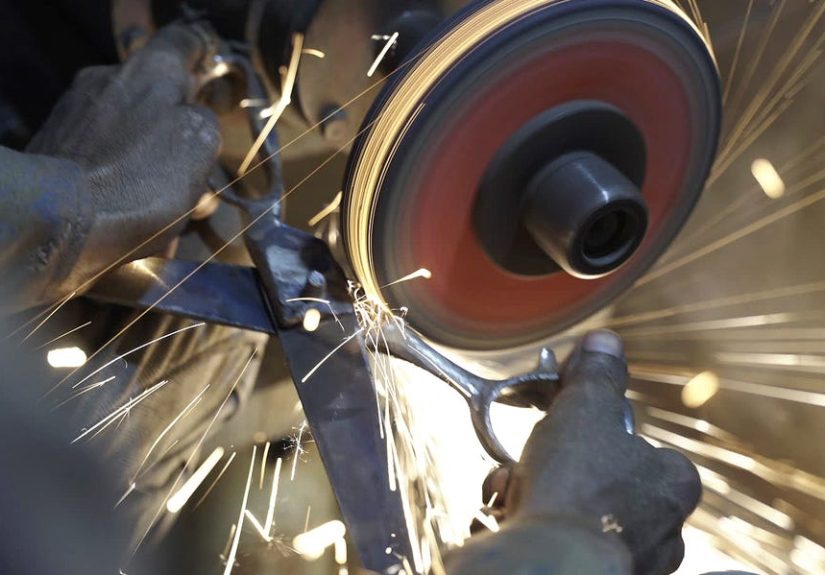
After shaping comes one of the most important stages: grinding. Grinding removes material, improves the blade profile, and helps create the edge geometry that determines how the scissors cut. In manufacturing, edge finishing and deburring are not cosmetic extras. They directly affect performance, durability, and safety. A ragged or poorly prepared edge leads to rough cutting and premature wear.
Artisans in Meerut hammer, grind, and polish the blades to refine them. This is where a rough blank becomes a working cutting instrument. The angle of the edge matters. The smoothness of the finish matters. The relationship between blade thickness and cutting angle matters. Even in modern blade science, edge geometry is considered one of the most important factors in cutting performance. In plain English: sharpness is not magic. It is geometry plus materials plus careful finishing.
Polishing matters too. A polished blade reduces drag, improves appearance, and helps the finished tool feel cleaner and more precise. In higher-end blade work, honing and polishing are used to create a durable, consistent edge. Handmade scissors in Kainchi Bazaar may not be marketed with glossy engineering diagrams, but the practical logic is the same: smoother, better-prepared edges cut better.
5. Assembly, Adjustment, and the Final “Snip” Test
Then comes assembly. The two blades are fastened together, adjusted, and tested. This stage is where craftsmanship stops being theoretical. A pair of scissors can look great and still cut terribly if the blades do not meet correctly. Skilled assemblers make minute corrections, listening and feeling for the right action as the blades open and close.
That final tuning is one of the most human parts of the entire process. Some reports on Meerut’s workshops note that artisans listen for the familiar cutting sound and make small adjustments until the pair behaves properly. It is a reminder that quality control does not always arrive wearing a lab coat. Sometimes it arrives as a practiced thumb, a trained ear, and a worker who knows when a tool feels right.
Local manufacturers have said that one pair of handmade scissors can take anywhere from about 8 to 15 days to complete, moving through roughly 14 stages and more than 20 sets of hands. That is a remarkable amount of labor packed into an object many people buy without a second thought.
What Makes Meerut’s Handmade Scissors Different
The big difference is not nostalgia. It is process. Handmade scissors from Kainchi Bazaar are built through serial specialization, where each stage adds something tangible: shape, hardness, finish, alignment, tension, sharpness, and balance. The tool is not simply manufactured; it is gradually corrected into usefulness.
That is why local makers often emphasize longevity. A well-made pair can often be resharpened, readjusted, and kept in service. By contrast, many cheaper imported scissors are designed around low cost and easy replacement. They can work fine for casual use, but they rarely inspire devotion. Nobody dramatically announces their affection for a throwaway scissor. A durable handmade pair, though? That earns drawer priority.
There is also visual character. Brass handles, hand-polished surfaces, and subtle variations in finish give Meerut scissors a personality that machine-perfect products often lack. They look like objects that have passed through labor rather than objects that appeared out of a packaging algorithm.
The Hard Truth Behind the Craft
Romance alone does not keep a workshop alive. The labor in Kainchi Bazaar can be dangerous. Makers work with hot metal, sharp blades, grinding dust, and finishing operations that demand good ventilation and protective equipment. Occupational safety guidance on welding, cutting, grinding, and polishing makes clear why this kind of work carries risk: metal fumes, airborne particles, burns, cuts, eye injuries, and respiratory hazards are all real concerns.
That matters because some modern reporting on Meerut’s scissor workshops has highlighted poor ventilation and the health toll that can come from constant exposure to metal particles. Handmade craft often gets praised for its authenticity, but authenticity is not a substitute for safe conditions. A beautiful tool should not require invisible damage to the people who make it.
Why the Bazaar Is Under Pressure
Kainchi Bazaar is also under economic pressure from cheaper imported scissors, especially machine-made products that can flood the market at lower prices. For a buyer focused only on price, handmade production can look slow, complicated, and expensive. For the craft community in Meerut, that competition has been painful.
Still, the industry has not stood still. The Meerut scissor trade received Geographical Indication protection in India in 2013, which helped recognize the identity of the craft and protect the use of the regional name. There were also reports of stronger demand during the pandemic, when more people cut hair at home and looked for practical household tools. These boosts do not erase the structural challenges, but they show that traditional industries can still find moments of relevance.
Why Handmade Scissors Still Matter
Kainchi Bazaar matters because it preserves a kind of manufacturing intelligence that is hard to rebuild once lost. When a city spends centuries learning how to turn scrap steel into tuned cutting tools, it accumulates more than products. It accumulates muscle memory, process knowledge, design instincts, repair culture, and pride. That is industrial heritage in its most useful form.
And unlike decorative heritage, this one still cuts. It still serves homes, trades, and workshops. It still proves that handwork can survive beside industrial scale, even if the fight is uneven. In a disposable age, a handmade scissor from Meerut carries a stubborn message: not everything valuable should be cheap, instant, and forgettable.
Experiences From the World of Kainchi Bazaar
To understand Kainchi Bazaar, it helps to imagine the experience of moving through it slowly rather than treating it like a headline. The first thing that stands out is the sound. Not one clean sound, but layers of them: the ring of hammer on metal, the scratch of grinding, the click of assembled blades opening and closing, the chatter of sellers, the shuffle of workers moving unfinished pieces from one station to the next. It is a market, yes, but it also feels like a long conversation between steel and skill.
Then there is the visual rhythm. You see dull scrap, glowing metal, rough blade shapes, brass handles, drilled pivot holes, gray dust, mirrored polish, and finally the finished pairs stacked together like neat little promises. Each stage looks ordinary on its own. Together, they tell a richer story. A pair of scissors is no longer just a consumer item. It becomes the visible result of repetition, judgment, error correction, and patience.
There is also something surprisingly emotional about the final adjustment stage. A worker opens and closes the blades, not dramatically, just carefully. The motion is small. The result is huge. Too much resistance, and the pair feels wrong. Too little tension, and it loses bite. In that tiny tuning moment, the craft reveals itself. The blade is not finished when it looks complete. It is finished when it behaves correctly. That distinction says everything about handmade tools.
The bazaar also leaves an impression because of its contradictions. It is proud, but pressured. Traditional, but commercial. Skilled, but vulnerable. You can admire the durability of the finished product while also recognizing the physical strain behind it. You can appreciate the beauty of brass-handled scissors while knowing that grinding dust and workshop heat are part of the same reality. That tension makes the place more real, not less meaningful.
For visitors, writers, buyers, or even curious readers half a world away, Kainchi Bazaar offers a rare reminder that everyday objects still have human stories inside them. The next time someone absentmindedly grabs a pair of scissors to open a package, trim thread, cut herbs, or snip paper for a school project, it is worth pausing for a second. Somewhere, in a lane crowded with tools and trade, someone may have spent days helping create an object so familiar it almost disappears in plain sight.
That may be the most memorable experience connected to Kainchi Bazaar: realizing that usefulness can also be heritage. The scissors are not museum pieces. They are meant to work. They are meant to be sharpened, used again, passed along, and kept in motion. In that sense, the bazaar’s philosophy is wonderfully practical. Make it strong. Make it repairable. Make it worthy of being kept. That is not just good craft. That is a pretty excellent life lesson from a pair of scissors.