Table of Contents >> Show >> Hide
- The Real Reason King Cake Season Has a Start Date
- Before New Orleans: A European Party Trick Disguised as Dessert
- How King Cake Got to Louisiana (and Found Its Forever Home)
- Why the Cake Is Purple, Green, and Gold (and Why That’s Not Random)
- From Bean to Baby: How the “King Cake Baby” Took Over
- How King Cake Became a New Orleans Powerhouse
- So… Where Did It All Begin?
- Bonus: of King Cake “Experience” (What It Feels Like in Real Life)
- Conclusion
If you’ve ever eaten a slice of king cake and suddenly felt like you were defusing a tiny pastry bomb (“Is that… a BABY?”),
congratulations: you’ve participated in a tradition that’s part church calendar, part European party game, and part New Orleans
genius for turning any excuse into a celebration. The king cake story starts long before purple-green-gold sugar hit the scene
and the “king cake baby” has its own glow-up arc, from humble bean to plastic celebrity.
The Real Reason King Cake Season Has a Start Date
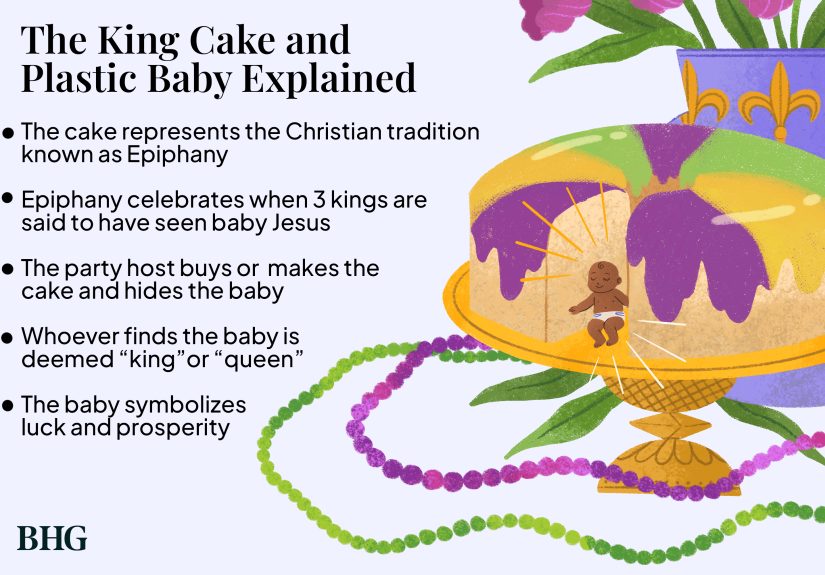
King cake isn’t just “Mardi Gras dessert.” Historically, it’s tied to Epiphany (January 6), the Christian feast day
associated with the visit of the Magialso known as the Three Kingsto the infant Jesus. That’s why you’ll hear king cake called
Three Kings Cake, Epiphany cake, or Twelfth Night cake (the twelfth day after Christmas).
In places shaped by Catholic tradition, Epiphany marks a turning of the seasonal page: Christmas winds down, and Carnival begins its
slow, sparkly march toward Lent.
In Louisiana, that matters because Carnival is a season, not just one daymeaning king cake becomes socially acceptable (and heavily
encouraged) starting on January 6 and running until Mardi Gras. That “window” helps explain why locals can be both generous and
judgmental: they’ll happily share a slice, but they might side-eye you if you break out king cake in, say, October. (Yes, some bakeries
sell them year-round. No, that doesn’t mean your aunt approves.)
Before New Orleans: A European Party Trick Disguised as Dessert
Long before king cake became a Carnival icon, Europe had a love affair with hiding surprises in pastry. In France, Epiphany is famous
for galette des rois (especially in the north) and gâteau des rois (a ring-shaped brioche style more common
in the south). In Spain, there’s roscón de reyes. Across regions, the details changepuff pastry vs. brioche, almond filling
vs. candied fruitbut the plot stays the same: a festive cake plus a hidden token.
The Fève: A Fancy Word for “Tiny Thing That Decides Your Fate”
The hidden token is often called a fève (French for “bean”), becausesurprise!it was frequently a literal bean.
Whoever found it was crowned “king” (or queen) of the gathering, sometimes with fun obligations attached. In some versions, you might
be expected to host the next party, buy the next cake, or play along with whatever goofy rules the group invented.
That’s the key idea: king cake is not only food. It’s a social contract you can eat. A sweet, circular way of saying,
“Congratulations, you’ve been chosen… to keep this party going.”
How King Cake Got to Louisiana (and Found Its Forever Home)
New Orleans didn’t invent the concept of an Epiphany cake, but it did what New Orleans always does: it adopted traditions brought by
settlers and immigrants, blended influences, and turned the whole thing into a signature cultural phenomenon. French and Spanish
presence in Louisiana shaped local foodways, and Creole households kept Twelfth Night customs alive in ways that felt both familiar
(to European roots) and distinctly local.
Twelfth Night Revelers: The Moment King Cake Joined the Carnival Chat
A major “dot-connecting” moment arrived in 1870, when the Twelfth Night Revelers (a Carnival krewe in
New Orleans) helped formalize the link between Twelfth Night festivities and the Carnival season. Not long after, king cake began to
show up as a central prop in the city’s seasonal social lifeespecially in the late 1800s and early 1900s, when Twelfth Night/Kings’ Day
parties became a reported-on, planned-for event rather than a quiet household custom.
One often-cited example of how quickly this tradition caught fire: in 1871, the Twelfth Night Revelers hosted a debutante
ball featuring a cake with a bean made of gold and others made of silver. A debutante named Emma Butler received the gold
bean and became Mardi Gras’s first queenan anecdote that captures how dessert, symbolism, and social ritual fused into one iconic package.
Why the Cake Is Purple, Green, and Gold (and Why That’s Not Random)
The colors on a Louisiana king cake aren’t just “because it’s festive.” They’re tied to Mardi Gras traditionespecially the imagery popularized
by the Rex organization. The colors purple, green, and gold have been associated with Mardi Gras since the late 19th century,
and their commonly repeated meaningsjustice (purple), faith (green), and power (gold)were
reinforced through Rex’s “Symbolism of Colors” theme in 1892.
So when you see those colors sprinkled on a king cake, you’re looking at a mash-up of ideas: Epiphany’s “Three Kings” symbolism plus
Carnival’s visual language. In other words, king cake is a dessert that wears a costumevery on-brand for New Orleans.
From Bean to Baby: How the “King Cake Baby” Took Over
The hidden token didn’t start as a plastic baby. Earlier versions used beans, nuts, coins, or small trinketsthings that were easy to
hide in dough and easy to explain. Over time, figurines became popular in various regions. In Louisiana, the “baby” became the superstar,
but the timeline is a little fuzzy because traditions evolve the way families do: slowly, messily, and with everyone insisting
their version is the original.
The McKenzie’s Effect: Popularizing the Baby in the Mid-20th Century
Many accounts credit New Orleans bakery cultureespecially the commercial reach of McKenzie’s Pastry Shoppeswith
popularizing the baby trinket in king cakes in the mid-20th century. Some tellings place the “baby-in-the-cake” trend
gaining steam around the 1930s–1950s, beginning with porcelain pieces before plastic became the practical, widely available
option. (Porcelain looks charming until someone chips a tooththen suddenly everyone becomes a fan of lightweight plastic.)
What the Baby Means (Besides “You’re Hosting Next Time”)
Symbolically, the baby is commonly linked to the infant Jesus and Epiphany’s religious context. Socially, the baby is a party mechanism.
It creates a tiny, friendly drama: everyone wants the “lucky” slice, but no one wants the responsibility that can come with it.
That tension is basically the secret frosting of the tradition.
- Luck & prosperity: Many people treat finding the baby as a good omen.
- “King/queen for a day”: The finder gets bragging rights and, often, a paper crown.
- Obligation: Depending on the crowd, the finder buys the next king cake or hosts the next gathering.
How King Cake Became a New Orleans Powerhouse
King cake didn’t stay a quiet Epiphany custom. In Louisiana, it grew into a seasonal industry and a cultural signal: “Carnival is here.”
Bakeries ramp up production between January 6 and Mardi Gras, and the demand can be intenselines out the door, shipping nationwide,
flavors multiplying like beads after a parade.
The cake itself also evolved. Traditional Louisiana-style king cake is often a ring of sweet, yeasted doughbrioche-like, frequently
cinnamon-forwardiced and showered with colored sugar. Modern bakeries offer fillings (cream cheese, fruit, praline-inspired flavors)
and reinterpretations that still keep the ritual intact: the ring shape, the colors, and the hunt for the hidden prize.
A Note on Safety (Because Nobody Wants a Trip to the Dentist)
If you grew up hearing “Don’t chew too fast,” king cake is why. Many sellers now provide the baby separately for the purchaser to insert
after baking, partly to avoid baking plastic and partly to reduce choking hazards. Some traditions are cute; some require adult supervision.
King cake is both.
So… Where Did It All Begin?
If you zoom out, the king cake tradition is a braid of three big strands:
- Religious calendar: Epiphany, the Magi, and the end of the Christmas season created the “why now?” timing.
- European folk celebration: The hidden fève/bean tradition turned dessert into a game of chance and community.
- Louisiana Carnival culture: New Orleans amplified the ritual, dressed it in Mardi Gras colors, and made the “token” (now
usually a baby) the engine that keeps parties rolling from one gathering to the next.
In other words: king cake began as an Epiphany tradition, and the king cake baby began as a practical (and hilarious) way to keep the
ritual aliveone tiny figurine at a time.
Bonus: of King Cake “Experience” (What It Feels Like in Real Life)
The most honest way to understand king cake isn’t to read about Epiphany or memorize datesit’s to watch a room react when the box opens.
The lid lifts, and suddenly adults with mortgages and kids with homework become sugar-powered detectives. Someone always says,
“Okay, who’s cutting?” like they’re appointing a Supreme Court justice. Another person asks, “Did you put the baby in yet?” with the
seriousness of a pre-flight checklist.
At work, king cake is basically office diplomacy with frosting. The moment the slices hit the break-room table, you’ll see three types of
people: (1) the ones who want the baby because they love chaos, (2) the ones who want the baby because they love luck, and (3) the ones who
carefully request “the smallest piece” because they’re trying to dodge next week’s responsibility like it’s a surprise meeting invite.
Someone will hover and “casually” choose a slice that looks suspiciously thick, pretending it’s random. It’s not random. It’s never random.
In families, the tradition turns into a multi-generational drama where everyone claims they can “feel” which slice has the baby. A grandparent
insists the baby always ends up near the seam. A cousin swears it’s “always on the left side.” A kid bites down cautiously, eyes wide, as if
the figurine might leap out and demand tribute. And when someone finally finds it, the reactions split again: cheers, laughter, mock outrage,
and at least one person saying, “Waitdoes that mean you have to bring the next cake?” as though the rules were just invented five seconds ago.
The funniest part is how king cake creates a tiny, shared storyline. People remember “the year Uncle Ray got the baby twice” or “the time the
baby got lost and we found it in the napkin pile” like those are historic events. Out-of-towners get initiated fast: you explain Epiphany in
one sentence, then immediately jump to the practical stuff“If you get the baby, you’re on the hook.” Suddenly they’re invested. Suddenly
they’re guarding their slice like it’s a winning lottery ticket.
And then there’s the quiet magic: the way a simple cake can stitch people together. You don’t need to know every detail of medieval French
customs to feel what the tradition does. It turns a calendar season into a community rhythm. It gives strangers a reason to talk, coworkers a
reason to laugh, and families a reason to show upbecause even if you’re not sure what Epiphany commemorates, you’re very sure that purple,
green, and gold sugar means it’s time to celebrate.
Conclusion
King cake started as an Epiphany-centered celebration of the Three Kings, traveled through European “hidden token” customs, and then found a
loud, joyful home in Louisiana’s Carnival season. The king cake babyonce a bean, then a figurine, now often plasticdidn’t replace the
tradition; it supercharged it. It made the ritual instantly recognizable, slightly competitive, and just responsible enough to keep the party
rolling from one cake to the next. Which is, honestly, the most New Orleans thing a dessert can do.