Table of Contents >> Show >> Hide
- Pick the Right Pumpkin (Because Not All Gourds Are Created Equal)
- Set Up Like a Pro (Your Future Self Will Thank You)
- Tools You’ll Actually Use (No, You Don’t Need a Chainsaw)
- Design Planning: The Difference Between “Spooky” and “Accidentally Confused”
- Step-by-Step: How to Carve a Pumpkin (Clean, Safe, and Actually Fun)
- Easy Upgrades: Make Your Pumpkin Look More Impressive Without Becoming a Sculptor
- Lighting Your Jack-o’-Lantern (Glow Without the Drama)
- How to Make a Carved Pumpkin Last Longer
- Don’t Waste the Seeds: A Quick “Bonus Treat” Routine
- Hosting a Pumpkin Carving Night (That Doesn’t End in Chaos)
- Troubleshooting: Fix the Most Common Pumpkin Problems
- Pumpkin-Carving Experiences: What It’s Really Like (And What People Learn the Hard Way)
- Conclusion
Pumpkin carving is the rare craft that’s equal parts art class, minor cardio, and “why is this goo on my elbow?” If you’ve ever ended the night with a lopsided grin, a countertop that looks like it hosted a squash crime scene, and exactly one hand that smells like autumn forevercongrats. You did it right.
This guide walks you through how to carve a pumpkin the smart (and fun) way: safer tools, cleaner techniques, better lighting, and a few tricks that make your jack-o’-lantern last longer than a carton of milk left on the porch. Whether you’re making a classic spooky face or trying something fancy with stencils, you’ll find step-by-step help, plus real-world “what usually goes wrong” stories at the end.
Pick the Right Pumpkin (Because Not All Gourds Are Created Equal)
What to look for at the store or pumpkin patch
- Firm skin with no soft spots, cracks, or moldy “freckles.”
- A flat base so it sits steadily without wobbling like it’s auditioning for a circus.
- Good shape for your design: tall for big faces, wide for landscapes, squat for cute characters.
- Stem check: a sturdy stem usually means the pumpkin wasn’t stressed or damaged in transit.
Pro tip: Carry pumpkins from the bottom, not by the stem. The stem is a handle in the same way a spaghetti noodle is a handle.
Set Up Like a Pro (Your Future Self Will Thank You)
Create a safe, less-mess workspace
- Cover the surface with newspaper, a disposable tablecloth, or a trash bag.
- Work in bright light. Shadows + sharp tools = an ER-themed Halloween special.
- Put a damp towel under the pumpkin to keep it from sliding.
- Keep paper towels nearby to dry hands and tools (pumpkin slime is basically nature’s lubricant).
- If kids are helping, assign jobs: drawing, scooping, and “official seed supervisor.”
Safety rules that aren’t optional
- Use a pumpkin carving kit (small saws are easier to control than big kitchen knives).
- Cut away from your body and keep your non-cutting hand out of the blade’s path.
- Keep hands and tools clean and dry.
- Skip open flames if possibleLED lights are safer and won’t “cook” the pumpkin from the inside.
Tools You’ll Actually Use (No, You Don’t Need a Chainsaw)
Basic pumpkin carving tools
- Marker or washable pen for sketching.
- Serrated pumpkin saw (from a carving kit) for cutting the opening and shapes.
- Scraper/scoop (or a sturdy metal spoon/ice cream scoop).
- Small paring knife (optional, for adults only, for detail trimming).
- Toothpicks for fixing wobbly parts or attaching small pieces.
- Battery LED tealight or mini string lights for illumination.
Nice-to-have upgrades for cleaner results
- Linoleum cutter or small carving tools for detail work.
- Push pin/thumbtack for transferring stencil outlines.
- Hand mixer beater (yep) to loosen stringy pulp quicklyuse carefully and clean thoroughly afterward.
- Carving gloves (cut-resistant) if you want extra confidence.
Design Planning: The Difference Between “Spooky” and “Accidentally Confused”
Choose a design that matches your skill level
If you’re new, start with bold shapes: big eyes, triangle nose, chunky smile. The smaller and fussier the details, the more likely they’ll collapse into “abstract sadness” once the pumpkin starts drying out.
Two easy ways to get the design onto the pumpkin
- Freehand sketch: Draw directly on the pumpkin with a washable marker. If you mess up, wipe with a damp cloth and pretend you meant to do that.
- Stencil transfer: Tape a paper pattern onto the pumpkin, then poke holes along the lines with a thumbtack or poking tool. Remove the paper and connect the dots.
A fun hack for stencil transfers: lightly dust the pumpkin with baby powder after removing the stencildots can pop visually so you carve more accurately. (Just don’t turn your pumpkin into a powdered-donut tribute.)
Step-by-Step: How to Carve a Pumpkin (Clean, Safe, and Actually Fun)
Step 1: Wash the pumpkin
Rinse the outside with water and a little soap, then dry it. This reduces surface gunk and helps your marker lines stick. If you’re trying to make your pumpkin last longer, starting clean matters.
Step 2: Cut the opening (bottom is the secret weapon)
Instead of cutting a lid around the stem, consider cutting a hole in the bottom. It’s easier to scoop, easier to place over a light, and your stem stays pretty for photos. To cut the opening:
- Turn the pumpkin on its side or upside down so it won’t roll.
- Use the kit saw to cut a circle big enough for your hand and scoop.
- Angle the cut slightly inward so the piece doesn’t fall through.
Step 3: Scoop out the “guts”
Remove seeds and stringy pulp. Then scrape the inside wallsespecially behind the area you’ll carve. Aim for roughly 1 inch thick walls where your design goes; thinner walls carve more easily and glow better.
Want to speed things up? Some people use a hand mixer beater (not the full mixer) to loosen stringy pulp. Keep it slow, keep your grip steady, and don’t let the beater meet the rind at full speed unless you enjoy pumpkin confetti.
Step 4: Trace your design
Draw your face or tape on your stencil and poke the outline. If you’re doing letters, keep strokes thick, like a bold headlinenot delicate cursive that will tear mid-season.
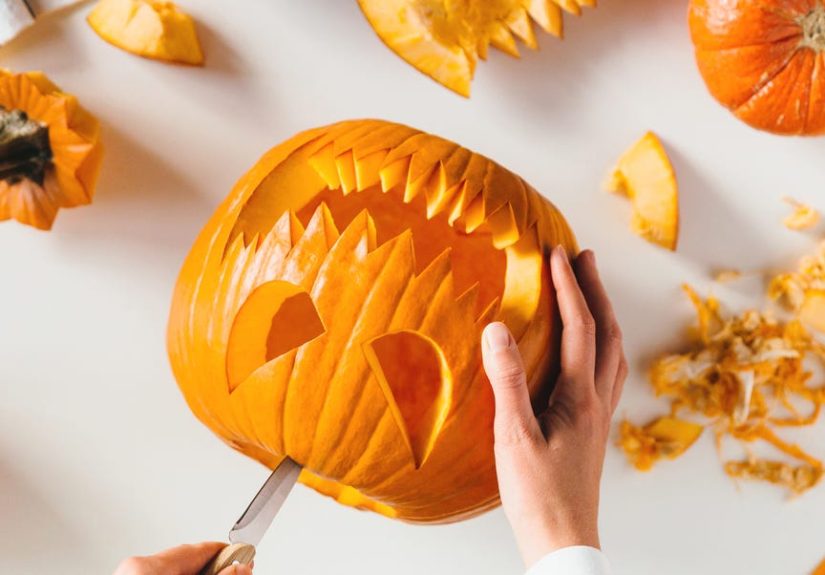
Step 5: Start carving (small saw, gentle pressure)
- Carve from the center outward on complex designs so you don’t weaken key support areas too soon.
- Use short, controlled strokes with the sawpumpkin rind is tough, but force isn’t your friend.
- Pop pieces out gently. If they fight back, cut again rather than prying hard (that’s how cracks happen).
Step 6: Detail and cleanup
Smooth jagged edges with a small knife or carving tool (adults only). Wipe marker lines away with a damp cloth. Then do a quick “light test” by shining a flashlight inside to spot uneven areas that need trimming.
Easy Upgrades: Make Your Pumpkin Look More Impressive Without Becoming a Sculptor
Technique 1: Carve, don’t cut all the way through
For shading, scrape off the pumpkin skin (the orange part) and carve into the lighter layer underneath without punching a full hole. When lit, these “etched” areas glow softly and look way fancier than they were to make.
Technique 2: Add texture
Use a small tool or linoleum cutter to add lines, wrinkles, or hair. This is perfect for faces, cats, haunted housesanything that benefits from detail without needing tiny cutouts.
Technique 3: Keep pieces attached
If you’re cutting out shapes like teeth, consider leaving little “bridges” of pumpkin to support them. Think stained glass, not cookie cutter.
Lighting Your Jack-o’-Lantern (Glow Without the Drama)
LED is the safest (and surprisingly dramatic)
Battery-operated tealights, flicker LEDs, or mini string lights give great results and reduce fire risk. They also keep the pumpkin cooler, which can help it last longer.
If you use a real candle, do it carefully
- Use long matches or a utility lighter.
- Never leave it unattended.
- Place the pumpkin away from anything flammableand not where trick-or-treaters will brush past it.
How to Make a Carved Pumpkin Last Longer
Carving exposes moist flesh, and nature immediately responds by sending in the “rot crew.” You can slow the process with three strategies: clean, seal, and keep it cool.
Option A: A quick sanitizing rinse (common extension-office advice)
Many extension programs recommend a dilute bleach solution to reduce microbes on cut surfaces. Practical examples you’ll see include ratios like 1 part bleach to 9 parts water (a 10% solution) for a quick dip/spray, or a lighter mix such as about 1 tablespoon bleach per gallon of water. Always follow product labels, wear gloves, and work in a ventilated area. Let the pumpkin air-dry before sealing.
Option B: Seal cut edges with petroleum jelly
After the pumpkin is dry, rub a thin layer of petroleum jelly on cut edges to slow dehydration. This helps keep crisp lines and reduces shriveling.
Option C: Keep it cool and dry
- Store carved pumpkins in a cool spot (garage, fridge if you have space, or shaded porch).
- Bring it inside during warm afternoons if possible.
- Avoid placing directly on damp ground or hot concreteuse cardboard, a tray, or an upside-down pot.
Don’t Waste the Seeds: A Quick “Bonus Treat” Routine
Save seeds while you scoop
Put seeds in a bowl as you go. Rinse, dry, toss with oil and seasonings, then roast until crisp. It’s the easiest way to turn pumpkin carving into “I totally planned snacks, too.”
Hosting a Pumpkin Carving Night (That Doesn’t End in Chaos)
Set up stations
- Design station: markers, stencils, tape, thumbtacks.
- Scoop station: big bowls, scoops, trash bag for pulp.
- Carve station: carving kits, gloves, towels, adult supervision.
- Light station: LEDs, test lighting, final photo spot.
Keep kids involved safely
Younger kids can draw designs, poke stencil holes, scoop pulp, sort seeds, and name the pumpkin. Adults handle the cutting. Everyone wins.
Troubleshooting: Fix the Most Common Pumpkin Problems
“My pumpkin keeps sliding!”
Put a damp towel underneath, and rotate the pumpkin so you carve on the flattest side. Also, sit downcarving while standing is how your pumpkin learns to escape.
“My design looks jagged.”
Use slower strokes and smaller bites. Smooth edges with a detail tool. When lit, tiny imperfections disappearlike wrinkles in soft lighting, but for gourds.
“I cracked the pumpkin.”
Use toothpicks to “stitch” cracked areas together from the inside. For small breaks, petroleum jelly can help reduce drying along the crack while you salvage your masterpiece.
“It started rotting fast.”
Move it to a cooler place, swap to LED lighting, and consider a gentle disinfecting rinse next time. Pumpkins are basically delicious plant matter; they won’t last forever, but you can negotiate.
Pumpkin-Carving Experiences: What It’s Really Like (And What People Learn the Hard Way)
The internet makes pumpkin carving look like a calm, candlelit craft session where everyone’s hands are clean, the stencil transfers perfectly, and the final result belongs in a magazine spread titled “Gourds of Glory.” In real life, the experience is messierbut also funnierand that’s kind of the point.
A very common first-time experience: you start with heroic confidence, choose a design with tiny swirls and razor-thin teeth, then realize your pumpkin is as hard as a bowling ball. The lesson people repeat every year is simple: big shapes first, tiny details later. If you carve delicate areas too early, the pumpkin’s structure weakens and those little parts become the first to collapse. Many people end up “editing” their design mid-carveturning intricate fangs into a friendlier grin. That’s not failure. That’s pumpkin storytelling.
Another classic moment happens when someone cuts the lid, reaches in, and instantly questions all life choices. The goo factor is real. What helps most is having a setup that expects the mess: newspaper, a big bowl, and a “seed zone.” People who have the best time usually treat scooping like a team sport. Someone scrapes, someone rinses seeds, and someone narrates dramatically like it’s a cooking show: “And now we remove… the ancient pulp.” It sounds silly, but it turns the messy part into the fun part.
If you’ve ever carved with a big kitchen knife, you know the other real-world experience: the pumpkin slips, your hand tenses up, and suddenly everyone gets very respectful of safety rules. Many families switch to carving kits after one “close call” because small saws feel more controlled and less like you’re auditioning for a horror movie as the villain. People also learn fast that dry hands matter. The moment your palm gets slick, you pause, wipe down, and reset. It’s not overcautiousit’s how you keep the night fun.
Then there’s the lighting debate. A lot of people start with the romantic idea of a real candle, but the “experience” often includes heat discoloration, faster spoilage, and the constant anxiety of “Is this too close to the decorations?” Households that switch to LEDs usually don’t go back. The glow is steady, the pumpkin lasts longer, and nobody’s doing fire-risk math while trying to enjoy Halloween.
Finally, there’s the emotional arc of every carved pumpkin: you place it outside, admire it proudly, take twenty photos, and thentwo days laterit starts to sag. People who carve every year tend to accept this as part of the tradition. They carve closer to Halloween, keep pumpkins cooler, and use simple preservation tricks like sealing cut edges. The big takeaway experience-wise is that carving isn’t just about a perfect final product. It’s about the night itself: music on, seeds roasting, someone laughing because the pumpkin’s expression accidentally looks “concerned,” and everyone agreeing to do it again next year (even though they’ll complain about scooping, again, next year).
Conclusion
If you remember just three things, make them these: pick a firm pumpkin, use the right tools, and keep it safeespecially with kids and lighting. From there, it’s all creativity. Start simple, go bolder than you think, and don’t be afraid to “edit” your design as you carve. Halloween is forgiving, pumpkins are temporary, and your photos will look amazing even if your jack-o’-lantern ends up with a slightly dramatic eyebrow. (Honestly, that’s a feature.)