Table of Contents >> Show >> Hide
- What Is an Intramuscular Injection, Exactly?
- Before You Start: The Golden Rules
- Supplies You’ll Need
- Best Intramuscular Injection Sites
- Step-by-Step: How to Give an Intramuscular Injection
- Step 1: Wash Your Hands and Set Up a Clean Space
- Step 2: Check the Medication
- Step 3: Prepare the Syringe
- Step 4: Choose the Injection Site
- Step 5: Clean the Skin
- Step 6: Relax the Muscle
- Step 7: Insert the Needle at a 90-Degree Angle
- Step 8: Inject the Medication Slowly and Steadily
- Step 9: Remove the Needle and Apply Gentle Pressure
- Step 10: Dispose of the Needle Immediately
- Common Mistakes to Avoid
- Aftercare: What’s Normal and What’s Not
- Special Situations That Deserve Extra Caution
- Real-Life Experiences With IM Injections: What People Often Learn the Hard Way
- Conclusion
If the phrase intramuscular injection makes you picture a dramatic hospital scene with stainless steel trays and one very serious nurse, take a breath. An intramuscular injection, often called an IM injection, is simply medication delivered into a muscle so the body can absorb it correctly. Some medicines work better this way than by mouth, and some are specifically designed to be given as a shot.
That said, this is not a “just wing it and hope for the best” situation. Giving an IM injection safely means using the exact medicine, route, dose, needle, and site your clinician or pharmacist taught you to use. Think of this article as a smart, practical refresher, not a substitute for professional training. If you have not been shown how to give your specific shot, stop before your needle does and call your healthcare team.
What Is an Intramuscular Injection, Exactly?
An intramuscular injection places medicine deep into muscle tissue, where there is a strong blood supply. That helps certain medications absorb more reliably than they would if they sat in the fatty layer just under the skin. Common examples include some hormones, vitamin B12, emergency medicines, long-acting treatments, and certain vaccines.
The important thing to remember is that “injectable” does not always mean “intramuscular.” Some medicines are meant for subcutaneous injection, some for intravenous use, and some should only be given in a clinic. Never switch the route on your own. Your body is impressive, but it is not fond of improvisation.
Before You Start: The Golden Rules
Before you give an IM shot, make sure all of the following are true:
- You were specifically told to give this medicine by the intramuscular route.
- You know the correct dose, timing, and injection site.
- You have the right syringe and needle for your medication and body site.
- You have a sharps container ready before the shot, not after the “now what?” moment.
- You know what side effects are expected and which symptoms mean you should call for help.
Also check the medication label every single time. Confirm the patient name if relevant, the medicine name, the dose, the expiration date, and any mixing instructions. If the liquid looks wrong, the label does not match, or you are suddenly unsure of the plan, pause and verify before giving the injection.
Supplies You’ll Need
Most at-home IM injections require a simple setup:
- The prescribed medication
- A new sterile syringe and needle, or a prefilled syringe if that is what you were prescribed
- Alcohol wipes
- Gauze or a cotton ball
- A bandage if needed
- An approved sharps container
- Your medication instructions or training sheet
If your medicine comes in a vial, you may also need a separate drawing needle, depending on the product and what your care team taught you. Some thick medications need special handling. Some prefilled syringes need mixing or activation. This is where the package directions and your clinician’s instructions matter more than internet confidence.
Best Intramuscular Injection Sites
Not every muscle is a good candidate. The safest IM sites are the ones your clinician taught you to landmark correctly and use consistently.
1. Vastus Lateralis (Outer Thigh)
This is one of the easiest places for self-injection. It is located on the outer middle part of the thigh. Many people prefer it because they can clearly see the area and reach it without turning into a human pretzel. If you are giving yourself a shot for the first time, the thigh is often the least intimidating place to start.
2. Ventrogluteal Site (Hip Area)
This site sits on the side of the hip and is commonly used for IM medications in adults. It can be an excellent option because the muscle is thick and the site is generally considered a safer landmarked area than the classic “butt shot” people usually imagine. It can feel a little awkward at first, but many patients and caregivers grow to love it once they learn the landmarks properly.
3. Deltoid (Upper Arm)
This is the familiar upper-arm site used for many vaccines. It is convenient, but it is not always ideal for home self-injection because the muscle is smaller and the site can be harder to landmark on your own. Some medications also are not appropriate for that area. Use the deltoid only if your clinician specifically told you to.
Whichever site you use, rotate locations when instructed. Repeatedly injecting the exact same spot can lead to soreness, irritation, or lumps. Your muscle deserves a little variety.
Step-by-Step: How to Give an Intramuscular Injection
Step 1: Wash Your Hands and Set Up a Clean Space
Wash your hands thoroughly with soap and water, then dry them well. Lay out your supplies on a clean surface with good lighting. This is not the moment for dim mood lighting or multitasking near your coffee mug.
Step 2: Check the Medication
Read the label. Then read it again. Confirm the medication name, strength, expiration date, and prescribed dose. If the medicine should be clear and it looks cloudy, discolored, or full of particles, do not use it unless your instructions specifically say that appearance is normal.
Step 3: Prepare the Syringe
If you are using a prefilled syringe, follow the product instructions exactly. If you are drawing medicine from a vial, clean the rubber stopper with alcohol first if instructed, then prepare the dose the way your clinician showed you. Remove large air bubbles as directed. Do not guess at this part. If you are not confident drawing up the dose, ask your pharmacist or nurse to review the process with you.
Step 4: Choose the Injection Site
Pick the site your clinician recommended. Avoid skin that is red, bruised, sore, swollen, scarred, infected, or irritated. If you are rotating sites, keep a simple log on your phone or a paper calendar. That tiny habit saves surprising amounts of confusion later.
Step 5: Clean the Skin
Use an alcohol wipe to clean the area and let it dry completely. Do not blow on it, fan it dramatically, or touch it again with your fingers. Wet alcohol can sting more, and re-touching the skin defeats the whole point of cleaning it.
Step 6: Relax the Muscle
A relaxed muscle makes the injection easier. Sit or lie in a comfortable position. If you are injecting into the thigh, let the leg rest. If you are using the hip site, position yourself so the muscle is not clenched like it is auditioning for an anatomy chart.
Step 7: Insert the Needle at a 90-Degree Angle
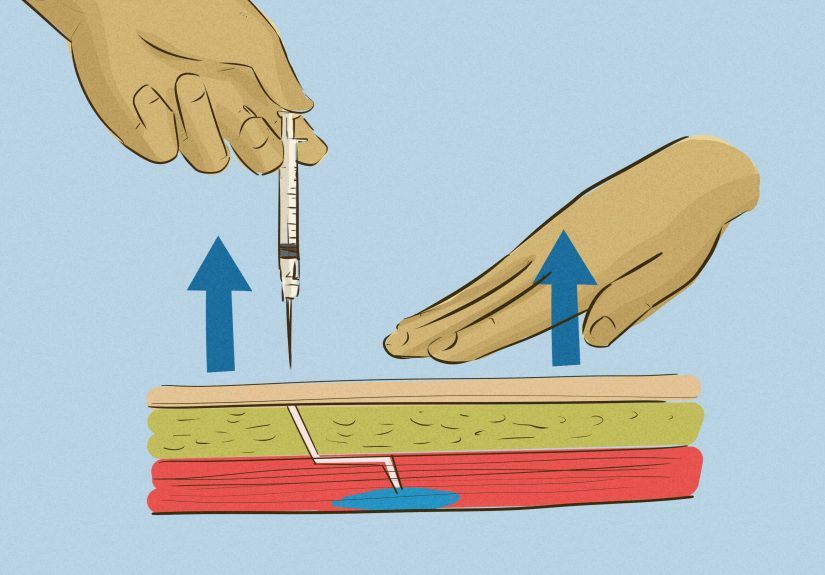
Hold the syringe like a dart and insert the needle with a quick, controlled motion straight into the muscle at a 90-degree angle. Your clinician may have taught you to spread the skin flat or to gently hold the muscle depending on your build and the medication. Follow the technique you were personally shown.
Step 8: Inject the Medication Slowly and Steadily
Push the plunger down in a smooth, controlled way. No need to rush. No need to perform for speed. Slow and steady is the grown-up version of bravery here.
For many modern IM injections, especially vaccines, routine aspiration is not recommended. However, some medication-specific instructions may differ. Follow your product directions and your clinician’s training rather than internet folklore passed down from the age of flip phones.
Step 9: Remove the Needle and Apply Gentle Pressure
Pull the needle straight out, then place gauze or a cotton ball over the site and apply gentle pressure. A tiny drop of blood is not unusual. Use a bandage if needed. Do not rub or massage the area unless your care team specifically told you that it is okay for your medication.
Step 10: Dispose of the Needle Immediately
Put the used needle and syringe directly into a sharps container right away. Do not recap the needle, bend it, or leave it sitting on the table while you “deal with it in a second.” That is how accidental sticks happen.
Common Mistakes to Avoid
- Using the wrong route, such as giving an IM medicine into fatty tissue by mistake
- Guessing the site instead of landmarking it properly
- Reusing needles or syringes
- Touching the needle or cleaned skin before the shot
- Injecting through skin that is bruised, infected, or painful
- Skipping site rotation when you are supposed to rotate
- Recapping a used needle
- Ignoring unclear instructions because “it probably means this”
One more big one: never change the needle size, site, or technique because a friend online said it worked for them. Your medication is not their medication, and your body is not their body.
Aftercare: What’s Normal and What’s Not
Some mild soreness, a small amount of bleeding, or temporary tenderness can be normal after an IM injection. Many people feel a dull ache for a few hours, especially with thicker medications. That alone is not usually a reason to panic.
Call your healthcare provider promptly if you notice:
- Increasing redness, warmth, swelling, or red streaks
- Fever or chills
- Severe pain that keeps getting worse
- Numbness, tingling, or unusual weakness
- Persistent bleeding
- A hard lump that does not improve
- Hives, rash, or itching after the injection
Get emergency help right away if there is trouble breathing, swelling of the lips or tongue, fainting, or signs of a serious allergic reaction. That is not a “wait and see” situation.
Special Situations That Deserve Extra Caution
If you take blood thinners, have a bleeding disorder, have very low muscle mass, or have been told to avoid certain injection sites, talk with your clinician before giving the shot. The plan may still be perfectly manageable, but the technique may need to be adjusted for safety.
If the medication is new to you, ask for a supervised first dose whenever possible. Watching a trained clinician do the injection once, then doing one with them observing you, can flatten the learning curve fast. Confidence grows much better with coaching than with guesswork.
Real-Life Experiences With IM Injections: What People Often Learn the Hard Way
The most common first-time experience with intramuscular injections is not usually “Wow, that was painful.” It is “Wow, I was way more nervous than I needed to be.” The anticipation is often worse than the shot. People tend to imagine the needle in cinematic detail, rehearse every possible mistake, and then discover that the actual injection takes only a few seconds.
Many patients say the hardest part is building a routine. The first week can feel clumsy. You check the label three times, wash your hands like you are prepping for surgery, and spend five full minutes deciding whether the thigh looks more “correct” from one angle or another. Then, somewhere around injection number three or four, the process starts to feel less dramatic and more procedural. That is a good sign. Safe technique should become familiar, not thrilling.
Another common experience is realizing that tiny comfort measures matter a lot. People often report that a relaxed muscle makes a bigger difference than they expected. Sitting down, taking one slow breath, and letting the leg go loose can turn a tense, stingy shot into a much smoother one. Letting the alcohol dry fully helps too. So does having everything ready before you start. Hunting for gauze with one hand while holding a syringe in the other is nobody’s best moment.
Caregivers often describe a different emotional challenge: they are less worried about the injection itself and more worried about hurting someone they love. Parents, partners, and adult children giving IM shots at home sometimes feel guilty even when they are doing everything correctly. Over time, many of them say the injection becomes an act of care rather than a source of dread. The moment shifts from “I hate doing this” to “I know how to help.” That is a powerful change.
People who take long-term IM medications also become experts in practical details that textbooks do not always emphasize. They learn which chair gives the best angle, which time of day feels least rushed, how to rotate sites without overthinking it, and why a simple notes app can save them from forgetting where the last injection went. They also learn not to compare themselves to anyone else. Some people prefer the thigh forever. Some switch to the hip and never look back. Some still need a pep talk each time. All of that can be normal.
Perhaps the most useful shared experience is this: confidence usually comes after repetition, not before it. You do not need to feel fearless to give an IM injection correctly. You need a clear plan, the right supplies, proper training, and the willingness to slow down and follow the steps. The confidence part tends to show up later, often quietly. One day you notice that your hands are steadier, your setup is faster, and the shot no longer dominates your evening. That is progress.
And if you have a rough injection once, that does not mean you are bad at this. Maybe the muscle was tense. Maybe the angle felt awkward. Maybe you were tired. One imperfect experience does not cancel good technique. What matters is reviewing what happened, correcting anything that needs correcting, and reaching out to your nurse, doctor, or pharmacist when something does not feel right. The people who do best with home IM injections are not the ones who never ask questions. They are the ones who ask before a small uncertainty becomes a bigger problem.
Conclusion
Learning how to give an intramuscular injection can feel intimidating at first, but it becomes much more manageable once you focus on the basics: use the exact medication and route prescribed, choose the correct site, insert the needle at the proper angle, dispose of sharps safely, and pay attention to warning signs afterward. The goal is not to become casual about injections. The goal is to become calm, careful, and consistent.
When in doubt, use your healthcare team as your backup. Good IM injection technique is a skill, and skills improve with training, repetition, and clear instructions. No gold medal is awarded for guessing.