Table of Contents >> Show >> Hide
- Step 1: Set the plan (and gather the right supplies)
- Step 2: Build a box that can take a hit
- Step 3: Wrap each piece like it owes you money
- Step 4: Pack smart inside the box (no clinking, no shifting)
- Step 5: Double-box for shipping (the safest move for fragile items)
- Step 6: Label, insure, and ship with common sense
- Common mistakes (so you can laugh at them from a safe distance)
- Experience Notes: What this looks like in real life
- Conclusion
Shipping fine china or glassware is basically asking a bunch of fragile objects to survive a
cross-country obstacle course… inside a cardboard costume. The good news: with the right supplies
and a few pro-level packing habits, your plates and stemware can arrive in one pieceno matter
how enthusiastic the delivery truck feels about potholes.
This guide walks you through six practical steps used by movers and major carriers alike. It’s
written for real life: heirloom china, crystal glasses, wedding-gift goblets, or the “why did I buy
twelve champagne flutes?” collection. Let’s keep your breakables unbroken.
Step 1: Set the plan (and gather the right supplies)
Before you wrap a single saucer, do a quick “shipping reality check.” Your goal is to prevent
three things: impact (drops), crushing (heavy boxes stacked on yours),
and movement (items shifting inside the box).
Quick pre-flight checklist
- Decide what’s shipping-worthy: If something is irreplaceable, consider professional packing or hand-carrying it.
- Photograph the items: Take clear photos of each piece and any existing chipsuseful for insurance and peace of mind.
- Estimate value: Not to be dramatic, but this affects how you insure and how much padding you’ll happily “overdo.”
- Choose the shipping speed wisely: Faster shipping often means fewer transfers and less time in the system, which can reduce risk for fragile packages.
Supplies that actually help (and a few that don’t)
- Sturdy boxes: New, rigid corrugated boxes. For dishes, use specialty dish-pack or double-wall boxes when possible.
- Smaller inner boxes: Especially helpful for cups, teacups, and single fragile pieces.
- Packing paper: Clean, ink-free paper is the MVP for china and glass.
- Bubble wrap or foam sheet: For extra cushioning (great for glass and irregular shapes).
- Cardboard dividers / cell kits: Ideal for stemware and glasses to keep pieces separated.
- Void fill: Crumpled paper, foam, or other filler to eliminate empty space.
- Strong packing tape: Use quality tape and don’t be shy with it.
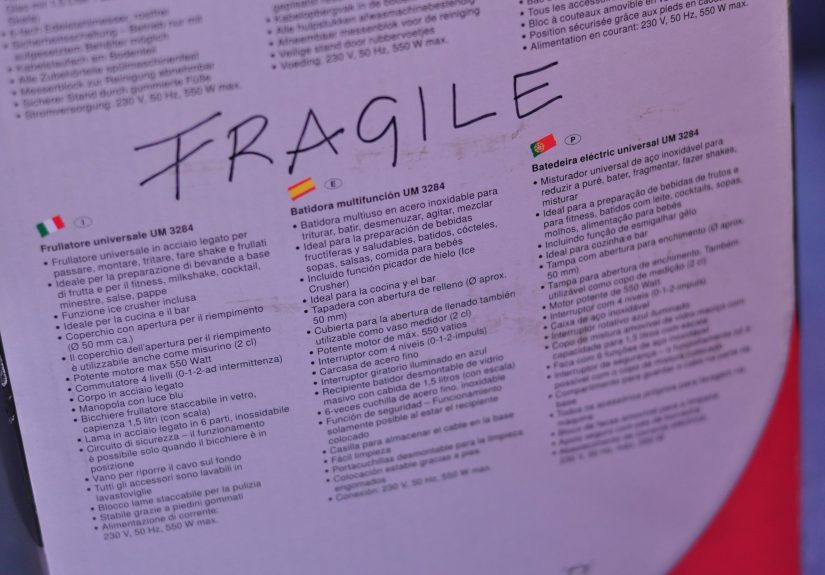
- Marker + labels: “FRAGILE,” “THIS SIDE UP,” and an item list on the outside.
One thing to avoid: “mystery boxes” from the garage that have already lived a hard life.
Cardboard gets weaker after prior shipping, moisture, and time. For fragile shipping, strength is not optional.
Step 2: Build a box that can take a hit
A box isn’t just a containerit’s a shock absorber. Your china shouldn’t touch the box walls,
and it definitely shouldn’t be able to slide around and high-five the corners.
How to prep the box
- Reinforce the bottom: Tape the bottom seam, then tape across it again in a big “H” pattern.
- Create a cushioned base: Add a thick layer of crumpled packing paper, foam, or bubble wrap at the bottom.
- Use the right size box: You want room for paddingbut not a cavern where items can gain momentum.
Pro tip: if you’re packing plates or heavier serving pieces, pick a box that won’t become a
60-pound “fragile boulder.” Heavier boxes are more likely to be droppedby good people having a bad day.
For dishware, multiple smaller boxes beat one giant backbreaker.
Step 3: Wrap each piece like it owes you money
The safest rule is simple: every piece gets wrapped individually. Fine china scratches.
Glass cracks. Handles snap. Wrapping is what stands between your heirloom teacup and a tragic rattle-fest.
How to wrap plates and saucers
- Lay several sheets of packing paper flat.
- Place the plate in the center and wrap corner-to-corner, tucking neatly as you go.
- Add a second wrap for fine china or anything with metallic trim.
- Optional: add a bubble-wrap layer for extra insurance, especially for long-distance shipping.
How to wrap bowls
- Wrap each bowl individually in packing paper.
- If you nest bowls, place paper between each bowl, then wrap the entire stack again.
- Don’t nest a delicate decorative bowl with heavier stonewareseparate them like rival siblings.
How to wrap cups, mugs, and teacups (handles are the drama)
- Stuff the inside lightly with paper for support.
- Wrap the handle area with extra paper or foam first.
- Wrap the full cup and secure with a final layer.
How to wrap stemware and wine glasses
- Stuff the bowl with packing paper (gentle support, not a paper-weightlifting contest).
- Wrap the stem with extra paddingthis is the most common failure point.
- Wrap the entire glass with bubble wrap or foam, then paper as needed for stability.
- Use dividers/cells whenever possible so glasses can’t touch each other.
If you’re shipping something especially delicate (crystal, etched glass, thin porcelain),
treat it like a solo artist: its own wrap, its own space, and enough cushioning that it can survive
a small meteor strike (or at least a conveyor belt).
Step 4: Pack smart inside the box (no clinking, no shifting)
Now we assemble the “no-break” puzzle. The packing goal is separation and stability:
items shouldn’t touch each other, and the whole box should feel like one solid unitnot a maraca.
Best practices for loading dishware
- Plates go on their edges: Pack them vertically, like records or like you’re loading a dishwasher. This reduces pressure cracks.
- Heaviest pieces at the bottom: Large plates, platters, and heavier items form the base.
- Fill every gap: Use crumpled paper or foam to eliminate empty space between items and at the sides.
- Top it off with padding: Add a final cushion layer before closing.
Best practices for glassware
- Use dividers/cells: They isolate glasses so they can’t collide.
- Place glasses upside down: This can help protect rims (and it’s a common mover method).
- Keep handles facing the same way: For mugs and cups, consistent orientation reduces pressure points.
- Center everything away from walls: Your items should be buffered from every side of the box.
Do the “shake test”
Before you seal, gently lift and tilt the box. If you feel movement, you have homework:
open it back up and add void fill until nothing shifts. Movement is the silent villain of shipping.
Step 5: Double-box for shipping (the safest move for fragile items)
If you’re shipping fine china or glassware through a carrier network (rather than moving it yourself),
double boxing is one of the most reliable ways to reduce breakage. Think of it as a box wearing a helmet.
How to double-box correctly
- Pack the item(s) in a smaller inner box with padding so nothing moves.
- Choose a larger outer box that allows room on all sides for cushioning.
- Add a thick cushion layer at the bottom of the outer box (paper, foam, bubble wrap).
- Center the inner box inside the outer boxkeep it away from edges and corners.
- Fill all sides and the top with cushioning so the inner box can’t shift.
For truly fragile shipments (crystal stemware, antique porcelain, delicate figurines),
double boxing is less “extra” and more “basic survival strategy.” It also helps protect against
crushing forces when other packages are stacked nearby.
Seal like you mean it
- Use quality shipping tape.
- Tape all seams, especially the center seam, using an H-taping method (top and bottom).
- If the box has hand holes or weak spots, reinforce them with extra tape.
Step 6: Label, insure, and ship with common sense
You can pack perfectly and still lose to chaos if you skip the final step: shipping strategy.
Labels don’t guarantee gentle handling, but they help. Insurance doesn’t prevent damage,
but it can prevent heartbreak turning into an expensive lesson.
Labeling that helps handlers (and future you)
- Mark “FRAGILE” on multiple sides.
- Add “THIS SIDE UP” arrows when orientation matters.
- Write the room or contents category (e.g., “KitchenChinaOpen First”).
- Include an item list on the outside and a copy inside the box.
Shipping choices that reduce risk
- Use a service level that fits the item: For high-value fragile shipments, consider faster delivery and signature confirmation.
- Insure appropriately: If the contents would ruin your week to replace, insure them and keep documentation/photos.
- Avoid peak chaos if you can: Holidays and major sale weeks mean more volume, more handling, and more opportunities for things to go sideways.
- Consider professional packing for heirlooms: Pack-and-ship stores can be worth it for high-value pieces.
Finally: if you’re shipping multiple boxes, number them (“Box 1 of 3,” etc.). It’s a small detail that helps
when tracking and receivingespecially if your dishes are going to a new home, a storage unit, or a customer.
Common mistakes (so you can laugh at them from a safe distance)
- Using one giant box: Heavy boxes get dropped. Smaller boxes are safer and easier to pad properly.
- Skipping void fill: Empty space becomes momentum during transit.
- Letting items touch: Contact points = chips, cracks, and “why is there glittering dust in my box?”
- Reusing weak boxes: A tired box is a betrayal waiting to happen.
- Trusting a single “FRAGILE” sticker: Stickers don’t stop physics. Padding does.
Experience Notes: What this looks like in real life
Reading packing steps is one thing. Actually packing fine china or glassware is… an emotional sport.
Below are a few realistic scenariosbased on the kinds of situations people commonly faceplus what tends
to work best when the stakes feel high.
Scenario 1: “It’s my wedding china and I’m terrified.”
Wedding china tends to be both fragile and sentimental, which is the worst (and most relatable) combination.
In this scenario, the smartest approach is to pack it in smaller batches: one box for dinner plates, one for
salad plates, one for bowls, and so on. The big win is preventing weight from building up in a single carton.
Plates do best on their edges with thick padding between clusters, and handles (teacups especially) get the
“VIP treatment” with extra wrap. People who have the smoothest outcomes usually do two things:
they take photos as they go (so they can recreate the set later), and they create an inventory list that goes
inside the box in case the outer label smears or tears. It sounds fussyuntil you’re unpacking and instantly
know what’s where.
Scenario 2: “I shipped glasses once and it sounded like a tambourine.”
That tambourine sound is your clue that the box has become a tiny concert venue. When glassware breaks,
it’s rarely because someone “hates your package.” It’s usually because the items had room to move and
lightly knock together over and over until tiny fractures became a full snap. The fix is almost always void fill
plus separation: each glass wrapped individually, placed in a divider cell, and cushioned so it can’t wobble.
Stuffing the bowl with paper gives the glass internal support, which helps prevent collapse if there’s pressure.
People who ship glassware safely tend to treat “no movement” as the rule, not the goal. If the box moves
even a little during the shake test, it gets reopened and correctedeven if that means adding more padding
than feels reasonable. (This is the moment you realize packing paper is cheaper than replacement crystal.)
Scenario 3: “We’re moving cross-country and the truck is already booked.”
Cross-country moves add time, vibration, temperature changes, and lots of lifting. The most reliable strategy
here is dish-pack or double-wall boxes, packed in layers: heavy on the bottom, lighter on top, and paper or
foam filling every gap. A common success move is using cell dividers for glassware and a rigid cardboard pad
between levels. It prevents pieces from “settling” into each other as the box gets jostled. Another good habit:
keeping the number of boxes higher but the weight per box lower. That reduces drops, makes stacking safer,
and gives you more control over how fragile items are handled. In real-world moves, the people who report the
fewest breakages are the ones who avoid shortcutsespecially the shortcut where you think, “It’s probably fine.”
(It’s always “probably fine” until it’s confetti.)
Scenario 4: “I’m shipping a single heirloom piece to a family member.”
Shipping one special piecea crystal decanter, an antique teapot, a hand-painted serving platteroften calls
for the strongest approach: wrap, inner box, then double box with generous cushioning around the inner box.
The reason is simple: a single object inside a large box tends to slide and slam if there’s open space.
Double boxing creates a stable center where the inner box can’t touch the outer walls, even if the package gets
bumped. The most consistent “happy ending” pattern is packing the item so it’s suspended in cushioning:
nothing touches the box walls, and there’s padding on every side like a protective moat. People also have better
outcomes when they choose signature confirmation for truly irreplaceable itemsbecause fewer porch adventures
usually means fewer accidents.
In every scenario, the lesson is the same: shipping success is mostly a game of controlling movement and
absorbing impact. If you can stop clinking, eliminate empty space, and build a cushioned barrier between your
valuables and the outside world, you’re doing what the pros dojust with less jargon and more tape.
Conclusion
Packing and shipping fine china or glassware isn’t about luckit’s about engineering a tiny, padded world
where nothing can shift, touch, or crack under pressure. Use clean packing paper, wrap pieces individually,
pack plates on edge, fill every gap, and double-box anything you’d be devastated to replace. Add smart labeling,
reasonable insurance, and a shipping service that matches the value of what’s inside. Your future self (and your
dishes) will thank you.