Table of Contents >> Show >> Hide
- First, Know What “Real Turquoise” Actually Means
- 1. Look at the Color Closely
- 2. Study the Matrix, Not Just the Blue Part
- 3. Check for Dye Buildup in Cracks and Drill Holes
- 4. Pay Attention to Surface Texture and Luster
- 5. Consider the Price Without Letting Wishful Thinking Drive
- 6. Ask What Treatments Have Been Used
- 7. Compare It to Common Turquoise Look-Alikes
- 8. Think About Durability and Wear Patterns
- 9. For Expensive Pieces, Get Documentation or a Gemologist’s Opinion
- Quick Real-World Checklist Before You Buy
- Common Mistakes Buyers Make
- Final Thoughts
- Experience and Buying Stories: What People Often Notice in Real Life
- SEO Tags
Turquoise has one of those colors that can stop you mid-scroll, mid-conversation, and possibly mid-budget. It is bright, earthy, historic, and wildly popular in rings, cuffs, necklaces, beads, and Southwest-inspired jewelry. It is also one of the most imitated stones on the market. That means a piece can look absolutely gorgeous and still be plastic, dyed howlite, dyed magnesite, glass, composite material, or genuine turquoise that has been treated so heavily it barely resembles its original self.
So how do you tell if turquoise is real? Not by squinting dramatically and whispering, “I have a feeling.” You need a smarter checklist. Real turquoise has patterns, color behavior, texture, density, and wear traits that usually make sense once you know what to look for. The trick is understanding that “real,” “natural,” “stabilized,” “dyed,” and “reconstituted” are not interchangeable words. In the turquoise world, those details matter a lot.
This guide breaks down 9 things to look for when identifying real turquoise, plus practical buying advice so you do not end up paying gemstone money for what is basically an overachieving bead.
First, Know What “Real Turquoise” Actually Means
Before you inspect color, matrix, or price, get clear on the vocabulary. A stone can be genuine turquoise and still be treated. That is common. Turquoise is naturally porous, and many stones are stabilized with resin or polymer to improve durability and color. Some are also dyed. Others are made from small turquoise fragments bonded together into reconstituted or composite turquoise.
If you want the most collectible form, you are usually looking for natural turquoise with minimal or no treatment. If you simply want a beautiful stone for everyday wear, stabilized turquoise may still be a good choice. The issue is not that treatment exists. The issue is whether the seller tells you the truth.
1. Look at the Color Closely
Real turquoise usually falls somewhere between sky blue, robin’s-egg blue, blue-green, and greenish blue. The color can be even, but it often has subtle variation. Natural stones rarely look like they were filled in with a single bright marker from edge to edge.
If the stone is an extremely saturated electric blue with no soft areas, no tonal shift, and no visual depth, be cautious. Dyed howlite and magnesite often show a very uniform, almost too-perfect color. That “wow” factor can be the exact reason you should slow down.
That said, do not make the mistake of thinking all uniform turquoise is fake. Some high-grade material is naturally clean and evenly colored. The better question is this: Does the color look believable for a mineral, or does it look manufactured?
2. Study the Matrix, Not Just the Blue Part
Matrix is the host rock or veining that appears as webs, patches, or lines in turquoise. In natural stones, matrix patterns often look irregular and organic. They may be thin in one area, clustered in another, and slightly uneven the way nature usually prefers to operate.
Fake or imitation turquoise may have matrix lines that look too black, too sharp, too repetitive, or suspiciously decorative. If every vein looks evenly spaced like it was designed by a very tidy robot, that is a clue. Some imitation beads even have printed or artificially enhanced matrix patterns to mimic spiderweb turquoise.
Natural matrix is not always present, so a lack of matrix does not prove a stone is fake. Some prized turquoise is known for its clean, uninterrupted blue. But when matrix does appear, it should generally look random rather than rehearsed.
3. Check for Dye Buildup in Cracks and Drill Holes
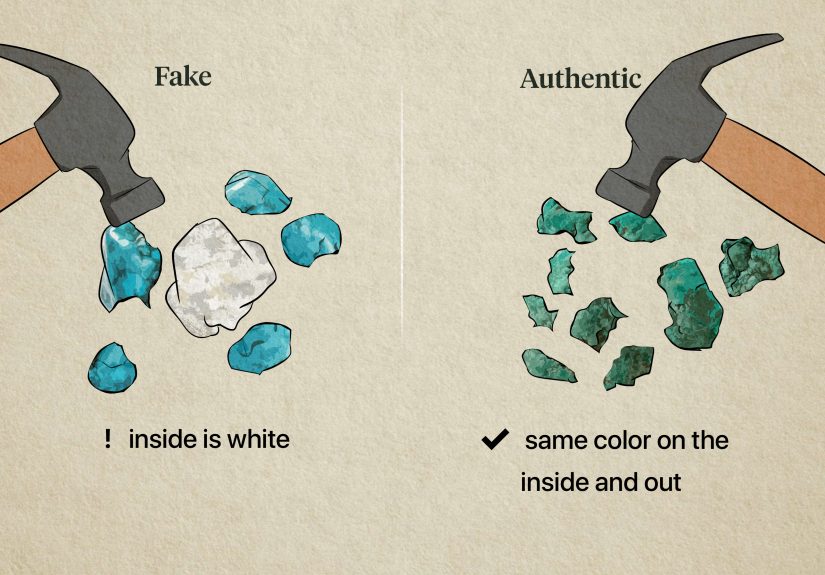
This is one of the most practical things to look for, especially with beads and cabochons. If a stone has been dyed, the color often gathers in tiny cracks, pits, porous spots, or around drill holes. Use a loupe or magnifying glass and inspect the edges carefully.
If the color looks darker near fractures or the inside of the bead hole is much more intense than the outside surface, the stone may be dyed. This does not always mean there is zero turquoise present, but it does mean the appearance has likely been enhanced.
Think of it like cheap hair dye on a white towel. The extra color always seems to confess somewhere.
4. Pay Attention to Surface Texture and Luster
Real turquoise is usually cut into smooth cabochons, beads, or inlay, but under magnification it may show a slightly waxy to sub-vitreous luster rather than a super-glassy shine. Because turquoise is porous, untreated stones can look a little softer or chalkier than synthetic imitations.
Plastic fakes may appear too smooth, too lightweight, and oddly uniform. Glass imitations can look overly glossy and sometimes reveal bubbles or a very slick, manufactured finish. Composite material may show an unnatural “packed together” look, especially at edges where small fragments seem fused into one mass.
In short, real turquoise should look polished, but not plastic-perfect.
5. Consider the Price Without Letting Wishful Thinking Drive
A bargain is fun. A miracle is usually a warning label.
Fine natural turquoise, especially with attractive color and desirable origin characteristics, is not usually sold at garage-sale prices in a luxury setting. If a seller is offering a large “natural turquoise” cuff for a suspiciously tiny price, ask why. Then ask again.
This does not mean affordable turquoise is automatically fake. Stabilized turquoise, lower-grade turquoise, small beads, or mass-market pieces can be reasonably priced. But if a seller claims a stone is rare, untreated, high-grade, and old-mine quality while pricing it like costume jewelry, skepticism is not rude. It is financial self-defense.
6. Ask What Treatments Have Been Used
This is where smart buyers separate themselves from impulse buyers. Ask directly whether the stone is:
- Natural and untreated
- Stabilized
- Dyed
- Reconstituted or composite
- Synthetic or imitation
A reputable seller should be able to answer without acting like you just requested nuclear launch codes. In the jewelry trade, treatment disclosure matters. If the response is vague, defensive, or full of creative storytelling, treat that as useful information.
One of the biggest shopping mistakes is assuming “genuine” means untreated. It often does not. A stone can be genuine turquoise and still be stabilized. That may be perfectly acceptable, but you should know what you are paying for.
7. Compare It to Common Turquoise Look-Alikes
Many buyers do not lose money because the fake is brilliant. They lose money because they never compare it to the usual suspects.
Dyed Howlite
Howlite is white to gray with veining and takes dye very easily. Once dyed blue, it can look surprisingly convincing to beginners.
Dyed Magnesite
Magnesite also has a porous structure and can be dyed to imitate turquoise. It often appears in beads and lower-cost jewelry.
Plastic and Resin
These are often too light in weight and may feel warmer to the touch more quickly than stone. They can also have a flat, slightly toy-like appearance.
Glass
Glass imitations may look too glossy or reveal bubbles under magnification.
Composite or Reconstituted Material
This may contain real turquoise fragments, but the final product is bonded together with resin or other material. It is not the same as a solid natural stone.
If you learn the look of these imitations, your odds of spotting questionable turquoise improve fast.
8. Think About Durability and Wear Patterns
Turquoise is not diamond-tough. It is a relatively soft gemstone, usually topping out around Mohs 5 to 6. That means real turquoise can show wear over time, especially in rings and bracelets that get knocked around during everyday life.
If you are looking at a vintage piece, slight wear may actually be believable. A supposedly old turquoise stone that looks unnaturally hard, hyper-glossy, and completely untouched can sometimes point to imitation or heavy treatment.
At the same time, do not start scratching jewelry to “test” it. That is a great way to damage a real stone, annoy a seller, and accidentally turn yourself into the villain of the jewelry counter. Non-destructive inspection is always the better move.
9. For Expensive Pieces, Get Documentation or a Gemologist’s Opinion
When the price climbs, guessing should leave the building.
If you are buying a high-value ring, collector-grade cabochon, or a piece being marketed as natural untreated turquoise, ask for documentation. A lab report, appraisal, or an opinion from a trained gemologist can save you from an expensive mistake.
This is especially important because some treatments are difficult to detect with the naked eye. Certain stabilization methods and proprietary processes can make turquoise look very convincing. In other words, your eyeballs are helpful, but they are not a laboratory.
Quick Real-World Checklist Before You Buy
- Does the color look natural rather than neon or overly uniform?
- Does the matrix look organic instead of repeated or painted on?
- Do drill holes or cracks show signs of dye concentration?
- Does the surface look stone-like rather than plastic-slick or glassy?
- Is the price believable for what is being claimed?
- Has the seller clearly disclosed treatments?
- Could it be howlite, magnesite, glass, resin, or composite material?
- Does the wear pattern make sense for real turquoise?
- Is there documentation for expensive pieces?
Common Mistakes Buyers Make
The first mistake is buying based on color alone. Turquoise is famous for its color, but color is also what scammers imitate first.
The second mistake is assuming all treatments are bad. Stabilization is common and can make turquoise more wearable. What matters is honest disclosure and fair pricing.
The third mistake is believing every stone with matrix is natural. Fake matrix exists. Dyed stones exist. Composite stones exist. The presence of black lines is not a magic certificate from the geology gods.
The fourth mistake is skipping the seller conversation. Ask questions. A trustworthy seller should welcome them.
Final Thoughts
If you want to tell whether turquoise is real, think like a careful observer, not a gambler. Check the color, matrix, drill holes, texture, price, treatment history, common look-alikes, wear pattern, and documentation. No single clue proves everything, but several clues together can paint a very clear picture.
The best turquoise buyers are not the ones with mystical gemstone powers. They are the ones who slow down, inspect carefully, ask smart questions, and know that a stone can be beautiful without being exactly what the label claims. And honestly, that is a pretty solid life skill far beyond jewelry.
Experience and Buying Stories: What People Often Notice in Real Life
A lot of people first learn about fake turquoise the frustrating way: by buying something that looked amazing online and then opening the package to find beads that seem a little too bright, a little too light, and a little too suspiciously perfect. In photos, imitation turquoise can be stunning. Under real lighting, though, the cracks often start to show. The blue may look flat instead of rich. The matrix may appear printed instead of natural. The piece may feel more like a fashion accessory than a mineral specimen.
One common experience happens at flea markets, gift shops, and tourist stops. A seller may describe a bracelet as “natural Southwestern turquoise” while offering no details about treatment, mine, or source. The piece looks attractive, but every stone is the exact same color and every black line is nearly identical. Buyers often realize later that the stones were likely dyed howlite or composite material. The jewelry was still wearable, but it was not what they thought they were buying.
Another common situation shows up in family jewelry boxes. Someone inherits a ring from a relative and assumes it must be valuable because it is old. Sometimes that turns out to be true. Other times the stone is genuine but heavily treated, or it is an older imitation material that was popular in its own era. Age alone does not confirm authenticity. Vintage pieces still need the same careful inspection as modern ones.
Collectors and longtime jewelry shoppers often say the biggest turning point came when they stopped asking, “Is it pretty?” and started asking, “Does it make sense?” Does the price make sense? Does the seller’s explanation make sense? Does the matrix make sense? Does the condition match the claimed age? That mindset saves people from a surprising number of bad purchases.
People who buy turquoise frequently also learn that there is a huge difference between disappointment and disaster. Buying a stabilized turquoise ring for a fair price and loving how it looks is not a disaster. Buying dyed magnesite at natural turquoise prices is. The real goal is not perfection. It is accurate information.
Experienced buyers also tend to rely less on dramatic home tests and more on observation. They do not scrape, stab, soak, or otherwise attack the jewelry. Instead, they use a loupe, compare similar stones, ask direct questions, and buy from sellers who disclose treatment clearly. That approach is less exciting than a fake internet “hack,” but it is much better for the stone and for your wallet.
Over time, people often develop a feel for real turquoise. Natural pieces usually have a kind of visual complexity that imitations struggle to copy. The color has subtle variation. The surface has depth. The matrix, when present, feels unplanned in a convincing way. It is not magic. It is pattern recognition built through careful looking. And once you see the difference a few times, it gets a lot harder to unsee it.