Table of Contents >> Show >> Hide
- Before You Start: The “Two-Minute Rule”
- Step 1) Sanity-check the seller (and the deal)
- Step 2) Check the box label like it owes you money
- Step 3) Verify the size tag (inside the shoe)
- Step 4) Inspect the Primeknit pattern (the “fabric fingerprint”)
- Step 5) Feel the Boost (yes, literally poke it)
- Step 6) Study the outsole and midsole details
- Step 7) Look at the overall shape (silhouette doesn’t lie)
- Step 8) Examine stitching and seam quality
- Step 9) Check the pull tab (if your model has one)
- Step 10) Do the “inside job” inspection (insole, lining, smell)
- Step 11) Compare with a trusted reference (the “truth mirror”)
- Common Fake Yeezy Scams (so you don’t get got)
- When to Stop Playing Detective and Use Authentication
- Conclusion
- Extra: Real-World Yeezy Legit-Check Experiences
Buying Yeezys in 2026 can feel like adopting a rare panda: adorable, expensive, and there’s a non-zero chance someone hands you a raccoon in eyeliner.
Counterfeiters are good. Sometimes scarily good. But the good news? Real Yeezys still have tellstiny, nerdy details that fake factories
struggle to nail consistently.
This guide walks you through 11 practical checks you can do at home (no lab coat required). Use it whether you’re eyeing a pair of
Yeezy Boost 350 V2, 700s, or slides. And remember: one “red flag” isn’t always a convictionwhat you’re hunting is a pattern of
weirdness.
Before You Start: The “Two-Minute Rule”
Do a fast scan first. If the seller story is messy, the price is unreal, and the photos look like they were taken inside a witness protection
program (blurry, dim, suspiciously cropped), don’t even bother counting stitches. Walk away. Authentic pairs don’t need mystery.
Step 1) Sanity-check the seller (and the deal)
What to look for
- Price that’s too good: “Brand new, deadstock, half off” is usually a fairy tale.
- Clean paper trail: Original order confirmation, receipts, or verified marketplace history.
- Consistent details: Size, colorway name, and style code match across listing, box, and tags.
Real pairs can be found below market occasionallybut “too good” plus “no returns” plus “pay me in gift cards” is basically a counterfeit haiku.
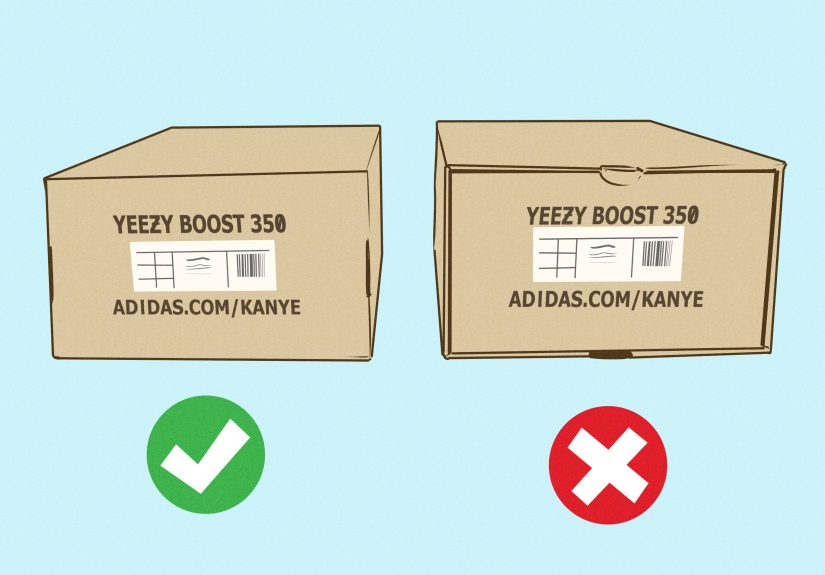
Step 2) Check the box label like it owes you money
What to look for
- Style code, size, and colorway printed cleanlyno fuzzy ink, no crooked alignment.
- Spacing and font consistency: Fakes often look “close enough” until you compare letters side-by-side.
- Sticker placement: Slapped on at an odd angle or partially peeling can be suspicious (not alwaysshipping happens).
Pro tip: a real box doesn’t guarantee real shoes. Box swaps are a classic move. The box is evidencenot a verdict.
Step 3) Verify the size tag (inside the shoe)
What to look for
- Print sharpness: Authentic size tags usually have crisp edges and clean spacing.
- Correct formatting: Country sizing order and spacing should look intentional, not improvised.
- Serial code behavior: On many authentic Yeezy pairs, the serial code differs between the left and right shoe.
If both shoes have the exact same serial code, that’s a big side-eye moment. Not every model/year behaves identically, but duplicated codes are a
repeat offender in fake-land.
Step 4) Inspect the Primeknit pattern (the “fabric fingerprint”)
Yeezys aren’t just “knit.” They’re engineered knit. The pattern, density, and transitions should look purposeful. Fakes often miss
subtle geometry or look printed instead of woven.
If your pair has SPLY-350 text
- Letter shapes: Look closely at curves, thickness, and spacing (the “S” and “3” are common giveaway zones).
- Weave integration: On authentic pairs, the text tends to feel integratednot like a cheap overlay.
Step 5) Feel the Boost (yes, literally poke it)
Boost is famous for that “bouncy-yet-supportive” feel. When you press it, it should compress and reboundnot feel like stiff plastic or dead foam.
Also, the Boost texture matters: genuine Boost tends to show a more “bubbly” pellet structure.
What to look for
- Texture: Real Boost often looks like tightly packed pellets; fakes may look smoother or oddly glossy.
- Rebound: Press with your thumbauthentic pairs should spring back.
- Consistency: Weird patches, uneven firmness, or “squeaky toy” vibes are suspicious.
Step 6) Study the outsole and midsole details
This is where counterfeiters either do great… or get lazy because they assume you won’t turn the shoe over. Prove them wrong.
What to look for
- Ribbing precision: Edges and tips should look rounded and consistent, not chunky or flat.
- Clean molding: Random roughness, warping, or sloppy lines can be a tell.
- Color accuracy: Slight variance happens, but “why is this butter-yellow?” should trigger questions.
Step 7) Look at the overall shape (silhouette doesn’t lie)
Authentic Yeezys have a recognizable stance: toe shape, heel curve, and collar height tend to sit a certain way. Many fakes look subtly “off”like
they’re wearing a disguise that almost fits.
Quick shape checks
- Toe box: Not overly bulbous, not collapsed like a sad pancake.
- Heel profile: Should look structured with a natural curvenot a straight wall.
- Side profile: The shoe should look balanced, not like it’s leaning forward in existential dread.
Step 8) Examine stitching and seam quality
Sloppy stitching is one of the most common counterfeit shortcuts because it’s time-consuming to do right. On authentic pairs, stitching is usually
neat, consistent, and intentionalespecially on the heel seam and key joins.
What to look for
- Even spacing: No random gaps or sudden tight/loose shifts.
- No loose threads: One stray thread can happen, but a fringe festival is suspicious.
- Minimal glue mess: Some glue is normal; heavy residue suggests poor construction.
Step 9) Check the pull tab (if your model has one)
Pull tabs are smallbut they’re a quality checkpoint. Authentic pairs typically have strong material, clean edges, and tidy stitching.
What to look for
- Center stitching: Should look straight and reinforced.
- Angle and placement: Tabs that sit oddly high/low or look crooked can be a red flag.
- Weave quality: Cheap tabs often look thin or flimsy.
Step 10) Do the “inside job” inspection (insole, lining, smell)
Time to get personal. Remove the insole if possible and look at printing quality, foam cut, and lining finish.
Thenyesdo a quick smell check. Authenticators sometimes use scent as one data point, because certain chemical/glue smells can be telling.
You’re not trying to inhale your sneakers like they’re fresh cookies, but a strong “chemical factory” smell can be suspicious.
What to look for
- Insole print: Clean, not smudged; logo placement looks deliberate.
- Lining: Even, not wrinkly or poorly glued.
- Odor: Overpowering sharp chemical smell can be a clue (not a standalone verdict).
Step 11) Compare with a trusted reference (the “truth mirror”)
The fastest way to spot a fake is comparison. Pull up official product images or listings from trusted platforms with authentication and compare:
toe shape, knit pattern, Boost window look, label formatting, and outsole details. Even high-quality replicas usually slip somewhere when you compare
multiple angles.
Best comparison habits
- Compare your exact colorway and style code (not “close enough”).
- Use multiple photos: lateral, medial, heel, outsole, size tag, box label.
- Look for clusters of inconsistenciesnot just one tiny mismatch.
Common Fake Yeezy Scams (so you don’t get got)
- The Box Swap: Real box + fake shoes inside.
- The Photo Switch: Listing shows authentic pair; you receive a different one.
- The Sponsored Trap: Social ads that look “official” but push counterfeits.
- The “Authentication Screenshot”: Random, unverifiable screenshot used as “proof.”
When to Stop Playing Detective and Use Authentication
If the pair is expensive, rare, or you’re buying from a stranger on the internet, professional authentication can be worth it. Major marketplaces
and services use multi-point inspections, and some use technology-assisted methods (like image databases and microscopic scanning) to catch subtle
inconsistencies. Translation: you can absolutely learn to legit check, but you don’t have to become Sherlock every time you want shoes.
Conclusion
Spotting fake Yeezys is less about one “magic test” and more about stacking evidence. Start with the seller and the story, then move to the
hard-to-fake details: size tags, Primeknit pattern, Boost texture, outsole precision, and overall shape. If several things feel off, trust your gut.
The best deal is the one that doesn’t leave you stuck with $200 “Yeezys” that squeak like supermarket flip-flops.
Extra: Real-World Yeezy Legit-Check Experiences
Sneaker culture has a special kind of drama: the kind where adults argue about the curvature of a knitted letter “S” like it’s a Supreme Court case.
And honestly? That’s why fake-checking Yeezys is both frustrating and weirdly fun.
One of the most common “I knew it” moments sneakerheads talk about is the feel test. Not the “walk around your living room like a
runway model” testmore like the thumb press into the midsole. People describe authentic Boost as having that distinct pellet look and rebound that
feels lively, while some fakes feel oddly stiff or plasticky. The difference can be subtle, but when you’ve handled a few pairs, your hands start to
recognize it the way your brain recognizes your own phone buzzing. You don’t need to overthink ityou just notice.
Another classic story: someone buys a pair that comes with a gorgeous, perfect-looking box… and that’s exactly the problem. The box looks so
convincing that buyers relax and stop checking. But box swaps happen. A real box is easy to source, especially for popular models. So experienced
buyers treat the box like a movie trailer: exciting, but not the full plot. They still go straight for the size tag, the serial behavior, and the
knit pattern.
Then there’s the photo trap, which is basically the sneaker version of catfishing. Listings can show a real pairgreat lighting,
perfect angles, close-ups of the size tag. But what arrives is “cousin Yeezy,” similar enough that you briefly question your own sanity. That’s why
seasoned buyers insist on timestamped photos (today’s date, seller’s username) and specific angles on request. The seller’s reaction matters: an
honest seller usually complies; a sketchy one suddenly becomes allergic to cameras.
Social media adds another layer. People see slick ads or sponsored posts offering “Yeezy 350 $119” and think, “Wow, a miracle!” But miracles don’t
usually come with a checkout page that looks like it was built during a long layover. A lot of sneaker fans learn this the hard way: if the price is
suspiciously low and the site isn’t a known retailer or authenticated marketplace, you’re not shoppingyou’re gambling.
And yes, the smell test comes up a lot. It sounds ridiculous until you realize serious authenticators sometimes use it as one small
signal among many. Some fakes arrive with an intense chemical odor that doesn’t fade quickly, and buyers describe it as the difference between “new
shoes smell” and “industrial adhesive convention.” Is smell enough to prove anything? No. But combined with messy stitching, weird tags, and off
shape, it becomes part of the bigger picture.
The most useful “experience-based” lesson is also the least glamorous: compare everything. People who get good at spotting fake
Yeezys usually aren’t born with magical sneaker visionthey’ve simply compared lots of pairs, lots of photos, and lots of tiny details. Over time,
your brain starts to build a reference library. You stop asking, “Is this fake?” and start asking, “Why does this look… slightly wrong?” That’s the
moment you level up.
Bottom line: legit-checking is a skill, not a vibe. Take your time, stack evidence, and don’t be afraid to walk away. The best flex isn’t a
bargainit’s confidence.