Table of Contents >> Show >> Hide
- What a Miter Saw Does (and Doesn’t) Do
- Know Your Saw: Types and Why It Matters
- Safety First: The Rules That Keep Your Weekend Fun
- Set Up Your Station Like You Mean It
- The Core Method: How to Make a Cut (Step-by-Step)
- Common Cuts You’ll Actually Use
- Repeatable Cuts: Stop Blocks, Jigs, and “Make 12 Pieces Exactly the Same”
- Pro-Level Habits That Make Your Cuts Cleaner (and Your Life Easier)
- Troubleshooting: When Your Cuts Are “Almost” Right
- Basic Maintenance (Because Future You Deserves Nice Things)
- Conclusion: Cut Confidently, Not Casually
- Experiences: Real-World Lessons from Using a Miter Saw (About )
There are two types of people in this world: those who love perfectly crisp trim corners, and those who “eyeball it” and then invent creative ways to hide gaps with caulk. If you’d like to join Team Crisp Corner (and keep all ten fingers), a miter saw is your best friendpowerful, precise, and just dramatic enough to deserve a little respect.
This guide walks you through using a miter saw safely and correctly, from setup to common cuts (crosscuts, miters, bevels, and the “wait, why is my angle backward?” moments). We’ll also cover real-world tricksstop blocks, sacrificial fences, and the small habits that separate “DIY confident” from “DIY… we’ll fix it later.”
What a Miter Saw Does (and Doesn’t) Do
A miter saw is built for accurate crosscutscuts across the width of a board. That includes:
- Straight crosscuts (90°)
- Miter cuts (the table swings left/right to cut angled ends)
- Bevel cuts (the blade tilts to cut an angle through the thickness)
- Compound cuts (miter + bevel at the same timecommon in crown molding)
What it’s not great at: ripping boards lengthwise (that’s a table saw or circular saw job), freehand “hold my coffee” cuts, or cutting material that can’t be held firmly against the fence.
Know Your Saw: Types and Why It Matters
Before you cut, know what you’re working with. Miter saws come in a few flavors:
Standard Miter Saw
Swings left/right for miters and makes clean crosscuts. Great for basic trim, picture frames, and quick repeat cuts.
Compound Miter Saw
Does everything a standard miter saw does plus the head tilts for bevel cuts. Helpful for trim work where profiles need angled edges.
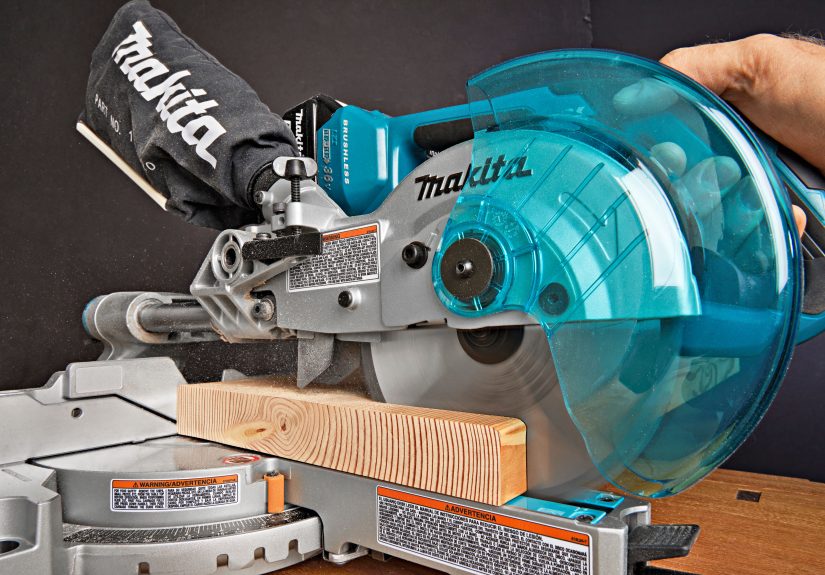
Sliding Miter Saw
The head slides forward and back, increasing cutting capacity for wider boards. If you regularly cut big stock, this is the “wide-board hero” model.
Dual-Bevel (Double-Compound) Sliding Miter Saw
Tilts both directions (left and right) so you can keep work oriented the same way without flipping as oftenespecially handy for crown and complex trim.
Blade size matters, too. Many saws are 10-inch or 12-inch. In general, larger blades cut deeper and wider stock, and sliding mechanisms increase width capacity even more. If you’re mostly cutting 1x trim and 2x lumber, a 10-inch saw can be plenty; if you want more capacity for wider boards, a 12-inch slider is a common step up.
Safety First: The Rules That Keep Your Weekend Fun
Miter saws are safe when you use them correctlyand surprisingly unforgiving when you don’t. Follow these basics every time:
- Wear PPE: safety glasses, hearing protection, and a dust mask/respirator appropriate for sawdust exposure.
- Secure the saw: bolt it to a bench or lock it onto a stable miter saw stand so it can’t walk around.
- Hands stay away: a common guideline is keeping hands at least 6 inches from the blade path. Use clamps and hold-downs to avoid “close-hand cutting.”
- Let the blade reach full speed before starting the cut, and don’t raise the saw until the blade stops spinning.
- Never cut freehand: keep the work tight to the fence and table, and clamp when practicalespecially small pieces.
- Inspect your stock: check for nails/screws, and avoid warped or twisted boards that can pinch the blade.
- Keep guards working: don’t defeat the blade guard “because it’s annoying.” The guard is annoying for the same reason seatbelts wrinkle your shirt: it’s doing its job.
Set Up Your Station Like You Mean It
Good cuts start with a solid setup. Here’s the checklist that prevents wobble, drift, and mystery angles.
1) Stable Surface + Level Support
Place the saw on a sturdy bench or miter saw stand. Support long boards so they stay level with the saw table. If one end droops, your cut can shift mid-slice (and your trim joint will show it).
2) Dust Collection (Your Lungs Will Write You a Thank-You Note)
If you can, connect a shop vacuum or dust collection system. Wood dust isn’t just messy; it can irritate your eyes/skin/airways and adds up over time. Even basic collection is better than “let the garage become a snow globe.”
3) Check the Blade and the Fence
Before your first “real” cut (and anytime the saw gets transported), confirm the saw is cutting square. Quick accuracy checks commonly include:
- Blade square to table: with the saw unplugged, lower the head and check with a reliable square against the blade (avoid the teethuse the blade plate).
- Fence alignment: make sure the fence is straight and square to the blade at 0° miter.
- Test cuts: cut a piece of scrap, flip or mate pieces together, and look for gaps.
Many how-to guides recommend using a square and even a flashlight to spot tiny gaps during alignment checks. If you see inconsistencies, consult your manual for fence, bevel-stop, and miter-stop adjustments.
4) Choose the Right Blade
A sharp, appropriate blade is the difference between “smooth professional finish” and “why does it look fuzzy like a stressed-out hamster chewed it?” For trim, a higher tooth count blade typically leaves a cleaner cut. For framing lumber, fewer teeth generally cut faster. Sliding saws often benefit from blades with tooth geometry and hook angles suited to that style of cutting (your manual or blade packaging will specify compatibility).
The Core Method: How to Make a Cut (Step-by-Step)
This is the basic workflow you’ll use for nearly every cut. Once it’s habit, accuracy becomes boringin the best way.
- Measure and mark. Use a tape measure and mark your cut line clearly. For trim work, a sharp pencil (or knife line) helps precision.
- Position the board. Place the workpiece flat on the table, tight against the fence (unless you’re intentionally cutting on edge for a bevel-style setup).
- Support long stock. Use extensions, stands, or a helper surface so the board stays level.
- Set your angles. Adjust the miter (table swing) and/or bevel (head tilt) to your required angles. Lock everything down firmly.
- Dry-run the cut path. With the saw OFF, lower the blade to confirm it lines up with your mark and won’t hit clamps or the fence.
- Clamp when needed. If the piece is small, slick, or likely to shift, clamp it. If you’re thinking “it’ll probably be fine,” that’s your cue to clamp it.
- Start the saw and reach full speed. Keep your hands safely away, then trigger the saw and wait a beat for full RPM.
- Make the cutsmooth and controlled. Lower the blade through the work without forcing it. Let the blade do the work.
- Finish and pause. Release the trigger and keep the blade down until it stops spinning completely.
- Raise the head and clear scraps safely. Only remove offcuts when the blade is stopped. Reposition and repeat.
Common Cuts You’ll Actually Use
Straight Crosscut (90°)
Set miter to 0° and bevel to 0°. Mark your board, align the blade with the waste side of the line, clamp if needed, then cut. This is your bread-and-butter for framing, shelving parts, and most “make it shorter” tasks.
Miter Cut (Angled End)
A miter cut changes the angle across the face of the board. Think picture frames, baseboard corners, door casing, and trim returns.
- Loosen the miter lock, swing the table to your angle, and lock it firmly.
- Line up the blade with your mark and make the cut.
- Pro tip: When cutting opposing corners (like a frame), label parts and keep orientation consistent so you don’t mirror the angle by accident.
Bevel Cut (Tilted Blade)
A bevel cut changes the angle through the thickness of the board. Depending on your saw and the task, bevel cuts can be made by tilting the head (on a compound saw) or by standing the board on edge for certain situations. Lock the bevel angle securely, keep the stock stable against the fence, and clamp tall/narrow pieces so they can’t tip.
Compound Cut (Miter + Bevel Together)
Compound cuts are common for crown molding and complex trim. You’ll set both a miter angle and a bevel angle. Many saws include charts for popular molding “spring angles,” and many installers make test cuts on scrap to dial in perfect joints. If you’re new to compound cuts, do this in the least stressful way possible: scrap wood first, and only then the expensive trim.
Repeatable Cuts: Stop Blocks, Jigs, and “Make 12 Pieces Exactly the Same”
If you’re making multiple pieces the same lengthbalusters, slats, picture frame parts, or repeated trim segmentsstop blocks are your best friend.
- Stop block method: Clamp or secure a block to an extension fence/stand so each board end registers at the same point before cutting.
- Don’t trap the offcut: Avoid setups where the cutoff can’t move away from the blade. Binding is a fast track to kickback and rough cuts.
- Use a sacrificial fence/backer: A scrap fence behind the work can help reduce tear-out and can make it easier to clamp small parts safely.
For small pieces, specialized jigs can keep your hands well away while controlling the workpiece. The goal is simple: your fingers should never be “acting as clamps.”
Pro-Level Habits That Make Your Cuts Cleaner (and Your Life Easier)
Let the blade do the work
Forcing the cut can deflect the blade, increase tear-out, and reduce accuracy. Use steady, controlled downward pressure.
Stay out of the danger choreography
Keep your body positioned slightly to the sidenot directly in line with the blade pathand avoid reaching across the saw. Also, don’t cross your arms in front of the blade. If you have to contort to hold the work, your setup needs a rethink.
Sliding saw technique: control the travel
On a sliding miter saw, use the slide function deliberately. Make sure the travel path is clear, keep locks adjusted appropriately, and return the carriage to its recommended position after each cut (your manual will often specify best practice for your model).
Make practice cuts when accuracy matters
Trim joints don’t forgive “close enough.” If you’re cutting casing for a visible corner, do one quick scrap cut to confirm angle and fit. It takes 30 seconds and saves 30 minutes of “creative caulking.”
Troubleshooting: When Your Cuts Are “Almost” Right
Problem: Gaps in miter joints
- Check calibration: Verify the saw is square at 0° miter and 0° bevel.
- Confirm the fence: A fence that’s out of alignment can throw everything off.
- Use consistent pressure: Twisting the workpiece mid-cut can create tiny angle errors.
Problem: Tear-out or splintering
- Switch to a higher-tooth blade for finish work.
- Use a sacrificial backer or fence to support fibers at the cut line.
- Ensure the work is fully supported and doesn’t vibrate.
Problem: Burn marks or rough cuts
- Blade may be dull or dirty.
- Cutting too slowly can sometimes increase friction (especially on certain woods).
- Let the blade reach full speed and use smooth motion.
Basic Maintenance (Because Future You Deserves Nice Things)
- Unplug before adjustments (always).
- Keep the table and fence clean of dust buildup so stock sits flat.
- Check blade sharpness and replace/clean as needed.
- Confirm guards move freely and return fully.
- If you have rails/slides, keep them clean and maintained per your manual (dry debris is the enemy of smooth travel).
Conclusion: Cut Confidently, Not Casually
Learning how to use a miter saw isn’t about becoming a woodworking wizard overnightit’s about building reliable habits: stable setup, correct angles, controlled cutting, and safety practices that don’t depend on luck. Start with simple crosscuts, move into miters, then bevels, and finally compound cuts once you’ve got your workflow down.
And remember: the miter saw is like a very talented employee. Treat it well, give it a stable workstation, and it will produce beautiful results all day. Treat it like chaos, and it will file an HR complaint in the form of ruined trim.
Experiences: Real-World Lessons from Using a Miter Saw (About )
Most first-time miter saw users expect the hard part to be “operating a loud spinning blade.” Surprise: the hard part is usually everything around the blade. The saw is perfectly happy to cut accuratelyif you feed it a calm, stable situation. The moment your board is drooping off the side of the stand like a tired spaghetti noodle, the saw becomes an unreliable narrator.
One of the most common experiences is the “Why is this cut not square?” spiral. You cut a board, flip it, and suddenly the ends don’t meet. You assume your tape measure is haunted. In reality, it’s often something boring: the saw got bumped during transport, the fence isn’t perfectly aligned, or the board wasn’t tight against the fence the whole time. That’s why seasoned DIYers do a quick scrap test cut before trim workbecause learning your saw is out of alignment after you’ve cut eight pieces of expensive casing is a special kind of character development.
Then there’s the moment everyone has with miters: you confidently set 45°, cut, and hold two pieces together… and the joint looks like it’s doing the “awkward handshake” instead of forming a corner. This is where you discover that orientation matters. Left miter vs. right miter, face-up vs. face-down, inside corner vs. outside cornermiter saws are wonderful, but they do not read your mind. A simple trick that helps is labeling boards with arrows or “top” and “face” before cutting. It feels overly organized until you realize it saves you from making two perfect but completely wrong mirror-image cuts.
Another real-world lesson: small parts are where people get brave in the worst way. It’s tempting to “just hold it” because it’s quick. But tiny offcuts can shift, get pulled, or kick, and suddenly your fingers are way too close to an event you don’t want tickets for. The practical experience most people eventually adopt is this: if the piece is small enough to feel sketchy, it’s small enough to clamp. A sacrificial fence and a stop block can turn a stressful cut into a boring oneand boring is the gold standard for power tools.
Finally, there’s the dust reality. The first time you cut a bunch of MDF or even a few boards of softwood, you realize your garage air now has texture. Many DIYers don’t think about dust collection until they’ve seen the fine layer on everything they own. Once you connect a shop vac (even imperfectly), it’s hard to go back. Cleaner air, cleaner lines, less sweeping, fewer “why am I coughing like I adopted a sawmill?” moments. The experience takeaway: miter saw mastery isn’t just anglesit’s setup, repeatability, and habits that keep projects enjoyable.