Table of Contents >> Show >> Hide
- Micro Bird Sculptures: What Makes This Art So Mesmerizing?
- “The Outside World Disappears”: The Psychology Behind the Microscope Spell
- How Tiny Are We Talking? Scale, Materials, and “Millimeter Physics”
- Tools of the Trade: The Microscope, the Blades, and the “Giant” Needles
- The 20-Pic Tour: What You’re Really Seeing in These Close-Ups
- Why This Kind of Tiny Making Feels So Big
- Want the “Outside World Disappears” Feeling Without a Microscope?
- Experience Addendum (500+ Words): What It Feels Like to Carve Tiny Birds Until the World Goes Quiet
- Conclusion
There are hobbies, and then there are hobbies that make your brain forget what time is. Microsculpting tiny birds under a microscope is firmly in the
“wait…how is that even possible?” categoryright next to balancing a spoon on a cat, or folding a fitted sheet into anything other than a resentful
little lump.
French microsculptor Marie Cohydon describes the feeling in a way that’s both poetic and very, very relatable: when she’s under the microscope, the
outside world disappears. Not “softens.” Not “fades.” Disappears. In her words, she can’t even see her fingersjust the tiny universe in front of
the lens, where sewing needles become skyscrapers and a bird’s beak becomes an epic engineering project.
This post is a deep dive into that miniature world: what “microscope carving” actually involves, why birds are such a perfect subject at a microscopic
scale, and what you’re seeing in a set of 20 close-up photosplus an experience-based addendum at the end that captures the mental “vanishing act”
that happens when your whole attention fits inside a millimeter.
Micro Bird Sculptures: What Makes This Art So Mesmerizing?
Microsculpture is exactly what it sounds like: sculpture created at a scale so small you can’t properly appreciate it with the naked eye. We’re not
talking “tiny figurine on your desk.” We’re talking “blink and it’s gone” tinypieces measured in millimeters, sometimes smaller than the tip of a
pencil lead.
Birds are a dream subject for this kind of work for two reasons:
- They’re instantly recognizable. Even at a tiny scale, a curved beak, a round head, or a perched stance reads as “bird” right away.
- They’re built for detail. Feathers, eyes, wing shapes, and patterns give you endless texture to play withwithout needing a giant canvas.
Cohydon’s birds are often portrayed mid-personality: a proud puffed chest, a curious tilt, a comically serious owl stare. The humor is subtle, but
it’s therelike the bird is thinking, “Yes, I know I’m 2 millimeters tall. No, I will not be taking questions.”
“The Outside World Disappears”: The Psychology Behind the Microscope Spell
When someone says, “I lose myself in it,” they might mean they got mildly distracted while reorganizing a spice rack. Microsculptors mean it
literally. The work demands such intense focus that there’s no mental bandwidth left for doomscrolling, deadlines, or whatever weird thing you said
in a meeting in 2019.
Psychologists have a name for that experience: flowa state of deep, enjoyable absorption in an activity. Flow tends to show up when
the task is challenging (so you have to concentrate) but doable (so you don’t panic and abandon the project to become a professional napper).
Microsculpture stacks the deck for flow: the scale forces attention, the steps are clear, the feedback is immediate (your blade either did what you
wanted or it launched your bird’s wing into the shadow realm), and time has a funny way of slipping through the cracks.
How Tiny Are We Talking? Scale, Materials, and “Millimeter Physics”
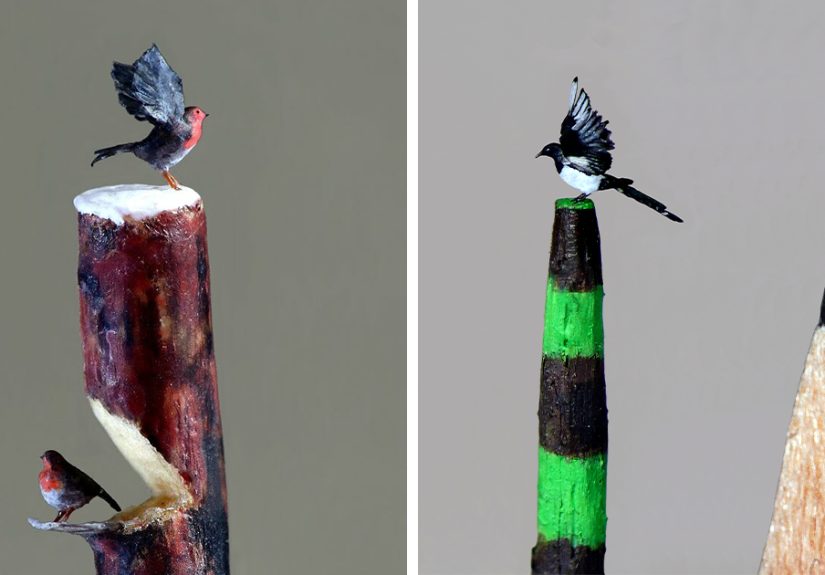
A helpful reference point that shows up in photos of Cohydon’s work: pencil lead. Not because she’s trying to humble the pencilpencils have
had a good runbut because it gives your brain a ruler it understands.
In some of her documented comparisons, photographed pencil leads are about 5 mm high and 2 mm wide, which makes the sculptures
beside them feel borderline unreal. At this size, the rules get weird:
- “Steady hands” becomes “steady everything.” Heartbeat, breathing, tiny air currentseverything matters.
- Materials behave differently. At micro scale, pieces can split or snap cleanly; dust becomes boulders; a tiny flake can ruin a surface.
- “Undo” doesn’t exist. If something breaks, it often means rebuildingnot repairing.
Cohydon’s background in jewelry design also makes a lot of sense here. Jewelry work is already detail-forward and tool-heavy. Microsculpture is like
jewelry work that decided to go on “hard mode” and then turned the difficulty knob until it snapped off.
Tools of the Trade: The Microscope, the Blades, and the “Giant” Needles
Here’s the part everyone asks first: What tools do you use to carve something you can barely see?
In Cohydon’s process as described in profiles of her work, tools like mini scalpels, sewing needles, and extremely fine needles (including acupuncture
needles) do the heavy lifting. Under magnification, these aren’t delicate little tools anymore. They’re cranes and excavators. Your “tiny” blade
suddenly looks like it could slice a submarine.
The microscope does more than enlarge the work; it changes the entire experience of space. And because microscope imaging has a shallow “in-focus”
zone (depth of field), you’re often working in a thin slice of claritymoving and refocusing as you go. That’s why close-up photos of these pieces
feel so magical: you’re seeing the crispness that the artist fought for millimeter by millimeter.
The 20-Pic Tour: What You’re Really Seeing in These Close-Ups
Since the photos are the headline act, let’s talk like we’re scrolling the gallery togetherwithout pretending we’re not zooming in like our thumbs
are training for the Olympics.
-
Pic 1: The “Wait, That’s a Bird?!” moment.
The first image usually sets the scale with a familiar object (often pencil lead). Your brain does a quick reboot. -
Pic 2: A perched silhouette.
Even when details blur, posture tells the storyhead angle, balance, stance. -
Pic 3: A beak that looks painted with a single thought.
At this scale, color placement is as demanding as carving. -
Pic 4: The eyetiny, but expressive.
One dot too big and the bird looks startled forever. One dot too small and it’s suddenly “ghost bird.” -
Pic 5: Feather texture that shouldn’t be possible.
You’re not just seeing carvingyou’re seeing controlled restraint: suggesting feathers without turning the surface into fuzz. -
Pic 6: A pair of birds with distinct personalities.
The magic isn’t only detail; it’s attitude. One looks curious. One looks unimpressed. Just like real life. -
Pic 7: A wing that implies motion.
Micro sculpture can’t rely on big gestures, so movement is hinted through tiny curves and angles. -
Pic 8: The “how many attempts?” photo.
Artists in this field often restart repeatedly to get one part rightthis is where that reality becomes believable. -
Pic 9: A beak open mid-chirp.
Open beaks at micro scale are brutal: they require negative space and thin structural bridges that don’t crumble. -
Pic 10: A tiny bird with a bold pattern.
Patterns amplify errors, which makes them the ultimate flex. -
Pic 11: The “microscope view” behind the scenes.
These shots remind you the piece isn’t floating in space; it’s being wrestled into existence under magnification. -
Pic 12: A bird that reads as “owl energy.”
Round head, forward gaze, serious vibe. Owls are basically the librarians of the bird world. -
Pic 13: A longer beak that screams “tropical.”
When you see a bold beak shape, your brain supplies the restthis is design economy at work. -
Pic 14: A bird on a “branch” base.
The base isn’t just support; it’s composition. It frames the pose like a tiny stage. -
Pic 15: The color wash photo.
Even subtle watercolor can change the whole moodwarm, cool, soft, dramatic. -
Pic 16: The “I can’t believe this is glue/hair/tiny material” moment.
At micro scale, unconventional materials can become incredibly functional. -
Pic 17: A micro scene that feels like a story.
Tiny sculptures often hint at narrativelike you’ve caught a moment in the bird’s day. -
Pic 18: The detail you only see after zooming in.
The joy of micro art is delayed gratification: the closer you look, the more it rewards you. -
Pic 19: The “special magnifier camera” crisp shot.
This is where the photos become almost surrealevery ridge and dot suddenly reads as intentional. -
Pic 20: The finishing shotthe one that makes you want to try it.
It’s inspirational and slightly dangerous. Next thing you know, you’re googling “microscope for beginners” at midnight.
Why This Kind of Tiny Making Feels So Big
Here’s the sneaky truth: the birds are small, but the effect is huge.
A lot of mental noise thrives on open spaceempty moments where your mind can wander into worry, rumination, or the “Top 50 Things I Should Have Said
Instead” highlight reel. Highly absorbing creative work shrinks that space. You can’t multitask when your task is “make an eyelid on a bird that’s
smaller than your patience.”
This doesn’t mean art is a replacement for therapy or medical care (it’s not). But reputable health organizations do recognize that mindfulness
practices can help people manage stress and improve well-being, and that creative therapies can support emotional resilience and distress reduction.
Microsculpture behaves like a high-powered attention practice: it recruits your senses, anchors you in the present, and makes distractions feel far
awaybecause they are. They’re outside the lens.
Want the “Outside World Disappears” Feeling Without a Microscope?
You don’t need to carve a 2 mm toucan on day one. If you want the same kind of focused calm, steal the structure of microsculpture rather
than the scale:
1) Pick a task with clear steps
Try whittling, miniature clay shaping, detailed sketching, needle felting, or even careful model painting. The key is a process you can repeat and improve.
2) Make the work just challenging enough
If it’s too easy, your mind wanders. If it’s too hard, you rage-quit and start reorganizing your sock drawer as “self-care.”
3) Build a distraction-free “lens”
You can mimic the microscope effect by narrowing your environment: one light, one surface, phone in another room, a timer for 20–30 minutes.
4) Celebrate tiny progress
Microsculptors often remake pieces repeatedly. That mindsetpatient iterationturns frustration into fuel.
Experience Addendum (500+ Words): What It Feels Like to Carve Tiny Birds Until the World Goes Quiet
The first strange thing about working tiny is that your body becomes part of the weather.
You sit down thinking you’re the one in chargehands ready, tools lined up, lighting just rightthen you look through magnification and realize your
heartbeat has opinions. Your breath has opinions. The air itself has opinions. Under the microscope, a normal inhale isn’t “breathing.” It’s a gust
of wind across a landscape of dust and delicate edges. And that’s when you understand why micro artists talk about discipline like it’s a quiet sport.
The second strange thing is that your sense of scale rewires itself. A needle tip isn’t a needle tip anymore. It’s a heavy machine. A hair becomes a
beam. A speck of pigment becomes a whole paint bucket. At first, you laugh because it feels absurdlike you’ve walked into a tiny theater where
everything is dramatically oversized. But then the absurdity becomes soothing, because it turns your attention into a single point. You’re not
thinking about your inbox when your entire universe is “place this microscopic detail without breaking it.”
There’s a rhythm to it: look, nudge, lift, check. Look, nudge, lift, check. It feels like learning a new language where the alphabet is made of
millimeters. Sometimes you catch yourself holding your breathnot because you’re trying to be dramatic, but because your body instinctively wants
stillness. The funny part is that the stillness isn’t stiff. It’s attentive. The difference matters. One feels like tension; the other feels like
presence.
And then something almost embarrassing happens: the rest of life gets quieter.
Not because you solved your problems, or because the world suddenly became easier, but because you gave your mind a job it can’t half-do. The
microscope doesn’t allow “kind of focusing.” It’s all or nothing. If you drift, the blade drifts. If you rush, the piece snaps. The work teaches you
to be where you arenot through inspirational quotes, but through immediate consequences. It’s like mindfulness with a tiny scalpel and zero tolerance
for nonsense.
Some sessions are pure joy. You make one clean cut and it feels like a tiny miracle. You place a detail and suddenly the bird looks alivelike it has
a thought. Other sessions are humbling. You misjudge pressure and a wing disappears. You stare for a second, then you do the most important thing:
you start again. That’s the secret training micro work offers: restarting without self-punishment. Not “I failed,” but “Okaynew attempt.” Over time,
that attitude leaks into everything else. You begin to treat mistakes like information rather than verdicts.
When you finally pull back from the lens, the room looks a little different. Not magically fixed. Just…wider. Your shoulders drop. Your jaw unclenches.
You remember you have hands. You remember you have a body. And even if all you did was carve a tiny curve that no one will notice unless they zoom in,
you feel like you visited a place where the world couldn’t reach youbecause, for a while, it truly couldn’t. It was outside the microscope.
Conclusion
Microsculpted birds are a spectacular blend of patience, engineering, and quiet imagination. But the real hook isn’t only the scaleit’s the state of
mind the scale creates. When an artist carves something so small the outside world disappears, you’re not just looking at miniature birds. You’re
looking at attention turned into art.