Table of Contents >> Show >> Hide
- Why Shanghai and Art Deco Make Such a Good Story
- How to Spot Art Deco Like You Didn’t Just Google It
- The 11-Picture Time Tunnel: Photo Stops + What to Capture
- Pic 1: Fairmont Peace Hotel (Sassoon House) The Bund’s Green-Cap Icon
- Pic 2: The Bund’s Art Deco & Moderne Cluster A “Skyline Museum” Moment
- Pic 3: Bank of China Building (No. 23 on the Bund) Chinese Art Deco Confidence
- Pic 4: Broadway Mansions A 1930s High-Rise Hugging Suzhou Creek
- Pic 5: Park Hotel The Skyscraper That Wanted to Be New York (Respectfully)
- Pic 6: Grand Cinema (Grand Theatre / Daguangming) Deco Goes to the Movies
- Pic 7: The Paramount Ballroom Shanghai Nightlife, Pressed Into Geometry
- Pic 8: Cathay Theatre A Sleek Street-Corner Time Capsule
- Pic 9: Wukang Mansion (Normandie Apartments) The Ship-Shaped Apartment Legend
- Pic 10: A French Concession Deco Apartment Entrance Where the Small Details Win
- Pic 11: The “Hu-Deco” Moment A Staircase, Elevator, or Lobby That Feels Like Jazz
- A Mini Route You Can Actually Walk
- Common Mistakes (and How to Avoid Them Without Crying)
- Conclusion: Shanghai Deco Is a Time Machine You Can Walk Into
- Extra: A Travel-Diary Style Experience Add-On (About )
I didn’t plan to time-travel. I just planned to take a few photos. Then Shanghai did that thing it does: one minute you’re dodging scooters, the next you’re staring up at a stepped tower that looks like it ordered a Manhattan skyline… with a side of jazz.
This is a photo-forward guide to Shanghai’s Art Deco erawhat it is, why the city has so much of it, and how to “picture it back” with 11 camera-ready stops. You’ll get quick history, what to look for in the details, and composition tips so your images feel less like “tourist snapshot” and more like “1930s movie poster that somehow learned Wi-Fi.”
Why Shanghai and Art Deco Make Such a Good Story
Art Deco isn’t just a styleit’s a mood. It loves modernity, speed, cinema, nightlife, and the idea that tomorrow will be sleeker than today. Shanghai, especially in the 1920s and 1930s, had the same energy: international influences, booming commerce, and a skyline racing to look “new.”
In practical terms, Art Deco thrived because it played well with new materials and new ambitions. Reinforced concrete and modern construction methods made taller buildings more feasible. Meanwhile, Shanghai’s neighborhoodsespecially around the Bund and the former French Concessionbecame showrooms for fashionable offices, hotels, theaters, and apartment houses. The result is a city where Deco isn’t a rare cameo; it’s a recurring character.
Shanghai’s “Deco Dialect” (Yes, Buildings Have Accents)
When people say “Shanghai Art Deco,” they often mean more than imported zigzags. The city developed a local flavorsometimes described as a blend of international Deco with Shanghai’s own modern identity. Think: Western geometric forms, but adapted to local tastes, local signage, and local urban life.
Translation: you’ll see classic Deco movesstepped setbacks, strong vertical lines, stylized ornament but also playful twists: curved corners on apartment blocks, streamlined façades, and lobbies that feel like they’re auditioning for a noir film.
How to Spot Art Deco Like You Didn’t Just Google It
If you remember only one thing, remember this: Art Deco likes geometry that looks confident. It’s not shy. It’s not rustic. It’s the architectural equivalent of showing up in a tuxedo to buy milk.
Quick visual checklist
- Vertical emphasis: pilasters, tall window bands, tower-like center masses.
- Stepped silhouettes: setbacks that climb upward like a wedding cake for machines.
- Geometric ornament: zigzags, chevrons, sunbursts, and stylized floral patterns.
- Streamlined curves: rounded corners, horizontal “speed lines,” ocean-liner vibes.
- Lux materials: terrazzo, marble, chrome, glass block, stained glass, lacquered wood.
How to “picture it back” (without lying to your camera)
You don’t need a DeLorean; you need framing. Shoot upward to emphasize height. Crop out modern brand signage. Wait for a moment when traffic thins. Try black-and-white mode to make shapes and light do the talking. And when you find a lobby with original metalwork or terrazzo, slow downDeco is a detail sport.
The 11-Picture Time Tunnel: Photo Stops + What to Capture
The stops below are organized like a “Deco day”: Bund first (big skyline drama), then central Shanghai (skyscraper swagger), then the former French Concession (apartment-house romance). Swap the order if your feetor the weatherstart negotiating.
Pic 1: Fairmont Peace Hotel (Sassoon House) The Bund’s Green-Cap Icon

If Shanghai had a signature Deco silhouette, this would be a finalist. The pyramidal roof and strong vertical rhythm read like “luxury” even if you’ve never set foot inside. For a time-travel effect, shoot from across the street and tilt slightly upward so the roof dominates.
Look for: stepped massing, crisp stonework, repeated window patterns, and that unmistakable green roof that anchors the skyline like a period punctuation mark.
Pic 2: The Bund’s Art Deco & Moderne Cluster A “Skyline Museum” Moment

The Bund is famous for its historic waterfront buildings, and while styles vary, the overall effect is pure “global city, early 20th century.” To picture it back, shoot at dusk when lighting softens hard edges and modern clutter visually melts away.
Look for: strong cornice lines, repeated vertical bays, and the way the street-level arcades and entrances create a rhythmlike architecture doing jazz hands, but with symmetry.
Pic 3: Bank of China Building (No. 23 on the Bund) Chinese Art Deco Confidence

This is a great “Deco with local character” stop: modern lines, geometric structure, and a sense of prestige that feels deliberately contemporary for its time. It also photographs beautifully because the façade reads clearly even in a busy streetscape.
Look for: geometric patterning, clean modern surfaces, and details that blend East-meets-West design language without turning the building into a costume.
Pic 4: Broadway Mansions A 1930s High-Rise Hugging Suzhou Creek

Broadway Mansions has that classic high-rise Deco presence: tall, layered, and slightly cinematic. Bonus: the location near Suzhou Creek gives you leading lines (bridge rails, water edge, street lights) to pull the eye toward the building.
Look for: stepped upper levels, strong vertical window groupings, and a “city landmark” vibe that practically begs for black-and-white.
Pic 5: Park Hotel The Skyscraper That Wanted to Be New York (Respectfully)

Park Hotel is one of Shanghai’s most famous Art Deco towers and a standout example of vertical, stepped massing. It’s the kind of building that makes you instinctively straighten your posture. (Don’t worryyour camera will do that too.)
Look for: setbacks as the building rises, a strong central shaft, and dark-toned surfaces that make highlights pop. If the sky is moody, congratulationsyou’ve been handed free noir lighting.
Pic 6: Grand Cinema (Grand Theatre / Daguangming) Deco Goes to the Movies

Deco and cinema are old friends. This historic theater is a perfect stop for capturing the entertainment side of the erawhere architecture didn’t just house a function, it sold an experience.
Look for: stylized fonts, metalwork, layered lighting, and the way the entrance composition funnels people inwardlike the building itself is saying, “Come on, the future is showing.”
Pic 7: The Paramount Ballroom Shanghai Nightlife, Pressed Into Geometry

The Paramount is peak “Deco as social theater.” Even from outside, you can feel it was designed for arriving, not just entering. Try a slightly off-center composition so curves and straight lines play against each otherDeco loves contrast.
Look for: streamlined curves, stacked bands, and the confident symmetry of a building that once expected glamorous people to appear on cue.
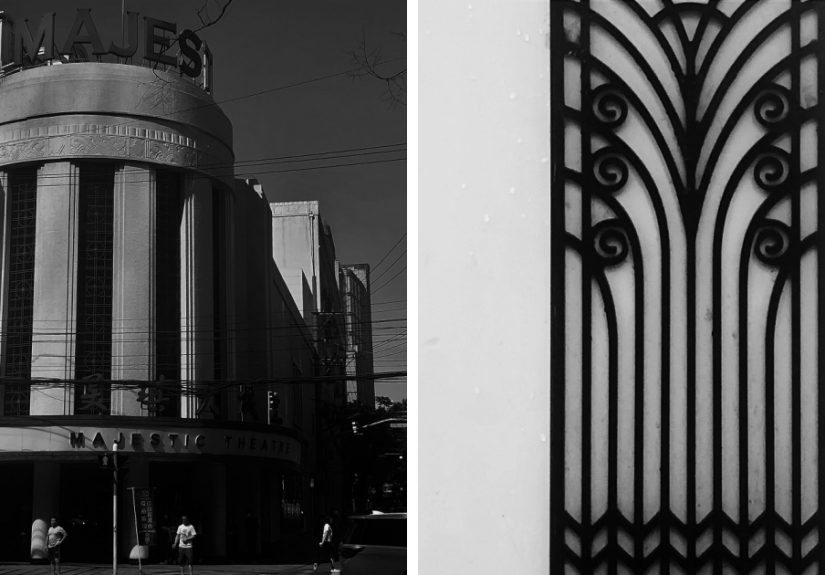
Pic 8: Cathay Theatre A Sleek Street-Corner Time Capsule

The former French Concession has multiple Deco-era entertainment sites, and Cathay is a favorite for “city life” shotsbuildings integrated into busy streets where the old and new overlap in one frame.
Look for: clean geometric lines, signage placement, and façade proportions that feel modern even by today’s standards.
Pic 9: Wukang Mansion (Normandie Apartments) The Ship-Shaped Apartment Legend

Wukang Mansion is the photogenic superstar of the former French Concession: a wedge-shaped building that reads like an ocean liner docked at an intersection. For “picturing it back,” wait for a quieter moment and focus on the curvature and brick textureyour eye will do the rest.
Look for: rounded corners, stacked balconies, and that prow-like point that turns a city block into a movie set.
Pic 10: A French Concession Deco Apartment Entrance Where the Small Details Win

Shanghai’s Deco isn’t only in famous towers. It’s also in residential buildings: door surrounds, geometric railings, etched glass, lobby floors, and light fixtures that look engineered to flatter everyone’s cheekbones.
Look for: chevron patterns, repeated rectangles, and “machine-age” materials like metal and glass. If you find terrazzo flooring, take the shotterrazzo is basically Deco confetti.
Pic 11: The “Hu-Deco” Moment A Staircase, Elevator, or Lobby That Feels Like Jazz

If your first nine photos are the skyline and the street, this one is the heartbeat. A single interior detail can do more “era work” than an entire blockespecially if it’s original metalwork or a stylized motif that screams 1930s optimism.
Look for: geometric repetition, polished surfaces, and lighting that turns ordinary space into a stage. If you can’t stop staring at a doorknob, congratulations: you’ve caught Deco.
A Mini Route You Can Actually Walk
- Start at the Bund: Peace Hotel, Bund façades, and the Bank of China building.
- Head toward Suzhou Creek: Broadway Mansions and bridge viewpoints.
- Shift to central Shanghai: Park Hotel and Grand Cinema for skyscraper + cinema Deco.
- Finish in the former French Concession: Paramount, Cathay, Wukang Mansion, and apartment details.
This route is less about “checking boxes” and more about collecting visual evidence. The goal is to come home with a set of photos that tells a story: commerce, leisure, home life, and styleone decade, many angles.
Common Mistakes (and How to Avoid Them Without Crying)
- Shooting too wide: Wide shots are great, but add at least one detail close-up per stop.
- Forgetting scale: Include a person (from behind or at distance) to show height and drama.
- Midday harsh light: Early morning or late afternoon makes stone and brick look expensive.
- Modern clutter takeover: Shift two steps left, crop tighter, or aim upwardproblem solved.
And one gentle reminder: “picturing it back” is about vibe, not erasure. The modern city is part of the story too. Your best photos usually show the overlapold forms holding their ground while the present rushes by.
Conclusion: Shanghai Deco Is a Time Machine You Can Walk Into
Shanghai’s Art Deco doesn’t just sit there looking pretty. It broadcasts a whole era’s confidence: the belief that design could make life sharper, brighter, and more modern. Whether you’re photographing landmark towers or a humble lobby railing, the trick is the samelet geometry lead, let materials glow, and let your framing do the time travel.
If you leave with 11 photos that feel like stills from a jazz-age film, mission accomplished. If you leave obsessed with elevator doors, also mission accomplished. That’s simply how Deco works.
Extra: A Travel-Diary Style Experience Add-On (About )
The day starts the way good photo days always start: with you telling yourself you’ll “just take a few shots,” and your camera quietly laughing because it knows you’re about to become a person who debates the emotional difference between 28mm and 35mm like it’s a moral philosophy.
On the Bund, the air feels like it has a soundtrackpart river breeze, part city hum. You line up the Peace Hotel roof in your frame and suddenly the green pyramid looks less like architecture and more like a signal flare from the past. A quick tilt upward, a tiny step to the side, and the modern shop signs drop out. For half a second, the building becomes what it was built to be: a glamorous exclamation point at the edge of the water.
You wander north, following the logic of light and curiosity, until Broadway Mansions rises near Suzhou Creek. Here, the city feels more layeredbridges, water, traffic, and that steady Deco mass holding court above it all. You try black-and-white mode and the building rewards you immediately: shadowy setbacks, bright windows, and a mood that says “mystery,” even if all you’re really hunting is the perfect angle.
Later, you stand at Park Hotel and realize your neck has become an architectural instrument. The tower pulls your eyes up in stages, like it’s teaching you how to look. You take one photo that’s perfectly centered and feel very accomplishedthen you take six more because the sky changes and you become the kind of person who respects sky changes. Someone passes behind you and you catch their silhouette in the lower frame. Suddenly the shot has scale, and the building looks even tallerlike it’s proud of itself.
By the time you reach the former French Concession, the pace softens. Tree-lined streets filter the sunlight, and the city turns quiet in the way a beautiful room turns quiet when you enter. The Paramount looks like it still expects an arrival: a car door closing, a coat adjusted, a laugh drifting into the night. You don’t need to see the dance floor to feel the choreographystreamlined curves do the storytelling for you.
And then Wukang Mansion appears at the intersection like a ship that got bored of the sea and chose urban life instead. You stand at the “bow,” wait for a gap in the crowd, and take the photo. The wedge shape makes everything cinematic. A cyclist glides through frame. Leaves move in the plane trees. For one moment, the city looks timelesslike it’s always been both old and new, just changing outfits.
On the way back, you realize your favorite image isn’t the biggest tower. It’s the smallest detail: a lobby railing, geometric and polished, catching a sliver of light. You take the shot and think, “This is the proof.” Not proof that the 1930s are still herethey’re notbut proof that good design doesn’t expire. It just waits for someone to notice.