Table of Contents >> Show >> Hide
- Why The Deep Sea Is Basically A Concept Artist With A PhD
- How I Designed The Most Unnameable Aquatic Creature Ever
- What Real Marine Biology Added To The Illustration
- The Best Part Of Drawing An Unnameable Sea Beast
- Specific Creatures That Secretly Co-Authored My Illustration
- Why Audiences Love Creatures They Can’t Quite Name
- My Experience Illustrating The Most Unnameable Aquatic Creature Ever
- Conclusion
- SEO Tags
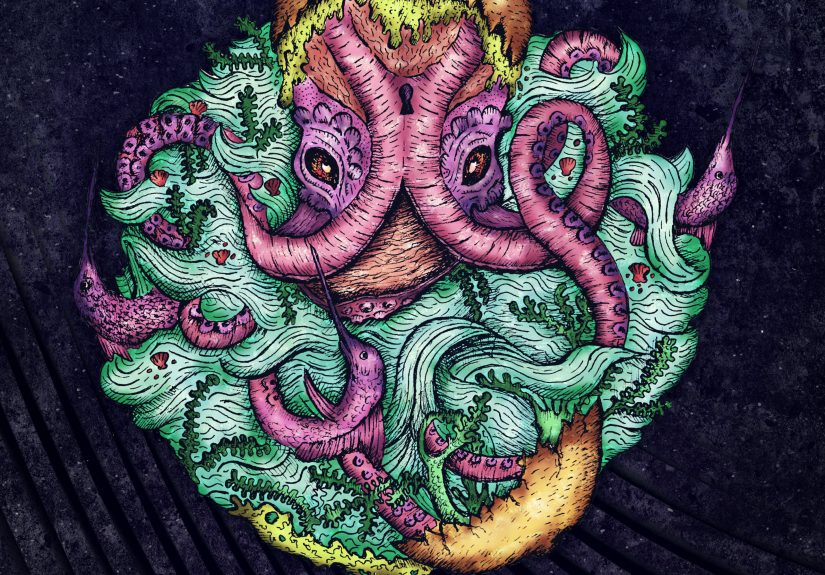
Some creatures arrive with neat labels. Jellyfish. Eel. Squid. Crab. Very organized. Very polite. And then there are the deep-sea animals that seem to have been assembled in a hurry by an artist with a glow stick, a fever dream, and zero respect for terrestrial expectations. That was the energy I wanted when I sat down to create my latest piece: not just a sea monster, but an unnameable aquatic creature so visually strange that even the dictionary would take a long coffee break.
This article is about how that illustration came together, why the deep ocean is the best co-author an artist could ask for, and what real-life marine biology taught me about designing something that feels impossible yet believable. Because the truth is almost rude in how creative it is. In the deep sea, sunlight disappears below roughly 200 meters, food becomes scarce, temperatures hover around a chilly 39°F, and life answers those problems with transparent heads, living lanterns, drifting feeding filaments, expandable gullets, and body plans that sound like they were pitched as a joke and somehow made it through review. That makes deep-sea creature illustration less about inventing weirdness and more about borrowing from nature without passing out from admiration.
Why The Deep Sea Is Basically A Concept Artist With A PhD
If you want to design an unforgettable aquatic creature illustration, the deep ocean is the place to shop for parts. It is the largest living space on Earth, and it is built around scarcity: not enough light, not much food, and pressure levels that would make a soda can look emotionally fragile. In that environment, cute little symmetry and modest fins do not always cut it. Survival favors function, and function often looks gloriously bizarre.
That is why so many real marine animals feel like speculative fiction with better funding. The vampire squid, for example, looks like it should be the final boss in a gothic video game, yet it survives partly by collecting drifting organic debris known as marine snow. The barreleye fish can see through its own transparent forehead. Siphonophores are not a single animal in the way most people imagine one; they are colonial organisms made of specialized parts working together like a living parade float from another dimension. Some even use glowing lures to attract prey. And dragonfish? They took one look at ordinary teeth and said, “No thanks, we’re going invisible.”
Once you understand that real marine life has already done the hard work of being unreasonably strange, the creative challenge changes. You are no longer asking, “How can I make this creature weird?” You are asking, “How can I combine real adaptations in a way that feels original, coherent, and just unsettling enough to make someone lean closer to the screen?”
How I Designed The Most Unnameable Aquatic Creature Ever
I did not begin with a name because names create boundaries, and boundaries were not invited to this party. I began with a silhouette. I wanted the creature to read as part fish, part cephalopod, part drifting colony, and part cosmic misunderstanding. The goal was not pure randomness. It was biological plausibility wearing dramatic eyeliner.
The Head: Borrowed From The Barreleye, Then Made Worse
The first feature I locked in was the head. Inspired by the barreleye fish, I gave the creature a translucent dome instead of a traditional skull cap. Transparent anatomy instantly makes viewers uncomfortable in the best possible way. It breaks the rule that animals should keep their business private. In my version, the dome held a pair of upward-tilted, emerald-tinted eyes and a ring of smaller light-sensitive nodules, suggesting that the creature could scan above, below, and behind without moving much at all.
That choice also helped the illustration feel smart. Deep-sea predators and scavengers cannot afford wasted motion. A body that can watch several directions at once suggests a creature adapted to a world where meals drift, flash, vanish, and sometimes try to eat you first.
The Mouth: Not Big, But Strategically Disturbing
I resisted the temptation to make the mouth enormous right away. Everyone expects giant teeth. Real weirdness is subtler. Instead, I designed a narrow, folding jaw that opened farther than it first appeared, lined with transparent needlelike teeth inspired by dragonfish research. That gave the creature two visual moods: quiet and catastrophic. At rest, it looked almost elegant. In action, it looked like a zipper on a nightmare.
This is one of my favorite tricks in marine creature drawing: build contrast between stillness and revelation. Deep-sea animals often conserve energy and drift until the moment absolutely requires drama. That makes the drama hit harder.
The Body: Somewhere Between Squid, Ribbon, And Thundercloud
The torso needed to avoid becoming “just another fish body,” so I built it as a flexible midwater form with soft fins, trailing membranes, and a slight spiral twist. That twist came from studying siphonophores and gelatinous drifters. Many deep-sea animals are less about brute force and more about suspension, buoyancy, and controlled haunting. They do not charge into scenes. They appear in them, which is much scarier.
I also added layered fringes along the flanks, almost like lace made by a biologist with a mischievous streak. These structures served two purposes in the design: they suggested sensory function, and they made the silhouette impossible to summarize in one glance. That is essential if you want a creature to feel unnameable. The viewer’s brain should keep trying to sort it into categories and keep losing.
The Appendages: Because One Set Of Limbs Felt Undercommitted
The creature ended up with two main hunting appendages and a cloud of smaller feeding filaments. That was my nod to the vampire squid and to the deep sea’s love affair with fine, dangling structures. A tentacle is dramatic. A thousand hair-thin filaments are worse, because they suggest patience. They imply a lifestyle built around drifting, collecting, sensing, brushing, trapping, and waiting. Nothing says “I am not operating on your rules” quite like anatomy that looks decorative until it starts working.
To avoid turning the design into visual soup, I grouped these appendages into clean rhythms. Some curled inward like handwriting. Others stretched outward like fishing lines. A good aquatic monster art piece should feel chaotic on first read and intentional on second read. Otherwise it is just a pile of excellent bad decisions.
What Real Marine Biology Added To The Illustration
The best fantasy creature design borrows from reality at the structural level, not just the cosmetic level. That was especially true here. I did not want a random mashup. I wanted the anatomy to answer deep-sea problems.
Problem one: darkness. So the creature needed light. I added bioluminescent organs in clusters rather than one cartoonish glowing bulb. Some dotted the underside for counterillumination. Some flared near the head for communication or intimidation. A few glowed a dim crimson at the tips of the outer filaments, inspired by the odd fact that certain deep-sea fish use red light almost like a private flashlight because many nearby animals cannot detect it.
Problem two: food scarcity. This ruled out a body built for constant sprinting. Instead, I designed a creature that could alternate between opportunistic hunting and particle feeding. It could snatch small prey when available, but it could also survive the long, quiet stretches by filtering drifting matter from the water. That “both elegant and desperate” feeding strategy made the whole design feel more real.
Problem three: pressure and energy efficiency. I avoided bulky muscles, heavy armor, and anything that looked like it belonged in shallow tropical water. The body became soft, flexible, and almost fabric-like. In visual terms, that softness is powerful. It signals that the creature belongs to the deep, where rigid swagger often gives way to slow, specialized survival.
Problem four: camouflage. Color in the deep sea behaves differently than it does in shallow water. Red can vanish into darkness. Transparency can hide an outline. Silver can scatter light. So instead of painting the creature bright neon from nose to tail, I used a mostly dark wine-red and charcoal base, then concentrated the luminous colors into strategic highlights. That made the illustration feel more believable and, frankly, more stylish.
The Best Part Of Drawing An Unnameable Sea Beast
The most satisfying part was realizing I did not need to exaggerate every feature to make the creature memorable. Nature had already provided the logic. My job was choreography. The transparent head gave me vulnerability. The hidden jaw gave me menace. The drifting filaments gave me mystery. The controlled glow gave me mood. The ribbonlike body gave me grace. Together, they produced a creature that felt less like a monster and more like a misunderstood ambassador from the part of Earth we still barely know.
That is what makes deep-sea animal inspiration so rich for artists and writers. The ocean is not strange in a cheap way. It is strange with purpose. Every bizarre structure hints at a real pressure, a real need, a real tradeoff. That gives your creative work texture. You are not just drawing “weird.” You are drawing adaptation, scarcity, stealth, hunger, patience, and survival in a place where sunlight gave up long ago.
Specific Creatures That Secretly Co-Authored My Illustration
Vampire Squid
Despite the dramatic branding, the vampire squid is less slasher villain and more floating custodian of the midnight zone. Its feeding filaments helped me think beyond the standard predator template. Not every terrifying-looking animal chases. Some collect, drift, and outlast.
Barreleye Fish
The barreleye gave me permission to make the head transparent without apology. Its rotating eyes are proof that the face can be one of the weirdest parts of a fish and still be a masterpiece of engineering.
Angler Siphonophore
This creature pushed me toward modular design. A glowing lure is already brilliant. A colonial body built from specialized units? That is design overachievement, and I say that with respect bordering on jealousy.
Woolly Siphonophore
Its long, curtainlike form reminded me that scale in the deep sea can be deeply unsettling. Some gelatinous animals stretch far beyond what the eye expects, turning emptiness itself into part of the body plan.
Dragonfish
Transparent teeth and red bioluminescence are the kind of details that make an artist sit up straight and whisper, “Excuse me?” That combination helped shape the hidden violence in my creature’s mouth and the selective glow in its outer anatomy.
Why Audiences Love Creatures They Can’t Quite Name
There is a reason people stop scrolling for art like this. A familiar animal is comforting because the brain recognizes it quickly. An unfamiliar animal is compelling because the brain keeps working. It searches for patterns: eel? squid? jelly? fish? alien scarf? The uncertainty becomes sticky. That is exactly what happened with my illustration. The creature was readable enough to feel organic, but unresolved enough to stay in memory.
For SEO and storytelling alike, that sweet spot matters. The phrase unnameable aquatic creature works because it invites curiosity without locking the image into one category. It also taps into broader interest in ocean creatures, deep-sea monsters, bioluminescent animals, marine illustration, and speculative natural history. In other words, it is catnip for readers who like art, science, and beautiful nonsense with a backbone.
My Experience Illustrating The Most Unnameable Aquatic Creature Ever
I will be honest: the first draft looked less like a deep-sea revelation and more like a haunted ravioli. That is the unglamorous truth of creature design. You begin with confidence, make three excellent lines, ruin the fourth one, then spend 20 minutes staring at the canvas like it owes you rent. I had gathered references, I knew I wanted something inspired by real deep-ocean adaptations, and I still managed to draw a form that looked like a depressed stingray wearing curtains.
So I started over, but this time I stopped trying to invent “the weirdest thing possible.” That approach never works. Weird for its own sake collapses under its own enthusiasm. Instead, I asked better questions. Where does it feed? How does it see? Would it chase prey or let prey come to it? Does it flash light as a warning, a lure, or a private signal? Those questions changed everything. The creature stopped being a costume and started becoming an organism.
Once I shifted into that mindset, the drawing session became much more exciting. I remember building the transparent head and instantly feeling the piece come alive. Suddenly the creature had a logic. The dome gave me a reason to soften the skull line. That soft skull line gave me permission to make the jaw more hidden. The hidden jaw made the moment of opening feel dangerous. Then the filaments arrived, and the whole thing turned from “odd fish” into “please do not turn off the submersible lights.”
The color stage was another turning point. My first instinct was to make it bright, but that felt false. The deep sea does not reward recklessness. So I pulled the palette back and worked mostly in blacks, wine reds, bruised purples, and smoky blues. Then I layered in controlled points of light. Tiny glows under the body. A dim red trace at the ends of two appendages. A greenish shine around the eyes. That restraint made the creature feel far more convincing than a full neon meltdown would have.
Emotionally, the most satisfying part of the process was the moment the creature stopped feeling borrowed. Up to that point, I could still see the real-world influences too clearly: a bit of vampire squid here, a little siphonophore there, some dragonfish mood around the mouth. But after enough revision, those references fused into something that felt original. Not random. Not derivative. Just plausibly impossible. That is the magic zone I am always chasing as an illustrator.
I also loved the physical rhythm of drawing all those tiny structures. There is something hypnotic about painting feeding filaments, translucent membranes, and faint bioluminescent freckles one by one. It feels less like building a monster and more like gardening in the dark. Every small mark suggests a purpose. Every curve hints at motion. By the end, I felt as if I had not simply drawn the creature but discovered it floating there, waiting for me to notice it.
And yes, I absolutely tried to name it afterward. I failed magnificently. Every option sounded either too dramatic, too cute, or suspiciously like an indie band. In the end, leaving it unnamed felt right. The deep sea still holds countless mysteries, and many species remain undescribed. My illustration is, of course, fictional, but it belongs to that same emotional territory: the place where wonder shows up wearing unfamiliar anatomy. Sometimes the strongest creative decision is to leave a little uncertainty intact and let the audience do what the ocean has been making scientists do for generationslean in, look closer, and admit that the weirdest life on Earth is still out there rewriting our standards.
Conclusion
Illustrating the most unnameable aquatic creature ever turned out to be less about inventing chaos and more about respecting the astonishing design language of the deep ocean. Real marine animals already glow, vanish, drift, lure, filter, sting, and see through themselves. Once I let those truths guide the artwork, the creature became richer, stranger, and far more believable. That is the real lesson here: if you want to create unforgettable aquatic creature art, start with the sea. It has been out-designing us for a very long time.