Table of Contents >> Show >> Hide
- What an Ion Trap Actually Does
- Why Ion Traps Are So Good at Making Quantum Computers Programmable
- How the Programming Side Works
- Real Examples That Show Ion Traps Are More Than Hype
- The Challenges Are Real, Too
- Why This Platform Matters Beyond the Lab
- Experiences Related to Ion-Trap Programmable Quantum Computing
- Conclusion
Note: Prepared for web publication in clean HTML body format. Remove any CMS-injected citation artifacts before publishing.
Quantum computing has a talent for sounding like science fiction written by a physicist who drank too much espresso. Qubits, superposition, entanglement, error correction, cryogenics, lasers, and enough acronyms to make a government agency jealous. But one of the most promising paths to a truly programmable quantum computer is surprisingly elegant: trap a row of individual ions, control them with exquisite precision, and use light and electromagnetic fields to turn those ions into logic units that behave according to the rules of quantum mechanics.
That, in plain American English, is the big idea behind an ion-trap quantum computer. Instead of carving qubits out of manufactured circuits alone, this approach uses charged atoms suspended in carefully designed electromagnetic traps. Because atoms of the same type are naturally identical, they offer a major advantage in a field where tiny imperfections can cause huge headaches. In the race to build useful quantum machines, trapped-ion systems have earned a strong reputation for long coherence times, flexible connectivity, and high-fidelity control. In other words, they are not just weird science toys. They are serious contenders for the future of programmable computing.
This matters because a programmable quantum computer is not just a one-trick lab experiment. It is a system that can run different algorithms, simulate molecules, optimize certain classes of problems, explore new materials, and eventually support layers of quantum error correction. And while no one should pretend that your next laptop is about to come with a built-in ion trap next to the webcam, trapped-ion machines are already helping researchers and companies test what real quantum workflows could look like.
What an Ion Trap Actually Does
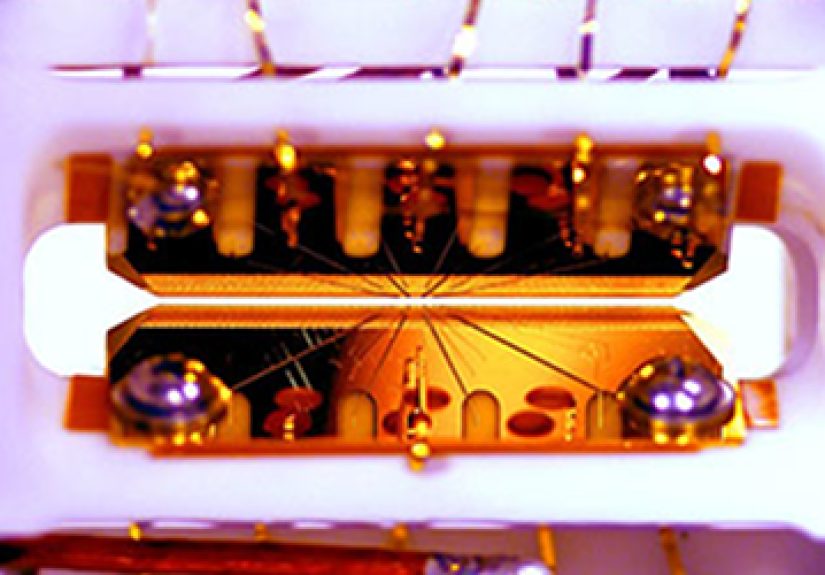
At the heart of the machine is a simple but mind-bending concept: ions are atoms that carry an electric charge, and charged particles can be held in place using electromagnetic fields. In an ion-trap quantum computer, those ions are suspended in a vacuum and cooled so that unwanted motion is reduced as much as possible. Each ion stores quantum information in internal energy states, which act as qubits. Scientists then use laser pulses, microwave fields, or both to manipulate those states with very fine control.
If that sounds delicate, it is because it absolutely is. A trapped-ion quantum computer is less like flipping a light switch and more like conducting a silent orchestra where every violin is an atom and every missed cue makes the math cry. The trap keeps the ions lined up, the control system addresses them, and the shared motion of the ions helps create entangling operations between qubits. That ability to entangle qubits reliably is the whole show. Without it, a quantum computer is basically just expensive décor for a physics lab.
The beauty of this platform is that the qubits are not random manufactured objects with slightly different personalities. They are identical atomic systems. That consistency is one of the reasons trapped-ion quantum computing keeps showing up in serious conversations about scalable, programmable machines.
Why Ion Traps Are So Good at Making Quantum Computers Programmable
Identical qubits are a big deal
Classical chips are built by fabrication. Ion-trap qubits, by contrast, are built from nature’s own copy-paste function. A ytterbium ion is a ytterbium ion. That kind of uniformity helps reduce the variability that can complicate calibration and control in other quantum platforms. When engineers talk about reliable hardware, identical qubits are not a cute bonus feature. They are oxygen.
All-to-all connectivity makes algorithms less awkward
Many trapped-ion systems are known for all-to-all connectivity, meaning one qubit can interact with any other qubit without needing long chains of swap operations just to introduce them. That matters because every extra operation is another chance for noise to crash the party. When hardware offers more direct interactions, circuit design becomes more flexible and efficient. The machine spends less time shuffling qubits around logically and more time doing useful quantum work.
Long coherence times help qubits stay useful
Quantum information is fragile. Qubits want to leak their magic into the environment like a badly guarded secret. Trapped-ion systems are valued because their qubits can maintain coherence for relatively long periods, which gives researchers more time to perform operations before errors pile up. That does not eliminate noise, but it gives the system a better fighting chance.
High-fidelity operations improve trust in the result
A quantum computer that produces nonsense faster is still nonsense. One reason ion-trap platforms receive so much attention is their strong performance in gate fidelity and measurement quality. High-fidelity operations mean the machine is better at doing what the programmer asked, rather than improvising an avant-garde version of the circuit.
Mid-circuit measurement and qubit reuse push the platform forward
Programmability is not just about running a circuit from start to finish. Advanced quantum computing also needs features such as measuring some qubits in the middle of a computation, using those results to guide later operations, and reusing qubits when appropriate. Those capabilities are important for more sophisticated algorithms and for error-correction strategies. Trapped-ion platforms have become especially interesting here because several commercial and research systems have demonstrated mid-circuit measurement, conditional logic, and other features that make the hardware feel more like a real computational tool and less like a fragile demo.
How the Programming Side Works
Calling an ion-trap system a programmable quantum computer means developers can compile quantum circuits into operations the machine understands. A programmer writes an algorithm using software tools and gate models, the compiler maps that algorithm to the device’s native operations, and the control stack translates those instructions into carefully timed pulses and measurements. Under the hood, it is still a circus of lasers, cooling, and vacuum hardware. From the programmer’s point of view, though, it starts to look like a real platform.
This is one of the quiet revolutions in quantum computing: the hardware and software layers are finally meeting in a useful way. Programmability depends on more than physics. It also depends on compilers, scheduling, calibration, cloud access, benchmarking, and error mitigation. An ion-trap machine can be beautiful in theory, but if it cannot accept a meaningful circuit and execute it repeatably, it is not much help outside a research paper.
That is why trapped-ion systems have drawn attention from cloud providers, enterprise software teams, and government-backed research programs. The goal is not merely to build a quantum object. The goal is to build a programmable quantum resource that researchers can actually use.
Real Examples That Show Ion Traps Are More Than Hype
The trapped-ion story is not just a promise for tomorrow. There are already concrete demonstrations that show how the platform works in practice.
One of the classic milestones came from trapped-ion implementations of Grover’s search algorithm, where researchers demonstrated better-than-classical performance on a complete three-qubit search. That was important because it showed programmable control over a nontrivial quantum algorithm, not just isolated gate operations.
Another major step involved the quantum charge-coupled device, or QCCD, architecture. This design treats ions as mobile qubits that can be moved between different zones for storage, interaction, and measurement. The idea is clever because it tries to preserve high-fidelity local operations while offering a path to scaling. Instead of forcing one giant static chain to do everything at once, QCCD lets the machine organize where and how interactions happen. That is the kind of engineering detail that sounds boring until you remember it may help determine whether quantum computing becomes practical or remains a permanent TED Talk topic.
Commercial trapped-ion systems have also shown why this architecture matters. Quantinuum’s systems have emphasized all-to-all connectivity, mid-circuit measurement, and qubit reuse, while IonQ has built its approach around identical atomic-ion qubits and flexible gate operations between arbitrary pairs. These are not cosmetic differences. They shape how efficiently algorithms can be compiled and how gracefully the hardware can support future error-corrected workflows.
Then there is the logical-qubit milestone. Microsoft and Quantinuum reported the creation of highly reliable logical qubits on trapped-ion hardware and used them in a hybrid quantum-classical chemistry workflow. That does not mean fault-tolerant quantum computing has fully arrived, but it does mean the conversation has moved beyond “Can quantum hardware do anything interesting?” toward “How do we scale reliable computation?” That is a much more exciting question to have.
Government-backed programs also reinforce the platform’s seriousness. Sandia’s QSCOUT testbed gives researchers unusually low-level access to a trapped-ion machine, making it a valuable open environment for experimentation. That is the kind of infrastructure that helps a field mature. You do not build an ecosystem by hiding the hardware behind a velvet rope and a mysterious press release.
The Challenges Are Real, Too
Now for the honest part: ion traps are impressive, but they are not magic. They come with engineering tradeoffs that researchers are working hard to solve.
Speed can be a limitation
Compared with some other quantum platforms, trapped-ion systems are often slower at executing gate operations. Faster is not always better if the results are noisy, but speed still matters. A platform with excellent fidelity must also keep improving throughput if it wants to run deeper and larger algorithms efficiently.
Scaling the control hardware is difficult
Traditional trapped-ion setups can involve a lot of optical hardware. Think lasers, beam delivery, alignment, stability, and enough precision to make ordinary electronics look carefree. Recent work from MIT and MIT Lincoln Laboratory on chip-based photonic cooling shows one promising route toward more scalable, integrated systems. That is encouraging because a practical quantum computer cannot rely forever on a hardware footprint that looks like a small moon-landing rehearsal.
Error correction is still expensive
Even strong physical qubits are not enough on their own. Large-scale useful quantum computing will require logical qubits protected by error-correction schemes. Trapped-ion hardware has shown meaningful progress here, especially because features like mid-circuit measurement and flexible connectivity are helpful for error-correcting codes. But the number of physical resources required remains substantial. The future is promising, not effortless.
Integration and networking remain active frontiers
Researchers are also pushing on photonic interconnects, modular designs, and improved transport mechanisms so that multiple ion-trap modules can work together. In plain language, the dream is not just one better trap. It is an architecture where many high-quality components cooperate without turning the machine into a temperamental science project.
Why This Platform Matters Beyond the Lab
Ion-trap quantum computing sits at an interesting intersection of beautiful physics and practical engineering. It uses some of the most precise control humans have ever achieved over single atomic systems, but it does so with an eye toward computation, not just pure experimentation. That combination is rare. It is also why trapped ions remain one of the most respected approaches in the quantum industry.
For businesses, the appeal is straightforward: a programmable platform with strong qubit quality, flexible connectivity, and a credible path toward more reliable quantum computation. For researchers, the platform offers a powerful environment for quantum simulation, algorithm development, and benchmarking. For the rest of us, it provides a useful reminder that the future of computing may depend less on squeezing ever more transistors onto familiar chips and more on learning how to choreograph atoms without making them lose their minds.
That last part, admittedly, is relatable.
Experiences Related to Ion-Trap Programmable Quantum Computing
One of the most interesting things about ion-trap quantum computing is that the experience of using it does not feel like the old stereotype of science locked inside a basement lab. Increasingly, researchers, students, software developers, and enterprise teams can interact with trapped-ion systems through cloud platforms, testbeds, and software development kits. That changes the experience from “watch a brilliant physicist touch mirrors with tweezers” to “write code, submit a circuit, analyze performance, and improve the workflow.” It is still advanced science, but it is becoming operational science.
For researchers, the experience is often one of precision and patience. Trapped-ion machines reward careful circuit design. Because the hardware has strong connectivity and high-fidelity operations, users can often explore elegant circuit structures that would be clumsy on more rigid architectures. The flip side is that every decision still matters. Choice of ansatz, circuit depth, measurement strategy, and compilation path can dramatically affect outcomes. Working with these systems feels less like brute-force computing and more like collaborating with a brilliant but literal-minded instrument.
For students and new quantum developers, ion-trap systems can be surprisingly educational. The hardware makes abstract textbook concepts feel concrete. Entanglement is no longer just something in a diagram. Mid-circuit measurement is no longer a buzzword. Suddenly, you are dealing with real constraints, real device characteristics, and real tradeoffs between ideal algorithms and practical execution. That is a valuable learning experience because it teaches the difference between knowing quantum theory and knowing how quantum computing actually behaves when hardware gets involved.
For industry teams, the experience is more strategic. Companies exploring chemistry, materials, optimization, machine learning, and secure communications are not using trapped-ion computers because they enjoy expensive hobbies. They are testing whether the platform’s high-quality qubits and flexible programmability can support workflows that matter in business or national research environments. In that setting, the experience is often hybrid by design: classical preprocessing, quantum execution, classical post-processing, and lots of benchmarking. No one serious is pretending the quantum computer works alone like a superhero in a cape. It works more like a specialist on a very smart team.
There is also a practical emotional experience that comes with the field. Quantum computing can be humbling. You can build a beautiful circuit, send it to a device, and get results that tell you your assumptions were cute but incorrect. Then you revise, recompile, reduce noise, change measurement counts, and try again. That cycle is not failure. It is the lived experience of programmable quantum computing today. Trapped-ion systems, because of their stability and flexibility, often make that learning loop more informative. The machine gives you a clearer signal about what worked, what did not, and what to improve next.
In the long run, that may be the most important experience of all. Ion-trap quantum computers are teaching the field how to move from isolated scientific feats to repeatable computational practice. They are showing what it means to program quantum hardware, evaluate it honestly, and refine it step by step. That is not flashy in the movie-trailer sense. But it is exactly how important technologies grow up.
Conclusion
Ion traps make programmable quantum computers by combining precise atomic control with a hardware model that supports flexibility, fidelity, and a realistic path toward scaling. The result is one of the strongest platforms in the quantum race: a system where identical qubits, all-to-all connectivity, long coherence times, and advanced measurement features work together to support real algorithms instead of just theoretical ambition.
The road ahead still includes serious engineering work, especially around scaling, integration, and error correction. But the direction is clear. Trapped-ion technology has already moved beyond the “neat experiment” stage. It is now part of the practical conversation about how programmable quantum computing will actually happen. That alone makes ion traps worth watching very closely.