Table of Contents >> Show >> Hide
- Meet the journalist behind the whiskered time capsule
- Why vintage cat photos hit us right in the nostalgia
- A quick tour of the “40 new pics” vibe (without spoiling the fun)
- How photographing cats became a thing (long before the internet)
- Where do these images come from?
- How to “read” a vintage cat photo like a story
- Why “cats with famous people” feels more meaningful than it sounds
- Ethics, credit, and the not-so-tiny details
- Want to start your own mini-collection? Here’s a practical approach
- Conclusion: a tiny cat-shaped bridge to the past
- Experiences: What it feels like to fall down the vintage cat photo rabbit hole ()
There are two kinds of time machines: the ones in sci-fi movies, and the ones you scroll at 1:00 a.m. while whispering,
“Okay, just one more.” This story is absolutely the second kind.
A journalist named Paula Leite Moreira has been curating a wonderfully specific corner of internet joy: vintage photos of cats
posing with famous (and occasionally “wait, I know that guy…”) personalities from the past. The result feels like historical research,
but with more whiskers and fewer footnotesa stream of images where icons and ordinary people alike appear to be sharing the spotlight
with a cat who did not agree to the schedule, the lighting, or the concept of “smile for the camera.”
In this fresh batch of 40 new pics, the charm isn’t only that the photos are old. It’s that they’re human. These aren’t staged brand
campaigns or polished PR moments. They’re snapshots of real affection, casual companionship, and the timeless truth that cats have been
stealing scenes since long before the word “viral” meant anything besides “please stay home.”
Meet the journalist behind the whiskered time capsule
The collection is tied to “All Vintage Cats,” an Instagram project Paula created in 2020 after she saw a 19th-century cat photo online.
That first spark turned into a full-on hunt through historical collections, archives, image banks, and magazines to find more cat moments
from earlier erasthen share them with anyone who needs a quick mood upgrade.
What makes this curation feel different from a random “old photo dump” is the eye behind it: a journalist’s instinct for what tells a story.
A person’s posture. The setting. The way a cat sits like it owns the furniture (because it does). Each photo becomes a tiny narrative about
everyday life and celebrity lifeboth interrupted, in the most adorable way possible, by a cat.
Why vintage cat photos hit us right in the nostalgia
Part of the magic is psychological: cats are both relatable and mysterious. They’re companions, but also tiny roommates who appear to be
judging your life choices from a windowsill. Put that energy into a historical photo and you get an instant story prompt:
“Who was this person, where were they going, and did the cat approve?”
There’s also something comforting about realizing that, decades ago, people did the same stuff we do nowexcept their “content” involved
film, patience, and a much higher chance of someone saying, “Don’t move for 30 seconds or the whole thing is ruined.”
We’re used to seeing history as formal and distant. A cat photo pulls it back into the realm of the everyday.
And yes, the human-animal bond is real. Modern public health resources note that pets can support well-being by offering companionship and
encouraging social connection, while also reminding people to practice healthy habits around animals. In other words: pets can be good for us,
and we’ve been leaning on that comfort for a very long time.
A quick tour of the “40 new pics” vibe (without spoiling the fun)
A collection like this doesn’t need you to memorize all 40 images. It invites you to notice patternshow photography styles change, how people
pose, and how cats remain hilariously consistent through every decade. Here are a few highlights that capture the range:
1) The “global celebrity… local cat” contrast
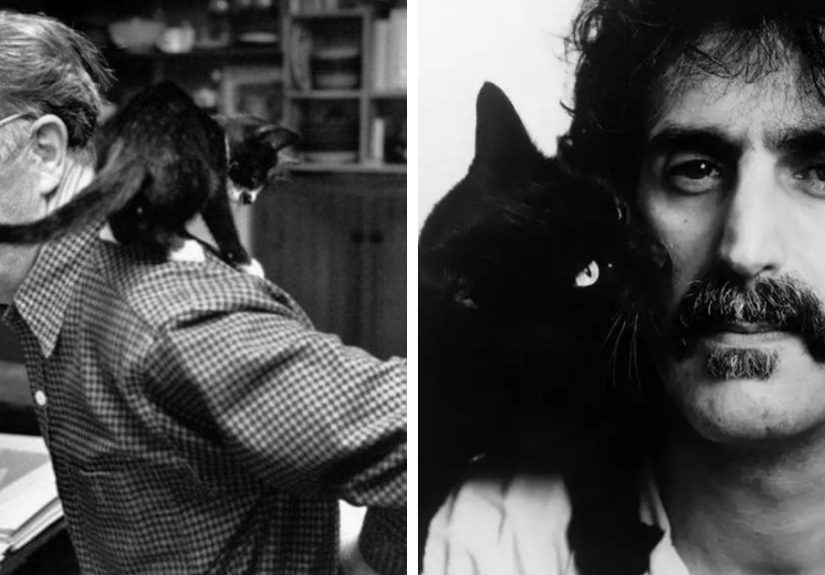
Some photos are fascinating because the human subject is instantly recognizable. One example from the collection features musician Frank Zappa
holding a cat in 1970an image that reads like “legendary artist” meets “soft household moment.” The contrast makes the photo feel unexpectedly
intimate, as if the cat accidentally revealed the person behind the persona.
2) The “cool factor” multiplier
Another image spotlights actor Steve McQueen in 1963proof that even peak cool can be improved by adding one cat. It’s a visual equation that has
never failed: sunglasses + calm posture + cat = instantly iconic.
3) The old-Hollywood tenderness
Vintage celebrity photos can feel guarded or overly posed, but cats tend to soften the scene. A 1935 image of actress Jean Harlow with a cat has
that classic studio-era glamouryet the cat brings it back to something warm, ordinary, and almost domestic.
4) The “history is a real place” effect
The collection also includes people from different professions and countries. For instance, a 1967 photo of Finnish documentary photographer Ismo
Hölttö with a cat carries a different moodless glitz, more lived-in authenticity. It reminds you that cats weren’t just props for famous faces;
they were present in everyday life, too.
The best part: you don’t have to “know” every personality to enjoy the photos. Sometimes the most interesting ones are the unfamiliar faces,
because you’re forced to read the image itself. The cat becomes your guide: if the cat looks relaxed, the room probably felt safe. If the cat looks
like it’s plotting an escape, the photographer probably asked for “one more take.”
How photographing cats became a thing (long before the internet)
It’s tempting to think of cat obsession as a modern inventionlike Wi-Fi or overpriced iced coffee. But cats have been camera-ready since the earliest
days of photography, even when cameras were absolutely not cat-ready.
Early photographic processes required long exposure times and careful handling. The daguerreotype, announced publicly in 1839, could take minutes in its
earliest form, and even later improvements still demanded stillness. That’s why early portraits often look formal: people were literally trying not to move.
Now imagine asking a cat to do that. (You can’t even ask a cat to keep the same opinion for 12 seconds.)
As photography evolvedfaster processes, better lenses, more portable camerascandid life became easier to capture. Cats naturally slipped into the frame
because they were already part of the home: on laps, on porches, in workshops, in gardens, and occasionally on the exact table you told them not to climb.
Vintage cat photos were early “memes,” just slower
If you think captions and silly poses are a social-media invention, history has a surprise for you. Libraries and special collections have documented
funny animal images and novelty photo trends long before “LOLcats.” In fact, archivists have pointed out that small novelty cards and captioned animal
photos functioned like the meme format of their daymass-produced, shared, and instantly understandable even without context.
What changed isn’t our love of cat content. What changed is the speed of sharing it. In the past, it traveled by postcard, magazine, or photo album.
Today, it travels by screenshot.
Where do these images come from?
A big reason collections like this can exist is that many museums, libraries, and archives have digitized historical materials and made them searchable.
In the U.S., several major institutions offer large sets of images that are free to use or open access, making it easier for researchers, writers,
educators, and collectors to explore the past.
1) Major digital archives and library collections
- Library of Congress digitized collections and themed “Free to Use and Reuse” sets (including a cat-focused set).
- Smithsonian Open Access program, which provides millions of digital items for download and reuse.
- Public library digital collections that feature historical photography, postcards, and ephemera.
- University special collections that preserve novelty prints, magazines, and photo series.
2) Historical magazines and image banks
Vintage magazines often contain portraits and candid shots that don’t always circulate widely. When those materials are digitized (or indexed by collectors),
they become part of the “findable” history that a curator can surface again. Paula has described using a wide range of historical collections and archives,
which makes sense: the best image might be in a national repository, or it might be tucked inside a long-forgotten publication.
How to “read” a vintage cat photo like a story
The most fun way to enjoy a collection like this is to treat each photo like a tiny documentary. You’re not just looking at “person holding cat.”
You’re looking at a moment with context. Here’s what to pay attention to:
Look at the hands
Hands tell you whether the cat is being gently supported, proudly presented, or barely contained. A relaxed hold often suggests familiarity.
A stiff grip can mean “the photographer promised this would be quick.” (The photographer lied.)
Look at the background
A studio backdrop creates a formal portrait vibe; a messy living room or a backyard steps you into daily life. Backgrounds can hint at class, profession,
and cultural trendsfurniture styles, clothing cuts, even the presence of other animals hovering just out of frame.
Look at the cat’s face first
This isn’t even adviceit’s an involuntary human reflex. But it works. Cats telegraph mood quickly: content, suspicious, bored, or “I have a meeting in
three minutes, please wrap this up.” Their expression becomes the emotional caption you supply in your head.
Why “cats with famous people” feels more meaningful than it sounds
On paper, “famous person holding cat” might sound like a novelty. In practice, it’s a shortcut to humanizing history. A celebrity portrait can feel distant;
a cat turns it into a domestic moment. That matters because it shifts how we understand the past.
These photos also remind us that fame has always existed alongside ordinary routinespets needing food, naps happening at inconvenient times, fur ending up on
dark clothing, and someone saying, “No, we cannot keep the cat off the couch,” then immediately giving up.
If you’re a fan of cultural history, you’ll recognize another layer: cats have long been symbols in art and mediasometimes elegance, sometimes independence,
sometimes pure chaos in a small package. Seeing them in real historical photos helps separate symbolism from reality. Cats weren’t just “ideas.” They were
present companions.
Ethics, credit, and the not-so-tiny details
Working with vintage photographs comes with responsibilities. Even if an image is old, it may still have rights restrictions depending on who owns the photo
or how it was digitized. The safest approach is to treat every image like it has a “paper trail”: where it came from, what the rights statement says, and how
the hosting institution requests attribution.
There’s also the human side. Historical photos can include private moments. Sharing them thoughtfullywithout mocking subjects, and with context when possible
keeps the project rooted in respect rather than exploitation. The goal is to celebrate the humanity in the image, not turn it into a punchline at someone’s
expense. (Except the cat. The cat can handle it.)
Want to start your own mini-collection? Here’s a practical approach
If this story makes you want to hunt for your own vintage cat photos, congratulations: you have the best kind of research itch. Here’s how to do it without
getting overwhelmed:
- Pick a theme. Examples: “cats in studios,” “cats with writers,” “cats on farms,” “cats with musicians,” or “cats ignoring royalty.”
- Choose 2–3 reliable archives to start. Big national institutions are easiest because search tools and metadata are strong.
- Search like a librarian. Try keywords like “cat,” “kitten,” “feline,” “pet,” “portrait,” “studio,” plus decade or location terms.
- Save the metadata. Title, date, collection name, and rights statementfuture you will be grateful.
- Write captions that add value. A good caption explains what we’re seeing and why it’s interesting (not just “Aww”).
The big secret is consistency. A collection becomes compelling when it feels curatedlike someone is guiding you through a specific doorway in the past,
not just tossing photos into your lap like a cat dropping a toy mouse.
Conclusion: a tiny cat-shaped bridge to the past
“All Vintage Cats” is the kind of project that looks simple at first glancejust old photos, just catsbut ends up being something richer: a cultural collage,
a history lesson, and a comfort scroll rolled into one. Paula Leite Moreira’s collection shows that our relationship with cats isn’t a modern quirk. It’s a
long-running, cross-generational companionship that pops up in studios, homes, and celebrity lives alike.
So if you find yourself staring at a black-and-white photo of a famous face from decades ago and thinking, “Wow… that cat is the real star,” you’re not wrong.
You’re simply participating in a tradition older than the internet: noticing that history is made of ordinary momentsplus cats.
Experiences: What it feels like to fall down the vintage cat photo rabbit hole ()
If you’ve never gone “vintage cat photo hunting,” let me describe the experience the way it usually happens for normal people with good intentions.
You start responsibly. You tell yourself: “I’m going to look at a few historical images, appreciate the past, and then return to my life.”
Ten minutes later, you’re reading about photographic processes from the 1800s, your browser has 27 tabs open, and you’ve developed strong opinions about
whether a certain tuxedo cat in a 1930s portrait is giving “polite” or “politely furious.”
The first surprise is how much the search feels like detective work. You don’t always type “cat with famous person” and get a neat answer.
You try “cat portrait,” then “kitten studio,” then “pet photograph,” then you discover that sometimes a cat is tagged as “animaldomestic,” and sometimes
it’s tagged as “cat,” and sometimes it’s tagged as “miscellaneous” as if the archivist sighed and said, “Look, it’s adorable, but I’ve got 10,000 items
to catalog before lunch.”
The second surprise is how quickly you start noticing style and era. A Victorian studio photo feels formal, like everyone is attending a very serious meeting
about manners. A mid-century snapshot feels casual, like the photographer caught a real moment in a living room that still smells faintly like coffee.
And then you see a cat in every decade doing the same timeless cat activities: sitting exactly where it’s not supposed to sit, accepting admiration as a birthright,
and staring at the camera with the confidence of a creature who has never had to pay taxes.
The third surprise is emotional. You think you’re going to look at “cute pictures,” but the photos have weight. They’re evidence of ordinary life:
people pausing long enough to hold a pet and be present. Sometimes you can practically feel the quiet in the room. Sometimes you can see the affection in a
hand that supports a cat gently, like the person has done it a hundred times. Even the serious faces soften, because a cat changes the atmosphere of a photo.
A cat makes the moment less about performance and more about relationship.
And then there’s the thrill of a “find.” The best moment is when you stumble on an image that isn’t widely circulatedsomething tucked inside a collection
you didn’t know existed. You sit up a little straighter. You zoom in. You read the description. You check the date. You look at the cat’s posture like you’re
analyzing fine art (which, honestly, you are). That’s when you realize why curated projects like this matter: they don’t just entertain. They rescue small,
delightful details from the past and let them live again.
By the end of the rabbit hole, you don’t feel like you wasted time. You feel like you visited history through a friendlier doorwayone lined with paws.
And if you come away believing that cats have been quietly shaping human joy for generations, you’re not being dramatic. You’re being accurate.
(Your cat, however, will still demand credit.)