Table of Contents >> Show >> Hide
- Who Is JPS, and Why Do His Retro Game Pieces Work So Well?
- Why Retro Video Game Nostalgia Hits Like a Power-Up
- The 10 JPS Retro Game Artworks That Might Reboot Your Inner Kid
- 1) Rampage (first released in 1986)
- 2) Mortal Kombat (first released in 1992) “Sub-Zero” moment
- 3) Doom (first released in 1993)
- 4) Mortal Kombat (first released in 1992) the “Fatality!” callback
- 5) Grand Theft Auto (first released in 1997)
- 6) Superfrog (first released in 1993)
- 7) Worms (first released in 1995)
- 8) Pang / Buster Bros. (first released in 1989)
- 9) Lemmings (first released in 1991)
- 10) Super Sprint (first released in 1986)
- Why These Pieces Feel So Personal (Even If You’ve Never Seen One in Person)
- Extra : The Shared Experience of Retro Game Nostalgia
- Conclusion: JPS Turns Sidewalks Into Save Points
There are two kinds of people in this world: (1) the ones who hear “Finish him!” and immediately start
button-mashing in their head, and (2) liars. Retro games don’t just live in our memoriesthey squat there like a
tiny pixelated landlord, collecting rent every time we see a joystick, a chunky CRT, or a suspiciously perfect
sewer drain that looks like it could be the entrance to Level 2.
That’s why the street artist known as JPS (Jamie Paul Scanlon) is such a cheat code for nostalgia.
He takes the everyday stuff we walk pastsignposts, cracked walls, manhole covers, drainsand turns them into playful
tributes to classic games. It’s the kind of art that makes you grin first… and then suddenly wonder where your old
SNES controller went, and why your thumbs still remember combos you haven’t tried since the 1990s.
Who Is JPS, and Why Do His Retro Game Pieces Work So Well?
JPS is a street artist whose work often leans on humor, pop-culture icons, and clever placement. He’s open about
having a rough early life and then returning to art in a big way around 2009finding inspiration after seeing stencil
work in Bristol and deciding to commit to creating again. In other words: a comeback arc worthy of a final boss fight,
minus the melodramatic cutscene.
His secret weapon is context. Street art isn’t hanging politely in a quiet galleryit’s out there in
public, shoulder-to-shoulder with street signs and scuffed brick. JPS uses that setting as part of the punchline.
A crack becomes damage. A drain becomes a portal. A sign becomes an instant “level start” screen. When the environment
becomes part of the artwork, the viewer doesn’t just lookthey play along.
Why Retro Video Game Nostalgia Hits Like a Power-Up
Nostalgia isn’t just you being sentimental. Psychologists describe it as a longing for a remembered past that feels
“better than the present” in some meaningful wayoften tied to comfort, identity, and social connection. Research
and psychology organizations have also noted that nostalgia can support well-being by reinforcing belonging and meaning,
especially during stressful seasons or transitions.
Retro games are especially potent nostalgia triggers because they’re tied to “firsts”: first console, first sleepover,
first time you beat a level without a guide, first time you realized your friend was absolutely cheating in a
split-screen match. Museums and preservation groups have been taking games seriously for yearscollecting artifacts,
documenting gamer stories, and even treating games as design objects worth keeping. When culture starts preserving
something, it sends a message: your memories were part of history.
JPS taps into that emotional circuit in a sneaky, delightful way. His pieces don’t demand that you know art theory.
They ask one simple question: “Remember this?” And your brainbetrayer that it isanswers in milliseconds.
The 10 JPS Retro Game Artworks That Might Reboot Your Inner Kid
Below are ten playful JPS pieces inspired by popular retro video games. Some are direct references, and some are
“if you know, you know” winkslike a secret passage hidden behind an obviously suspicious wall texture.
1) Rampage (first released in 1986)
The game in a nutshell: You are the monster. The city is the snack.
Rampage let players stomp buildings, swat helicopters, and generally act like a kaiju with a time limit.
JPS’s twist: He uses a real street sign as the “stage,” placing the monsters so they look like
they’re actively tearing into the sign itself. It’s funny because it’s simple: the destruction isn’t painted
around a city skylineit’s happening to an actual piece of the modern world.
2) Mortal Kombat (first released in 1992) “Sub-Zero” moment
The game in a nutshell: A one-on-one fighting tournament that became iconic fastand controversial
even faster.
JPS’s twist: He drops a recognizable fighter into a real urban scene so it feels like a character
stepped out of the arcade cabinet and into your neighborhood. It’s a “waitdid I just see Sub-Zero?” moment, which
is honestly the correct reaction to any unexpected ninja in public.
3) Doom (first released in 1993)
The game in a nutshell: Doom helped redefine the first-person shooter genre and became a
landmark title that people still study, mod, and debate.
JPS’s twist: He frames Doom like a warning signbecause if any game deserved a “do not enter”
sticker, it’s the one that made countless players say, “Just one more level” at 2:00 a.m. The piece often works
because the real-world sign language (danger, caution, keep out) matches the game’s intense vibe.
4) Mortal Kombat (first released in 1992) the “Fatality!” callback
The game in a nutshell: Mortal Kombat didn’t just create a franchiseit helped spark
major debates about what games depict and who they’re for.
JPS’s twist: Instead of painting a full fight scene, he leans into the catchphrase energythe kind
of soundbite that lives in your head forever. It’s less about showing violence and more about acknowledging how one
dramatic announcer voice can become a cultural landmark all by itself.
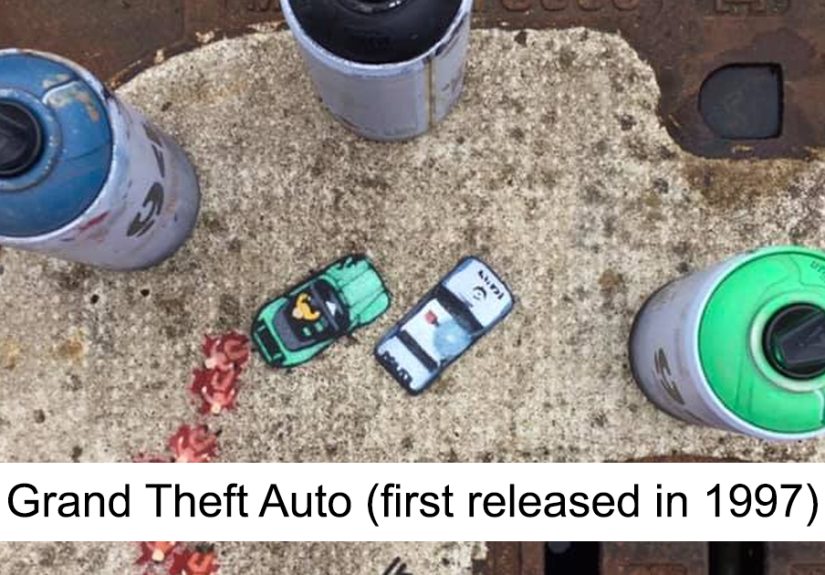
5) Grand Theft Auto (first released in 1997)
The game in a nutshell: The early Grand Theft Auto titles used a bird’s-eye view and centered
on missions in a crime-filled open worldan approach that later grew into one of the biggest series in gaming.
JPS’s twist: He plays with street signage and “car culture” in a way that feels like a wink rather
than a lecture. A simple visual cuean angle, a parked car, a signcan suddenly make you think, “Oh no… is this a
mission start?” It’s nostalgia with a side of “I probably shouldn’t, but…”
6) Superfrog (first released in 1993)
The game in a nutshell: A bright, bouncy platformer where a heroic frog rescues the day with classic
side-scrolling energy.
JPS’s twist: This is where his humor shines. A frog-themed character near a real street feature
(like a curb edge, a sign, or a corner that feels like a platform) makes the real world look like a game level.
Suddenly you’re mentally measuring jump distance like you’re about to grab a floating power-up.
7) Worms (first released in 1995)
The game in a nutshell: Turn-based chaos with tiny teams, ridiculous weapons, and the eternal truth:
your “perfect plan” will absolutely backfire.
JPS’s twist: He uses the texture of a wallchips, holes, rough patchesto suggest a battlefield.
That’s perfect for Worms, because the terrain is half the comedy. The art feels like a paused match where
you’re about to aim… and your friend is yelling advice that is definitely wrong.
8) Pang / Buster Bros. (first released in 1989)
The game in a nutshell: Dodge bouncing spheres, shoot them into smaller ones, and repeat until your
reflexes become either elite or emotionally exhausted.
JPS’s twist: The series is famous for globe-trotting backdrops and simple-but-addictive gameplay.
JPS mirrors that simplicity: a clean character reference plus a real-world “bubble” shape (pipes, circles, drains)
can be enough to trigger the entire memory of frantic dodging.
9) Lemmings (first released in 1991)
The game in a nutshell: You don’t control the lemmings directlyyou guide them, assign roles, and
try to prevent a tiny marching disaster.
JPS’s twist: A ledge in the real world becomes the perfect “oh no, they’re walking off again” moment.
His lemming-inspired placement makes you instantly recognize the puzzle: the environment is the level, and you’re
mentally searching for the tool to save the crowd.
10) Super Sprint (first released in 1986)
The game in a nutshell: A top-down racer that turned tight tracks into pure competitive chaosoften
with friends, often with shouting.
JPS’s twist: He places the racing reference on or near street elements that already resemble tracks:
circular covers, loops, lane-like seams in pavement. It’s a brilliant shortcut. Your brain fills in the rest:
tiny cars, tight turns, and the inevitable moment someone “accidentally” bumps you into the wall.
Why These Pieces Feel So Personal (Even If You’ve Never Seen One in Person)
JPS’s retro game art works because it’s not only about the gamesit’s about how games lived in our routines. Retro
gaming was social: arcades, couch co-op, swapping cartridges, arguing over whose turn it was, and celebrating wins
like you’d just qualified for the Olympics (except with more snacks).
- It’s familiar: recognizable titles, iconic characters, and “instant memory” visuals.
- It’s interactive: the city becomes the game screen, and you become the player again.
- It’s accessible: you don’t need a museum ticket to enjoy itjust eyeballs and a sense of fun.
Extra : The Shared Experience of Retro Game Nostalgia
Picture a normal day: you’re walking down the street, thinking about absolutely nothing importantmaybe lunch,
maybe a playlist, maybe whether your phone battery is dropping faster out of spite. Then you spot it: a little piece
of art tucked near a drain, a sign, or a cracked corner of brick. It’s not shouting for attention. It’s just there,
quietly waiting like a hidden bonus room. And suddenly your brain does that magic trick where it time-travels without
asking permission.
You remember the feel of a controller that had just enough resistance to make you believe skill mattered more than luck.
You remember the sound of the console powering on, the way the screen “snapped” into life, the almost ceremonial act
of blowing on a cartridge like you were performing ancient troubleshooting rituals. You remember sitting too close to
the TV because the action felt better when it filled your whole field of view. And if you ever played at a friend’s
house, you remember the unspoken rules: don’t pause during a boss fight, don’t hog the good controller, and don’t
pretend you weren’t looking when someone typed in a cheat code.
Retro nostalgia isn’t only about the gamesit’s about the tiny surrounding details: the couch that swallowed you,
the snack wrappers on the floor, the way someone’s older sibling was either a generous guide or a ruthless gatekeeper.
Maybe you remember the first time you figured out a puzzle without help and felt like a genius. Or the first time you
lost badly and still demanded a rematch because pride is also a classic game mechanic.
And then there’s the “soundtrack in your head” effect. You see something that resembles a levellike a curb that looks
like a platformand you can practically hear the imaginary jump sound. You see a circular manhole cover and your mind
turns it into a racing track. You see a warning sign and instantly remember the feeling of entering a dangerous zone
in a game: cautious, excited, and completely convinced you’re ready (you were not ready).
What makes JPS-style retro pieces especially powerful is how they turn nostalgia into a public experience. You might
be alone on the sidewalk, but the reference is shared. Somewhere out there, someone else has had that same “wait, I
remember this” momentsame game, same era, maybe even the same muscle-memory grin. And when you tell a friend about
it later, you don’t describe it like a museum exhibit. You describe it like a secret you found: “I saw this thing,
and it totally reminded me of that game.”
That’s the best kind of nostalgia: not the kind that traps you in the past, but the kind that reminds you you’ve been
part of stories, communities, and goofy little victories that still matter. It’s a reminder that fun has historyand
sometimes history shows up right next to a drain cover and says, “Hey. Remember me?”
Conclusion: JPS Turns Sidewalks Into Save Points
JPS’s retro video game artworks are fun on the surfaceclever, playful, instantly recognizable. But they also work
because they respect what retro games meant: creativity, community, and the kind of joy that doesn’t need fancy graphics
to feel enormous. If nostalgia is a power-up, these pieces are basically handing it out for free on your daily walk.