Table of Contents >> Show >> Hide
- The Backstory: A 1985 Leap of Faith (and a Lot of Elbow Grease)
- Upcycling Isn’t a Style HereIt’s the Operating System
- Kitchen Tour: The Details That Make This Upcycled Hackney Kitchen Work
- Fire-Door Cabinets: The Best Career Change Since the Office Escape
- Square White Tile Work Surfaces: Retro Grid, Modern Calm
- The Island: A Victorian Butcher’s Block on a Metal Base
- The “Floating” White-Tiled Table, Held by Raw Beams
- A Pot Rack and Lighting Made from Antique Parts
- The Pub Radiator: Industrial, Rusted, and Still Doing Its Job
- Shallow Built-In Shelving and a Whitewashed Backdrop
- Old House, Modern Comfort: Windows, Laundry, and Everyday Reality
- Art in the Room: Tea Ads, Spotlight Niches, and Color That Feels Earned
- French Doors to the Garden: A Kitchen That Breathes
- Why This Upcycled Kitchen Works (Even If You Don’t Own a Single Antique Screw)
- How to Steal the Look in the U.S.: A Practical Upcycled Kitchen Game Plan
- Maintenance Reality Check: The Price of Character Is Occasional Effort
- What This Kitchen Teaches Us About Sustainable Kitchen Design
- Field Notes: The Real-World Experience of Chasing an Upcycled Kitchen Dream (Extra)
- Conclusion
Some kitchens are designed. Some kitchens are built. And then there are kitchens that are rescuedpiece by piecefrom the “please don’t throw that away” pile. Artist Graham Carter’s upcycled Hackney kitchen is the kind of space that makes you look at a battered door and think, “You’d be gorgeous as a cabinet.” It’s charming, a little rebellious, and quietly brilliant in the way it turns reclaimed materials into daily comfort.
This is a kitchen where the cabinets have lived a previous life, the worktops are tiled like a crisp white sketchbook grid, and the room feels less like a showroom and more like the world’s most welcoming studioone where dinner just happens to get made between ideas.
The Backstory: A 1985 Leap of Faith (and a Lot of Elbow Grease)
In 1985, Carter walked into a two-bedroom Victorian terrace house in Hackney that was, by most people’s standards, “a hard no.” It was worn down, layered in not-so-cute “improvements,” and generally doing its best impression of a damp paperback. Carter was short on cash, long on vision, and bought it the same day.
Over time, he rehabbed the roughly 1,200-square-foot, circa-1870 home himself, aiming to reveal the building’s patina while bringing in contemporary art and color. That same philosophypreserve the soul, upgrade the experienceshows up loudest in the kitchen, where raw reclaimed wood becomes the main character and every object feels chosen, not “added to cart.”
Upcycling Isn’t a Style HereIt’s the Operating System
“Upcycled kitchen” can sometimes sound like code for “we ran out of money halfway through.” Not here. Carter’s approach is what happens when sustainability, craft, and creativity all share a group chatand nobody gets muted.
It also taps into a bigger reality: construction and renovation generate a massive stream of debris. The environmental win of salvage is simple: every door reused and every cabinet rebuilt means fewer virgin materials mined, processed, shipped, and installed. In other words, reuse isn’t just aesthetic; it’s practical climate math that also looks great with a cup of coffee.
Organizations in the U.S. that advocate for building-material reuse often describe construction and demolition waste as one of the largest sources of refuse, which is exactly why “save it, fix it, use it” is having a moment far beyond Pinterest. Carter just happened to be doing it before it was trendyand without turning it into a personality trait.
Kitchen Tour: The Details That Make This Upcycled Hackney Kitchen Work
Fire-Door Cabinets: The Best Career Change Since the Office Escape
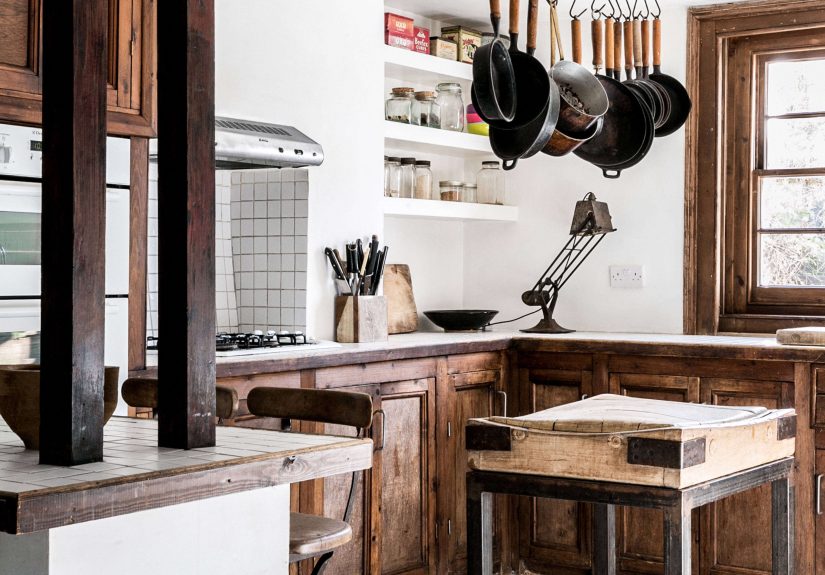
The headline detailbecause it deserves headlinesis the cabinetry: Carter fashioned cabinets from salvaged wood panels and old fire doors, finished with antique handles. Fire doors are built to be sturdy, so they bring that rare mix of “tough as nails” and “I have stories” to the room. The antique hardware is the wink that keeps the look warm and intentional instead of “I built this at midnight with whatever I could find.”
Square White Tile Work Surfaces: Retro Grid, Modern Calm
Carter covered the work surfaces in square white tile. Visually, it’s clean, bright, and slightly graphiclike a minimalist canvas that lets everything else (wood grain, art, cookware, life) pop.
And yes, tiled countertops are having a comeback conversation. Designers love the character and DIY friendliness, but everyone has opinions about grout. Grout can stain, it can feel high-maintenance, and it definitely does not care if you’re “too busy this week” to seal it. The trick is being honest about how you cook. If you’re a daily sourdough-and-simmer-sauce person, you’ll want to plan for regular cleaning and sealingor choose tile placements that aren’t your messiest prep zone.
The Island: A Victorian Butcher’s Block on a Metal Base
At the center sits an island work surface made from a Victorian-era butcher’s block on a metal base. It’s equal parts functional and poetic: a literal working surface from another era, now doing laps in a new century. Wood adds warmth, metal adds edge, and together they anchor the room like a good bassline.
The “Floating” White-Tiled Table, Held by Raw Beams
The kitchen’s signature move might be the white-tiled work surface that extends from the wall, supported by two raw wood beams that drop from the ceiling. It functions as a daily-use dining table with four vintage stools parked around itcasual, social, and perfectly sized for real life.
This is also a great example of why upcycled design feels so human: you can see how it’s made. Nothing is hiding behind glossy perfection. The structure is part of the beauty.
A Pot Rack and Lighting Made from Antique Parts
Above the island, the pot rack and countertop lighting are also made from antique components. It’s the kind of detail that makes the kitchen feel collected over timeeven if you’re seeing it all at once in photos. A little patina overhead does wonders for making a space feel less like a catalog and more like a home.
The Pub Radiator: Industrial, Rusted, and Still Doing Its Job
Beneath the work surface sits a rusted, working radiator reclaimed from a nearby pub that was scheduled for demolition. It’s functional heat, surebut it’s also a mood. It’s the design equivalent of wearing vintage boots with a tailored jacket: grounded, a bit gritty, and cooler because it didn’t try so hard.
Shallow Built-In Shelving and a Whitewashed Backdrop
Carter added shallow, built-in shelving along both sides of the kitchen and gave it the same whitewash used throughout the house. That consistent wall finish matters: it keeps the visual volume low so reclaimed wood can shine without the room feeling busy.
If you’ve ever seen an upcycled kitchen that felt chaotic, it’s often because every surface is shouting. Here, the palette is calm. The materials do the storytelling quietly.
Old House, Modern Comfort: Windows, Laundry, and Everyday Reality
In a very European (and very honest) move, the washing machine lives in the kitchen. Meanwhile, Carter replaced modern PVC windows with wood replicas that better match what might have been original to the house. That’s a key balance: reuse where it adds character, upgrade where it improves daily comfort and respects the architecture.
Art in the Room: Tea Ads, Spotlight Niches, and Color That Feels Earned
An antique tea advertisement hangs above the fireplace. There’s also a shelving niche with an embedded light that spotlights artwork. These small gestures matter because they reinforce the point: this is an artist’s kitchen. The room isn’t merely a place to cook; it’s a place to live with objects that carry meaning.
French Doors to the Garden: A Kitchen That Breathes
A set of French doors opens to the rear garden. Outside, there’s loose gravel, mature plants, and an outdoor marble dining table that seats 10. The indoor-outdoor connection makes the kitchen feel larger and lighter, which is especially valuable in a terrace-house footprint.
Why This Upcycled Kitchen Works (Even If You Don’t Own a Single Antique Screw)
Carter’s kitchen is a masterclass in how to make reclaimed materials feel cohesivenot like a thrift store exploded. The formula is surprisingly transferable:
- Choose one calming constant: Here, it’s whitewash walls and white tile surfaces.
- Let texture do the decorating: Reclaimed wood, worn metal, aged hardware.
- Make structure visible: Beams, brackets, and honest construction become design features.
- Mix eras on purpose: Antique parts with practical modern needs (hello, laundry).
- Use art like punctuation: A few bold moments keep the room from feeling “rustic on autopilot.”
It’s also aligned with what many U.S. design editors and builders keep repeating: natural materialsespecially reclaimed woodadd warmth, depth, and a lived-in quality that brand-new finishes can struggle to fake.
How to Steal the Look in the U.S.: A Practical Upcycled Kitchen Game Plan
1) Source Like a Scavenger (But With a Tape Measure)
In the U.S., one of the easiest entry points is your local Habitat for Humanity ReStore, which often accepts and sells donated building materials like kitchen cabinets, doors, windows, lighting, and flooring. Architectural salvage shops can be goldmines tooespecially for old doors, hardware, and oddball pieces that instantly add character.
Online marketplaces can help, but the real superpower is showing up with measurements, photos of your space, and a willingness to walk away if the piece is wrong. Salvage is only charming when it fits.
2) Plan Before You Build: Inventory Everything
Salvage projects go smoother when you treat them like a mini construction site, not a spontaneous craft night. Builders who work with reclaimed lumber often recommend a simple tracking systemgrouping pieces by finish level, material type, and priorityso you don’t end up with “six perfect boards” and no idea where they go.
Translation: label, photograph, and organize. Future-you will be grateful. Future-you is also the one who will be de-nailing boards, so present-you should probably put on gloves and behave.
3) Give Old Materials a Clean Bill of Health
Reclaimed wood can come with nails, grime, and mystery finishes. De-nail thoroughly, sand thoughtfully, and consider testing or professional advice if you suspect lead paint (common in older components). Also check for warping, rot, and structural integrityespecially if the piece will support weight, like a countertop or shelving.
4) Choose Your “Hero” Feature
Carter’s hero features are the fire-door cabinets and the white-tiled surfaces. Pick one bold reclaimed move and let it lead. Options that play well in American homes include:
- Cabinet fronts made from reclaimed doors or panels
- A butcher-block island built from reclaimed wood
- Open shelving from salvaged boards (especially if you love your dishware)
- Vintage hardware that patinas naturally over time
5) Tile Countertops: Do It for the Vibe, Not the Fantasy
Tile counters can be affordable, durable, and full of personality, but grout is the tradeoff. If you love the look, consider:
- Fewer grout lines: larger tiles or tighter joints reduce maintenance.
- Smarter grout choices: some modern grout products resist staining better than old-school mixes.
- Sealing: plan for periodic sealing, especially around food-prep zones.
- Placement strategy: tile a coffee bar or baking station first if you’re cautious.
6) Balance Old With New Where It Matters
An upcycled kitchen doesn’t mean suffering. Pair reclaimed cabinetry with reliable appliances. Use modern lighting where you need task brightness. Upgrade windows and ventilation if your home demands it. Carter’s kitchen is proof that “historic character” and “functional Tuesday night cooking” can absolutely coexist.
Maintenance Reality Check: The Price of Character Is Occasional Effort
Every charming choice has a little asterisk:
- Tile countertops: grout needs care; spills don’t politely wait for you to finish your show.
- Open shelving: it looks airy, but it requires editing (and wiping) more often than closed cabinets.
- Reclaimed wood: it can dent, scratch, and patinausually a feature, sometimes a surprise.
The upside is that these materials age with dignity. A small scratch on brand-new glossy cabinetry feels like tragedy. A small scratch on reclaimed wood feels like… Tuesday. That’s freeing.
What This Kitchen Teaches Us About Sustainable Kitchen Design
Carter’s upcycled Hackney kitchen isn’t just visually appealing; it’s a working example of circular design thinking: keep materials in use, extend their lifespan, and build beauty from what already exists.
If you want your own kitchen renovation to feel more sustainable, you don’t have to replicate every detail. Start with one reclaimed elementdoors, hardware, shelves, a butcher-block top, a vintage lightand build outward. The point isn’t perfection; it’s progress with personality.
Field Notes: The Real-World Experience of Chasing an Upcycled Kitchen Dream (Extra)
If you decide to build an upcycled kitchen inspired by Graham Carter’s, here’s what the experience tends to feel like in real lifeequal parts treasure hunt, problem-solving sprint, and sitcom episode where the main character keeps saying, “This will be easy.”
First, there’s the optimism phase. You walk into a salvage yard or a ReStore and instantly believe you are the kind of person who can spot “future cabinetry” with the confidence of an art dealer. You start holding up odd objects to the light. You tilt your head. You whisper, “This has good bones,” about something that is, technically, a door.
Then comes the measurement phase, where the tape measure becomes your emotional support tool. You learn quickly that “close enough” is not a measurement and that a cabinet opening that’s off by half an inch will haunt you like a catchy jingle. You also discover that doors are not shy about being slightly warped after decades of weather and life. A little warp can be charming on a wall. On a cabinet, it can turn into a daily negotiation.
Next is the prep phase: de-nailing, sanding, cleaning, and occasionally staring into the middle distance wondering how one board can contain so many nails. Reclaimed materials are generous that waythey give you character, history, and the chance to practice patience. If you’re lucky, you’ll set up a dedicated “dirty zone” in a garage or backyard, because the dust output of reclaimed wood can make your home feel like it’s auditioning for a desert documentary.
Then comes the design phase, which is where Carter’s kitchen offers the best lesson: choose a calm baseline. When you’re mixing old wood, antique hardware, and a patchwork of parts, a steady backdrop (white walls, simple tile, consistent paint) keeps the space from feeling like a costume party. This is also when you learn that “cohesive” doesn’t mean “matching.” It means your materials are in conversation, not competing for attention.
The installation phase is a blend of satisfaction and surprise. A reclaimed door panel becomes a cabinet front and suddenly looks like it always belonged. A vintage butcher-block top turns into your favorite spot in the house. And if you choose tile countertops, you’ll have a brief honeymoon period where the grid looks gorgeous and you feel unstoppablefollowed by the moment you realize grout is basically a magnet for spaghetti sauce. The fix isn’t panic; it’s planning: sealing, smart cleaning routines, and accepting that “lived-in” is part of the charm.
Finally, there’s the living-with-it phase, the part that makes all the effort worth it. An upcycled kitchen feels personal because it is. You remember where the wood came from. You remember the day you found the hardware. You remember the absurdly heavy thing you carried home thinking, “This is fine,” while your arms begged to differ. And when someone compliments the space, you get to say, casually, “Oh, that used to be a door,” which is one of the most satisfying sentences in home design.
The biggest takeaway is that an upcycled kitchen doesn’t just reduce wasteit changes your relationship to your home. You stop seeing materials as disposable. You start seeing them as reusable, adaptable, and full of potential. And that mindset, more than any single tile or cabinet, is the real design upgrade.