Table of Contents >> Show >> Hide
- The Wedding Was Built for Maximum Visual Impact
- Why the Internet Started Calling Out the Photos
- But Were They Really Proof of a Photoshop Disaster?
- The Optics Problem Was Bigger Than the Editing Allegations
- Why This Story Was So Irresistibly Clickable
- What Public Figures Can Learn From the Backlash
- Final Take: The Real Story Wasn’t Just the Photos
- The Experience Behind the Backlash: Why These Wedding Photos Hit a Nerve
- SEO Tags
Some celebrity weddings get applause. Some get envy. And some get the internet doing what the internet does best: zooming in like it has been personally hired by a federal agency. That is exactly what happened when photos from Lauren Sanchez and Jeff Bezos’ lavish Venice wedding began circulating online. What first looked like a glossy, high-fashion fairy tale quickly turned into a full-blown digital detective party, with social media users pointing out what they believed were strange edits, warped details, and a few visual choices that made the whole thing feel less “storybook romance” and more “wait, why does that chair look haunted?”
The result was a very modern kind of controversy. The wedding itself was already massive, expensive, and impossible to ignore. Then came the photos, followed by the comments, followed by the screenshot breakdowns, followed by the AI speculation. In other words, it was no longer just a wedding album. It became a cultural Rorschach test about wealth, image control, celebrity branding, and whether the internet can ever look at a polished photo without assuming somebody got a little too friendly with the editing tools.
This is what made the story so compelling. It was never only about whether a seam looked odd or a hand looked slightly off. It was about trust. In a moment when audiences are already suspicious of perfect-looking content, even the most glamorous wedding photos can end up facing the same scrutiny as a suspicious real estate listing with mysteriously curved walls and a refrigerator that seems to exist in three dimensions at once.
The Wedding Was Built for Maximum Visual Impact
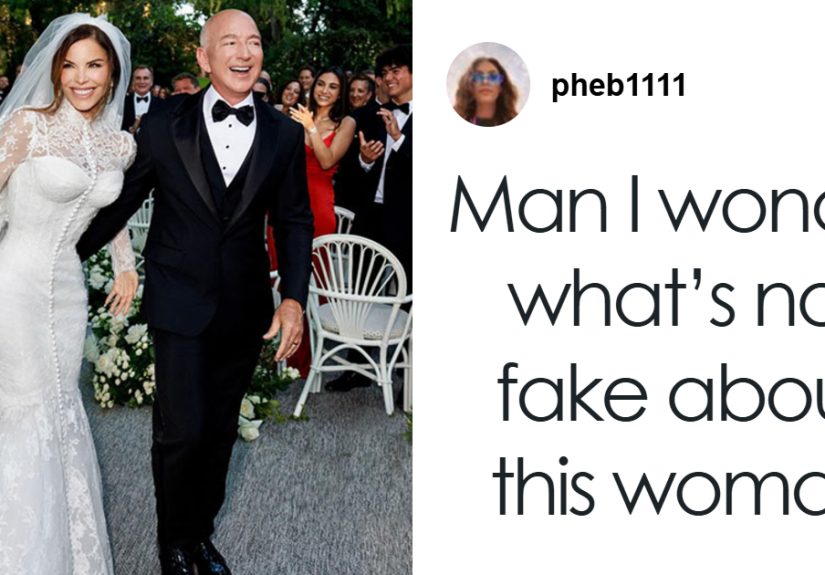
To understand why the photos drew so much attention, you have to start with the scale of the wedding itself. Lauren Sanchez and Jeff Bezos married in Venice in June 2025 in a celebration that was anything but low-key. The event was reported as a multi-day luxury spectacle with roughly 200 guests, water taxis, couture fashion, and enough famous faces to make the canals look like the world’s most expensive group chat.
Lauren’s bridal look was also designed to generate headlines. She wore a custom Dolce & Gabbana gown with a high-neck lace design, long sleeves, a corseted silhouette, and rows of delicate buttons. The dress was framed as a more classic, elegant departure from the sexier red-carpet style many people associated with her public image. That transformation mattered because it positioned the wedding photos as more than candid snapshots. They were part of a carefully shaped visual narrative: timeless bride, grand setting, luxury craftsmanship, polished romance, and a very expensive version of happily ever after.
In traditional celebrity-publicity terms, this was all perfectly logical. Big weddings generate big coverage. Exclusive dress details generate fashion write-ups. Beautifully staged photographs help define the event before the tabloids and comment sections do it for them. The problem is that once images are presented as flawless, the audience tends to approach them like a challenge. If the vibe says “perfection,” viewers immediately start looking for the crack in the marble.
Why the Internet Started Calling Out the Photos
The backlash centered on alleged inconsistencies that online users claimed to spot in the wedding images. Some commenters focused on the buttons on Lauren’s dress, arguing that in one image they seemed to run farther down the gown than in another. Others pointed to what looked like a safety pin left in place, while some said certain fingers looked warped or duplicated. A few viewers even claimed a background chair appeared to be missing a leg. This is the sort of internet spiral that starts with “Hmm, that’s odd” and ends with someone building a slideshow narrated like a true-crime documentary.
The phrase “epic Photoshop fails” spread because it packaged the whole situation into one irresistible headline. It suggested both glamour and embarrassment, which is catnip for entertainment coverage. Add a billionaire groom, a famous bride, a couture dress, and an audience primed to distrust hyper-polished images, and you have the ingredients for a very clickable storm.
What made the chatter louder was the leap from ordinary retouching claims to AI speculation. Some online commentators argued that the images looked not just edited, but strangely synthetic. That is a much bigger accusation because it moves the conversation from standard celebrity photo cleanup into the realm of authenticity panic. Suddenly the discussion was no longer “Did someone smooth the lace too aggressively?” It became “Are we even looking at reality anymore?”
The Specific Complaints That Fueled the Debate
The most repeated claims fell into a few categories. First, there were garment inconsistencies, especially around the line of buttons and the detailing on the dress. Second, there were body anomalies, including fingers and hands that some viewers said looked distorted. Third, there were background oddities, the kind of visual glitches that often go viral because they seem tiny at first and impossible to unsee once pointed out. Finally, there was the overall texture of the photos, with some critics describing parts of the lace and details as too blurry or too clean in ways that felt suspicious to them.
These observations were enough to turn a luxury wedding photo set into a crowdsourced inspection lab. That is the thing about digital culture: once one person circles an odd detail, everyone else starts hunting for five more. The image stops functioning as a memory and starts functioning as evidence.
But Were They Really Proof of a Photoshop Disaster?
This is where the conversation needs a little air, a little context, and probably a little less dramatic violin music. Public criticism does not automatically equal proof. Based on the coverage surrounding the wedding photos, the most responsible takeaway is that people alleged visible retouching mistakes and possible AI-like glitches. That is different from confirming that the photos were fabricated or deceptively manipulated in any major way.
There are several reasons why images from a heavily styled event can look inconsistent without becoming evidence of a grand digital conspiracy. One possibility is that the photos being compared were taken at different moments: during fitting, styling, preparation, or the actual ceremony. Another is that compression, cropping, lighting, motion, and social-media reposting can make details appear different from one version of a photo to another. And yes, the most obvious explanation may still be basic retouching, the kind that has existed in celebrity imagery for decades. Imperfect editing is not the same thing as a fake wedding.
That nuance matters. In the coverage reviewed, the online debate was energetic, skeptical, and occasionally hilarious, but it did not produce publicly verified proof that the images were AI-generated. What it did reveal was something more interesting: people are now primed to question polished visuals first and admire them second. That shift may be more important than the alleged mistakes themselves.
Why Minor Glitches Feel Bigger in 2025 and 2026
Ten years ago, a weird hand in a celebrity photo might have inspired a few jokes and a shrug. Now it can spark a larger conversation about authenticity, synthetic media, and narrative control. That is because audiences live in an environment flooded with filters, face tuning, image enhancement, AI image generation, and brand-managed storytelling. When a high-profile couple releases highly polished wedding photos, people do not just ask whether they look good. They ask whether they look too good, and whether that polish is trying to sell them something beyond romance.
Jeff Bezos’ connection to the tech world only intensified that reaction. Fair or not, some critics treated the visual oddities as symbolically loaded. In their view, a billionaire associated with power, platforms, and the future of technology did not just have wedding photos. He had wedding photos that represented a larger culture of curation, control, and spectacle. Suddenly a blurry detail in lace was not just a blurry detail. It was a referendum on modern reality.
The Optics Problem Was Bigger Than the Editing Allegations
The photo controversy did not emerge in a vacuum. The wedding was already under scrutiny before anyone began counting missing chair legs. Venice locals and activists had criticized the event as a symbol of excess, inequality, and overtourism. Media coverage around the wedding frequently highlighted both the glamour and the backlash. In other words, the atmosphere was already charged. The photos simply gave critics a fresh target.
That context helps explain why the public response was so intense. When people are already irritated by the scale of an event, they are not likely to greet its official images with soft piano music and silent reverence. They are more likely to look at those images as PR assets and ask whether they are being sold a fantasy that feels disconnected from ordinary life. That mood also helps explain the criticism surrounding the Vogue treatment of the wedding aesthetic. For some readers, the issue was not just visual polish. It was cultural tone-deafness.
Celebrity photography always carries a message, and in this case the message was luxury, exclusivity, and elevated romance. But public reception depends on timing. A glossy visual campaign can read as aspirational in one moment and absurdly overproduced in another. The Bezos-Sanchez wedding landed in a media environment where many viewers were already skeptical of elite excess. The alleged retouching issues merely gave that skepticism a close-up.
Why This Story Was So Irresistibly Clickable
The headline worked because it combined three internet obsessions: celebrity wealth, visual perfection, and public takedowns. Put those together and you get a content machine that practically powers itself. People who love fashion clicked because they wanted to see the dress. People who love gossip clicked because they wanted the drama. People who love internet sleuthing clicked because they wanted to play forensic detective with a screenshot and a suspicious thumb.
And then there is the emotional satisfaction of catching perfection slipping. That is one of the oldest and most reliable engines in entertainment media. A perfectly staged public image invites admiration, but it also invites resistance. The moment someone notices a flaw, the audience gets to feel savvy. They are no longer passive consumers of celebrity imagery. They become the people who “saw through it.” In digital culture, that feeling is powerful currency.
It also explains why the discussion did not stay confined to technical image analysis. The story expanded into commentary about class, taste, authenticity, branding, AI, social media, and who gets to control the story of a public event. One wedding, one set of photos, and suddenly everyone has a thesis.
What Public Figures Can Learn From the Backlash
There is a lesson here for celebrities, brands, publicists, and frankly anyone who posts a carefully curated image online. Perfection is no longer the safest strategy. The more polished an image looks, the more viewers may assume it has been manipulated. In today’s media environment, audiences often trust something that looks slightly imperfect more than something that looks immaculate.
That does not mean public figures should stop editing photos altogether. Let’s be honest: celebrity photography has never been a raw documentary form. But it does mean that hyper-controlled visuals now carry a risk. If an image looks too processed, it can undermine the emotional effect it was meant to create. Instead of inspiring awe, it can trigger suspicion. Instead of saying “what a beautiful moment,” people say “why does that hand have a side quest?”
The smarter strategy may be balance: polished enough to feel elevated, natural enough to feel believable. In the age of AI anxiety, authenticity is not just a moral value. It is a visual strategy.
Final Take: The Real Story Wasn’t Just the Photos
Lauren Sanchez and Jeff Bezos’ wedding photos became controversial not because the internet suddenly developed a passion for tailoring details, but because the images landed at the center of several larger tensions. People are tired of being sold flawless narratives. They are suspicious of highly managed visuals. They are increasingly aware of how images can be edited, enhanced, or transformed. And they are especially ready to question any image tied to extreme wealth and public spectacle.
So yes, the “Photoshop fails” angle made for a juicy entertainment story. But the deeper story is about how modern audiences read images now. They do not just look. They investigate. They compare. They distrust. They meme. They zoom in until the romance is replaced by pixel theory. In that sense, this was the perfect 2025 celebrity wedding controversy: lavish, stylish, wildly public, and somehow derailed by the possibility that a few details looked just a little too weird under the magnifying glass of the internet.
The wedding may have been designed as a fairy tale, but the reaction was pure digital democracy: messy, funny, skeptical, and impossible to fully control. Welcome to modern fame, where the bouquet is gorgeous, the gown is couture, and somewhere in the background, thousands of strangers are arguing about a chair leg.
The Experience Behind the Backlash: Why These Wedding Photos Hit a Nerve
What made this whole episode feel so oddly personal for viewers was that the experience of looking at the photos mirrored how many people now experience the internet itself. You open a glamorous image expecting a quick scroll and a little escapism. Maybe you admire the lace, maybe you judge the guest list, maybe you wonder what it must be like to get married in Venice with enough couture in the room to fund a small museum. Then somebody in the comments points out one strange detail, and suddenly your entire brain changes channels. Now you are not browsing. You are investigating.
That shift is deeply familiar in modern digital life. We no longer consume images in a calm, passive way. We consume them like suspicious little auditors. We pinch to zoom. We compare screenshots. We read comments before we finish looking at the actual picture. We assume there is a hidden layer, a retouch, a strategy, a narrative trick. In that sense, the wedding photo controversy was not unusual at all. It was simply a very glamorous example of the broader trust problem people have with images online.
There is also a strange emotional pleasure in catching a polished image looking imperfect. It gives viewers a sense of agency. A billionaire wedding is about as far from ordinary life as most people can imagine, but spotting a weirdly edited hand or a suspicious dress detail pulls that fantasy back down to earth. It says, in effect, “Aha, even this giant luxury machine cannot control every pixel.” That reaction is part humor, part skepticism, and part resistance to a culture that often asks the public to admire wealth without asking too many questions.
For many readers, the photos also arrived with baggage already attached. The wedding had been framed as extravagant from the start. The venue was iconic, the guest list was elite, the fashion coverage was immediate, and the surrounding press felt less like private joy and more like an international product launch with excellent tailoring. By the time the photos appeared, some viewers were already prepared to side-eye everything. The alleged editing issues simply gave people a visual reason to express a bigger discomfort they were already feeling.
That is why this story traveled so well. It was never just about Lauren Sanchez, Jeff Bezos, or even the wedding itself. It touched a modern nerve: the fear that images are becoming less trustworthy just as they become more polished, more strategic, and more central to how public figures shape their identities. When people reacted to these photos, they were also reacting to influencer culture, to AI culture, to wealth culture, and to the uneasy feeling that seeing is not what it used to be.
In the end, the experience was almost bigger than the evidence. People did not need a formal investigation to feel that something about the images captured the weirdness of modern media. They looked glossy, beautiful, controversial, and just suspicious enough to set off the internet’s collective alarm bells. And maybe that is the most revealing part of all: we now live in a world where even wedding photos can become a public debate about reality itself. That is both fascinating and, honestly, a little exhausting. But it also explains why this story kept people staring at their screens long after the vows were over.