Table of Contents >> Show >> Hide
- The Quote That Lit Up Studio 8H (Again)
- What Does “Denouncing Trump Doesn’t Work” Even Mean?
- Platforming Trump: The 2015 Warning Label That Never Came Off
- “He Knows How to Hold an Audience”: The Ratings Machine Dilemma
- The “Nonpartisan DNA” Argumentand Why It Makes People Roll Their Eyes
- Satire as a Safety Valveor a Megaphone?
- So What’s the Smarter Play: Denounce, Ignore, or De-Mythologize?
- A Practical Playbook for Political Comedy That Doesn’t Accidentally Become PR
- Conclusion: Michaels’ Logic Is UnderstandableAnd Still Dangerous
- Experiences & Lessons From the “Denouncing Doesn’t Work” Era (Extra )
If American politics were a family dinner, the past decade has been the part where someone flips the table, the dog eats the centerpiece,
and your cousin insists the whole thing is “good for engagement.” In that chaos, Lorne Michaelsthe long-reigning ringmaster
of Saturday Night Livehas offered a blunt thesis that sounds like it was written on a Post-it stuck to a studio camera:
“Denouncing [Trump] doesn’t work.”
It’s a line with the kind of chill pragmatism you’d expect from a producer who’s survived disco, the fax machine, and sketch pitches that begin,
“Okay, so what if Abraham Lincoln had a podcast?” But it’s also a line that instantly raises the big, uncomfortable question:
if denouncing doesn’t work, does platforming Trumpor keeping him central to the comedy machinework any better?
Or does it simply turn political outrage into a weekly subscription model?
This article unpacks what Michaels seems to mean, why people hear something else entirely, and how Saturday Night Live
keeps getting dragged into the eternal debate over media responsibility, political satire,
and whether the punchline is secretly the platform.
The Quote That Lit Up Studio 8H (Again)
Michaels’ comment didn’t land in a vacuum. It surfaced amid renewed anxiety about the health of late-night comedy, the business realities of legacy TV,
and an environment where political humor can feel less like a pressure valve and more like a lightning rod.
In the same breath as his “denouncing doesn’t work” stance, Michaels has framed Trump as a uniquely powerful performersomeone who knows how to hold an audience.
Translation: this is not just a politician; it’s a media organism.
The timing matters. Late-night has been jittery about politics, backlash, advertiser skittishness, and corporate cautionwhile audiences are simultaneously
begging for sharper jokes and complaining that sharp jokes are “too political.” Michaels’ remark reads like a veteran producer’s survival tactic:
moral scolding doesn’t move the needle, so the show sticks to what it sellscomedy, characters, and
the weekly ritual of turning headlines into sketches before the headlines mutate again.
What Does “Denouncing Trump Doesn’t Work” Even Mean?
In plain English, Michaels’ argument suggests that many people already know who Trump is and have decided how they feel.
Denunciationespecially from entertainersoften functions like yelling at a thunderstorm: emotionally satisfying, meteorologically irrelevant.
It can energize critics, harden supporters, and convert the undecided into… people who mute you.
Denouncing vs. Dissecting
Denouncing is a statement. Dissecting is a strategy. Satire, at its best, doesn’t just shout “bad!”it shows the mechanics:
how power sells itself, how language manipulates, how spectacle distracts. Michaels’ viewpoint implies that parody can be more useful
than proclamations because parody demonstrates, repeats, and exaggerates the performance until viewers see the seams.
The Catch: Comedy Still Gives Attention
Here’s the twist: even dissecting can double as free advertising. Comedy needs a subject, and Trump is a subject who arrives with built-in ratings gravity.
The risk is that satire becomes a reliable spotlight. The joke lands, the clip goes viral, and the very act of “mocking” becomes another way
Trump stays centralan ever-present character in America’s longest-running sketch.
Platforming Trump: The 2015 Warning Label That Never Came Off
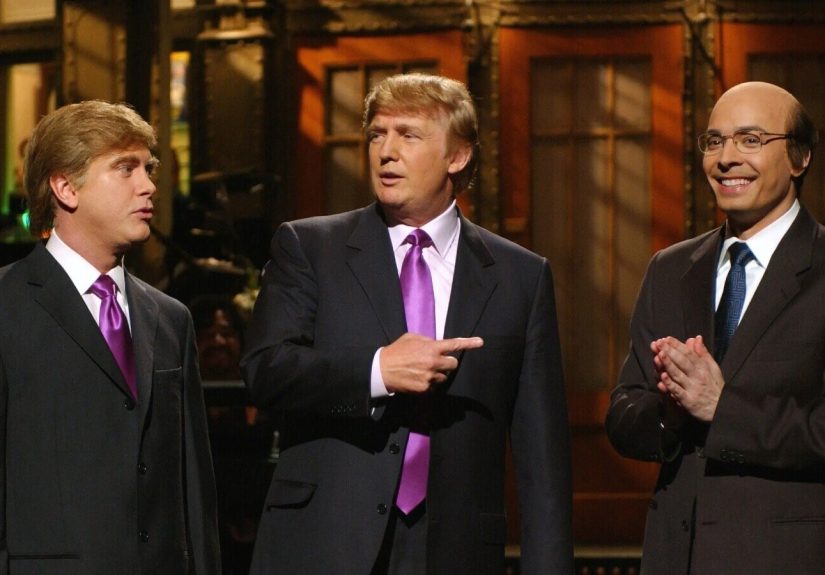
To understand why Michaels’ quote hits a nerve, you have to rewind to 2015when Trump hosted SNL during his campaign and critics accused NBC
of normalizing him for laughs and ratings. Protests formed. Petitions grew. The message was simple:
giving a candidate that kind of mainstream entertainment stage wasn’t “just comedy”it was validation.
Coverage at the time detailed how activism surged around the hosting gig, including large petition counts and a visible #RacismIsntFunny campaign.
The argument wasn’t that comedy can’t joke about politicians; it was that inviting a politician to host is different from mocking them.
Hosting is a stamp of cultural legitimacy. It says, “Come in, Americathis person is safe enough for a fun night out.”
The Show Business Math Nobody Likes to Admit
SNL is art, yesbut it is also a weekly live product with advertisers, affiliates, and a hungry digital afterlife.
Trump has always been a ratings magnet, and the entire entertainment industry has historically struggled to resist magnets.
If a controversial figure can deliver attention, the temptation is to treat attention like a neutral substancelike electricity.
The problem is that electricity can power a hospital or burn down your garage.
“He Knows How to Hold an Audience”: The Ratings Machine Dilemma
Michaels’ framing of Trump as a powerful media figure is both an observation and a warning.
Trump’s political identity is inseparable from his entertainment identity. He is not merely covered by the media; he uses media as the stage on which
the political product is performed.
That’s why critiques of platforming Trump often focus on the format. News interviews, late-night appearances, comedy cameos
each one can become content that supports the persona: the celebrity outsider, the unstoppable disrupter, the guy who can’t be canceled because the camera
keeps finding him.
Even the “Behind-the-Scenes” Stories Tell You Something
One of the most revealing details from reporting on Michaels’ world is how intensely image-conscious Trump has been in entertainment settings.
In one widely circulated anecdote, he reportedly objected to a sketch costuming choice because he worried it made him look heavy.
It’s funny, surebut it’s also instructive: even in satire, he plays defense around the brand.
He understands the show’s power, and he negotiates with it like a businessman negotiating with a billboard.
The “Nonpartisan DNA” Argumentand Why It Makes People Roll Their Eyes
Michaels has long described SNL as aiming for a kind of “nonpartisan” credibility: whoever is in power becomes the target,
and the goal is a “smart take,” not a campaign ad.
That stance sounds noblecomedy as a skeptical equal-opportunity roast.
But it also annoys people for two opposite reasons at the same time, which is the only true bipartisan achievement left:
- Critics on the left hear “nonpartisan” and translate it as “careful not to alienate viewers who like the villain.”
- Critics on the right hear “nonpartisan” and reply, “Sure, buddy,” while counting impressions and cold opens.
The deeper issue is that “nonpartisan” can be mistaken for “neutral,” and neutrality can look like complicity when the culture feels genuinely
high-stakes. In an era when facts, institutions, and civic norms are part of the fight, comedy’s old rules (“punch up,” “mock power,” “stay funny”)
get stress-tested every Saturday night at 11:30.
Satire as a Safety Valveor a Megaphone?
The central paradox is this: political satire can deflate power, but it can also spread it.
A killer impression can expose absurdity, yet still strengthen a figure’s cultural dominance by keeping them omnipresent.
When every week includes a Trump cold open, the country never fully exits “Trump Time,” even when it’s begging for new programming.
Past reporting on SNL in the Trump era has highlighted the tension between “we have to address it” and “are we feeding it?”
Even well-intentioned jokes can accidentally polish the persona: the charismatic villain, the unstoppable showman, the guy who “owns the room.”
Comedy can turn a political threat into a recurring charactercomplete with catchphrases and fan compilations.
The Difference Between Mocking and Hosting
It’s worth separating two very different actions that get lumped together:
- Mocking Trump (impressions, sketches, Weekend Update jokes) uses him as a subjectoften the butt of the joke.
- Hosting Trump hands him the keys to the show, allowing him to control tone, soften edges, and cash in on cultural legitimacy.
Michaels’ “denouncing doesn’t work” remark lands like a defense of the first categorybut critics hear it as a justification for the second.
And because the show has previously crossed into “hosting,” the suspicion never fully disappears.
So What’s the Smarter Play: Denounce, Ignore, or De-Mythologize?
If we treat Michaels’ comment as a pragmatic media strategynot a moral philosophythen the question becomes:
what does “working” even mean?
If “work” means changing minds…
Denunciation rarely flips committed supporters. Neither does satire, at least not directly. But satire can shape the broader atmosphere:
it can frame behaviors as ridiculous, highlight hypocrisy, and make certain claims socially costly outside the devoted base.
If “work” means serving the audience…
Viewers come to late-night comedy for relief, for catharsis, and for the comfort of shared reality.
Sometimes the joke isn’t “Stop him,” it’s “Yes, you are seeing this too.”
In that sense, “denouncing” can feel like a sermon while satire feels like a group text that says, “You up?”
If “work” means not feeding the beast…
This is where the platforming critique bites hardest. Trump benefits from attentionany attentionbecause attention is his medium.
The strategy that “works” here might be selective spotlight: cover the consequences, not the performance; mock the power, not the branding;
stop building the entire cold open around the same gravitational center.
A Practical Playbook for Political Comedy That Doesn’t Accidentally Become PR
If SNL (and late-night comedy more broadly) wants to avoid turning satire into a megaphone, here are tactics that respect both humor and impact:
1) Make the joke about power, not charisma
Don’t let the impression become cool. Don’t let the villain become the most “alive” person on stage.
If the character steals every scene, congratulationsyou’ve built a fan edit.
2) Shift focus to systems and enablers
Satire can be smarter when it pans out: the consultants, the donors, the media incentives, the institutional failures.
When you only roast the frontman, you leave the engine untouched.
3) Avoid “self-parody” moments that polish the brand
There’s a long history of politicians using comedy cameos to soften their image.
That can work like reputational Febreze. The joke becomes, “See? He can laugh at himself.”
Sometimes that’s harmless. Sometimes it’s strategy.
4) Let the punchline land on reality
The funniest sketches often contain a sting of truthreal stakes, real consequences, not just vibes.
The audience shouldn’t leave thinking, “Wow, he’s kind of entertaining,” but “Wow, that’s a scary way to sell an idea.”
5) Diversify the cultural oxygen
A show with hundreds of minutes per season doesn’t have to spend so many of them in the same political orbit.
Variety isn’t avoidanceit’s refusing to let one figure colonize the national imagination.
Conclusion: Michaels’ Logic Is UnderstandableAnd Still Dangerous
Lorne Michaels’ claim that denouncing Trump “doesn’t work” sounds like the wisdom of a man who has watched outrage cycle into exhaustion for years.
From a producer’s seat, denunciation can look like a dead end: it pleases people who already agree and enrages people who will never agree, all while
making comedy feel like homework.
But the critics aren’t wrong to worry that the alternativekeeping Trump central as contentcan quietly “work” in the worst way:
by normalizing his presence, turning civic stress into entertainment rhythm, and letting spectacle keep winning the calendar.
The challenge for Saturday Night Live isn’t whether to joke about Trump. It’s how to do it without accidentally becoming
part of the performance.
Experiences & Lessons From the “Denouncing Doesn’t Work” Era (Extra )
If you’ve lived through even one group chat argument about politics, you already understand the emotional truth behind Michaels’ line.
Someone posts a clip. Someone says, “Can you believe this?” Someone else responds with a 14-tweet thread disguised as a single message.
A third person drops a meme like a peace offering. And by the end, nobody’s mind is changedexcept maybe yours, because you now hate your phone.
That’s the modern media experience in miniature: denunciation feels like action, but it often behaves like a signal flare for your
own side. It rallies, it vents, it bonds. It does not magically convert.
And if you’re a comedy show with a live audience and a national broadcast window, you’re not just dealing with politicsyou’re dealing with
psychology, tribal identity, and the attention economy.
Here are a few “lived” patterns most of us have seen (even if we’ve only lived them from the couch, clutching a remote like it’s a stress ball):
Experience #1: The Lecture That Killed the Room
You’re at a party. Someone goes full monologuefacts, outrage, moral clarity. They’re not wrong.
But watch the room: people stop listening, not because they disagree, but because they feel trapped.
Comedy dies when it becomes a sermon. Michaels’ instinct is basically: “We’re here to make people laugh, not to hold a town hall.”
The trick is writing jokes that carry truth without turning into a PowerPoint with punchlines.
Experience #2: The Joke That Accidentally Made the Villain Cool
Every era has its “funny bad guy” problem. The character is outrageous, quotable, memeableand suddenly the satire
gets consumed like fandom. People share the clip because it’s entertaining, not because it’s damning.
If the impression is too charismatic, it can produce admiration where it meant to produce critique.
That’s when “platforming” happens without anyone formally handing over the microphone.
Experience #3: The Endless Loop That Replaces Real Life
Another common experience: you realize you know more about what a politician said than what a policy did.
The spectacle hijacks the brain. Late-night comedy can either resist thatby joking about consequences and systemsor intensify it by chasing
the most viral quote of the week.
The loop is comfortable. It’s also corrosive.
Experience #4: The Relief of Being Seen
To be fair to satire, there’s a reason people keep coming back. When the world feels absurd, humor provides a social anchor.
It tells you you’re not alone, you’re not crazy, and yes, that headline really did happen.
For many viewers, SNL isn’t a political strategy toolit’s a coping mechanism with a live band.
Experience #5: The Moment You Realize “Attention” Is the Whole Game
Eventually, most people have the same sinking thought: “Waitdoes he actually benefit from this?”
That’s when you start noticing how outrage spreads content faster than approval, how mockery can still build fame,
and how being the center of the joke is still being the center.
That realization doesn’t mean comedy should go silent. It means comedy needs to be intentional.
The best takeaway from Michaels’ quote might be this: denouncing may not “work,” but neither does pretending attention is harmless.
If you’re going to joke about Trump (and it’s hard not to, because the culture keeps handing you material), do it in a way that reduces the myth,
not reinforces the brand. Make the joke smarter than the spectacle. Make the target the power, not the performance. And, whenever possible,
let the punchline point back to realitywhere people have to live after the laughs.