Table of Contents >> Show >> Hide
- The Road to the Moon Was Built Long Before Apollo 11 Landed
- Apollo 11: The Crew Behind the Mission
- The Landing at Tranquility Base
- The First Steps: A Moment Bigger Than Television
- What Armstrong and Aldrin Actually Did on the Moon
- The Human Side of the Moon Landing
- Why Man’s First Day on the Moon Still Matters
- Experiences Related to “Man’s First Day on the Moon”
- Conclusion
Note: Body-only HTML. SEO tags are included at the end in JSON format.
The first day humans set foot on the Moon did not begin with magic. It began with checklists, alarms, fuel calculations, and the kind of calm breathing people do when they are trying very hard not to panic in front of history. Yet by the time Neil Armstrong climbed down the ladder of the lunar module Eagle on July 20, 1969, the ordinary language of engineering had turned into something much bigger. Humanity was no longer just staring at the Moon from porches, observatories, and cheesy diner parking lots. For the first time, it was standing there.
“Man’s first day on the Moon” remains one of the most powerful moments in modern history because it combined science, politics, courage, and pure wonder. Apollo 11 was not just a successful mission. It was a turning point that proved human beings could leave Earth, land on another world, work there, and come home alive. That sentence sounds normal now only because Apollo 11 made the impossible sound almost routine. It was not routine. It was astonishing.
The Road to the Moon Was Built Long Before Apollo 11 Landed
The Moon landing did not appear out of nowhere like a surprise sequel nobody asked for. It grew from years of Cold War competition, NASA planning, engineering failures, astronaut training, and a national promise. In 1961, President John F. Kennedy set the goal of landing a man on the Moon and returning him safely to Earth before the decade ended. That promise sounded bold, expensive, risky, and maybe a little wild. In other words, it was perfect for the 1960s.
Between Kennedy’s challenge and Apollo 11’s success, NASA pushed through the Mercury and Gemini programs, developed rendezvous techniques in orbit, tested spacecraft systems, trained crews under punishing conditions, and learned painful lessons from tragedy, including the Apollo 1 fire. By the time Apollo 11 launched, it carried more than three astronauts. It carried years of national effort, public expectation, and the stubborn refusal of thousands of engineers, mathematicians, technicians, and support staff to accept “almost” as good enough.
Apollo 11: The Crew Behind the Mission
Apollo 11’s crew looked simple on paper but brilliant in combination. Neil Armstrong, the mission commander, was known for his technical skill and cool under pressure. Buzz Aldrin, the lunar module pilot, brought deep knowledge of orbital mechanics and a sharp, analytical mind. Michael Collins, the command module pilot, remained in lunar orbit while Armstrong and Aldrin descended to the surface. Collins is sometimes treated like the forgotten third man, which is wildly unfair. He was essential to the mission and had the lonely job of orbiting the Moon alone, ready to bring everyone home.
Each astronaut had a different role, but Apollo 11 worked because it was a team mission from launch to splashdown. Armstrong and Aldrin became the faces of the moonwalk, yet Collins carried the immense responsibility of maintaining the command module Columbia in lunar orbit. No drama, no return trip. It really was that simple.
The Landing at Tranquility Base
On July 20, 1969, the lunar module Eagle separated from Columbia and began its descent. This was not a gentle float into a moonlit parking spot. The landing grew tense as computer alarms appeared and Armstrong realized the planned landing area was covered with rocks and hazards. He took semi-manual control, guiding the spacecraft to a safer spot while fuel ran dangerously low.
Then came the words that snapped the whole planet to attention: “Houston, Tranquility Base here. The Eagle has landed.” It was a calm sentence carrying an absurd amount of emotional weight. Inside Mission Control, people who had trained themselves not to celebrate too early finally exhaled. Around the world, viewers understood that a human spacecraft was sitting on the Moon.
The landing site in the Sea of Tranquility was soon known as Tranquility Base, a name that somehow managed to sound both scientific and poetic. It was not just a location. It became a symbol of the point where imagination met boot prints.
The First Steps: A Moment Bigger Than Television
Several hours after landing, Armstrong opened the hatch, climbed down the ladder, and carefully tested the surface. Then he stepped onto the Moon and delivered one of the most quoted lines in history. Whether people remember every syllable exactly or not, the meaning has never faded: this was a giant leap not just for one astronaut, or even one country, but for all humankind.
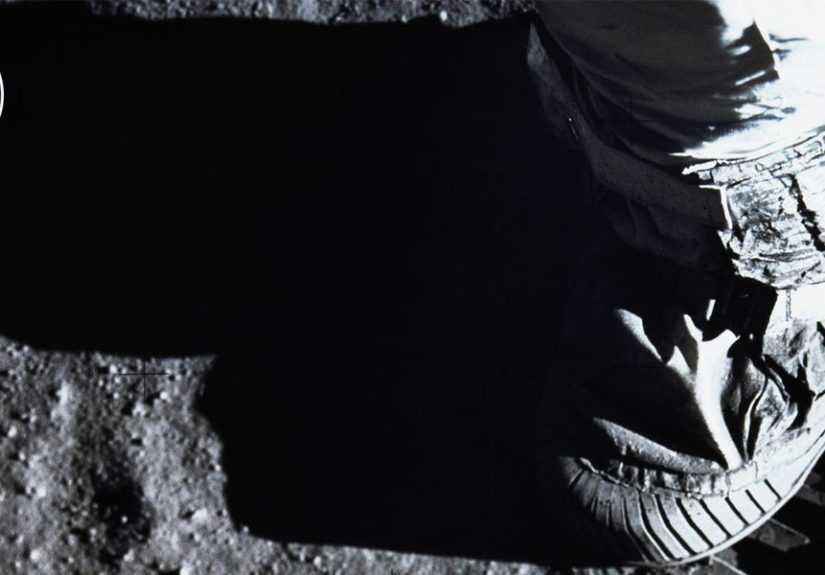
About 19 minutes later, Buzz Aldrin joined him on the surface. Aldrin later described the lunar landscape as “magnificent desolation,” and honestly, it is hard to top that. The Moon was beautiful, bleak, silent, dusty, and utterly unlike Earth. There were no trees, no breeze, no ocean smell, no birds, no coffee, and definitely no welcome center. Just gray terrain, black sky, and two humans moving carefully in bulky suits while the world watched.
This was one of the most watched events in broadcasting history. Families crowded around televisions late into the night. People gathered in bars, public squares, military bases, and living rooms. Grainy pictures flickered across screens, yet nobody cared that the image quality was rough. The content was unbeatable. Humanity had gone from mythology to moonwalk in a single generation.
What Armstrong and Aldrin Actually Did on the Moon
The first moonwalk was not a casual stroll with sightseeing commentary. Armstrong and Aldrin had work to do, and plenty of it. Their moonwalk lasted about two and a half hours, during which they collected lunar samples, took photographs, set up scientific experiments, examined the surface, and tested how humans could move in one-sixth of Earth’s gravity.
They planted the American flag, but the mission was also framed as an achievement for humanity. A plaque left on the lunar module descent stage reflected that wider meaning, declaring that the astronauts came in peace for all mankind. That message mattered. Apollo 11 was undeniably an American triumph, yet it also became a shared human milestone because the Moon belongs to no single nation’s imagination.
The astronauts returned with nearly 47.5 pounds of lunar rocks, soil, and core samples. These materials were not just souvenirs from the world’s most difficult camping trip. They gave scientists valuable information about the Moon’s composition, geological history, and relationship to Earth. Apollo 11 proved that exploration was not only symbolic. It produced real science.
The Science Packed Into a Short Visit
Even on that first day, Apollo 11 was more than flags and famous quotes. Armstrong and Aldrin deployed scientific instruments, including experiments designed to study seismic activity and measure the distance between Earth and the Moon. They documented the texture of the lunar surface, gathered samples from different areas, and observed how dust behaved under low gravity. Every photograph, boot print, and sample bag helped turn the Moon from a distant object into a place that could be studied directly.
That scientific mindset is part of what makes the first day on the Moon so remarkable. The mission did not stop at “we made it.” It immediately moved to “what can we learn?” That is one of the best habits science has ever had.
The Human Side of the Moon Landing
History often smooths great moments until they look polished and inevitable. Apollo 11 was neither. The human side of the mission is what keeps it alive. Armstrong was famously reserved, yet even he understood the symbolic force of his first step. Aldrin brought energy, precision, and vivid description. Collins, orbiting above, later wrote with remarkable honesty about the solitude of circling the Moon alone. Meanwhile, in Houston, flight controllers sweated through every stage of the landing and moonwalk like people whose heart rates had personally declared war on them.
President Richard Nixon even placed a call to Armstrong and Aldrin while they were on the Moon, calling it the most historic telephone call ever made from the White House. That sentence sounded dramatic, but for once, the dramatic line may have undersold the occasion.
And then there was the public. Children stayed up past bedtime. Adults who rarely agreed on anything agreed this was incredible. Newspapers, radio broadcasts, and television coverage turned the event into a global shared experience. For a brief moment, the world stared in the same direction.
Why Man’s First Day on the Moon Still Matters
The first day on the Moon matters because it changed what humanity believed was possible. Before Apollo 11, the Moon was mostly a symbol, a target, a dream, or a metaphor in poetry. After Apollo 11, it was also a destination. The mission reset the boundaries of ambition. It showed that extraordinary achievements come from giant ideas supported by unglamorous details: calculations, training, testing, revision, discipline, teamwork, and resilience.
It also matters because the Moon landing remains a benchmark for how big goals can unite science, government, industry, and public imagination. The Apollo program demanded innovation in computing, materials, communications, and systems engineering. Its ripple effects reached far beyond space exploration. When people talk about aiming high, Apollo 11 still hovers in the background like the gold standard of human audacity.
There is also an emotional reason the story endures. The Moon landing reminds us that wonder is useful. Curiosity is not fluff. Exploration is not decoration. Those forces help civilizations move forward. When Armstrong and Aldrin stood on the lunar surface, they were not just completing a checklist. They were expanding the mental map of what human beings could do.
Experiences Related to “Man’s First Day on the Moon”
To understand the full meaning of man’s first day on the Moon, it helps to think beyond the headline and into the experience itself. Start with Armstrong at the ladder. He knew millions were watching, but the moment was also intensely physical. He had to move carefully in a pressurized suit, manage equipment, judge the firmness of the surface, and stay aware that one mistake could turn history into disaster. That first step was symbolic, yes, but it was also an act of concentration. The Moon did not care that the cameras were rolling.
Then imagine Aldrin stepping down into a world with no wind, no weather, and no sound except what came through his suit and radio. He described the view as “magnificent desolation,” and that phrase remains one of the best summaries of the lunar experience ever spoken. The Moon was stunning, but it was also empty in a way Earth never is. No rustling leaves. No distant traffic. No barking dog three houses over. Just stillness so complete it must have felt almost unreal.
There was also the strange bodily experience of moving in low gravity. The astronauts had trained for it, but training and reality are cousins, not twins. Walking, hopping, turning, bending down, and handling tools all required adjustment. The lunar dust clung to surfaces and made every step part science and part dance rehearsal gone slightly wrong. Even so, both astronauts reported that moving around was manageable. In a funny way, the first day on the Moon was both the most extraordinary workday in history and a practical lesson in how not to fall over while wearing a backpack the size of a household appliance.
Michael Collins had a different experience altogether. While Armstrong and Aldrin were making history below, he orbited above in Columbia, alone whenever the spacecraft passed behind the Moon and radio contact with Earth disappeared. His experience reminds us that the first day on the Moon was not a two-man story. It was also a story of trust. Collins had to believe his crewmates would lift off safely. They had to believe he would be there to meet them. Mission Control had to believe the numbers on their screens. Exploration runs on courage, but it also runs on trust between people who know that precision is a form of love.
The emotional experience on Earth mattered too. Viewers knew they were watching something larger than a news event. Parents watched with children and quietly understood that the future had just changed shape in the living room. Scientists saw decades of theory and engineering become real. Politicians saw the payoff of national commitment. Dreamers saw proof that impossible things can become scheduled activities on a flight plan. That may be the deepest experience connected to man’s first day on the Moon: the feeling that human beings are at their best when they dare, prepare, and then dare a little more.
Conclusion
Man’s first day on the Moon was not memorable only because Neil Armstrong stepped onto lunar soil before anyone else. It became unforgettable because Apollo 11 turned a bold national promise into a global human achievement. Armstrong, Aldrin, and Collins showed what disciplined courage looks like when the stakes are cosmic. The landing at Tranquility Base, the first steps, the scientific work, and the safe return to Earth all combined into a story that still feels larger than life.
More than half a century later, Apollo 11 remains a master class in exploration. It reminds us that history does not belong only to dreamers or only to technicians. It belongs to both. The first day on the Moon was built by imagination, math, steel, training, risk, and the refusal to back down from a very hard goal. That is why it still shines. It is not just a story about where humans went. It is a story about who humans can be.