Table of Contents >> Show >> Hide
- What Counts as “National Park Land,” Exactly?
- The Big Picture: Why the Map Looks So Lopsided
- Top 10 States With the Most National Park Service Land
- Bottom 10 States With the Least National Park Service Land
- Map Surprises: What the Rankings Don’t Tell You (But You Should Know)
- How to Use This Map for Trip Planning
- Conclusion: What This “National Park Land” Map Really Means
- Bonus: of Real-World Experiences From Both Ends of the Map
If you’ve ever looked at a U.S. map and thought, “Wow, the West is basically one big postcard,” you’re not wrong.
But the real plot twist is this: the National Park Service (NPS) doesn’t spread its land evenly like butter on toast.
It piles it high in a few places (hello, Alaska) and then sprinkles tiny, history-packed crumbs elsewhere (hi, Rhode Islandyes, really).
In this guide, we’re going to break down which states have the most and least National Park Service–managed land,
why that happens, what the “map” is really telling you, and how to use this info to plan smarter tripswhether you want glacier-sized wilderness
or a quick urban park stop between coffee and dinner.
What Counts as “National Park Land,” Exactly?
It’s bigger than “national parks” (the title kind)
When people say “national parks,” they often mean the famous headline-makersYellowstone, Yosemite, the Grand Canyon, and friends.
But the National Park Service manages a much larger National Park System made up of many different designations:
national monuments, national historical parks, seashores, recreation areas, memorials, preserves, and more.
That matters because a state can have tons of NPS-managed acreage without having a long list of “National Park” title parksor the other way around.
Think of it like a music festival: “National Park” is the headliner, but the full lineup includes dozens of stages.
How the acreage gets counted
The acreage numbers in this article reflect how much land inside each state is managed by the National Park Service across the whole system.
This includes sprawling wilderness units and also tiny historic or commemorative sites that fit inside a city block.
Big parks that cross state lines can have their acreage split across those states in official accounting.
Translation: this isn’t a popularity contest and it’s not a “how many national parks are in each state” list.
It’s strictly about how many acres of NPS-managed land are located in each state.
The Big Picture: Why the Map Looks So Lopsided
Reason #1: Alaska is basically the final boss of acreage
If the National Park System were a pizza, Alaska would be the slice that takes up half the box.
It holds more than half of all NPS-managed acreagethanks to enormous parks and preserves that protect some of the biggest, wildest landscapes in the country.
Alaska’s “big five” alone are jaw-dropping in scale: Wrangell–St. Elias, Gates of the Arctic, Denali, Katmai, and Lake Clark.
These aren’t just parks; they’re entire ecosystems with glaciers, volcanoes, tundra, and wildlife that doesn’t care about your selfie schedule.
Reason #2: The lower 48 is more crowded (and more complicated)
In the contiguous U.S., there are plenty of huge parksDeath Valley, Yellowstone, Everglades, and more.
But the land is also more densely developed and the NPS mission includes a lot of cultural and historic preservation,
which often means smaller footprints: battlefields, memorials, historic homes, monuments, and trails.
Reason #3: Some “park units” involve partnerships and non-federal land
Here’s a sneaky detail that affects the “least acreage” states:
some NPS units are co-managed or involve substantial non-federal ownership.
Kansas is the poster childits major prairie preserve is mostly privately owned and co-managed, which keeps the “NPS-owned/managed acres in-state” total surprisingly small.
Top 10 States With the Most National Park Service Land
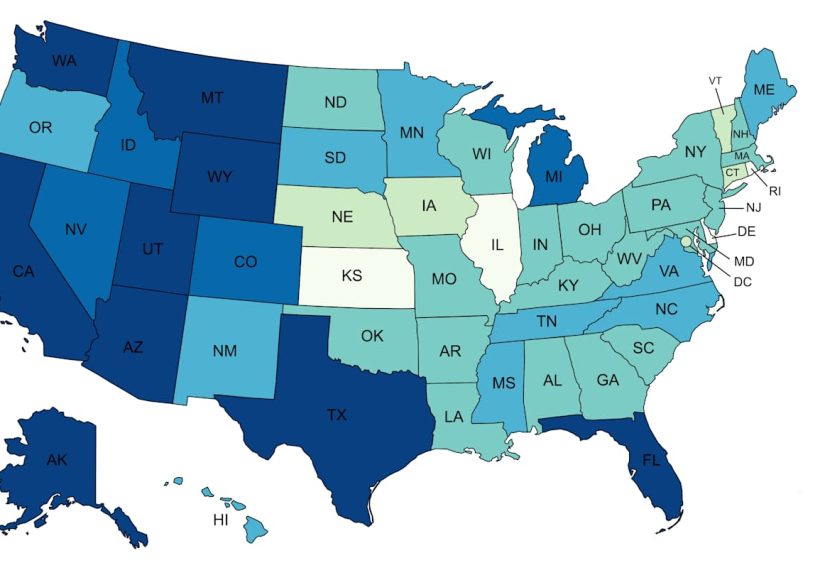
Below are the top states by total acreage of land managed by the National Park Service within their borders.
Think of this as your “go big or go home” list.
| Rank | State | Total NPS-Managed Acres | What’s Driving the Acreage? |
|---|---|---|---|
| 1 | Alaska | 52,455,308 | Massive parks & preserves (the heavyweight champion) |
| 2 | California | 7,612,898 | Big desert + mountain parks, multiple large units |
| 3 | Arizona | 2,658,112 | Grand landscapes and major park units |
| 4 | Florida | 2,469,173 | Wetlands, coasts, and huge ecosystems (Everglades) |
| 5 | Wyoming | 2,345,619 | Yellowstone’s scale does a lot of lifting |
| 6 | Utah | 2,097,860 | Red rock parks and large protected areas |
| 7 | Washington | 1,834,616 | Volcanoes, islands, and big protected landscapes |
| 8 | Montana | 1,214,193 | Large parks/units plus big open land protection |
| 9 | Texas | 1,206,489 | Big Bend energy + large historic/natural units |
| 10 | Michigan | 632,280 | Great Lakes–shaped NPS land and water footprint |
#1 Alaska: The Acreage Superpower
Alaska’s lead is so large it feels like it should come with a “please check your calculator” disclaimer.
The scale comes from parks and preserves that are measured in millions of acres:
Wrangell–St. Elias alone spans about 13.2 million acresbigger than some U.S. states.
Gates of the Arctic covers over 8.4 million acres, and Denali’s protected lands stretch over six million acres.
Katmai and Lake Clark add even more mega-wilderness to the mix.
The travel reality: Alaska is not a “pop in for an hour” park state. It’s a “plan a whole life event” park state.
Many areas require flights, boats, weather flexibility, and a willingness to be very small in a very big place.
#2 California: The Lower-48 Leader
California is the acreage king of the contiguous U.S., powered by a deep bench of large, famous units.
Its biggest heavyweight is Death Valleyabout 3.3 million acres of desert extremes.
Add mountain giants and iconic protected landscapes, and California stacks acreage fast.
The fun paradox: you can be snowshoeing in the morning and sweating in the desert by afternoon.
California is basically three different vacations wearing a single trench coat.
Florida, Wyoming, Utah: Ecosystems, Icons, and Red Rock
Florida’s acreage comes from huge ecological systemsespecially the Everglades, where “land” includes vast wetlands that don’t behave like tidy rectangles on a map.
Wyoming’s ranking is supercharged by Yellowstone’s size.
Utah’s number reflects the state’s concentration of large protected red-rock landscapeswhere the scenery looks like another planet, but the parking lots still fill up like it’s a mall on a Saturday.
Planning tip: high-acreage states often mean bigger travel distances and bigger crowds in peak season.
Shoulder seasons (spring/fall) can be your best friendbetter weather, fewer people, and a lower chance you’ll spend your day staring lovingly at a “Lot Full” sign.
Bottom 10 States With the Least National Park Service Land
Now for the other end of the mapthe states where NPS-managed land is tiny in acreage,
but often big in cultural value. These are the “small footprint, high impact” entries.
| Rank (from smallest) | State/District | Total NPS-Managed Acres | What This Usually Means |
|---|---|---|---|
| 1 | Rhode Island | 5 | Tiny urban memorial-style sites |
| 2 | Illinois | 12 | Very small historic/urban sites in the system |
| 3 | Kansas | 462 | Major unit is largely privately owned/co-managed |
| 4 | Delaware | 890 | Small NPS footprint (often historic-focused) |
| 5 | Iowa | 2,708 | Small sites and limited land area units |
| 6 | Connecticut | 5,846 | Smaller sites, trails, and heritage locations |
| 7 | Nebraska | 5,899 | Smaller units and historic landscapes |
| 8 | District of Columbia | 8,476 | Iconic sites, compact geography |
| 9 | Vermont | 9,836 | Smaller units and corridors |
| 10 | Oklahoma | 10,011 | Smaller sites rather than huge preserves |
Rhode Island: Five Acres, Big Story
Rhode Island’s total is so small it sounds like a typobut it’s real: just five acres of NPS-managed land.
The key lesson here is that NPS value isn’t always measured in acreage.
A compact memorial or historic site can preserve nationally important stories in the middle of a city.
Illinois: A Dozen Acres and a Lot of History
Illinois shows how “National Park Service land” can mean tiny parcels tied to historic events, neighborhoods, or buildings.
You don’t go to Illinois for a million-acre backcountry trek; you go for places that connect you to labor history, civil rights, presidents, and turning points that shaped the country.
Kansas: The Prairie Plot Twist
Kansas is the one that surprises people, because the state is largeso why the tiny NPS number?
The answer is ownership and management structure.
Tallgrass Prairie National Preserve covers nearly 11,000 acres, but the National Park Service owns only a small portion of it,
with the majority in non-profit/private ownership and co-managed through partnership.
So Kansas looks “small” on an acreage chart even though the visitor experience can feel expansive and wild.
Map Surprises: What the Rankings Don’t Tell You (But You Should Know)
More acres doesn’t automatically mean more variety
Alaska has mind-bending acreage, but much of it is remote wilderness.
Meanwhile, a smaller-acreage state can pack in diverse storieshistoric sites, memorials, rivers, trails, and urban cultural landmarks.
The map measures land, not the number of different experiences per square mile.
Small parks can be the easiest wins on a busy itinerary
If you live far from the giant western parks, smaller NPS units can be the gateway drug to the whole system.
They’re often free or low-cost, easy to reach, and perfect for an afternoon trip.
Plus, they’re the best way to collect “I learned something today” points without buying a plane ticket.
Popularity is separate from acreage
Visitation numbers don’t track perfectly with land area.
Some huge parks have fewer visitors because they’re remote.
Some smaller parks are absolutely slammed because they’re close to major population centers or have a famous “single star attraction.”
How to Use This Map for Trip Planning
If you want “big nature”
- Choose high-acreage states like Alaska, California, Utah, Wyoming, and Washington for expansive landscapes and multi-day itineraries.
- Plan logistics earlylodging, shuttle systems, reservations, and timed-entry rules can be part of the modern national park experience.
- Build in flexibility for weather, especially in mountain and coastal parks.
If you want “big history” (with smaller driving distances)
- Don’t ignore low-acreage states. They often have rich cultural and historic sites that fit neatly into city-based travel.
- Pair parks with neighborhoods: museums, walking tours, food scenes, and NPS ranger programs can stack into a great day.
- Think in themes: civil rights, immigration, labor history, presidential sites, maritime heritagemany states shine here.
If you want the “sweet spot”
Some states combine big scenery with manageable logistics.
Utah, Arizona, and Colorado, for example, can deliver major landscapes without Alaska-level complexity.
You still need planningbut you’re less likely to be negotiating with floatplane schedules and unpredictable coastal fog.
Conclusion: What This “National Park Land” Map Really Means
The map of National Park Service land by state tells a clear story: America protects wilderness at epic scale in some places,
while preserving history and culture in tiny, powerful sites elsewhere.
Alaska dominates because its parks and preserves are enormous.
California leads the lower 48 with a deep roster of large units.
On the other end, states like Rhode Island, Illinois, and Kansas show how the National Park System can be measured in acresor in meaning.
The best takeaway isn’t “bigger is better.”
It’s “the system is wildly diverse.”
Whether you’re standing in a 13-million-acre park or a 4.5-acre memorial, you’re in a place protected because it matters.
Bonus: of Real-World Experiences From Both Ends of the Map
Here’s the funny thing about National Park Service land: your experience doesn’t scale neatly with acreage.
In a massive Alaska park, you might spend half the day traveling just to reach the trailheador the riveror the runway that looks like a runway
only if you squint and believe in yourself. The reward is the kind of silence that makes your brain reset.
The scenery doesn’t feel “pretty.” It feels seriouslike the landscape is politely reminding you that it existed long before your group chat and
will be here long after your phone battery gives up.
The practical experience in those big-acreage places is all about preparation:
you check weather obsessively, you respect distances that don’t look scary on a map but become very real on foot,
and you treat “I’ll just pop over there” as a phrase that can age you ten years.
People often imagine Alaska parks as nonstop action.
In reality, a lot of the magic is slower: watching light change on mountains, noticing how the air smells different near cold water,
realizing you’ve been quietly staring at a valley for twenty minutes because your brain is trying to download the view.
Now jump to the opposite end: a tiny urban memorial site in a low-acreage state.
The experience there can be surprisingly intense in a different way.
You’re not battling the wilderness; you’re stepping into a story.
You might walk through a place in fifteen minutesand then spend an hour reading plaques, listening to a ranger talk,
or connecting dots between what happened there and what’s happening now.
The “wow” isn’t a glacier; it’s perspective.
Kansas is the perfect “don’t judge by acreage” travel lesson.
If you visit a prairie preserve, you learn quickly that open land doesn’t need mountains to feel dramatic.
Prairie drama is quieter: wind, sky, grass moving like water, and sunsets that make you question why anyone invented fluorescent lighting.
And because partnership parks can include large areas that aren’t technically NPS-owned, you’re reminded that conservation often comes from teamwork,
not just federal boundaries.
If you want to turn this map into an itinerary, try a two-sided approach:
pick one high-acreage state for “big nature” (even if it’s a shorter trip to one major park),
then pair it with a low-acreage state for “big meaning” by visiting an NPS historic site in a city.
You’ll feel the full range of what the National Park System is designed to protect:
not only the places that take your breath away, but also the places that change your mind.