Table of Contents >> Show >> Hide
- Why Pinky and the Brain Still Matter
- The Office Legends Behind the Lab Mice
- From Hallway Caricatures to Cartoon Icons
- The Voice Work That Completed the Transformation
- Why the Pairing Works So Ridiculously Well
- How Real Life Became Satire
- The Viewing Experience: Why Learning the Real Inspirations Makes the Show Even Better
- Conclusion
Some cartoon characters feel invented in a writers’ room. Pinky and the Brain feel discovered, like somebody at Warner Bros. wandered down a hallway, peeked into the wrong office, and accidentally uncovered the world’s funniest personality mismatch. One mouse is a pint-sized tyrant with the ego of a fallen emperor. The other is a cheerful noodle with a heart the size of a weather balloon and the attention span of a distracted golden retriever in a fireworks store. Together, they became one of the sharpest comedy duos of the 1990s.
And that is what makes their origin story so delicious: Pinky and the Brain were not dreamed up from pure abstraction. Their chemistry was rooted in real people, real voices, real office lore, and the kind of creative cross-pollination that happens when talented weirdos share a building. The more you look into their history, the better the joke gets. These lab mice were built from caricature, performance, satire, and affection. They were ridiculous, but never random.
This is the real story behind the characters who spent every night trying to take over the world and every episode reminding viewers that failure is much easier to survive when it is delivered with a British accent and a dramatic monologue.
Why Pinky and the Brain Still Matter
Before getting into the real-life inspirations, it is worth remembering why these characters have remained lodged in pop culture’s collective skull. Pinky and the Brain were not just funny because they repeated a formula. They were funny because the formula was secretly a pressure cooker for character. Every plan to conquer the world exposed the same eternal truth: intelligence without humility becomes absurd, and silliness without malice can become strangely noble.
That combination let the series work on multiple levels. Kids saw two bickering mice. Adults saw workplace satire, political parody, theatrical references, literary nods, and the comedy of ambition gone completely sideways. That split appeal helped the duo stand out on Animaniacs and graduate into their own show. In other words, these mice did not just escape the cage; they escaped the sketch format.
Even now, the premise still feels fresh because it is built on recognizable human behavior. Everybody has met a Brain: brilliant, driven, overconfident, and somehow shocked that the universe refuses to cooperate with genius. Everybody has met a Pinky too: chaotic, warm, baffling, and far more emotionally intelligent than the room gives him credit for. The show turned those human types into cartoon animals, then dialed the comedy knob until it snapped off in their tiny paws.
The Office Legends Behind the Lab Mice
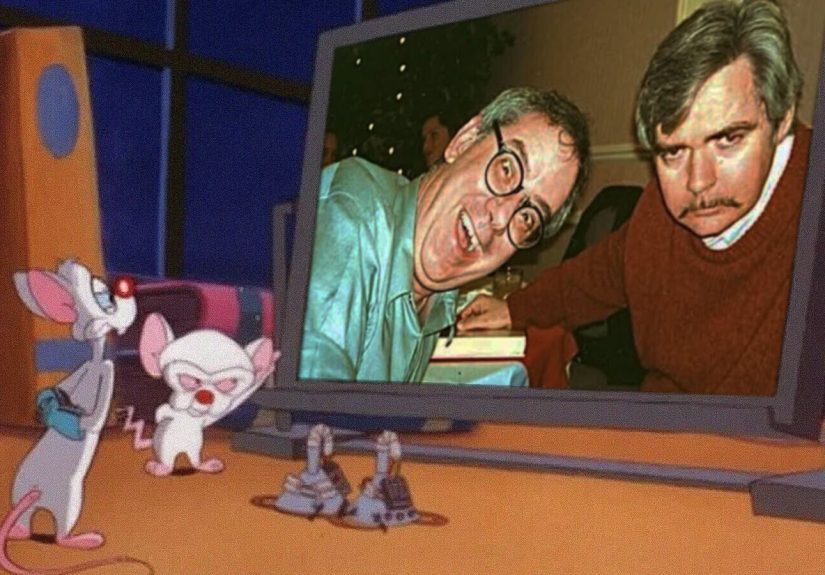
The most important real-life inspiration for Pinky and the Brain did not come from classic mythology, highbrow science fiction, or a dusty comedy textbook. It came from people working around Tom Ruegger during the Warner Bros. animation boom. The personalities that fed the characters belonged to Tom Minton and Eddie Fitzgerald, two colleagues whose contrasting energies practically begged to be animated.
Tom Minton: The Deadpan Engine Behind Brain
Tom Minton has often been described as dry, quiet, and intellectually sharp. That alone already sounds like Brain before the first syllable of an evil monologue has even cleared his mouth. Minton’s real-world vibe was not “foam-at-the-mouth supervillain.” It was subtler than that. He projected the kind of calm seriousness that becomes funnier when surrounded by chaos. Brain inherited that quality.
That is one reason Brain works so well. He is not written like a loud maniac. He is written like someone who believes his logic is so immaculate that raising his voice would be beneath him. His frustration comes not from incompetence, but from the unbearable inconvenience of being surrounded by reality. That sort of humor only lands when the character begins from a place of control, restraint, and confidence. Minton’s temperament helped provide that skeleton.
But the show did not simply copy one man and call it a day. It exaggerated. It stylized. It cartooned the cartoon. Brain became the distilled fantasy of the driven overachiever, the mad planner, the tiny autocrat who thinks one more PowerPoint-quality scheme will finally force the world to behave. He is not Tom Minton in mouse form. He is the comic super-concentrate of that inspiration.
Eddie Fitzgerald: The Spark Plug Inside Pinky
If Minton supplied the deadpan steel, Eddie Fitzgerald supplied the fireworks. Fitzgerald’s reputation around the studio was far more boisterous, playful, and impulsive. He had the bright, reactive energy that makes a room feel louder the second he walks in. Most importantly, he reportedly used nonsense exclamations that sounded suspiciously close to the Pinky vocabulary fans would later memorize with evangelical zeal.
That matters because Pinky’s comedy is not just stupidity. It is musicality. It is interruption. It is verbal confetti. His odd little outbursts do not simply fill silence; they turn language into a trampoline. He can derail Brain’s pompous momentum with a single sound effect disguised as a word. That rhythm makes Pinky feel alive. He is not the passive sidekick in the corner. He is the unpredictable pulse of the entire bit.
Fitzgerald’s influence helps explain why Pinky feels so specific. Lots of cartoons have “the dumb one.” Very few have a dumb one who seems simultaneously airy, affectionate, eccentric, theatrical, and oddly philosophical. Pinky is not a blank idiot. He is a beautifully tuned instrument of comic misdirection. He makes nonsense feel handcrafted.
From Hallway Caricatures to Cartoon Icons
The visual side of the origin story is just as fun. Artist Bruce Timm famously drew caricatures of people around the office, and those sketches became part of the creative chain that led to Pinky and the Brain. Later shaping by Ruegger and other artists pushed the concept closer to the final mice viewers know today. That is an important detail, because it reveals that the characters were not born in one lightning bolt. They were assembled through the kind of collaborative mutation animation does so well.
That process also explains why the duo feels both personal and iconic. They started with recognizable studio personalities, but the design quickly moved beyond private in-joke territory. The long noses, expressive faces, and instantly readable silhouettes transformed them from caricatures into archetypes. You did not need to know anyone at Warner Bros. to understand the joke. The characters had already evolved into something universal: the schemer and the wildcard, the tyrant and the fool, the executive and the intern, the brain and the impulse.
Frankly, that may be the secret sauce of great animation. It begins with a very specific human spark and then becomes broad enough for millions of strangers to recognize themselves in it. Pinky and the Brain did not stay office gossip with tails. They became comedy folklore.
The Voice Work That Completed the Transformation
If the real-life models gave the characters their skeleton, the voice actors gave them blood pressure, posture, vanity, tenderness, and timing. Without Maurice LaMarche and Rob Paulsen, Pinky and the Brain might have remained clever drawings. With them, they became a master class in animated performance.
Brain: Orson Welles by Way of Grand Tragedy
Maurice LaMarche’s performance as Brain is often linked to Orson Welles, and for good reason. The rich authority, the rolling theatrical diction, the sense that every sentence deserves its own spotlight cue, all of it screams old-school grandeur. But the performance is more interesting than a straight impression. LaMarche has described Brain as mostly Welles with some Vincent Price and a little extra mystery mixed in.
That blend is exactly why the voice works. A pure Welles imitation might have become a novelty. Brain’s voice instead feels like the sound of thwarted genius itself. It is elegant, wounded, pompous, cultured, dramatic, and somehow permanently offended. Even when Brain is proposing something absurd, like global domination through a deeply questionable gadget, he sounds as though he is presenting a Nobel lecture.
That contrast is where the comedy blooms. The character is tiny. The dream is impossible. The voice is enormous. Brain sounds like a man who should be addressing an empire, not arguing with a fellow lab mouse about why a plan involving helmets, cheese, and mass hypnosis has gone slightly off the rails. He is a tragedy in a pet-store body.
Pinky: British Comedy Chaos in a Lab Cage
Rob Paulsen approached Pinky from the opposite angle. Rather than sounding like authority, Pinky sounds like mischief wearing slippers. Paulsen has pointed to British comedy influences such as Monty Python, Peter Sellers, and The Goon Show, and you can hear that lineage in the performance. Pinky’s voice is not just “British.” It is elastic, playful, and delightfully unserious. It dances.
That choice was genius. Had Pinky sounded merely dim, he might have become annoying. By giving him buoyancy and charm, Paulsen made Pinky lovable from the first line. The voice contains innocence without helplessness. Pinky may misunderstand the plan, but he never sounds mean, never sounds cynical, and never sounds like dead weight. He sounds like someone who would absolutely ruin a coup and then ask whether anyone wants tea.
Even better, Pinky’s musical phrasing helps soften Brain’s edge. Brain can be arrogant, cold, and snappish, but Pinky turns the duo into a relationship instead of a lecture. His warmth makes Brain watchable. His delight makes the show breathable. In a weird way, Pinky is not just the sidekick. He is the emotional lighting technician.
Why the Pairing Works So Ridiculously Well
Lots of comedy duos are built on contrast, but Pinky and the Brain feel engineered at the molecular level. Brain is vertical. Pinky is sideways. Brain is control. Pinky is drift. Brain wants the whole planet. Pinky is still reacting to whatever sentence Brain said three seconds ago. It is impossible not to watch them bounce off each other.
But their relationship is more than contrast. It is loyalty. That may be the sneakiest reason the characters endure. Pinky genuinely cares about Brain. Brain, for all his irritation, clearly needs Pinky more than he would ever admit. Their dynamic is not just boss and subordinate. It is companionship disguised as conflict. The show understands that affection makes repetition sustainable. If these two genuinely hated each other, the premise would curdle. Because they are bound together, it sings.
This also explains why the real-life inspirations matter. The characters were not shaped from abstract categories like “smart one” and “dumb one.” They were shaped from human texture: one person quiet and dry, one person loud and exuberant, both clearly memorable enough to leave a creative dent on their coworkers. The show’s emotional reality came from observation, not formula.
How Real Life Became Satire
The genius of Pinky and the Brain is that it turns tiny personal observations into giant comedy themes. A deadpan coworker becomes a megalomaniac. A gleeful studio eccentric becomes an affectionate tornado of nonsense. A hallway sketch becomes a franchise. That is animation operating like alchemy.
The series also used those characters to satirize ambition itself. Brain is funny because he believes intellect automatically entitles him to power. Pinky is funny because he constantly interrupts that illusion with instinct, innocence, or total non-sequitur sabotage. Put them together and you get a cartoon argument about ego, control, creativity, failure, and the absurdity of trying to master a world that can barely manage its own office coffee.
Maybe that is why the show still feels modern. We still live in an age of Brain-like personalities who think cleverness alone should hand them the keys to civilization. We still need Pinky-like energy to puncture all that overinflated certainty. Not necessarily with policy. Sometimes a well-timed “Narf” will do.
The Viewing Experience: Why Learning the Real Inspirations Makes the Show Even Better
Once you know where Pinky and the Brain came from, rewatching the series becomes a different kind of pleasure. You stop seeing only a cartoon premise and start noticing the layers underneath it. Suddenly, Brain’s irritated dignity feels less like a stock comedy bit and more like a lovingly exaggerated portrait of a certain kind of brilliant, serious creative person. Pinky’s blurts feel less random too. They feel observed, borrowed from life, and then tuned until they became comedy music.
That changes the viewer’s experience in a surprisingly emotional way. Instead of feeling manufactured, the characters feel inherited. They came out of a real studio culture, a real moment in American animation, and a real network of artists, writers, and performers bouncing off each other. That kind of origin gives the show warmth. It reminds you that behind the laboratory cage was a building full of very funny humans turning each other into art.
There is also something deeply satisfying about learning that the performances were so carefully layered. Brain is not just “the Orson Welles mouse,” and Pinky is not just “the silly British one.” Each performance contains decades of comedic taste: classic radio, old-school movie grandeur, sketch influences, dialect work, timing, musical instincts, and actor chemistry. You can hear all of that in the finished product, even if you do not realize it at first. The older you get, the more the show reveals its craftsmanship.
For longtime fans, that discovery often leads to a second wave of appreciation. The first wave is simple nostalgia: the theme song, the catchphrases, the impossible plans, the nightly promise that tomorrow would definitely be the night. The second wave is admiration. You realize how much skill it took to make something this silly feel this smart. You realize how many hands shaped it. You realize the joke was never just that Brain wanted to conquer the world. The joke was that the whole production had the confidence to be weird, literate, theatrical, and emotionally grounded all at once.
That is why Pinky and the Brain remain bigger than their premise. They are not merely two laboratory mice from a beloved 1990s cartoon. They are proof that great comedy often begins with human observation. Somebody notices how one person talks. Somebody else exaggerates a facial feature. An actor finds a voice. Another actor finds a rhythm. A writer adds a repetition. A composer adds grandeur. An audience shows up and says, yes, these two tiny maniacs belong in the hall of fame.
And maybe that is the nicest part of the whole story. The real-life inspirations were not mined with cynicism. They were transformed with affection. Pinky and the Brain do not feel like mean caricatures of Tom Minton and Eddie Fitzgerald. They feel like tributes filtered through absurdity. The characters honor what made those personalities memorable in the first place. One had gravity. One had sparkle. Animation gave them tails and immortality.
So the next time Brain narrows his eyes and unveils another catastrophically overconfident master plan, or Pinky answers with a line that sounds like it escaped from another dimension, remember what you are really watching: studio folklore turned into comedy architecture. You are watching real life, pushed through the funhouse mirror, then polished until it became timeless.
That is a lovely legacy for any character, but especially for two rodents who spent so much of their time failing. They may never have conquered the world. They absolutely conquered reruns, animation history, and the strange little corner of your brain that still lights up when someone says, “Narf.”
Conclusion
Pinky and the Brain endure because their madness was built on something solid: recognizable human behavior. Tom Minton’s dry intensity, Eddie Fitzgerald’s gleeful unpredictability, Bruce Timm’s caricature instincts, Ruegger’s cartoon logic, LaMarche’s grand vocal authority, and Paulsen’s buoyant comic chaos all fused into one of animation’s best duos. That is why the show never feels like a one-joke relic. It feels alive.
The real miracle is not that these mice got a spin-off. It is that such specific inspirations became so universally funny. Pinky and the Brain are deeply personal creations that somehow belong to everybody. Which is fitting, really. For characters obsessed with world domination, they ended up doing something far more impressive: world-wide affection.