Table of Contents >> Show >> Hide
- Why This Comparison Keeps Going Viral
- Meet The Bears Behind The Memes
- The “Canadian Way” Of Dealing With Bears
- The “Finnish Way” Of Dealing With Bears
- What Both Countries Get Right (And What The Internet Gets Wrong)
- What To Do If You See A Bear
- A Practical Checklist For Bear Country
- So… Who Handles Bears “Better”?
- Extra: Of Real-World “Bear Moments” People Recognize
- Conclusion
Put two outdoorsy nations in the same comment section and eventually someone will say, “A bear would never survive my country’s vibe.”
Then the internet does what it does best: turns real wildlife safety into a comedy special.
The funny part is that the “Canadian way” and the “Finnish way” aren’t really about bravery or chill. They’re about context:
different bear species, different landscapes, different rules, and different everyday routines. Canada has a vast range of bear habitats
(and a lot of people recreating in them), while Finland’s brown bears are concentrated in a smaller footprint alongside a deeply ingrained
forest culture of hiking, hunting, berry-picking, and cabin life.
So yespeople laugh at the contrast. But if you zoom in, you’ll see both approaches share the same core principle:
respect the bear, don’t surprise the bear, don’t feed the bear, and don’t act like you’re auditioning for a nature documentary.
Why This Comparison Keeps Going Viral
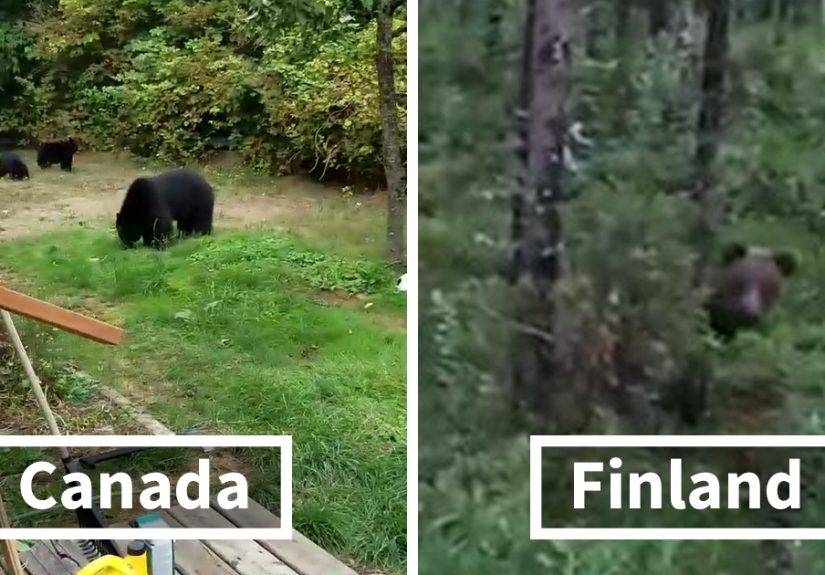
The “Canadians vs. Finns with bears” joke usually pops up under videos where someone calmly talks to a bear (or shouts at one like it owes rent).
Viewers then sort themselves into two imaginary teams:
- Team Canada: “Make noise, carry spray, follow the rules, and let the bear keep its personal space.”
- Team Finland: “Stay calm, talk to it like a misbehaving neighbor, and back away with quiet confidence.”
Both are “right” in the sense that calm, steady behavior reduces risk. Where they differ is what feels normal day-to-day.
In many parts of Canada, bear messaging is woven into parks, trailheads, campgrounds, and even town life. In Finland, bear encounters are
less common for most peoplebut the forest is still a shared backyard, and guidance often emphasizes calm withdrawal and giving the animal an escape route.
Meet The Bears Behind The Memes
Canada: A Bigger Menu Of Bears
Canada’s bear story is basically a three-season streaming series:
- Black bears: widespread and often involved in “oops, the trash smelled amazing” situations near communities.
- Grizzlies (brown bears): common in western mountain regions; more likely to be defensive if surprised or protecting cubs/food.
- Polar bears: in the far north; a different risk category entirely, with different safety protocols.
Because Canada has more overlap between people and bear habitat in many regions, public messaging tends to be very practical:
store food properly, keep distance, hike smart, and carry deterrents where recommended.
Finland: Mostly Brown Bears, Usually Shy
Finland’s primary bear is the Eurasian brown bear. Population estimates fluctuate and are influenced by cross-border movement and management decisions,
but recent public reporting has placed the population in the low-thousands (often cited around the mid–two-thousands in recent years).
The important behavioral note: Finnish brown bears are often described as avoiding people when they can. Encounters do happenespecially in regions
with higher bear density or where people spend long hours in the forest for work or recreationbut the typical advice focuses on staying calm,
not running, and retreating slowly while letting the bear choose its exit.
The “Canadian Way” Of Dealing With Bears
If you had to summarize the Canadian approach in one sentence, it would be:
“Plan like you’ll see a bear, act like you hope you won’t.”
1) Prevention Is The Main Event
In many bear regions, the best “bear encounter” is the one that never happens. That’s why you’ll hear the same greatest hits repeated:
travel in groups, stay alert, make your presence known on trails, and avoid surprising wildlife. These aren’t buzzwordsthey’re behaviors that
reduce the odds of stumbling into a defensive situation.
2) Distance Isn’t Rude, It’s Polite
One of the most consistent safety themes in North American parks is maintaining serious space from bears.
When visitors treat wildlife like a photo prop, it increases stress for the animal and risk for everyone. In popular park settings,
“back up and use a zoom lens” is basically a public service announcement.
3) Food Storage And “Smellables” Are A Big Deal
The Canadian camping culture in bear country leans heavily on clean camps and strict food handling because bears have strong noses and stronger motivation.
Coolers, scented toiletries, cooking grease, pet foodif it smells interesting, it can become a problem.
This is the unglamorous truth of bear safety: it’s less about hero moments and more about not turning your campsite into a buffet.
The same logic extends to townsbear-resistant garbage practices reduce conflict and help keep bears wild.
4) Deterrents: Practical, Not Magical
Bear spray is commonly recommended in many bear areas. Research and incident reviews frequently report high rates of success when used correctly,
but it’s not a force field. It must be accessible (not buried in a pack), deployed at appropriate distance, and used in conjunction with avoidance behaviors.
In other words: carrying it is not the same as being prepared to use it correctly. Canadians don’t “carry spray because they’re fearless.”
They carry it because they’re realistic.
The “Finnish Way” Of Dealing With Bears
The Finnish approach can look almost comically calm on video: a person speaks in a steady voice, backs away, and the bear disengages.
Commenters call it “peak Nordic energy.” But the calm is part culture and part practical guidance.
1) Calm Withdrawal Over Chaos
Finnish guidance commonly emphasizes staying calm, not running, and backing away slowly without turning your back.
The logic is straightforward: running can trigger pursuit instincts, and sudden movement can escalate a tense moment.
A steady retreat also gives the bear what it usually wantsdistance.
2) Give The Bear An Escape Route
A recurring theme in Finnish advice is making it easy for the bear to leave.
That means you don’t corner it, block its path, or move in ways that look like a challenge.
People who spend time in Finnish forestshikers, hunters, berry pickersoften talk about “sharing the woods,”
which is a nice way of saying: the bear was there first, and it doesn’t want your company.
3) Forest Familiarity Changes The Tone
Finland’s relationship with the forest is extremely everyday: cabins, saunas, mushroom spots, berry patches, and long walks are normal life.
That familiarity can make the human response look more casual on cameraless adrenaline, more “okay buddy, you go that way.”
But it’s still grounded in risk reduction: calm voice, slow movement, and leaving space.
4) Management And Hunting Context
Finland also has a management and hunting framework for large carnivores, and public conversation sometimes includes population estimates,
quotas, and how to reduce conflicts near homes or farms. That context affects what people expect from authorities and what “living with bears”
looks like over time.
What Both Countries Get Right (And What The Internet Gets Wrong)
Shared Best Practices
- Don’t run. Most reputable guidance says running is a bad idea in close encounters.
- Stay calm and steady. Panic reads as chaos; calm reads as “not prey, not threat.”
- Back away slowly. Create distance without triggering chase behavior.
- Don’t feed bears, ever. Food conditioning drives conflicts and often ends badly for bears.
- Control attractants. Food, trash, grills, bird feeders, and scented items matter.
Internet Myth #1: “Just Yell At It”
Sometimes loud noise helps when a bear is curious or lingering, but “yelling” is not a universal solution.
The safer framing is: use calm, firm voice and make yourself known, then create distance.
Noise is a toollike a seatbelt, not a superpower.
Internet Myth #2: “If You’re Calm, You’re Safe”
Calm helps, but it doesn’t erase risk. A bear protecting cubs, surprised at close range, or defending a food source may react defensively.
Your goal is to reduce triggers: don’t surprise it, don’t approach, and don’t block its exit.
Internet Myth #3: “Bears Only Attack Bad Hikers”
Even prepared people can have bad-luck encounterswind direction, dense brush, a blind corner on a trail.
The point of bear safety is risk management, not blame assignment.
What To Do If You See A Bear
Different agencies phrase it differently, but this is a widely consistent playbook:
- Stop and assess. Don’t run. Don’t sprint for the “perfect” photo.
- Make yourself known. Speak calmly so the bear identifies you as human.
- Create distance. Back away slowly; keep the bear in view without staring it down aggressively.
- Keep kids close. Pick up small children calmly if you can.
- Give it an exit. Angle away and don’t block trails, riverbanks, or narrow corridors.
- Use deterrent only if needed. If a bear approaches aggressively or charges and you have bear spray, use it as trained and only when appropriate.
- Report concerning behavior. A bear repeatedly approaching people or campsites should be reported to local authorities/park staff.
Important: if you recreate in bear country, learn local guidance for the bear species in that region. Black bear behavior and grizzly behavior
can differ, and local agencies tailor advice accordingly.
A Practical Checklist For Bear Country
On the trail
- Hike in a group when possible and stay alert in dense vegetation or near noisy streams.
- Make periodic human noise (especially around blind corners).
- Keep dogs under control; surprise encounters can happen when pets run ahead.
- Carry deterrent where recommended and keep it accessible, not buried.
At camp or cabin
- Store food and scented items securely; follow local rules for lockers, canisters, or hanging systems.
- Cook away from sleeping areas when possible and clean thoroughly.
- Pack out trash and avoid leaving scraps or grease.
- In bear-active communities: secure garbage, remove attractants, and keep grills clean.
So… Who Handles Bears “Better”?
The honest answer is: neither country “wins.” Canadians are practiced at living alongside multiple bear species and navigating heavily visited wild spaces.
Finns are practiced at moving through forests with calm, low-drama competence and letting wildlife keep its distance.
The humor comes from the vibe differenceCanada’s “gear and guidelines” energy versus Finland’s “quiet confidence” energy.
But the end goal is identical: fewer surprise encounters, fewer conflicts, and a bear that stays wild.
Extra: Of Real-World “Bear Moments” People Recognize
To make the internet comparison feel less abstract, here are a few encounter-style experiences that outdoor folks commonly describe
(not as bragging rightsmore like “file this under: why we take bear safety seriously”).
1) The Trail Corner That Teaches Humility
A classic North American scenario goes like this: you’re hiking a quiet trail, the wind is in your face, and you round a bend into thick brush.
Suddenly there’s a bear closer than you expectedmaybe it was feeding, maybe it was moving the same direction, maybe neither of you heard the other.
People often describe a split-second “brain buffering” moment. The safest responses tend to look boring on camera:
stop, breathe, speak calmly, back away, and give the bear room to leave. Later, everyone feels brave in hindsightuntil the next blind corner.
2) The Campground Temptation Test
In places where bears learn that humans equal snacks, the most “dramatic” events are often the least cinematic: a cooler left out,
a trash bag on the picnic table, a candy wrapper in the tent pocket. The bear doesn’t need to be aggressive; it just needs to be motivated.
Rangers and wildlife staff repeat the same message because it’s true: one sloppy campsite can create a bear that keeps returning,
which raises the odds of conflict for everyone else. The “experience” here is usually socialneighbors reminding each other to lock food up,
people doing late-night cleanup like it’s a group project, and everyone quietly agreeing that the bear-proof bin is the real MVP.
3) Finland’s “Chatty Retreat” In The Berry Woods
A Finnish-style bear moment often starts with normal forest routine: berry picking, a walk to a cabin, or a hunt club checking a trail.
Someone hears movement, sees a bear at a distance, and the goal becomes ending the meeting politely. People frequently describe talking out loud
(not screamingjust steady human sound), backing away without turning their back, and giving the animal a clear route away.
The “calm” isn’t magic; it’s a practiced response that reduces escalation. If you’ve spent years in the woods,
you learn that panic wastes energy and makes decisions worse.
4) The “Bear By The Road” Problem
Whether it’s a scenic highway in Canada or a rural road near forested areas in Finland, roadside wildlife creates a special kind of trouble:
people stop for photos, traffic bunches up, and the bear’s stress level rises as humans drift closer. The most responsible witnesses
usually do the least exciting thing: stay in the vehicle, keep distance, don’t lure the bear with food, and move along.
The experience that sticks with people is realizing how quickly a casual crowd can turn a calm animal into a pressured animal.
5) The “I Thought I Was Being Quiet” Lesson
Many hikers learn the hard way that “quiet” is not always respectful in bear country. Bears don’t want surprise meetings.
If you’re moving silently through thick vegetation, you can accidentally create the exact kind of close-range encounter everyone is trying to avoid.
A lot of experienced outdoors people describe switching to a rhythm of occasional human noisetalking with a buddy, clapping at blind corners,
or calling out on narrow trailsespecially in areas with known bear activity. It feels awkward for about ten minutes,
and then it feels normalbecause safety habits usually do.
If there’s a universal takeaway from these stories, it’s this: the “coolest” bear encounter is the one that ends with the bear walking away,
you walking away, and nobody posting a video titled “THIS COULD HAVE ENDED SO BAD.”
Conclusion
People laugh at the contrast because it’s fun to imagine national personalities expressed through wildlife encounters:
Canadians with their practical rules and bear spray holsters, Finns with their calm talk-and-retreat strategy.
But both approaches come from the same placeliving near bears long enough to know you don’t “win” against them.
Treat bears like wild animals (because they are), manage attractants, keep your distance, and learn the local guidance for the region you’re in.
The internet can keep the jokes. You can keep the good habits.