Table of Contents >> Show >> Hide
- What Is This “Arm in the Hole” Tattoo Idea, Exactly?
- Why Would Anyone Say Yes to a Mystery Tattoo?
- The Tattoo Industry Is Built on Trust Anyway
- Why the Project Felt Like Performance Art, Not Just a Stunt
- What Kinds of Tattoos Came Out of It?
- Why This Story Still Grabs People
- The Risks, Criticisms, and Very Reasonable Objections
- What This Says About Tattoo Culture Right Now
- Experience Section: What It Feels Like to Hand Over the Decision
- Final Thoughts
- SEO Tags
There are bold tattoo ideas, and then there is this: you walk up to a wall, slide your arm through a small opening, and let a famous tattoo artist permanently ink whatever he thinks belongs there. No preview. No polite little mock-up. No “Can we maybe make the snake a little smaller?” Just pure trust, a buzzing machine, and a level of commitment that makes most online shopping carts look emotionally unavailable.
That is the magnetic premise behind the mystery tattoo phenomenon made famous by artist Scott Campbell’s Whole Glory, a project that turned tattooing into a live-wire mix of performance art, faith exercise, and adrenaline test. On paper, it sounds like something your sensible friend would describe as “an absolutely terrible idea.” In practice, it became one of the most talked-about tattoo concepts in recent memory, precisely because it pushed against everything people assume tattoo culture should be: planned, personalized, and tightly controlled.
And yet, that tension is what makes the whole thing so fascinating. The people who volunteered were not just signing up for free ink. They were signing up to be surprised, to surrender authorship, and to accept that the final design might reveal something about trust, taste, ego, or spontaneity. In a world where everyone can customize everything from sneakers to sandwich toppings, the idea of giving up control hit like a lightning bolt.
What Is This “Arm in the Hole” Tattoo Idea, Exactly?
The setup is beautifully simple and slightly absurd. The participant places an arm through a hole in a wall or partition. On the other side stands the artist, unseen and unheard, working without the usual back-and-forth that defines most tattoo appointments. The person receiving the tattoo does not know the design until the arm comes back out.
That is the hook, but it is also the point. This is not random chaos in the way a carnival game is random. It is curated surrender. The artist is not spinning a wheel labeled “wolf,” “dagger,” and “tiny haunted teacup.” He is responding to the arm, the body, the moment, and his own instincts. That difference matters. It is less like gambling and more like commissioning a chef’s tasting menu, except the chef is holding a tattoo machine and the entrée lives on your forearm forever.
Campbell’s project became so compelling because it reframed tattooing as both intimate and theatrical. Usually, tattooing is personal first and public second. Here, the process itself became the spectacle. The mystery was not a side feature. It was the artwork.
Why Would Anyone Say Yes to a Mystery Tattoo?
At first glance, the answer seems to be thrill-seeking. And yes, thrill definitely bought a ticket. But that is not the full story. People were drawn to the experience because it offered something rare: the chance to stop micromanaging the outcome.
Modern life trains people to optimize everything. We compare ratings, read reviews, build mood boards, save inspiration folders, and ask three group chats for input before buying a lamp. Tattoos often follow the same pattern. Clients research placements, line weights, symbolism, healing, artist portfolios, and whether their chosen phrase will still sound profound in ten years or like a notebook doodle from a dramatic sophomore year.
This project flipped that script. It asked a different question: what if the most meaningful thing about the tattoo is not the exact design, but the act of trust behind it?
That idea is strangely powerful. For some participants, the appeal was likely artistic faith. Campbell is not a mystery guy with a machine in a basement; he is a well-known tattoo artist with a strong reputation. For others, the attraction was emotional. Surrendering the choice becomes a story in itself, one that can matter as much as the image. Long after the ink settles, the wearer can say, “I chose not to choose.” That is a wild kind of authorship.
The Tattoo Industry Is Built on Trust Anyway
If Whole Glory looked radical, it also exposed a quieter truth about tattooing: every great tattoo depends on trust, even the carefully planned ones.
People do not simply buy tattoos. They hand over skin, time, pain tolerance, and a small slice of personal mythology. A good tattoo artist does more than trace a concept. They interpret body shape, skin movement, scale, placement, longevity, and style. They understand what will age beautifully and what will blur into a philosophical smudge. The best artists are part designer, part technician, part therapist, and part kindly truth-teller who says, “That paragraph in six-point cursive on your ribcage is maybe not the move.”
That is why artist selection matters so much. Tattoo culture has increasingly moved toward custom work, healed-work transparency, and stronger conversations around inclusion, skin tone, technique, and aftercare. People are not just looking for someone who can tattoo. They are looking for someone whose eye they trust. In that sense, Campbell’s project was not rejecting normal tattoo logic. It was taking it to its most extreme conclusion.
Instead of saying, “I trust your shading,” participants were saying, “I trust your vision.” That is a much bigger leap.
Why the Project Felt Like Performance Art, Not Just a Stunt
Plenty of weird ideas get attention online. Not all of them deserve to be called art. This one stuck because it had a genuine conceptual backbone.
The wall matters. The hidden artist matters. The silence matters. By removing eye contact and consultation, the project stripped tattooing down to its rawest exchange: one person offering a body part, another leaving a mark. It turned a familiar service into a ritual. The drama came from uncertainty, but the meaning came from the structure.
That is why the project landed far beyond tattoo circles. It appealed to art audiences, fashion audiences, and people who normally treat tattoo studios like places they pass quickly while pretending not to stare. It was tattooing, yes, but also a commentary on authorship, vulnerability, and the weird modern hunger for authentic experiences.
And unlike many “experience economy” gimmicks, this one had stakes. You were not leaving with a themed cocktail and a blurry selfie. You were leaving with a permanent piece of evidence that you once let go.
What Kinds of Tattoos Came Out of It?
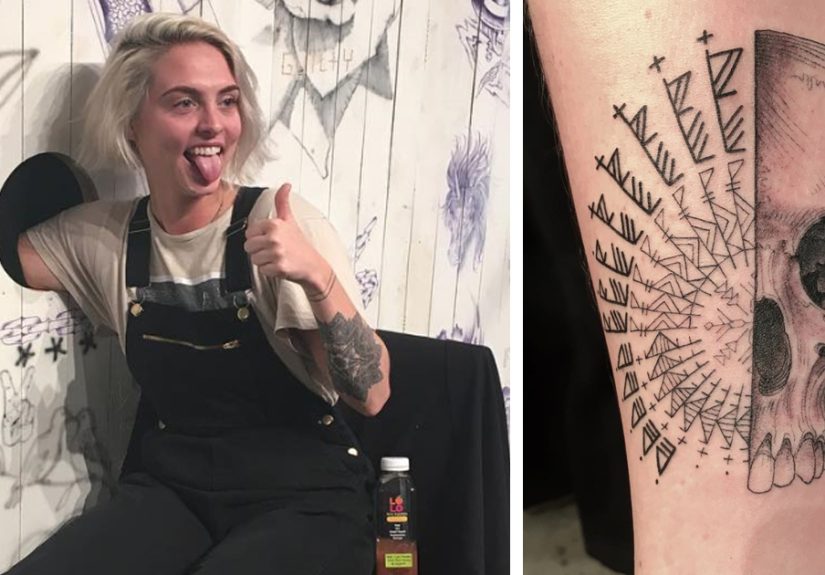
Reported coverage and image roundups showed that the resulting tattoos were not lazy jokes or reckless scribbles. Many leaned into familiar tattoo imagery and emotionally legible symbols: skulls, animals, flowers, eyes, spiritual motifs, and phrases with a sense of intimacy or gravity. That is important because it suggests the mystery was never about humiliation. It was about interpretation.
The tattoos still looked like they belonged in the world of serious body art. They were just chosen from the artist’s side of the equation, not the client’s. In other words, the surprise was real, but the craft was not abandoned.
That balance is probably why the concept resonated. Had the results looked careless, the project would have collapsed into a prank. Instead, it landed in the much more interesting space between risk and reverence.
Why This Story Still Grabs People
Because it presses on a timeless human conflict: do we want freedom, or do we want to be seen?
Most people think control is the safer choice. Usually, they are right. But there is a reason people also love tarot readings, blind taste tests, chef’s counters, mystery books, and playlists made by someone who knows them well. Being interpreted by another person can feel terrifying, but it can also feel intimate. When it goes right, it creates the thrilling sense that somebody noticed something you could not quite articulate yourself.
The mystery tattoo concept captures that exact emotional voltage. It says: step forward, offer a limb, and let another artist decide what fits. The result may not be what you would have chosen, but it might tell a more interesting story than the one you would have planned.
That helps explain why the story keeps circulating years later. It is not just “look at these unusual tattoos.” It is “look at what happens when people stop curating themselves for five minutes.” In the age of branding, that is practically radical.
The Risks, Criticisms, and Very Reasonable Objections
Of course, none of this means mystery tattooing is automatically wise. A tattoo is still a tattoo, not a temporary flirtation with chaos. Surrendering design control does not erase the usual concerns about placement, pain, permanence, healing, or whether a concept truly fits your life. Even people who admire the artistic boldness of Whole Glory can still reasonably conclude, “Absolutely not, I would rather pick my own tattoo like a grown-up.” Fair enough.
There is also a valid cultural shift toward informed consent in tattooing. Today’s best practices emphasize research, communication, healed examples, and artists who understand different skin tones and technical considerations. That is good progress. It makes the average tattoo experience safer, more inclusive, and more durable. The mystery format is compelling precisely because it is unusual, not because everyone should copy it before lunch.
In other words, Whole Glory works as art partly because it is not normal. The exception is the spectacle. The rule is still: know your artist, know your body, and do not let a permanent decision ride solely on vibes and caffeine.
What This Says About Tattoo Culture Right Now
Tattoo culture has become broader, more stylish, and more mainstream without losing its emotional punch. The old stigma has weakened. Fine script, micro realism, nostalgic references, neo-traditional work, ornamental placement choices, and deeply personal symbolism all coexist. Tattoos are now common enough to function like fashion, but meaningful enough to resist becoming just another accessory.
That tension is why a project like this matters. It reminds people that tattoos still have the power to unsettle, surprise, and provoke real reflection. Even in a world full of trends, body art remains one of the few aesthetic choices that asks for both confidence and consequence.
And maybe that is the deeper reason people were willing to stick their arms through a hole. Not because they did not care what happened, but because they cared enough to let the moment matter.
Experience Section: What It Feels Like to Hand Over the Decision
Imagine the scene from the participant’s side. There is a crowd nearby, a little buzz of curiosity, maybe some nervous laughter from people pretending they are not reconsidering everything. Your name gets called. Suddenly, the concept stops being a headline and becomes a body-level event. You walk toward the wall and realize there is no dramatic speech left to make. There is just your arm, the opening, and the point of no return.
That is where the experience changes shape. Before the moment, it feels like a stunt. During the moment, it feels like vulnerability. You cannot monitor the artist’s face. You cannot look down and decode what the lines are becoming. You cannot interrupt with “Actually, could we pivot away from skull energy today?” The normal client instincts vanish. What replaces them is a strange cocktail of trust, suspense, and sensory focus.
You begin noticing everything else instead: the hum of the machine, the posture of your shoulder, the length of a minute, the way anticipation can stretch time like taffy. Pain probably becomes secondary to curiosity. You are not just asking, “Does this hurt?” You are asking, “Who am I about to be when this arm comes back?”
That psychological shift may be the real artwork. The tattoo becomes a record of a brief decision to stop editing yourself. For many people, that is rare. Most of us narrate our own lives too aggressively. We explain our choices before they are made. We package our preferences. We treat our tastes like press releases. Mystery tattooing interrupts that reflex. It says: receive first, explain later.
And then there is the aftermath. When the arm finally comes back through the wall, the reveal is not just visual. It is emotional. Relief, laughter, shock, admiration, confusion, pride, maybe all five at once. Even if the tattoo is beautiful, the real thrill is that it exists at all. It is the proof that you tolerated uncertainty and came out marked by it.
For observers, the experience has a different charge. Watching someone volunteer for surprise ink creates instant drama because everyone projects themselves into the scenario. Some people react with envy. Some react with horror. Some immediately start doing mental math about laser removal. But nearly everyone understands the stakes. That shared recognition gives the event its electricity.
In the end, the experience is not just about bravery. It is about permission. Permission to trust a specialist. Permission to let art be inconvenient. Permission to leave with a story that was not focus-grouped into bland perfection. In a culture obsessed with control, that feels rebellious in the best possible way.
Final Thoughts
“People put their arms in a hole, letting this tattoo artist ink whatever he wants” sounds like the setup to a joke, a dare, or the beginning of a deeply concerned phone call. But the staying power of the story comes from something smarter. It reveals how much tattooing depends on trust, how hungry people are for real experiences, and how powerful it can feel to hand creative control to someone whose work you admire.
No, mystery tattooing is not for everyone. It should not be. But as an idea, it captures something essential about why tattoos still matter. They are not just decorations. They are commitments, conversations, and sometimes acts of faith. And occasionally, they begin with an arm through a wall and a willingness to let go.