Table of Contents >> Show >> Hide
There’s a special kind of childhood movie memory that doesn’t feel like a memory so much as a glitch in the simulation.
You remember vibes more than plot. A hallway that goes on too long. A face that should not move that way.
A song that sounded cheerful while something horrifying happened in the background. Years later, you bring it up at dinner
and your friend squints at you like you just admitted you once babysat a haunted microwave.
That’s the “fever dream movie” phenomenon: the strange films you caught too young, too late at night, or too sick on the couch
to process what you were seeing. And now grown-ups online keep confessing the same thing: “I swear this wasn’t real.”
Spoiler: it was real. And it probably had puppets.
Why Childhood “Fever Dream” Movies Stick Like Glitter
Kids don’t watch movieskids absorb them
Adults tend to track story and logic. Kids track images, feelings, and threat levels.
When you’re small, a movie doesn’t have to “make sense” to make a permanent home in your brain. It just needs one or two
unforgettable moments: a chase through an uncanny space, a character who transforms, a villain with an “I’m technically for children”
marketing campaign but a “I live in your walls now” energy.
Accidental viewing is the secret sauce
A lot of these films weren’t chosen; they were stumbled upon. A VHS someone taped over. A “family movie night” pick that looked safe
because it had animation or a whimsical title. A channel flip that landed on something already mid-scene (always mid-scenenever the part
where anyone explains what’s happening). That “dropped into the middle” feeling is why the memory comes back fragmented, like a dream
you can’t fully retell but can absolutely still feel.
Children’s fantasy used to be darker on purpose
Especially in the ’70s, ’80s, and early ’90s, family entertainment had a higher tolerance for menace. Stories trusted that kids could handle
fear as long as there was wonder nearby. The result? Films that are beautiful, imaginative, and occasionally capable of jump-starting a therapy
career for a stranger you’ve never met.
The Usual Suspects: Movies People Swear They Imagined
Online threads about “fever dream” childhood movies keep circling the same titlesbecause, collectively, we are apparently one generation of
adults trying to prove to ourselves that we didn’t hallucinate an entire film library. Below are the classics people mention again and again,
grouped by the kind of weird they deliver.
1) Dark fantasy that looked innocent on the box
Return to Oz is practically the patron saint of this category. It’s connected to a beloved story, but it leans into eerie atmosphere
and nightmare design: relentless pursuers, uncanny corridors, and the kind of villainy that makes you wonder who approved this for children and whether
they were, at the time, asleep. If you saw it young, you likely didn’t “follow the plot” so much as “survive the experience,” then spent years describing it
to people as “that Dorothy movie where everything feels… medically concerning.”
The Dark Crystal lives here toogorgeous world-building, intense creatures, and a tone that feels mythic and threatening in equal measure.
Many people remember it not as a narrative but as a parade of unsettling textures: leathery wings, crumbling castles, and villains who feel like they smell
like old coins and bad decisions. It’s the kind of film that makes you realize puppetry can be magical and terrifying, sometimes simultaneously.
Then there’s Labyrinth, which many viewers adore as adults and half-fear as children. It’s playful, musical, and imaginativeyet full of
bizarre character design and scenes that toe the line between whimsical and “why does that creature have that many teeth?” Childhood memories of it tend to
come back as a sequence of set pieces: a maze, a ball, a weird baby problem, and a sense that David Bowie is somehow both helping and judging you.
And if you want the emotional gut-punch version of dreamlike fantasy, The NeverEnding Story is a frequent mention. Even people who can’t
remember the full storyline vividly recall a grief-heavy moment in the swampsone that introduced many kids to the concept of despair in the least subtle way:
directly, poetically, and without asking permission.
2) Animation that got way too real, way too fast
Animated “fever dream” movies hit differently because kids approach animation as a safety signal. If it’s drawn, it must be safe… right?
The universe laughed, politely, and queued up several films that said, “Absolutely not.”
The Brave Little Toaster is famous for this bait-and-switch. The premise is sweet: household appliances go on a journey.
The execution includes bleak loneliness, sudden menace, and a handful of scenes that feel like they were designed by someone who asked,
“What if existential dread, but make it kitchen-adjacent?” Many adults can still picture specific momentsthe ones that made them stare at their ceiling
afterward and whisper, “Why did the toaster feel so much?”
The Secret of NIMH is another major entry: richly animated, emotionally sincere, and noticeably darker than a lot of mainstream family animation.
It’s packed with shadowy atmosphere, real peril, and a sense that the heroine is outmatched by the worldan intensity that can be thrilling for older kids and
deeply unsettling if you expected a cuddly talking-animal romp.
Watership Down shows up in “childhood movie trauma” conversations so often it’s basically a rite of passage. Many people remember thinking
it would be a gentle bunny story. Many people were wrong. The film’s reputation for violence and bleak themes is exactly why it gets filed under “fever dream”:
the mismatch between expectations and reality is so large your brain tries to reclassify it as something you must have dreamed.
If your “fever dream” memory includes stop-motion and an encounter that feels like a philosophical horror short, you might be thinking of
The Adventures of Mark Twain (specifically the segment involving a “Mysterious Stranger” figure often described as one of the most disturbing
depictions of Satan in a family-adjacent animated film). It’s the kind of scene that makes you pause the TV, look at the remote, and wonder if you’ve somehow
wandered into an advanced literature seminar you did not enroll in.
3) Comedies that accidentally traumatized everyone
Some “fever dream” movies aren’t dark fantasiesthey’re comedies with one or two moments that hit kids like a surprise pop quiz on mortality.
Pee-wee’s Big Adventure is beloved, goofy, and full of bright, cartoony energy… and also contains at least one infamous scare that has been
living rent-free in people’s heads for decades. Many viewers can’t recall every gag, but they can recall the feeling of being caught off guard and learning,
for the first time, that “funny” and “nightmare fuel” can be neighbors.
UHF also lands in the “I saw this too young and out of context” zone, especially for kids who caught pieces of it on TV. Its humor is frantic,
absurd, and sketch-likeperfect for a developing brain that likes randomness, and perfect for adult nostalgia that says, “Wait, was that an entire movie or
a collection of channel-flipping hallucinations?”
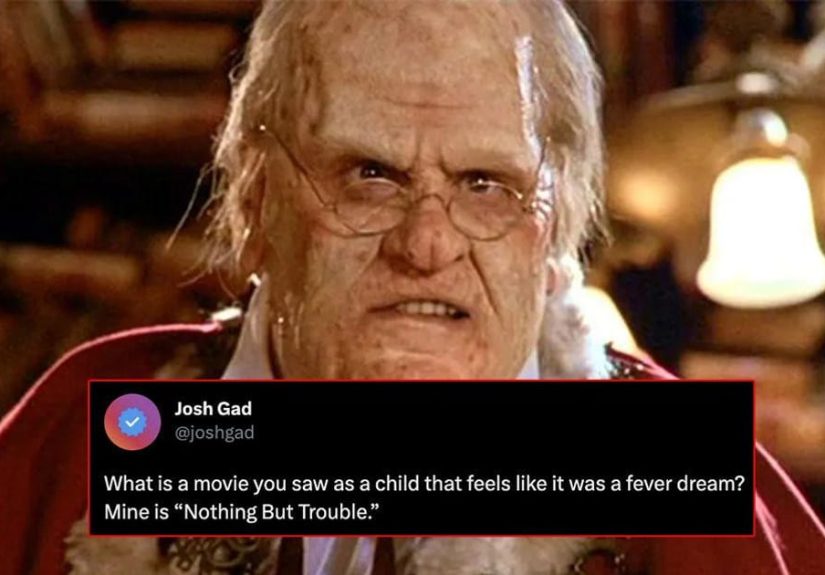
And then there’s Nothing but Trouble, which comes up in modern “fever dream” conversations because it’s grotesque in a way that feels almost
unreal. If you saw it as a childmaybe because it looked like a goofy comedyyou might only remember the set design, the makeup, the chaos, and the sense that
you accidentally watched something that should have come with a warning label and a complimentary glass of water.
Other common mentions in this lane include titles like Little Monsters, Death Becomes Her, and even
The ’Burbsmovies that are not “kids’ films” in the strict sense, but absolutely were encountered by kids anyway because cable TV and older siblings
have never been concerned with age-appropriate programming.
4) The deep cuts: “Are you sure this wasn’t a dream?”
The internet is especially good at resurfacing films that were never as mainstream as Disney or Spielberg. These are the titles that people describe with uncertainty
(“It had a kid… and hair… and maybe ghosts?”) until someone replies, “Oh my god, I know exactly what you mean.”
- The Peanut Butter Solution: frequently described as one of the strangest “children’s” films people half-remember, often recounted as a plot that
sounds fake until you learn it’s very real. - The Pagemaster: a reading-adventure fantasy that many ’90s kids remember in flashesstorms, books, animated sequenceslike a cozy dream with occasional
spooky edges. - Bugsy Malone and The Beastmaster: older titles that sometimes feel like they belong to a different planet’s version of children’s
entertainment, which is exactly why they get filed under “fever dream.”
What Makes a Movie Feel Like a Fever Dream?
The “liminal” factor
Many of these films spend time in spaces that feel empty, in-between, or slightly off: abandoned malls, echoing corridors, endless deserts, foggy forests, a
too-quiet house. Kids notice that “wrongness” immediately, even if they can’t name it. The setting becomes the scare.
Design that breaks the “kid-safe” rulebook
Puppets, masks, and practical effects can be wondrous, but they can also trigger that deep child-brain alarm that says, “This is a person… but also not a person.”
If the eyes are a little too shiny or the smile is a little too fixed, you get the uncanny-valley version of a bedtime story.
Emotion that’s too big for the moment
A lot of these stories hit huge themesdeath, loneliness, transformation, losing your homewithout the emotional guardrails modern family films often add.
Kids can handle heavy feelings, but the first time you encounter them can weld the scene into your memory forever.
How to Rewatch Your Childhood Fever Dream Without Ruining It
Go in with the right mission
Don’t rewatch to “prove it was bad” or “prove it was good.” Rewatch to solve the mystery: What did you actually see? Which parts were truly intense, and which parts
were your childhood brain turning mild weirdness into a full paranormal event?
Bring a buddy (or the group chat)
These movies are best revisited with someone who will laugh with you and also validate your shock when the unsettling scene arrives exactly where you remembered it.
Shared watching turns “private childhood dread” into “collective cultural artifact,” which is way more fun.
Accept that some of the magic was you
Childhood makes everything larger: shadows are darker, villains are scarier, and emotional moments hit like thunder. If the movie feels smaller now, that doesn’t mean
you were wrong back then. It means your brain grew up. (Unfortunately.)
Bonus: of Real-Life “Fever Dream Movie” Experiences
The most common “fever dream movie” origin story starts the same way: you were not supposed to be watching it. Maybe it was a sleepover and the older kids were in
charge of the remote, which is like putting a raccoon in charge of your pantry. They didn’t choose the movie because it was appropriate; they chose it because the
cover looked cool, or because someone said, “Trust me,” which has never once been true in the history of sleepovers.
Another classic scenario is the sick-day couch marathon. You’re home from school with a low-grade fever, the blinds are half-closed, and daytime TV is serving whatever
it hasoften older films that don’t match modern expectations of “kids’ entertainment.” In that state, your brain is already drifting. You’re half-awake, half-dreaming,
and the movie’s weirdest images get stitched directly into your memory with no quality control. Years later, you remember one shota hallway, a creature, a faceand the
rest feels like static.
Cable and local channels created a third kind of fever dream: the “mid-scene drop-in.” You flip channels and land on something already happening. No setup, no character
introductions, just a dramatic moment with zero context. A villain is monologuing. A puppet is screaming. A child protagonist is making a life-or-death decision with the
confidence of someone who has never paid taxes. You watch for five minutes, get rattled, and flip awayonly to spend the next decade wondering what on earth you just saw.
Then there’s the “parent-approved trap.” A parent sees animation, fantasy, or a familiar title and says, “Sure, that’s fine.” And to be fair, it is fineuntil
it suddenly isn’t. The shift is what brands it as a fever dream: a movie that starts cozy and then pivots into menace with no warning, like it quietly changed genres while
you were reaching for popcorn. Kids don’t have the media vocabulary to say, “This is tonal whiplash.” They just feel it as betrayal.
What’s funniest (and oddly comforting) is how similar adult reactions are during rewatches. People press play with bravado“I’m sure it wasn’t that bad”and then the scene
arrives. The exact scene. The one you remembered as a blurred nightmare. And there it is in high definition, as if the film is saying, “Hello. You never escaped.”
Sometimes the moment is still scary. Sometimes it’s hilariously dated. Either way, the rewatch turns a lonely memory into proof: you weren’t making it up. Your childhood
brain just did what it always doestook a strange story, turned the volume up to maximum, and filed it under “Important: beware of hallways and puppets.”
If you’ve got your own fever dream title, you’re in good company. The internet is basically one big support group where the admission fee is a sentence that starts with,
“Okay, does anyone else remember a movie where…”