Table of Contents >> Show >> Hide
- The Big Reveal Is Not Really About Skin
- Why These Photos Hit So Hard
- What Hidden Tattoos Say About Modern Identity
- From Ancient Marker to Modern Personal Archive
- The Workplace Layer: Why Clothes Still Matter
- What the Photographer Understands About Human Nature
- Why the Story Connects With Readers Beyond Tattoo Culture
- Experiences Related to What Hides Under Everyday Clothes
- Final Thoughts
- SEO Tags
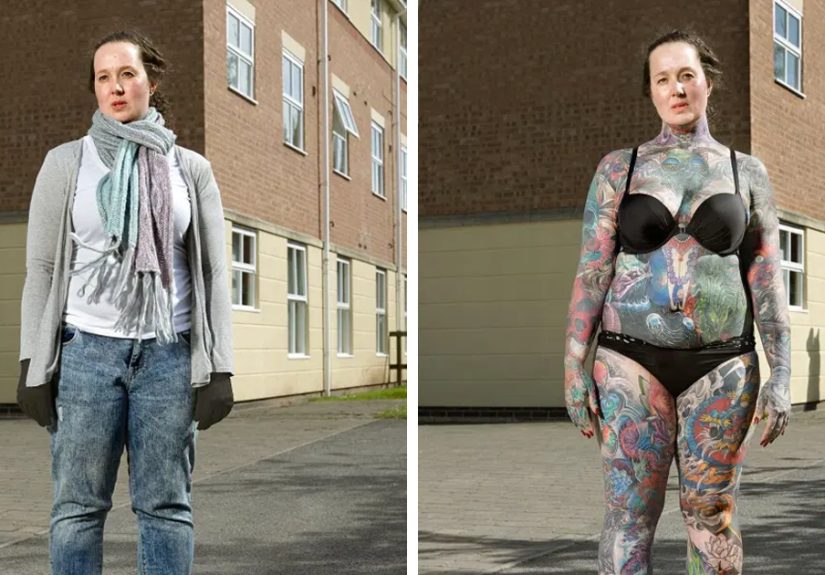
There are few things more humbling than realizing the person in the plain jacket next to you might be hiding a full-body masterpiece under a perfectly normal button-down. That is the irresistible tension at the heart of photographer Alan Powdrill’s Covered project, a portrait series that pairs ordinary dressed-up appearances with revealing portraits that show just how much tattoo art can live quietly beneath everyday clothes.
At first glance, the project looks simple: people are photographed as they usually appear in daily life, then photographed again with their body art exposed. But the effect is anything but simple. The images turn first impressions inside out. A black coat becomes camouflage. A workout hoodie becomes a curtain. A tidy dress becomes the world’s most convincing plot twist. Suddenly, the so-called “tattooed person” is not some dramatic stereotype from old movies or stale workplace handbooks. It is a teacher-looking person, a parent-looking person, a commuter-looking person, a person who could absolutely be in line ahead of you buying oat milk and aspirin.
That is what makes this photo series more than a visual gimmick. It is a sharp, stylish reminder that tattoos are no longer fringe decoration for a tiny subculture. They are memory, identity, rebellion, grief, humor, ritual, vanity, artistry, and sometimes all of the above before lunch. The clothes may look ordinary. The skin underneath may be carrying a whole autobiography.
The Big Reveal Is Not Really About Skin
Powdrill’s photographs work because they are built on contrast. In the dressed portraits, the subjects appear familiar and socially readable. We think we know them because we know the visual language of clothing. A blazer suggests professionalism. Denim suggests ease. Gym wear suggests routine. Dark basics suggest practicality. Our brains love shortcuts, and clothes are one of the fastest shortcuts around.
Then comes the second image, and the shortcut crashes into a wall.
Under the neat outer layer, there may be a near-complete bodysuit of tattoos, dense sleeves, vivid chest pieces, heavy back work, or carefully curated designs that took years to build. The project does not just reveal body art. It reveals how flimsy our assumptions can be. The photographs ask a sneaky question with excellent timing: if you were so wrong about what was under the shirt, what else are you guessing wrong about?
That is why the title lands so well. What hides under tattooed people’s everyday clothes is not merely ink. It is contradiction. Or, more accurately, the collapse of a contradiction that never should have existed. A person can be heavily tattooed and completely ordinary. A person can be heavily tattooed and deeply professional. A person can be heavily tattooed and still prefer sensible shoes, boring errands, and being home by 9:30.
Why These Photos Hit So Hard
Everyday clothes tell one story
We are trained to read clothing as biography. Uniforms, officewear, date-night outfits, school-run athleisure, and “I’m only going out for one thing” sweatpants all send signals. Powdrill uses that habit against us. His dressed images are not flashy. They are believable. That is what gives the project its bite.
Tattoos tell another story
Unlike clothes, tattoos are not changed on a whim because the weather got weird. They tend to carry longer emotional shelf lives. A tattoo might mark a lost loved one, a personal turning point, a cultural tradition, a private joke, a spiritual symbol, or a season of self-reinvention. Even when a design is chosen mainly because it looks great, that choice still says something about taste, identity, and the desire to be seen in a particular way.
The side-by-side format breaks lazy stereotypes
That visual before-and-after is doing a lot of cultural work. It quietly demolishes the old idea that tattooed people are easy to identify from a distance. Sometimes they are not. Sometimes the person with the most heavily tattooed body in the room is also the one wearing the most unremarkable cardigan. The series makes you realize that “hidden tattoos” are not rare at all. They are simply hidden in plain sight.
What Hidden Tattoos Say About Modern Identity
One reason this project feels so timely is that tattoo culture has changed dramatically. In the United States, tattoos are no longer a niche phenomenon. They are common enough to be part of regular life, but still personal enough to feel intimate. That tension matters. It means tattoos can be both mainstream and meaningful at the same time, which is honestly a pretty impressive trick for something made with needles.
Today, a tattoo is often less about announcing membership in a subculture and more about curating a visible private archive. People use tattoos to honor family, mark survival, capture beliefs, improve how they feel in their own skin, or simply wear art they genuinely love. Research and surveys on tattoo culture show a pattern that fits perfectly with Powdrill’s work: body art is more accepted than it used to be, but it still carries social meaning depending on who is looking, where, and under what circumstances.
That is where everyday clothes come in. Clothing gives tattooed people control over timing. It lets them decide when their body art becomes part of the conversation. In that sense, hidden tattoos are not necessarily about shame or concealment. Often, they are about editing the room. Not every meeting deserves your full visual autobiography. Not every grocery run requires your back piece to make a guest appearance. Sometimes you are just buying cereal.
From Ancient Marker to Modern Personal Archive
Tattoos also hit harder when you remember how old the practice is. Human beings have been marking skin for thousands of years. Across cultures, tattoos have been used to signal status, belief, protection, beauty, affiliation, healing, and rites of passage. In other words, humans have been turning skin into storytelling equipment for a very long time.
That history adds depth to Powdrill’s portraits. His subjects may be standing in modern streets in modern clothing, but the impulse behind the ink is ancient. The body is still a surface where people put memory, meaning, and belonging. What changes is style, context, and public reaction.
In earlier eras, tattoos could place someone inside a ritual system or social order. In modern life, they more often function like a chosen map of the self. Some are loud. Some are subtle. Some are funny. Some are sacred. Some are beautifully planned over years, while others begin with one “small meaningful piece” and end with a torso that now looks like a deluxe illustrated edition. Human ambition is adorable.
The Workplace Layer: Why Clothes Still Matter
If Powdrill’s series feels especially sharp, it is because the workplace question still lingers in the background. Even though social attitudes toward tattoos have softened, context still matters. Many employers are more open to visible tattoos than they once were, especially when the designs are not offensive and the role is not bound by stricter image standards. At the same time, some industries remain conservative, particularly in client-facing environments or settings with formal appearance rules.
That reality helps explain why so much tattooing still happens in places that can be covered by sleeves, collars, jackets, slacks, and shoes. The body becomes a negotiation between self-expression and situational strategy. This does not make the tattoos less authentic. It may actually make them more deliberate. They are placed with real life in mind.
There is something almost elegant about that compromise. A person can carry a full visual universe under office clothes and still move through a meeting without turning their torso into the agenda. The ink is there. The meaning is there. The choice about visibility remains theirs.
What the Photographer Understands About Human Nature
Good portrait photographers are never only photographing faces or bodies. They are photographing assumptions. Powdrill understands that the real subject of Covered is perception. His camera catches the split between who society expects people to be and who they actually are when the costume of normalcy is peeled back.
That does not mean the clothed version is fake. Quite the opposite. Both versions are real. The dressed portrait shows how a person participates in public life. The revealed portrait shows another layer of chosen identity. The magic of the project is that it treats both as legitimate. It does not frame tattoos as scandalous secrets. It frames them as important information that most strangers simply do not get to see.
And that is probably why the series resonates with so many viewers, even those who do not have a single tattoo themselves. Everyone understands the idea of having a version of themselves that the world sees first and another version that is more intimate, intentional, and privately assembled. Tattoos just make that split visible in a dramatic, highly photogenic way.
Why the Story Connects With Readers Beyond Tattoo Culture
This story is not only for tattoo enthusiasts. It works because it taps into a much broader fascination: the gap between appearances and identities. People love discovering hidden layers. We watch makeover shows, secret-room tours, behind-the-scenes documentaries, and before-and-after transformations for the same reason. We enjoy being reminded that surfaces are unreliable narrators.
In Powdrill’s work, everyday clothes are the surface. Tattoos are the plot twist. But the deeper emotional payoff is not shock. It is recognition. The project suggests that ordinary life and radical self-expression are not enemies. They can live in the same body, on the same morning, under the same laundry cycle.
That idea feels especially American right now. Modern identity is increasingly mixed, flexible, and self-authored. People build public and private selves across jobs, social media, families, communities, and aesthetics. Tattoos fit naturally into that ecosystem. They are permanent, yes, but they do not lock a person into one social role. If anything, they show how many roles can fit inside one life.
Experiences Related to What Hides Under Everyday Clothes
One of the most interesting things about heavily tattooed people is how often their daily experience depends on context rather than the tattoos themselves. In regular clothes, many move through the world with very little attention. They go to work, answer emails, carry groceries, sit in traffic, and complain about group chats just like everyone else. Then summer arrives, a sleeve rolls up, a collar shifts, or a beach trip happens, and suddenly people react as if a second identity has materialized out of thin air.
That moment can be funny, exhausting, flattering, annoying, or all four in the same afternoon. Some tattooed people describe the reveal as an instant personality rewrite. The person who was treated as quiet now gets labeled bold. The person who was assumed to be conservative suddenly becomes “unexpected.” The person who seemed ordinary is recast as edgy, artistic, rebellious, intense, or mysterious. All because a layer of fabric moved three inches to the left.
Many also learn early that different spaces produce different reactions. Friends may see tattoos as conversation starters. Family members may see them as a long-running debate with legs. Coworkers may be curious but cautious, especially if the tattoos only appear outside the office. Strangers tend to swing between admiration and absurdly personal questions. A heavily tattooed person in a tank top can become a pop-up museum for people who would never normally speak to a stranger in line. Suddenly everyone is an amateur anthropologist with a latte.
There is also the experience of gradual accumulation. Plenty of people start with one small piece in a place that is easy to hide. Then another arrives. Then another. Over time, what began as a single design becomes a visual record of changing taste, different artists, different ages, different losses, and different versions of the self. Everyday clothes become less about covering a shocking secret and more about wrapping a layered archive. Under a simple sweatshirt may live ten years of decisions.
For some, the hidden nature of tattoos is part of the pleasure. They like knowing the artwork is there whether anyone sees it or not. It becomes private confidence rather than public performance. For others, concealment is strategic. They know exactly when they want their tattoos visible and when they would rather not spend the next thirty minutes answering questions about pain levels, meaning, or whether they are “done yet.” That final question is especially funny because tattoo collectors rarely answer it with the conviction non-tattooed people seem to expect.
Then there is the emotional side. Tattoos often carry memories that are not obvious to viewers. A floral piece may commemorate grief. A bold traditional design may mark recovery. A quote may be less decorative than medicinal. Hidden tattoos can feel like portable reminders, a way of keeping something physically close without explaining it to everyone in the room. Clothes do not erase that meaning. They simply protect it until the wearer decides otherwise.
That is why a project like Covered matters. It reflects a truth tattooed people already know: the body under everyday clothing is not a contradiction of daily life. It is daily life, fully illustrated. The office outfit, the gym clothes, the weekend jeans, and the ink all belong to the same person. The reveal is dramatic for the viewer, but for the subject, it is often just Tuesday.
Final Thoughts
So what hides under tattooed people’s everyday clothes? Not just color. Not just shock value. Not just impressive pain tolerance and an increasingly serious moisturizer budget. What hides there are stories, choices, symbols, memories, and carefully managed visibility.
Alan Powdrill’s photography works because it exposes the distance between appearance and assumption. His subjects are not pretending to be ordinary when they are dressed. They are ordinary, in the best sense of the word: fully human, socially legible, busy, complicated, and carrying far more beneath the surface than strangers can see. The tattoos do not cancel that normalcy. They deepen it.
In the end, the project leaves viewers with a better question than “What are they hiding?” The better question is “Why did we think we knew so much from the clothes alone?” That is a more useful lesson, and frankly, a lot more interesting than another tired stereotype about ink.