Table of Contents >> Show >> Hide
- What Is AMD and How Does It Affect Your Hobbies?
- Mindset First: From “I Can’t” to “How Can I?”
- Build Your Support Squad: Eye Care, Rehab, and Tech
- Adapting Popular Hobbies When You Have AMD
- Setting Up a Hobby-Friendly Home Environment
- Staying Safe While You Stay Active
- 500 Extra Words of Real-World Experience: What Pursuing Your Hobbies With AMD Can Look Like
- Conclusion: Your Hobbies Still Belong to You
Getting diagnosed with age-related macular degeneration (AMD) can feel like someone dimmed the lights on your favorite parts of life. Reading, gardening, crafting, cooking, watching TV – suddenly they seem harder, slower, or just plain frustrating. But here’s the good news: AMD changes how you do your hobbies, not whether you can have them at all. With the right tools, smart tweaks, and a bit of creativity, you can absolutely keep doing the things that make you feel like you.
This guide walks you through how AMD affects your vision, why hobbies are still essential for your mental and physical health, and practical ways to adapt your favorite activities. Think of it as your playbook for living well – hobbies and all – with AMD.
What Is AMD and How Does It Affect Your Hobbies?
AMD is a condition that damages the macula, the tiny central part of your retina responsible for sharp, detailed vision. That’s the part you use to read small print, recognize faces, thread a needle, or see the golf ball on the green. AMD doesn’t affect your side (peripheral) vision as much, but it can cause blurry, dark, or distorted spots right in the middle of what you’re trying to look at.
There are two main types:
- Dry AMD: The most common form. It usually progresses slowly as cells in the macula thin and waste deposits (called drusen) build up.
- Wet AMD: Less common but more serious. Abnormal blood vessels grow under the retina and leak, causing faster vision loss.
Because AMD primarily affects central vision, it tends to impact hobbies that rely on fine detail: reading, sewing, painting, puzzles, or any task that demands clear, sharp focus. It might:
- Make words on a page look faded, broken, or missing.
- Turn straight lines wavy or distorted.
- Hide small details in the center of an image.
- Make low-contrast things (like gray text on a beige background) almost disappear.
That sounds discouraging, but here’s the flip side: your brain and your remaining vision are incredibly adaptable. With training, tools, and good lighting, most people can still enjoy a surprising range of activities.
Mindset First: From “I Can’t” to “How Can I?”
Before we talk gadgets and hacks, let’s talk mindset. It’s perfectly normal to feel sad, angry, or anxious when you first hear “AMD.” You might worry you’ll lose your independence or become a burden. Those feelings are real – and they’re also not the whole story.
Research and rehab experts consistently find that people who stay mentally and physically active with vision loss have better mood, more confidence, and a higher quality of life. Gentle activities like walking, stretching, yoga, or tai chi can reduce stress and support your overall health, which is important for your eyes as well.
A helpful mental trick is to replace “I can’t do this anymore” with “How can I do this differently?” Maybe you:
- Switch from printed books to audiobooks.
- Trade tiny paintbrush details for larger, more expressive brushstrokes.
- Use talking kitchen tools instead of relying on eency-weency measuring lines.
- Enjoy birdwatching by sound rather than by sight.
You’re not “giving up” the hobby – you’re evolving it. That shift in thinking can make a huge difference in how motivated and hopeful you feel.
Build Your Support Squad: Eye Care, Rehab, and Tech
AMD doesn’t come with a manual, but you do get a team. Beyond your ophthalmologist or retina specialist, there’s a whole world of professionals and services designed to help you stay independent and active:
- Low-vision specialists help you figure out what you can still see and which devices (magnifiers, special glasses, electronic readers) will help the most.
- Vision rehabilitation therapists and occupational therapists teach practical strategies: how to use better lighting, mark your stove settings, organize your craft space, or read with the parts of your retina that still work.
- Assistive technology specialists introduce you to screen readers, smartphone accessibility features, talking devices, and video magnifiers tailored to your hobbies and daily tasks.
Studies show that low-vision rehabilitation improves reading speed, functional independence, and satisfaction with daily activities for people with AMD. Training in daily living skills and assistive devices helps people keep doing things they love, from reading and crafts to cooking and gardening.
If your eye doctor hasn’t mentioned rehabilitation yet, it’s completely appropriate to say, “I really want to keep up my hobbies – can you refer me to a low-vision rehab program?”
Adapting Popular Hobbies When You Have AMD
Now for the fun part: practical ways to tweak specific hobbies so they still feel enjoyable rather than exhausting. Start with one or two activities that matter most to you and build from there.
1. Reading, Learning, and Staying Curious
Reading is often the #1 complaint when AMD shows up, but it’s rarely game over for book lovers. Low-vision rehab programs recognize reading as a primary goal and offer multiple ways to keep you turning pages – literally or virtually.
Tools and strategies that help:
- Large-print books and high-contrast fonts from libraries or online retailers.
- E-readers and tablets where you can increase font size, boost contrast, and use dark mode or sepia backgrounds.
- Audiobooks and podcasts that let you “read with your ears” while you relax, walk, or knit.
- Screen readers on your phone, tablet, or computer that will read text aloud – emails, articles, recipes, you name it.
- Electronic video magnifiers that enlarge and sharpen printed text on a screen.
- Eccentric viewing training, where you learn to look slightly to the side of what you want to see, using healthier parts of your retina.
Tip: Combine strategies. For example, follow along with enlarged text while the audiobook plays. You get audio support plus the satisfaction of seeing at least some of the words on the page.
2. Arts, Crafts, and Creative Projects
If you love knitting, quilting, painting, woodworking, or other hands-on projects, AMD may make fine detail harder – but creativity itself doesn’t vanish. Many people with partial sight still do impressive art and crafts by leaning into bold colors, strong textures, and larger-scale work.
Helpful adaptations include:
- Using bold, high-contrast materials – think dark yarn on light needles or bright thread on darker fabric.
- Choosing larger patterns or projects that don’t require micro-detail work.
- Adding task lighting with adjustable lamps placed behind your shoulder, shining onto your work surface.
- Marking measuring tools with tactile stickers or raised dots so you can feel key points.
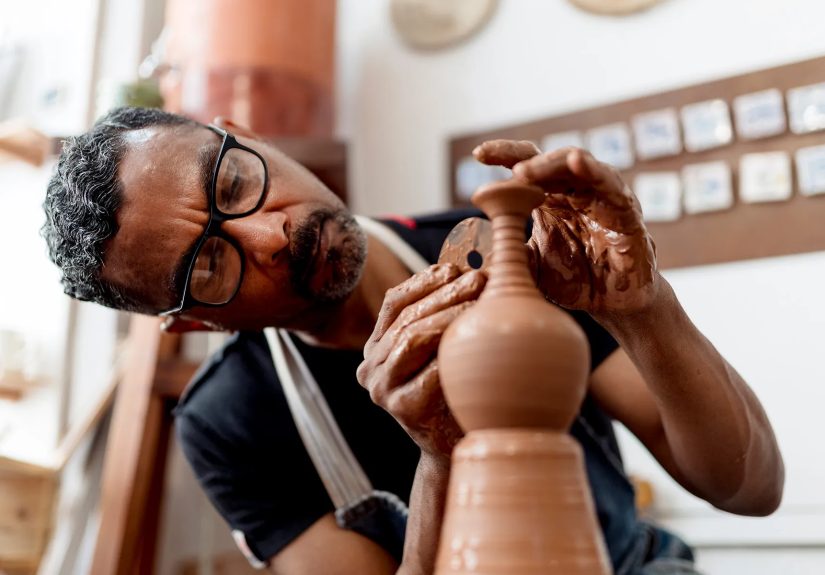
- Switching to freeze-frame crafting like clay, collage, or mixed media where perfection is optional and creativity is the goal.
You might be surprised to find that letting go of tiny details gives you a looser, more expressive style – “happy accidents” become part of the charm.
3. Cooking, Baking, and Kitchen Confidence
The kitchen can be both a joy and a stress zone with low vision. With a bit of organization and a few adaptive tools, though, you can keep making your favorite dishes without feeling like your stove is plotting against you.
Try these strategies:
- Use large-print or audio recipes and keep them on a stand at chest level.
- Label spices and staples with big, bold letters or tactile dots so you can tell salt from sugar at a glance (or a touch).
- Choose high-contrast cutting boards – dark boards for light foods and light boards for dark foods.
- Invest in talking timers, measuring cups, and scales that read measurements aloud.
- Declutter your work surfaces so there’s less to trip over visually or physically.
Many low-vision rehab programs specifically teach safe kitchen skills, so don’t hesitate to ask for training if cooking is a big part of your independence or joy.
4. Gardening, Nature, and the Outdoors
AMD may change how you interact with the outdoors, but it doesn’t mean you’re banned from the garden or the park. In fact, time outside is great for mental health and physical activity.
For gardening and nature hobbies:
- Arrange plants in straight rows or defined blocks so you can navigate by feel and memory.
- Use brightly colored stakes and labels to mark plants and pathways.
- Focus on sensory gardening – herbs you can smell, flowers you can feel, textures you can enjoy by touch.
- Try birdwatching by sound rather than sight, learning different bird songs and calls.
- Walk with a friend, support group, or walking stick if you’re concerned about uneven ground.
Outdoor hobbies remind you that the world is still large and interesting, even if you see it a bit differently now.
5. Games, Social Hobbies, and Staying Connected
AMD can make it tougher to play card games, board games, or video games – but there are adaptations for those too:
- Large-print playing cards, dominoes, and board game pieces.
- High-contrast, simple board designs with fewer tiny details.
- Voice chat, video calls, and messaging apps that keep you connected with friends and family.
- Voice-controlled smart speakers for quizzes, trivia games, music, and audio stories.
Social connection is a powerful antidote to the isolation that sometimes comes with vision loss, and many organizations offer support groups and activity programs for people with AMD.
Setting Up a Hobby-Friendly Home Environment
You don’t need a complete remodel to make your space more AMD-friendly. Small, smart changes can dramatically improve how comfortable and safe your hobbies feel.
Boost Lighting the Right Way
Good lighting is one of the simplest and most powerful tools you have. Try:
- Using adjustable task lamps that you can move close to your work.
- Positioning lights behind you, aiming at your project, to reduce glare.
- Experimenting with warmer or cooler bulbs to see which makes details easier to see.
Use Contrast and Organization
Your eyes work harder when everything blends together. Make objects “pop” visually:
- Place dark items on light backgrounds and vice versa.
- Use bold-colored tape or bump dots to mark important buttons and edges.
- Organize tools, craft supplies, and kitchen items in consistent spots so your hands and memory help your vision.
Lean Into Technology (Without Letting It Run Your Life)
Today’s tech can be incredibly helpful for people with AMD:
- Smartphones and tablets with built-in magnifiers, zoom, and text-to-speech.
- Smart speakers for music, audiobooks, timers, lists, and reminders.
- Wearable devices and apps that guide you with audio prompts or magnify text.
A low-vision rehab specialist can help you choose tools that match your actual needs instead of leaving you overwhelmed by endless options.
Staying Safe While You Stay Active
Most hobbies are safe to continue with adjustments. However, some tasks need an honest conversation with your eye doctor and maybe your family, especially:
- Driving, particularly at night or in unfamiliar areas.
- Using sharp tools, power tools, or hot equipment without safeguards.
- Activities in cluttered or poorly lit spaces where you could trip or fall.
Safety doesn’t mean you’re fragile; it just means setting yourself up to enjoy your hobbies without unnecessary risk. When in doubt, ask, “What can I change to make this safer?” rather than assuming the hobby is off-limits.
500 Extra Words of Real-World Experience: What Pursuing Your Hobbies With AMD Can Look Like
It can be hard to picture what life with AMD looks like day-to-day. So let’s walk through a few realistic examples of how people adapt, stumble a little, and then find their groove again.
Case Study 1: The Lifelong Reader
Imagine Maria, a 72-year-old retired teacher who used to devour two mystery novels a week. When AMD progressed, reading print felt like trying to decode a jigsaw puzzle underwater. At first, she stopped reading almost entirely and felt like she’d lost one of her closest friends.
Her low-vision specialist suggested a combination approach: an e-reader with very large fonts, strong contrast, and a bright task lamp, plus a subscription to an audiobook service. She learned eccentric viewing techniques and started using a handheld digital magnifier for mail and short notes.
The first week felt clumsy. She forgot which buttons did what, mixed up audiobooks and text, and occasionally hit “fast forward” by accident and jumped three chapters ahead (oops). But by week three, she had a new rhythm: listen to audiobooks while cooking or walking, and use her e-reader in the evenings for 20–30 minutes of “visual reading practice.”
Today, Maria still calls herself “a reader.” The format changed; the identity stayed the same.
Case Study 2: The Backyard Gardener
Then there’s Sam, 68, who lives for tomato season. When his AMD worsened, he started tripping over garden tools and couldn’t easily tell plants from weeds. He briefly considered ripping out his beds and replacing them with lawn – then decided he wasn’t ready to surrender his tomatoes to grass.
With help from his family and a vision rehab therapist, Sam reorganized his garden:
- Raised beds instead of ground-level rows, making it easier to reach and see.
- Brightly painted edges and stakes that stand out against the soil.
- Big, bold plant markers with large print.
- A simple rule: tools live in one brightly colored bucket, never laid on the ground.
He also embraced “sensory gardening” – focusing on smell and touch as much as sight. He grows fragrant herbs like basil and rosemary, bright marigolds he can see from the porch, and cherry tomatoes he recognizes by feel. He jokes that his garden is now “70% scent, 30% snack.”
Case Study 3: The Social Butterfly Gamer
Finally, meet Denise, 65, who loves game nights and staying connected with her friends and grandkids. Small-print cards and intricate board games became tough with AMD, and she found herself sitting out more often – which hurt more than losing a game ever did.
Her workaround:
- She bought large-print playing cards and bold domino sets.
- Her group started choosing simpler, high-contrast board games.
- Her grandkids taught her how to use voice chat and simple tablet games with big icons and zoom features.
At first, Denise felt self-conscious asking for changes. But when she finally said, “Hey, I still want to play – can we adjust a few things?” everyone was instantly on board. Now she’s often the one introducing new games, especially audio-friendly trivia and cooperative games where everyone wins or loses together.
What These Stories Have in Common
None of these people “pushed through” AMD by pretending nothing had changed. Instead, they:
- Accepted that their vision is different now.
- Asked for help – from professionals, family, and friends.
- Experimented with tools, strategies, and formats until they found what fit.
- Let their hobbies evolve rather than vanish.
You don’t have to do everything perfectly. You don’t have to love every adaptation. Some things may still feel like a hassle, and that’s okay. But if you’re willing to tweak, test, and try again, AMD doesn’t get the final say on what you enjoy.
The bottom line: your hobbies are more than “time killers.” They’re part of your identity, your social life, your mental health, and your sense of purpose. With AMD, you’re still allowed to laugh, be creative, get competitive, and be proud of what you make or learn. Vision may change – but joy, connection, and curiosity are very much still on the table.
Conclusion: Your Hobbies Still Belong to You
AMD can absolutely change how you move through the world, but it doesn’t erase the things that light you up. By understanding how AMD affects your vision, building a support team, adapting your environment, and reshaping your hobbies instead of abandoning them, you can keep living a rich, interesting, and meaningful life.
Think of it this way: your hobbies are not a luxury – they’re part of how you stay strong, hopeful, and connected. AMD may be in the picture, but it doesn’t get to be the author of your story. You do.