Table of Contents >> Show >> Hide
- From Pascal to the p-Machine
- What Was the UCSD p-System, Exactly?
- Portability Before “Write Once, Run Anywhere”
- Inside the Pascal Virtual Machine
- The Quirky World of UCSD Pascal
- UCSD P-System on the Apple II and IBM PC
- Why the UCSD P-System Faded Away
- The UCSD P-System’s Lasting Influence
- Lessons for Modern Developers
- Experiences and Anecdotes from the P-System Era
- Conclusion: Why the P-System Still Matters
Before we were spinning up Docker containers and arguing about which cloud is the cloudiest,
there was another kind of virtual machine quietly making history: the UCSD p-System. This
Pascal-based virtual machine promised something that sounded almost magical in the late 1970s:
write your program once, run it on almost anything with a floppy drive and a pulse.
Hackaday’s look back at the UCSD p-System nudged a lot of retro-computing fans down memory lane,
but the story of this Pascal virtual machine is bigger than nostalgia. It’s a missing chapter in
the history of virtual machines, influenced by academic research, shipped on real commercial
systems, and quietly shaping the way we think about portability even today.
From Pascal to the p-Machine
To understand the UCSD p-System, you have to start with Pascal itself. Designed by
computer scientist Niklaus Wirth in 1970, Pascal was created as a small, efficient language
that encouraged structured programming and good habits in students. It focused on clear
control structures, strong typing, and clean data organization think of it as the
“eat-your-vegetables” language that turned out to be surprisingly tasty.
Early Pascal compilers often followed a clever pattern: instead of compiling directly to a
specific CPU’s machine code, they produced an intermediate instruction set called p-code.
That p-code ran on a hypothetical stack-based computer called a p-Machine. In
other words, you compiled to a virtual machine first, then implemented that virtual machine
on real hardware. This approach showed up in experimental systems like Pascal-P and Pascal-S
and became known generally as a p-code machine.
The UCSD p-System ran with this idea and turned the p-Machine into the heart of an entire
operating system, not just a compiler back end. That’s where the story gets really interesting.
What Was the UCSD p-System, Exactly?
Developed at the University of California, San Diego (UCSD) in the mid-1970s under
professor Kenneth Bowles, the UCSD p-System was a complete environment built around Pascal.
It bundled a compiler, editor, utilities, file system, and a p-code interpreter into a coherent
platform. Programs were written in UCSD Pascal, compiled to p-code, and executed by the
p-Machine virtual machine.
Because everything targeted the same virtual machine instead of a particular CPU,
the p-System promised something radical for its time: machine independence.
Port the p-Machine to a new computer, and almost all your Pascal software just worked.
In an era of wildly incompatible processors and operating systems, this was a huge deal.
The p-System came with its own distinctive disk and file format as well. Many
implementations kept a 512-byte block structure inherited from the mini- and
mainframe world where UCSD Pascal first ran. When the system moved to microcomputers,
that block-based view came along, leading to unique “p-System disks” that didn’t look
anything like DOS or native file systems.
Portability Before “Write Once, Run Anywhere”
Before Java promised “write once, run anywhere,” the UCSD p-System quietly delivered
something similar for Pascal programs. Developers could run the p-System on a range
of platforms: PDP-11 minicomputers, Apple II systems, CP/M machines, HP Series 80 and
9000 workstations, Texas Instruments’ TI-99/4A, and even the original IBM PC, where the
p-System was one of the three official operating-system options alongside PC-DOS and
CP/M-86.
The portability story got so serious that Western Digital created a special microprocessor
that ran p-code natively, essentially turning the p-Machine from a virtual CPU into a very
real one. You know you’ve made it when someone builds silicon just to run your imaginary
computer.
For software vendors, this meant a single code base could reach a zoo of hardware platforms.
For educational institutions and hobbyists, it meant you could carry Pascal programs from
one lab machine to another without rewriting everything in yet another dialect.
Inside the Pascal Virtual Machine
Technically, the p-Machine was a fairly simple stack-based virtual CPU. It executed a compact
set of p-code instructions that performed operations like pushing constants, performing
arithmetic, calling procedures, and accessing variables within different lexical scopes.
The compiler transformed high-level Pascal constructs loops, conditionals, procedures
into sequences of these p-code operations.
When you ran a program, the p-System’s interpreter read each p-code instruction and executed
it. That design made the system slower than native machine code (no surprise there), but it
bought tremendous flexibility. As long as you had a p-Machine interpreter for your platform,
you could run the same UCSD Pascal program that was compiled somewhere else entirely.
If that sounds suspiciously like the Java Virtual Machine (JVM), the .NET Common Language
Runtime (CLR), or WebAssembly today, that’s not an accident. The idea of compiling to a
portable bytecode and interpreting (or JIT-compiling) it later has deep roots in systems like
UCSD Pascal and other p-code machines.
The Quirky World of UCSD Pascal
Language Subset and Extensions
UCSD Pascal grew out of the Pascal-P2 system, and as a result it began life with a
somewhat reduced feature set compared with full ISO Pascal. Some advanced features were
trimmed to make the compiler and virtual machine manageable on relatively small hardware.
Over time, UCSD Pascal added back many missing features and introduced its own extensions,
but it was never perfectly identical to standard Pascal a trait it shared with many later
Pascal dialects like Turbo Pascal and Delphi.
For programmers, this meant you sometimes had to tweak code when moving between
implementations, but the core ideas strong typing, structured control flow, nested
procedures remained familiar.
A File System with a Personality
Another charming quirk of the UCSD p-System was its disk and file system. Because the system
brought along its own block-based scheme, p-System disks often looked like strangers in a
strange land on microcomputers. On Apple II machines, for example, Apple Pascal disks used
the UCSD file system layout rather than the native DOS 3.3 layout, which made them slightly
mysterious to users coming from game floppies and DOS utilities.
On the plus side, the uniform file system helped preserve portability. A Pascal program stored
on a p-System disk was more or less self-contained and could be moved to other machines
running the p-System, even if the underlying hardware and native OS looked nothing alike.
The Development Workflow
Daily life in the UCSD p-System revolved around a text-mode menu and command environment:
edit source, compile to p-code, link, and run with pauses to swap floppies as needed.
The bundled editor and tools were intentionally minimal but consistent across platforms.
Especially in academic settings, this gave students a predictable experience regardless of
whether they were sitting at a minicomputer terminal or a microcomputer in the lab.
UCSD P-System on the Apple II and IBM PC
On the Apple II, the UCSD p-System appeared as Apple Pascal, a serious, professional
environment in a world often associated with games and hobbyist BASIC. Apple Pascal made
Pascal programming and portable p-code accessible to a much wider audience.
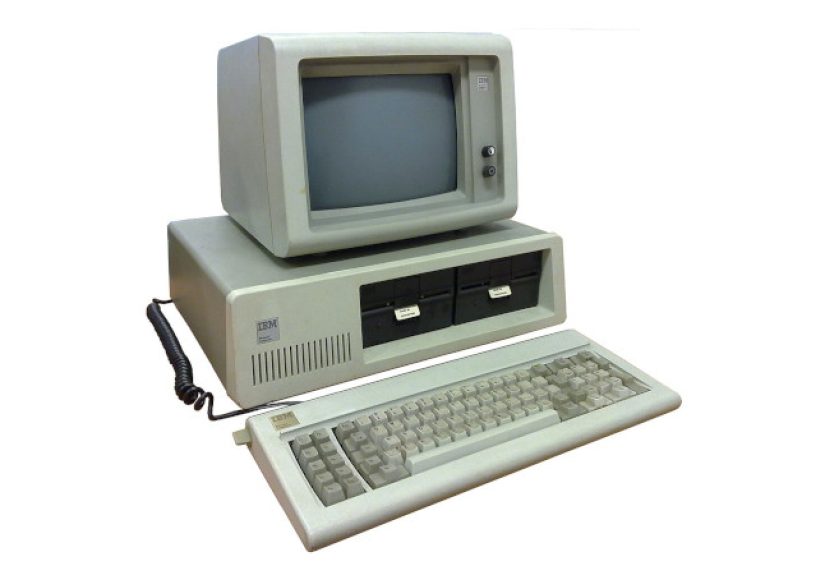
The IBM PC launch in 1981 is another fun footnote. Buyers could choose between PC-DOS,
CP/M-86, and the UCSD p-System. Imagine walking into a computer store and deciding whether
your new machine should speak DOS, CP/M, or Pascal-flavored p-code. In practice, PC-DOS
quickly dominated, but the mere presence of the p-System as a first-class option showed how
seriously people took its portability and educational value at the time.
For a while, the p-System was a legitimate alternative to the emerging DOS ecosystem, especially
in vertical markets and education where machine independence mattered more than raw speed.
Why the UCSD P-System Faded Away
So if the UCSD p-System was so clever, why don’t we boot into it today? Part of the answer
is that the hardware world changed. As the 1980s progressed, the IBM PC architecture became
the de facto standard. When nearly everything important ran on x86 PCs, portability across
wildly different systems mattered less than squeezing out maximum performance and taking
advantage of native OS features.
At the same time, native compilers got faster, cheaper, and easier to use. Turbo Pascal,
for example, delivered blazing-fast compile times and tight DOS executables that ran circles
around interpreted p-code in many situations, while still offering a friendly IDE and
Pascal’s structured style. The UCSD p-System’s portability advantage shrank just as its
performance disadvantages became more painful.
After the final release of UCSD p-System version IV in the late 1980s, the platform slowly
faded from mainstream use. Yet, as the Hackaday retrospective points out, it never truly
disappeared; it simply moved into the realm of retrocomputing projects, emulators, and
documentation sites run by enthusiasts who refuse to let old bytecodes die.
The UCSD P-System’s Lasting Influence
Although the p-System itself is mostly of historical interest now, its core ideas live on.
The notion of defining a virtual instruction set, compiling to a portable bytecode, and
implementing that virtual machine on multiple platforms shows up in the JVM, CLR, and even
in lightweight formats like WebAssembly.
Beyond the technical architecture, UCSD Pascal influenced later Pascal dialects. Many
features and conventions that showed up in PC-based compilers had roots in UCSD’s design,
and UCSD Pascal helped cement Pascal’s reputation as a practical language for both teaching
and real-world software rather than just an academic exercise.
In teaching, the p-System anticipated modern “managed” environments used in programming
courses: a controlled, consistent ecosystem where students compile and run code in a
sandboxed environment that behaves the same from one machine to the next.
Lessons for Modern Developers
Looking back at the UCSD p-System from a 21st-century perspective, it’s easy to smile at
its text-mode menus, slow floppies, and blocky interfaces. But the system still has lessons
for today’s developers:
- Portability matters. The p-System showed that you can design for
portability from the start by targeting a virtual machine, not a specific CPU. - Tooling shapes experience. A consistent editor, compiler, and file system
across platforms made development feel smoother, even on constrained hardware. - Education drives adoption. UCSD’s academic roots helped spread Pascal and
the p-System to classrooms worldwide, much the way Java or Python spread later. - Simplicity scales. A small, well-defined virtual machine can be easier to
port and reason about than a sprawling native stack.
In a sense, the UCSD p-System was an early answer to questions we still wrestle with today:
How do we write code once and run it everywhere? How do we protect developers from the messy
details of hardware without giving up too much performance? And how many layers of abstraction
is too many before the debugger starts crying?
Experiences and Anecdotes from the P-System Era
Talk to people who actually used the UCSD p-System, and the stories sound like a cross between
a computer science class and a retro-gaming session with extra disk swapping. Many remember
that first moment of booting into the system on an Apple II or a university minicomputer:
the screen cleared, a simple text menu appeared, and suddenly you were in a world that felt
more like “real computing” than typing 10 PRINT "HELLO" in BASIC ever had.
A common ritual went like this: slide in the system disk, wait for the whir of the drive,
choose the editor from a menu, write your Pascal program, then swap to a compiler disk.
If you were lucky, your code compiled without errors. If you weren’t, you got to see how
creative the compiler could be at pointing to the wrong line. Either way, the process taught
patience, careful typing, and a grudging respect for structured programming.
In university labs, the p-System often served as neutral ground between warring hardware
factions. Some students preferred DEC terminals, others were all-in on new microcomputers,
but UCSD Pascal gave them a shared environment where assignments behaved the same no matter
which keyboard they were hammering on. Instructors appreciated this because it simplified
debugging and grading “it works on my machine” was less of an excuse when everyone’s
machine was effectively the same p-Machine.
Hobbyists have their own angle on those years. For many, the UCSD p-System was the first time
their home computer felt like something a professional might use. Apple Pascal, in particular,
came with printed manuals, tidy binders, and a visual identity that looked serious. Combined
with the hexagonal cover art and the talk of a “portable operating system,” it gave users the
sense that they were stepping into grown-up computing, even if they were still sitting on the
floor next to a TV set acting as a monitor.
Modern retrocomputing fans recreate that experience with emulators, FPGA recreations, and
original hardware lovingly restored. They boot UCSD p-System disks, write small Pascal
programs just for the fun of watching p-code run again, and document details of the file
system and virtual machine that would otherwise have faded away.
There’s a certain charm in seeing a sine wave plotted as text characters in a UCSD environment
or paging through the old manuals archived by museums and collectors. It’s a reminder that
today’s sophisticated virtual machines didn’t come out of nowhere they stand on the shoulders
of simpler, scrappier systems like UCSD Pascal that proved the concept decades ago.
Conclusion: Why the P-System Still Matters
The UCSD p-System may never have become the dominant platform of the microcomputer era,
but it left a deeper mark than its market share suggests. It brought academic ideas about
virtual machines and structured programming into living rooms, classrooms, and early
offices. It showed that portability could be engineered at the virtual machine level,
and that a carefully designed environment could make even modest hardware feel powerful.
When we spin up a virtual machine in the cloud, compile to bytecode, or ship code in a
portable runtime today, we’re walking down a path that systems like UCSD Pascal helped
blaze. Remembering the p-System isn’t just an exercise in nostalgia it’s a way to
understand why our tools look the way they do, and to appreciate how much creativity it
took to build a virtual machine that fit on a floppy disk and still made programmers feel
like they were part of the future.