Table of Contents >> Show >> Hide
- Why Abandoned Castles Fascinate Us So Much
- 10 of the Most Beautiful Abandoned Castles in the World
- 1. Sammezzano Castle, Italy
- 2. Heidelberg Castle, Germany
- 3. Kilchurn Castle, Scotland
- 4. Dunluce Castle, Northern Ireland
- 5. Rocca Calascio, Italy
- 6. Ogrodzieniec Castle, Poland
- 7. Menlo Castle, Ireland
- 8. Château de la Mothe-Chandeniers, France
- 9. Bannerman Castle, United States
- 10. Čachtice Castle, Slovakia
- What Makes These Castle Ruins Stand Out
- The Experience of Visiting the World’s Most Beautiful Abandoned Castles
- Conclusion
- SEO Tags
There are beautiful buildings, and then there are abandoned castles: the overachievers of atmospheric real estate. They have everythingwind, ivy, drama, suspiciously photogenic cracks in the stone, and the kind of silence that makes your footsteps sound like they belong in a movie trailer. Some sit on cliffs above roaring seas. Some hide in forests like they are avoiding emails. Others loom over lakes and villages, looking as if they once hosted feasts, betrayals, and at least one uncle nobody trusted.
What makes the most beautiful abandoned castles in the world so irresistible is not perfection. It is the opposite. Their broken towers, weathered staircases, empty halls, and half-lost histories make them feel alive in a different way. These places are no longer polished for royal guests or military power. Time has edited them down to mood, memory, and silhouette. And somehow, that makes them even grander.
Below, you will find some of the world’s most stunning castle ruins and forgotten fortressesplaces where history still clings to the walls, nature has started redecorating without permission, and beauty shows up wearing moss.
Why Abandoned Castles Fascinate Us So Much
The appeal of castle ruins is part history lesson, part travel fantasy, and part human weakness for anything that looks terrific in fog. Abandoned castles compress centuries into a single view. You can see ambition in the stonework, war in the missing walls, weather in the softened edges, and neglect in the vines that have decided they now own the place.
They are also wildly varied. Some abandoned castles are skeletal ruins with just enough structure left to suggest what once stood there. Others still have towers, courtyards, decorative rooms, or fragments of frescoes. A few feel almost suspended between life and loss, as if one careful restoration campaignor one very determined pigeoncould change everything.
10 of the Most Beautiful Abandoned Castles in the World
1. Sammezzano Castle, Italy
If abandoned castles had a category for “most likely to make your jaw forget its job,” Sammezzano Castle would be a serious contender. Hidden in Tuscany, this 19th-century castle is famous for its dazzling Moorish Revival interiors, where room after room explodes with color, pattern, arches, domes, and ornamental detail. It does not look like a typical medieval fortress. It looks like someone challenged geometry to a duel and geometry lost beautifully.
That contrast is part of its power. The exterior already feels dreamlike, but the interior is what turns Sammezzano into legend. Even in abandonment, the castle looks theatrical and impossibly rich in imagination. It reminds you that “abandoned” does not always mean gray stone and melancholy ravens. Sometimes it means jewel-toned ceilings and a masterpiece waiting behind locked gates.
2. Heidelberg Castle, Germany
Heidelberg Castle is one of Europe’s great romantic ruins, and honestly, it knows it. Rising above Heidelberg’s old town, the castle combines Renaissance grandeur with the broken elegance that comes from centuries of war, fire, and stubborn survival. It is not tidy, and that is exactly the point.
What makes Heidelberg unforgettable is scale. The ruin still feels monumental, with imposing façades, huge courtyards, and a commanding perch above the Neckar Valley. It looks less like a building that disappeared and more like a giant memory that refused to leave. Writers, painters, and travelers have been falling for it for generations, and it is easy to see why. This is the kind of place that makes you suddenly understand why the word “romantic” once had more to do with ruins than candlelight.
3. Kilchurn Castle, Scotland
Some castles are dramatic because they are enormous. Kilchurn Castle is dramatic because it sits on Loch Awe like it was designed by a particularly moody cloud. This ruined Scottish castle is one of the most photographed in the country, and every photo basically says the same thing: yes, weather can be an accessory.
The castle’s long stone form, reflected in the water and framed by Highland scenery, gives it an almost unreal calm. It once served as fortress, residence, and garrison, but today it reads as pure atmosphere. Kilchurn is proof that abandonment can sharpen beauty rather than erase it. The less noise around the castle, the more the landscape gets to collaborate.
4. Dunluce Castle, Northern Ireland
Dunluce Castle does not merely sit near the sea. It commits to the sea. Perched on a dramatic basalt outcrop on the Causeway Coast, this ruin seems to hover between land and legend. If your ideal abandoned castle includes cliffs, crashing waves, and a constant risk of staring too long at the horizon, congratulations: you have found your place.
The present ruins mainly date from the 16th and 17th centuries, but the site’s history stretches back much further. What matters visually is the way the castle and coastline work together. Dunluce is rugged, exposed, and impossibly cinematic. It feels less like a relic and more like a warning from history: build something glorious by the Atlantic, and the Atlantic will still insist on co-author credit.
5. Rocca Calascio, Italy
Rocca Calascio has altitude, attitude, and the kind of scenery that makes people suddenly speak in whispers. Set high in the Apennines, this mountaintop fortress is one of Italy’s most striking ruined castles. The pale stone, open sky, and stark mountain backdrop create a landscape that feels almost lunar, only with better architecture.
Unlike castles that charm through ornate detail, Rocca Calascio wins through purity. Its broken towers and walls are reduced to essential forms, and that simplicity is what makes it feel timeless. The ruin looks as though it has been distilled by wind and light. It is also one of those places that confirms a universal travel truth: if several major films have used a location and it still exceeds expectations in person, you are dealing with something special.
6. Ogrodzieniec Castle, Poland
Poland is rich in castle ruins, and Ogrodzieniec is one of the most visually commanding. Rising above the limestone formations of the Kraków-Częstochowa Upland, the castle feels fused to the rocks beneath it. The result is half fortress, half geological event.
Its ruin is large, rugged, and wonderfully irregular, with towers, fragments of walls, open passages, and dramatic vantage points. Ogrodzieniec does not have the polished romance of a restored royal residence. It has something better: texture. You can sense the defensive logic, the layered rebuilding, and the long afterlife of the place as a symbol rather than a stronghold. It looks ancient in the best possible waylike it earned every crack.
7. Menlo Castle, Ireland
Menlo Castle has one of the loveliest settings of any ruin on this list. Standing on the banks of the River Corrib just outside Galway, the ivy-clad remains are soft, quiet, and deeply photogenic. This is not the kind of ruin that overwhelms you with military scale. It draws you in with atmosphere.
The 16th-century castle became the seat of the Blake family, and after a devastating fire in the early 20th century, only the walls remained. Today, Menlo feels poetic rather than imposing. The river, the greenery, and the surviving shell of the building turn it into the architectural equivalent of a sad ballad that somehow still looks excellent at sunset.
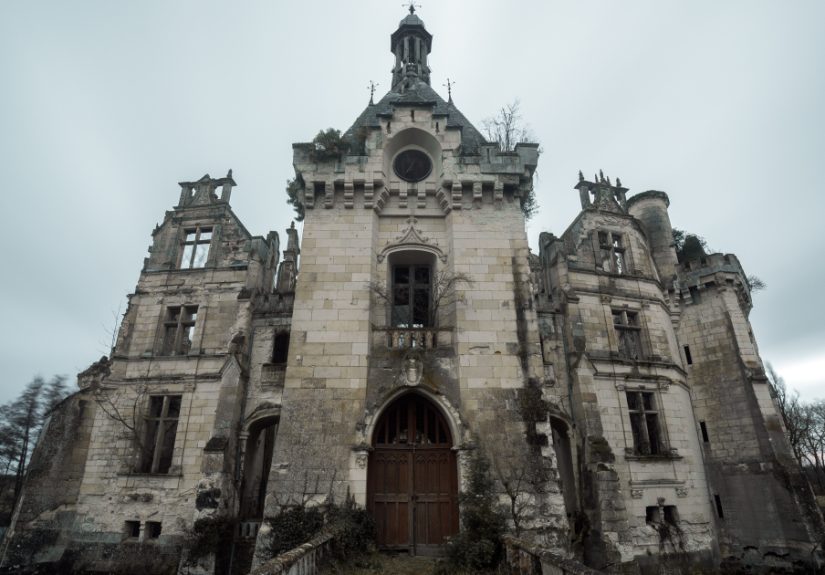
8. Château de la Mothe-Chandeniers, France
If you have ever imagined an abandoned French château wrapped in trees and reflected in a moat, you were probably imagining La Mothe-Chandeniers without knowing its name. This castle is pure fairy-tale ruin: elegant, overgrown, and just eerie enough to keep it from becoming too pretty for its own good.
After a 1932 fire, the château was left abandoned, and nature gradually moved in like an unpaid stylist with excellent instincts. Trees now rise from within the structure, greenery frames the towers, and the whole place looks like architecture trying to become forest. Few abandoned castles capture the romance of decay as perfectly as this one. It is delicate, haunted-looking, and almost absurdly photogenic.
9. Bannerman Castle, United States
Not every beautiful abandoned castle is medieval, and Bannerman Castle proves that age is not the only route to grandeur. Built on a small island in the Hudson River, this early-20th-century structure was originally a military surplus warehouse designed in the style of a Scottish castle. Which is a sentence you really only get to write once.
Today, its partial ruin gives it a strange and memorable character. The setting is everything: an uninhabited island, river views, fragmented stone walls, and a giant remnant of Gilded Age imagination. Bannerman feels like a castle invented by a businessman with excellent taste in drama and a very unusual storage problem. And yet, standing there in ruin, it genuinely earns its place among the world’s most beautiful abandoned castles.
10. Čachtice Castle, Slovakia
Čachtice Castle has the kind of reputation that arrives before you do. Perched above the Slovak landscape, the ruined stronghold is associated with the notorious Elizabeth Báthory legend, which gives it a darker cultural aura than most places on this list. But even without the stories, the castle is visually striking in its own right.
The hilltop setting, broken walls, and commanding views create the classic ingredients of a memorable ruin. Čachtice feels stern and weather-beaten, less romantic than some of the ivy-covered castles elsewhere in Europe, but no less beautiful. It is a reminder that beauty in ruins does not always have to be soft. Sometimes it can be severe, wind-battered, and unforgettable.
What Makes These Castle Ruins Stand Out
The best abandoned castles do more than look old. They create a full experience of place. Sammezzano dazzles through interior design. Dunluce wins with cliffside drama. Rocca Calascio is almost spiritual in its mountain setting. Menlo is intimate and lyrical. Ogrodzieniec feels carved from the land itself. La Mothe-Chandeniers looks like nature and architecture signed a truce and made art together.
Together, these ruins show why castle travel remains so compelling. Restored castles can be wonderful, but ruined castles offer something rarer: evidence of time. They let you see how beauty changes when power leaves the room. They are no longer trying to impress kings, armies, or noble families. They are simply existingcracked, weathered, and often more moving because of it.
The Experience of Visiting the World’s Most Beautiful Abandoned Castles
Visiting an abandoned castle is not like visiting a polished museum piece with perfect signage, spotless rope barriers, and a gift shop that somehow sells both bookmarks and jam. It feels different from the first moment. Even when a site is protected, stabilized, or partially managed for visitors, there is still a sense that you are walking into a place that time has already claimed as its own. That shift changes everything.
You notice sounds more sharply. Wind through broken windows. Birds circling a tower. Gravel under your shoes. The sea below Dunluce. The hush around Menlo. The sudden echo in a roofless hall. Ruins make you listen because there is less to distract you. Modern life does not fully stick to them. Notifications lose their authority. The castle has better material.
You also start paying attention to textures in a way you normally would not. Ivy climbing old walls. Rain-darkened stone. Staircases worn down by centuries of use. Shadows sitting where rooms used to be. The visual richness of abandoned castles comes from incompleteness. Your mind keeps filling in what is missing: the roof, the tapestries, the gates, the furniture, the people, the politics, the feasts, the arguments, the disasters. A ruin quietly recruits your imagination.
That is part of the emotional pull. These places feel both grand and fragile. Heidelberg still looks monumental, yet clearly vulnerable. La Mothe-Chandeniers feels almost delicate inside its vegetation. Kilchurn seems strong until the weather reminds you that the weather always wins eventually. In abandoned castles, human ambition is still visible, but it is no longer in charge. There is something humbling about that. Also something weirdly comforting.
And then there is the setting. The most memorable ruins are almost always in conversation with the landscape around them. Bannerman needs the river. Rocca Calascio needs the mountain air and open sky. Ogrodzieniec needs the limestone crags. Dunluce needs the cliffs and Atlantic wind. Without those surroundings, the castles would still matter historically, but they would lose part of their spell. Great castle ruins are not just buildings. They are stage sets created by geography.
There is also a practical side to the experience that seasoned travelers quickly learn: these sites reward patience. They are best approached slowly, respectfully, and with realistic expectations. Some are permanently closed or only visible from the outside. Some are under conservation. Some require a walk, a climb, or the willingness to accept that the best photo angle may involve mud. The glamour of abandoned castles is real, but so is the hill.
Still, that slight effort is part of the magic. Abandoned castles do not usually hand themselves to you in one neat glance. You arrive, adjust, look again, and slowly the place reveals its logic. A surviving arch aligns with the valley. A courtyard opens to the sky. A tower frames the water. A decorative room at Sammezzano suddenly explains why people speak about it with near-religious enthusiasm. The ruin becomes legible one detail at a time.
By the time you leave, the experience tends to stay with you longer than expected. Not because you “checked off” another landmark, but because ruined castles are emotionally sticky. They hold contradiction well. They are broken but impressive, empty but expressive, silent but full of story. They remind you that beauty does not depend on newness and that places can remain powerful long after their original purpose disappears. For travelers, photographers, history lovers, and anyone vulnerable to dramatic stonework, that is a pretty unbeatable combination.
Conclusion
The most beautiful abandoned castles in the world are not beautiful in spite of their decay. They are beautiful through it. Their missing roofs, weathered walls, overgrown courtyards, and dramatic settings give them a depth that pristine buildings often cannot match. Whether you prefer the kaleidoscopic interiors of Sammezzano, the river-island mystery of Bannerman, the cliffside power of Dunluce, or the mountain silence of Rocca Calascio, each ruin offers its own version of wonder.
They also offer perspective. Castles were built to project permanence, control, and prestige. Yet the ones we remember most vividly are often the ones that time cracked open. What remains is not failure. It is character. And when architecture, history, and landscape meet in exactly the right way, a ruined castle can become more beautiful than it ever was when the banquet tables were full and everyone was pretending to like court politics.