Table of Contents >> Show >> Hide
- What Exactly Is “The School of Athens”?
- Why “The School of Athens” Ranks So High
- Opinions on the Meaning: What Is Raphael Actually Saying?
- Modern Takes: From Documentary Deep Dives to Social Media
- How to Form Your Own Opinion About the Fresco
- Is It Overrated or Just That Good?
- Experience: What It’s Like to Meet “The School of Athens” in Person
If the Renaissance had a yearbook, Raphael’s The School of Athens would
absolutely win “Most Likely to Be Reposted on Instagram.” Painted more than 500
years ago on a Vatican wall, this sweeping fresco has become one of the most
famous images in Western art and a regular at the top of “greatest paintings”
lists. It’s part philosophy lecture, part architectural fantasy, and part
intellectual fan art featuring history’s most iconic thinkers all crammed into
one imaginary conversation.
In this article, we’ll unpack why The School of Athens ranks so highly
among art historians, critics, museums, and everyday visitors; what different
experts think the painting means; and how you can form your own opinion about it.
We’ll also end with a longer, more personal “experience section” that imagines
what it’s really like to stand in front of the fresco in the Vatican and join
this visual debate in person.
What Exactly Is “The School of Athens”?
A quick tour of the fresco
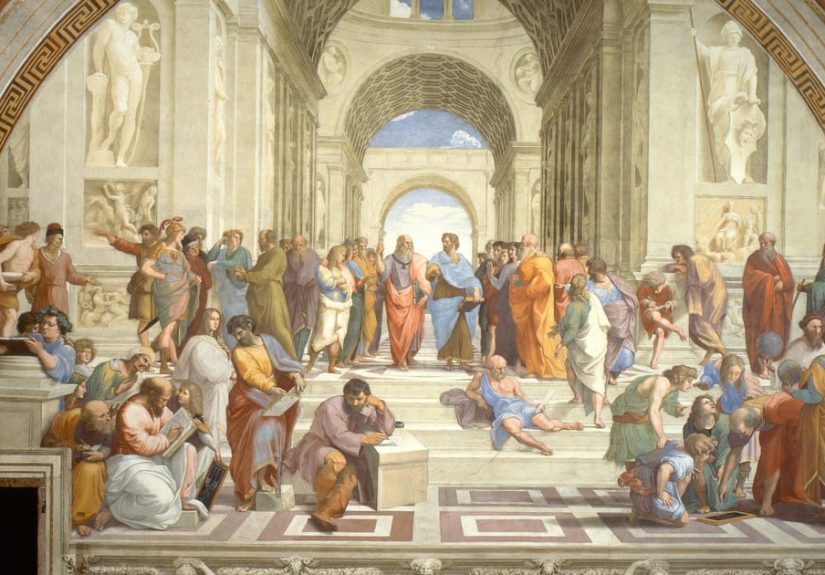
The School of Athens is a monumental fresco painted by the Italian High
Renaissance artist Raphael between about 1509 and 1511 for Pope Julius II. It
covers an entire wall in the Stanza della Segnatura, one of the famous Raphael
Rooms in the Vatican Museums. The work measures roughly 18 by 25 feet
(5.0 × 7.7 meters), so this is not some modest canvas you could hang above a
couchit’s more like walking into a full-blown philosophical universe.
The scene is set in an epic, imaginary classical building with grand barrel
vaults, coffered ceilings, statues of Apollo and Athena, and deep one-point
perspective that pulls your eye straight to the center. That middle vanishing
point is where Raphael places his two star players: Plato and Aristotle,
strolling side by side in animated discussion. Around them, arranged on marble
steps and in clusters, is an all-star lineup of ancient philosophers,
mathematicians, and scientists, from Pythagoras and Euclid to Socrates,
Diogenes, and what’s probably a portrait of Heraclitus inspired by Michelangelo.
Where the fresco fits in Raphael’s bigger project
The School of Athens is one of four main frescoes in the Stanza della
Segnatura, each representing a branch of knowledge: Theology, Poetry, Law, and
Philosophy. Raphael assigns philosophy to this wall and literally crowns it with
a personification and Latin phrase about the “knowledge of causes.” The idea is
that human reason, logic, and inquiry are worthy of a wall all their own, facing
the wall that celebrates Christian theology. Together, these frescoes visualize
the Renaissance dream of reconciling faith and reason in one intellectual
ecosystem.
Why “The School of Athens” Ranks So High
Raphael’s #1 hit (according to the rankings)
When critics and art sites rank Raphael’s greatest works, The School of
Athens nearly always lands at or near the top. Contemporary rankings of
Raphael’s best paintings often crown it as his masterpiece, highlighting its
balance of complex composition, technical perfection, and intellectual depth.
It’s praised as a “who’s who of Western thought” and a work that pushed
Renaissance painting forward in terms of perspective, spatial illusion, and the
integration of portraits into grand allegory.
In lists of the greatest Renaissance artworks, the fresco frequently appears
alongside Michelangelo’s Sistine Chapel ceiling and Leonardo da Vinci’s
Last Supper. For the Vatican Museums themselves, it’s one of their
crown jewelsso much so that many visitors come specifically to see the Raphael
Rooms and consider them a must-see stop on par with the Sistine Chapel.
Why the composition blows critics away
Critics often point to the composition of The School of Athens as one of
the main reasons it ranks so highly. Raphael uses a flawless one-point
perspective system: the lines of the architecture converge at Plato and
Aristotle, visually reinforcing their central role in the history of philosophy.
The architecture itself draws on designs associated with Donato Bramante, the
architect who was reshaping St. Peter’s Basilica at the time, making the fresco
feel like a dialogue between painting and real contemporary building projects.
Even with this rigorous geometry, the painting doesn’t feel stiff. Raphael
arranges figures in animated clusters, creating dozens of smaller interactions:
a student scribbling furiously, a thinker lost in thought, groups leaning in as
if they’re mid-argument. Viewers and art historians love how the fresco manages
to feel both extremely structured and full of lifea visual textbook that somehow
never feels like homework.
Opinions on the Meaning: What Is Raphael Actually Saying?
Plato vs. Aristotle: the famous hand gestures
If you’ve ever seen a meme about The School of Athens, chances are it
involves the hands of Plato and Aristotle. Plato, on the left, points upward,
while Aristotle extends his hand horizontally. These gestures are widely
interpreted as shorthand for their philosophies: Plato looking toward the realm
of abstract Forms and eternal truths, Aristotle grounding knowledge in the
observable world and ethics of everyday life.
Raphael reinforces this contrast with the books they hold. Plato carries a copy
of the Timaeus, a dialogue loaded with cosmic questions about time,
space, and the structure of the universe. Aristotle holds his
Nicomachean Ethics, a work centered on human behavior, virtue, and how
to live well. Together, they anchor the fresco as a conversation not only about
ideas but about different approaches to understanding reality.
Who’s actually in this “school”?
One of the longest-running art-historical debates about the fresco is the exact
identity of all the figures. Some are widely accepted: Socrates with his craggy
profile, a contemplative Pythagoras working on a tablet, Euclid (or possibly
Archimedes) bending over a slate with a compass to demonstrate geometry, and a
brooding figure thought to be Heraclitus modeled on Michelangelo’s appearance.
Others are heavily debated and may represent composite types rather than strict
portraits.
Raphael also slips contemporary figures into the scene. Many scholars agree that
he paints himself as the young man in the right-hand foreground, turning to look
at the viewer. This act of self-insertion is one reason modern rankings treat the
fresco as a bold, career-defining statement. Raphael isn’t just recording a
gathering of philosophers; he’s quietly saying, “I belong in this intellectual
conversation too.”
Philosophy vs. theologyor a peaceful truce?
Another major thread in opinions about The School of Athens is its
relationship to Christian theology. Some scholars see the fresco as celebrating
secular knowledgelogic, mathematics, scienceon equal footing with religious
truth. The pairing of this wall with its opposite, which depicts a theological
scene centered on the Eucharist, suggests that the room is structured as a
visual argument for harmony between reason and faith.
Others emphasize the humanist flavor of the painting: it reflects the Renaissance
belief that studying antiquityGreek philosophy, Roman architecture, classical
rhetoriccould deepen Christian understanding rather than threaten it. In this
reading, Raphael turns the Vatican wall into a campus where pagan and Christian
thought coexist in one grand curriculum.
Modern Takes: From Documentary Deep Dives to Social Media
Scholarly deep dives and new interpretations
Recent documentaries and scholarly works continue to re-examine
The School of Athens, sometimes challenging long-held assumptions about
who is who and what the painting “really” means. Some researchers even revisit
Giorgio Vasari’s 16th-century ideas and propose that certain foreground figures
might be read in more overtly Christian terms than earlier art historians were
willing to consider.
This ongoing debate is actually part of why the fresco remains so highly ranked:
it’s visually clear enough to be instantly recognizable, yet intellectually open
enough to support multiple, sometimes conflicting interpretations. That balance
of clarity and mystery is the kind of thing critics and historians can talk
about for decadesand they have.
Casual visitors: “It’s like a Renaissance group chat”
On the more informal side, travelers and casual art fans tend to describe
The School of Athens in vivid, modern terms. Many compare it to a giant
group chat or panel discussion where every major thinker gets a square. Others
point out how surprisingly colorful and airy the fresco looks in person compared
with textbook reproductions. After recent rounds of conservation work in the
Raphael Rooms, visitors often comment on how crisp the blues, whites, and warm
tones now appear.
Online, the painting sparks memes, personality quizzes (“Which School of Athens
philosopher are you?”), and endless zoom-ins on details like the bored
students, the wandering dog, or the casually lounging Diogenes stretched across
the steps like he forgot it’s picture day. All of this keeps the fresco
culturally alive, not just a dusty masterpiece in a survey book.
How to Form Your Own Opinion About the Fresco
Look for three things: structure, drama, and viewpoint
When you see The School of Athenseither in person or in a high-quality
reproductionyou can build your own informed opinion by focusing on three
aspects:
-
Structure: Follow the lines of the floor tiles and arches.
Notice how everything funnels your gaze toward the center. Ask yourself: does
that sense of order feel awe-inspiring, comforting, or maybe too controlled? -
Drama: Zoom in on the groups of figures. Each little cluster
is a mini-story: someone arguing, someone teaching, someone ignoring everyone
else. Which group feels most relatable? That might hint at which philosophical
“camp” you’re drawn to. -
Viewpoint: You stand slightly below the central figures, as
if you’re stepping onto the first row of the steps. Are you an outsider looking
up at intellectual giants, or do you feel invited into the conversation? Your
reaction says a lot about how you see the relationship between expert knowledge
and everyday life.
Some people come away feeling that The School of Athens celebrates an
idealized “elite” world of mostly male, mostly ancient thinkers. Others find it
inspiringa reminder that ideas can outlive their authors and that conversation
across time is possible. Neither reading is wrong; the power of the fresco lies
in its ability to hold all these opinions at once.
Is It Overrated or Just That Good?
Every ranking eventually bumps into the “overrated” question. Does
The School of Athens deserve its superstar status? The case in favor is
strong: technically brilliant, historically important, rich in symbolism, and
still endlessly discussable in college classrooms and museum tours.
The case against usually comes from two directions. First, the fresco’s fame can
overshadow Raphael’s more intimate workshis portraits and Madonnas, which some
viewers find more emotionally direct. Second, the painting reflects a very
specific canon of “great thinkers” that leaves out entire civilizations and
traditions. For viewers seeking a more global, diverse history of ideas, the
fresco can feel incomplete.
Ultimately, whether you personally rank it as “all-time greatest” or “important
but not my favorite,” The School of Athens earns respect for how
confidently it states its ambitions. Raphael isn’t shy. This is a painting that
looks you in the eye and says, “I’m here to represent philosophy itself.”
That kind of artistic boldness is part of what keeps it locked near the top of
so many lists.
Experience: What It’s Like to Meet “The School of Athens” in Person
Reading about The School of Athens is one thing; walking into the room
with it is something else entirely. Imagine you’ve already navigated the maze of
the Vatican Museumslong corridors, sculpture-filled galleries, rooms packed
with tapestries. The air hums with a mix of tour-guide microphones and the soft
shuffle of thousands of footsteps. Then, finally, you squeeze through a doorway
into the Raphael Rooms.
The Stanza della Segnatura isn’t huge by modern museum standards, and it’s
usually crowded. You might have to do a polite sideways shuffle just to reach a
patch of floor where you can see the whole wall. At first your eyes jump around,
trying to process the architecture, the statues, the dozens of figures. It’s a
little overwhelminglike opening too many browser tabs at once.
Then you notice that the painting quietly organizes your gaze. The marble floor
tiles line up under your feet and draw you toward the center. The arches create
a sort of visual tunnel. You start to feel less like a visitor gawking from
across the room and more like a character standing on the lower step, eavesdropping
on the world’s most serious study group.
If you’re with a friend, this is where the fun starts. One of you may play tour
guide: “Okay, that’s Plato, that’s Aristotle. I think that’s Pythagoras. No idea
who that guy with the globe is, but he looks important.” You might argue over
which figure you’d want to hang out with. (The lounging Diogenes is popular with
people who like chaos; the math crew around Euclid suits the geometry fans.)
The colors also hit differently in person. After conservation, the clear blues
and warm stone tones give the room an almost airy atmosphere. The sky visible
through the arches feels fresh, not faded, and the figures’ robes shift from
deep reds to soft greens and golds. It’s easy to forget you’re looking at
something from the early 1500s; the scene feels oddly current, like a conference
photo that just happens to feature togas.
Another surprise: the painting doesn’t feel quiet. Even though no one in the
fresco speaks, you can almost hear their voices overlappingthe teacher patiently
explaining, the student asking a skeptical question, the philosopher insisting
that everyone else is missing the point. Standing there, you may realize that
this noise is familiar. Swap the robes for hoodies and laptops, and you’re
basically in a college hallway between classes.
On a more reflective note, many visitors report a moment when the crowd noise
fades and the deeper theme sinks in. You’re surrounded by tourists from all over
the world, in a room painted for a Renaissance pope, looking at an imaginary
gathering of ancient thinkers. It’s three layers of history stacked together:
ancient philosophy, Renaissance humanism, and modern global tourism. Somehow,
the fresco holds all of it without collapsing.
When you finally turn to leave, you may find your opinion of
The School of Athens has shifted. Maybe you still think another artwork
deserves top billing, but it’s hard not to respect the ambition and craft on
display. You might even feel a little inspiredmotivated to pick up a book,
revisit a big question you’ve been dodging, or at least look up who all these
philosophers actually were.
And that, in the end, may be the best argument for the fresco’s high rankings.
A painting that can make you think about your own learning, five centuries after
it was created, is doing something right.
SEO metadata in JSON format