Table of Contents >> Show >> Hide
- A Real Space Weapon in a World That Already Had One
- Why a Laser Pistol Made Sense to Soviet Designers
- What the Public Record Says the Pistol Actually Did
- The Legal Loophole That Made Space Weapons Complicated
- Why the Weapon Never Became Famous
- What the Soviet Laser Space Pistol Really Reveals
- Experiences Around the Artifact: Why This Story Still Hits So Hard
It sounds like a prop department fever dream: a Soviet laser pistol designed for space, hidden behind Cold War secrecy, then quietly resurfacing decades later like a sci-fi artifact that missed its cue. And yet, unlike a lot of “secret space weapon” stories that collapse into rumor the moment you poke them, this one has enough surviving evidence to be taken seriously. The Soviet Union really did explore a handheld laser weapon for use in orbit. No, it was not a Death Star in your pocket. No, it was not a zero-gravity duel machine for two cosmonauts who had watched too much space opera. And no, it was not likely to blast a hole through a spacecraft wall while everyone inside yelled in Russian.
What it appears to have been, instead, is much more interesting: a compact anti-optics device born from a very specific Cold War fear. In other words, the Soviet laser space pistol was less “pew pew” and more “please stop looking at our classified station.” That may sound less cinematic, but it is far more revealing. Once you understand why this strange weapon was conceived, you start to see the pistol not as a gadget, but as a tiny, metallic summary of the entire Cold War in orbit: suspicion, secrecy, military ambition, engineering bravado, and a legal gray area wide enough to fly a space station through.
A Real Space Weapon in a World That Already Had One
The Soviet laser pistol did not emerge from nowhere. It belonged to the same strategic imagination that produced Almaz, the Soviet military space station program. Publicly, some of these stations were folded into the Salyut label, which sounded far more peaceful and much less like “please do not ask what is inside this orbital cylinder.” In reality, Almaz was a military reconnaissance platform, part spy post and part engineering experiment, created in an era when both superpowers were still deciding whether space would become a laboratory, a billboard, a battlefield, or all three before lunch.
That matters because Almaz was not just theoretical military hardware. The program produced real stations, and one of them, Salyut 3/Almaz 2, became the first successful manned Almaz platform in 1974. Another, Salyut 5/Almaz 3, flew from 1976 to 1977. These were not fantasy bunkers drifting in orbit for dramatic effect. They were practical surveillance stations with distinctly military goals. The Soviets had already shown a willingness to arm space hardware the old-fashioned way too: Almaz carried a cannon, and later public accounts said the weapon was test-fired in orbit. Suddenly, a handheld laser device stops sounding absurd and starts sounding like a natural next chapter in a very tense design brief.
That is the key to understanding the pistol. It was not the first sign that the Soviets were thinking about armed space systems. It was a smaller, cleverer, and arguably more plausible answer to the same question: if an enemy spacecraft gets too close, how do you defend a classified orbital asset without turning the whole encounter into a Michael Bay trailer with worse gravity?
Why a Laser Pistol Made Sense to Soviet Designers
Cold War space strategy had a habit of making paranoid ideas sound almost reasonable. American planners explored military uses of orbit. Soviet planners did the same. Inspector satellites, anti-satellite systems, space-based missile defense concepts, and orbital surveillance all lived in the same ecosystem of fear. The United States and the Soviet Union were not just racing to reach space. They were racing to make sure the other side did not get too comfortable once it got there.
Within that mindset, the Soviet concern was not necessarily that American astronauts would show up, kick in the hatch, and start an orbital fistfight. That scenario makes for excellent pulp fiction and terrible mission planning. The more believable fear was optical intrusion. If a nearby craft could photograph, inspect, track, or interfere with a military station, then the soft spot was not the hull. It was the station’s sensors, windows, optics, and guidance systems.
This is where the laser pistol becomes surprisingly logical. Public reporting suggests the device was conceived as a way to disable or blind sensitive optical equipment on an approaching spacecraft or satellite. That is a very Cold War solution: limited, targeted, deniable, and focused on ruining the other side’s electronics instead of vaporizing the other side’s crew. Think of it as a dazzling tool with attitude, the orbital equivalent of shining a flashlight into a nosy camera lens, except the flashlight had the personality of a Soviet design bureau.
There was also a practical reason to go compact. Space hates excess. Mass is expensive, volume is precious, recoil is annoying, and anything that risks fire, toxic contamination, or hull damage becomes everyone’s least favorite engineering discussion. A huge cannon on the outside of a station is one thing. A lightweight defensive device that could be carried, stored, and perhaps used from inside a pressurized compartment is a much neater answer. The pistol promised a defense option without demanding a full-blown orbital artillery doctrine every time someone floated too close for comfort.
What the Public Record Says the Pistol Actually Did
Here is where the story gets delightfully weird. Available descriptions suggest the Soviet laser space pistol was not a continuous-beam sci-fi blaster. It was more like a compact pulsed system designed to deliver enough energy to damage or overwhelm sensitive optical components at short range. Accounts indicate that it was not intended to kill a person outright, which is a useful correction for anyone picturing a dramatic duel next to a porthole while synthesizer music swells in the background.
The broad idea was straightforward. If an enemy optical system looked directly at a bright enough burst at the right wavelength, the optics themselves could help magnify the incoming energy onto vulnerable sensors. That means you do not necessarily need movie-level power to do real damage. You need enough energy, enough precision, and the bad luck of being on the receiving end of an overly curious camera. Public accounts also suggest the effective range was short, which fits the concept: this was not for picking off targets across vast orbital distances. It was for close encounters, the kind that make military planners start clearing their throats.
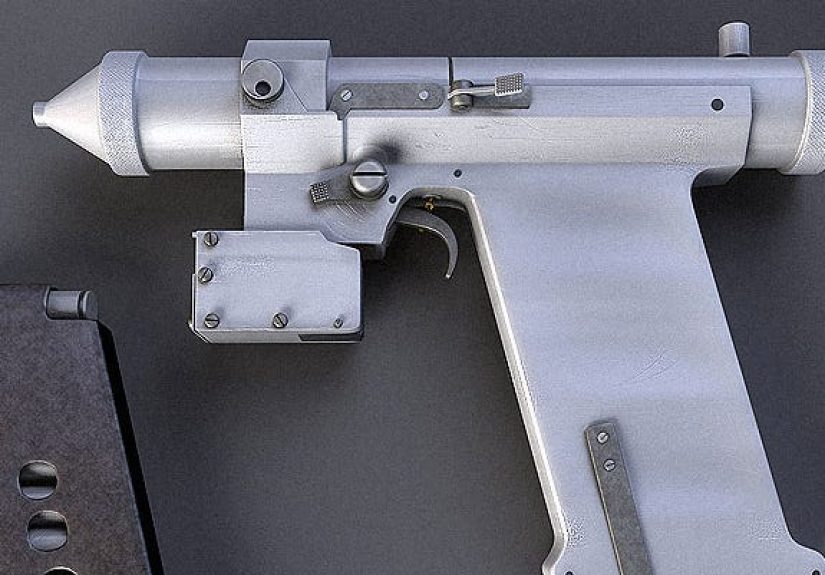
Some descriptions mention a pyrotechnic flash-lamp approach and disposable energy cartridges, which makes the device sound like the offspring of a lab instrument and a revolver that studied too hard. What matters for a general reader is not the exact internal anatomy but the design philosophy. Soviet engineers appear to have been chasing a laser system that was small, safe enough for station use, and capable of briefly delivering enough optical punishment to blind sensors. That is far less flashy than cinema, but far more plausible than a pocket-sized ray gun that could burn through steel in a vacuum.
The date most often attached to the project is 1984, which is almost too perfectly Orwellian to be polite. By then, the final Almaz crewed missions were already in the past. In other words, the pistol seems to have arrived when the exact mission profile that inspired it was losing momentum. That timing is one reason the weapon fascinates historians. It is both a real piece of hardware and an artifact of strategic lag: a serious answer to a problem that was already changing by the time the answer was ready.
The Legal Loophole That Made Space Weapons Complicated
One reason this story remains so compelling is that it lives in the gap between popular assumptions and the actual law of space. Many people hear “Outer Space Treaty” and assume all weapons in space are banned. That would be tidy, reassuring, and only partly true. The 1967 treaty barred nuclear weapons and other weapons of mass destruction from orbit and from celestial bodies. It also required peaceful use of the moon and other celestial bodies. What it did not do was outlaw every conventional weapon, every anti-satellite concept, or every piece of military hardware related to operations in orbit.
That left a giant gray zone. Reconnaissance satellites were fine. Military personnel in support of peaceful purposes were fine. Various counterspace concepts remained thinkable. So while the treaty slammed one very important door, it left several side windows cracked open. The Soviet laser pistol, like the Almaz cannon and broader anti-satellite thinking, belongs in that awkward legal and strategic in-between. It was not a doomsday weapon. It was the kind of highly specific military tool that emerges when treaties limit the worst possibilities without eliminating the rivalry that created them.
This legal ambiguity also helps explain why the Cold War produced such strange orbital ideas. Once the superpowers realized they could not simply park nuclear apocalypse in low Earth orbit and call it a day, they turned to subtler concepts: blinding, jamming, inspecting, nudging, intercepting, and threatening. In that ecosystem, a laser pistol is bizarre only until you compare it with everything else the era considered. Then it becomes almost normal, which may be the most Cold War sentence ever written.
Why the Weapon Never Became Famous
If the Soviet laser space pistol was real, why did it disappear from public memory for so long? Because secrecy did what secrecy does. Soviet military space projects were hidden behind bland labels, partial disclosures, and enough compartmentalization to make a filing cabinet feel important. Even after the Soviet collapse, many details came out in fragments: memoirs, museum exhibits, interviews, and later reporting. That makes the pistol historically credible but still a little foggy around the edges.
There is also a simpler reason. Space history usually remembers the loud winners: Moon landings, giant rockets, dramatic disasters, heroic firsts. A compact anti-optics sidearm built for a military station that never became a standard orbital tool does not naturally headline the school textbook. It lives in the footnotes, where some of the best history likes to hide. The pistol is not famous because it did not reshape the space race. It is famous now because it reveals how seriously governments once imagined conflict in orbit, and how far engineers would go to prepare for the possibility.
And frankly, the object itself is easy to underestimate. It is not sleek in the Hollywood sense. It does not come with a legendary battle story. It does not even seem to have reached orbit. But that is exactly why it is such a rich subject. It shows the mundane side of futuristic competition: committees, prototypes, technical constraints, mission drift, and the eternal bureaucratic hope that one more specialized device will finally solve a strategic headache.
What the Soviet Laser Space Pistol Really Reveals
The biggest lesson of the Soviet laser space pistol is not that the USSR almost turned space into a blaster duel. The real lesson is subtler and more unsettling. Once military planners begin to treat space as contested terrain, they do not only imagine giant platforms and apocalyptic systems. They also imagine the weird little tools. The sidearms. The dazzlers. The close-range answers to highly specific questions. That is how militarization works: not just through grand doctrine, but through practical design decisions made one prototype at a time.
The pistol also reminds us that Cold War space technology was often far stranger than fiction, because real engineers had to solve real constraints. Science fiction gives you unlimited power and dramatic lighting. Reality gives you mass budgets, fragile sensors, treaty language, toxicology concerns, and managers who would very much like an update by Thursday. The result is a weapon that sounds outlandish but, on closer inspection, is weirdly sensible for its time.
Above all, the pistol reveals how much of the space race happened in the shadows. We tend to remember the public theater: flags, launches, speeches, televised triumphs. But behind that spectacle sat another contest, one concerned with reconnaissance, vulnerability, denial, and control. The Soviet laser space pistol is a tiny witness to that hidden competition. It may never have changed history in orbit, but it changes how we understand the mindset that built the Cold War above Earth.
So yes, the Soviet laser space pistol was real enough to matter. But the truth is better than the myth. It was not a fantasy blaster from a space western. It was a compact symptom of an era that could imagine military tension following humanity into orbit and then, naturally, assign a design team to make something for it. That is the most Soviet part of the story, and also the most human.
Experiences Around the Artifact: Why This Story Still Hits So Hard
There is a particular feeling that comes with encountering an artifact like the Soviet laser space pistol for the first time. It is not the thrill of discovering that the past was cooler than expected, although that certainly helps. It is the stranger realization that the past was both more imaginative and more anxious than most people remember. A museum label, a grainy photo, or a historian’s careful reconstruction can suddenly collapse the distance between “Cold War history” and “people genuinely spent their workday designing a laser sidearm for orbit.” That is the moment when the topic stops being trivia and starts becoming atmosphere.
Imagine standing in front of the object, or even just staring at photographs of it online. At first glance, it does not necessarily scream “future.” It may look more like an odd instrument than a heroic weapon. That almost makes the experience better. The modest appearance forces you to do the mental work yourself. You have to picture the station, the secrecy, the planning meetings, the fear of surveillance, the assumption that space was not empty but contested. The artifact becomes a trigger for an entire worldview. Suddenly the Cold War is no longer a chapter heading. It is a mood with metal edges.
There is also a kind of intellectual whiplash in realizing how different real technology is from fictional shorthand. Popular culture trained us to expect laser weapons to be loud, glowing, and dramatically decisive. The likely reality here was narrower, more technical, and in some ways more unnerving. A device meant to blind sensors rather than vaporize a villain says something profound about modern conflict: often the goal is not to explode the enemy but to make the enemy unable to see, measure, or understand. That idea feels contemporary in a way the phrase “space pistol” absolutely does not.
For historians, writers, and curious readers, the experience of researching this topic is its own reward. You begin with what sounds like clickbait and end up in a web of treaties, reconnaissance doctrine, Soviet station design, anti-satellite theory, and the psychology of orbital suspicion. It is like opening a drawer expecting one strange object and finding an entire era folded inside it. Every detail points outward. Why a pistol? Why optics? Why Almaz? Why secrecy? Why 1984? The object refuses to stay small.
And then there is the emotional aftertaste. The Soviet laser space pistol is funny for about ten seconds. “Ha, wow, a laser gun in space.” Then the deeper reaction settles in. Human beings carried their rivalry upward almost immediately. We took wonder, discovery, engineering brilliance, fear, and military logic and packed them together in the same rocket fairing. That contradiction is what makes the topic linger. The pistol is not memorable only because it is unusual. It is memorable because it sits exactly at the intersection of awe and unease. It reminds us that even in humanity’s most visionary projects, we rarely leave our insecurities on the launch pad.
That is why the story still resonates. The artifact feels like a warning, a curiosity, and a punchline all at once. It invites us to marvel at the ingenuity, laugh at the absurdity, and then pause long enough to notice how familiar the logic still feels. We live in an age that talks again about counterspace systems, satellite vulnerability, orbital competition, and new military frontiers. In that context, the Soviet laser space pistol stops being a relic from a weird forgotten corner of history. It starts looking like an early draft of a conversation we never fully finished.