Table of Contents >> Show >> Hide
- Why thrifted cubbies make a surprisingly perfect coffee table base
- Pick the right thrifted cubbies (and avoid the wobbly heartbreak)
- Design choices that scream “mid-century modern” (without yelling)
- Tools and materials checklist
- Step-by-step: thrifted cubbies to mid-century modern coffee table
- Finish options (choose your own adventure)
- Storage and styling ideas that keep it functional
- Troubleshooting (because DIY is mostly “learning loudly”)
- Extra: of “real life” experiences people have with this exact project
- Conclusion
There are two kinds of people in this world: the ones who walk past a beat-up cubby shelf at a thrift store, and the ones who see a mid century modern coffee table hiding inside it like a stylish little secret. If you’re here, congratulationsyou’re the second kind. You’re also about to turn “random storage cubes” into “where did you buy that?” furniture, which is the highest compliment a living room can offer.
This project is equal parts practical and pretty. Cubbies give you built-in storage (hello, baskets and board games), while mid-century modern (MCM) design brings the clean lines, warm wood tones, and skinny legs that make everything look like it belongs in a magazine spread. The best part? You don’t need a full woodworking shopjust a plan, a little patience, and a willingness to sand while questioning your life choices (briefly).
Why thrifted cubbies make a surprisingly perfect coffee table base
Built-in storage that doesn’t look like a storage unit
Most coffee tables give you one flat surface to collect mugs, remotes, and the mysterious single sock that appears every week. Cubbies give you compartmentsaka the reason your living room can look “effortless” instead of “we live here.”
A low profile that plays nice with mid-century modern style
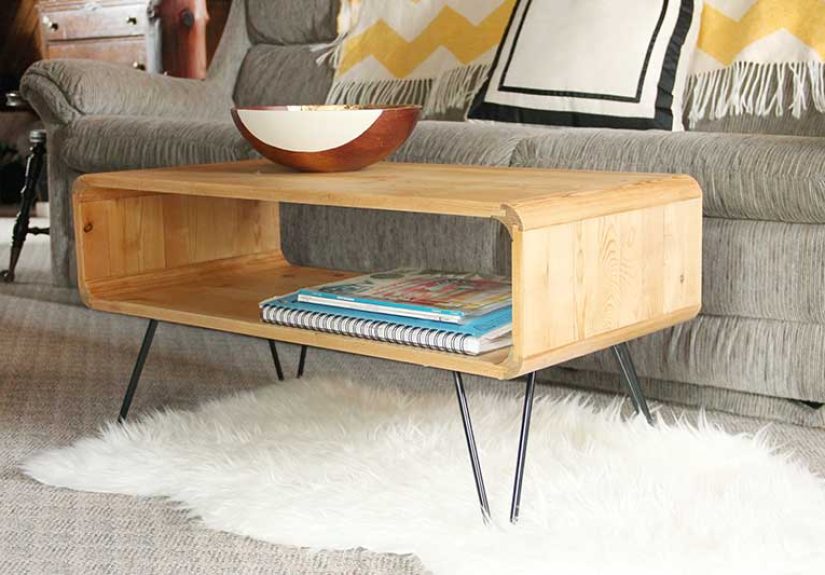
MCM furniture tends to sit low, feel airy, and show off the floor. A cubby shelf (especially a shorter, wider one) already leans in that direction. Add legshairpin or taperedand the whole piece gets that floaty, mid-century vibe.
They’re easy to customize
You can change the “personality” fast: stain the top for a walnut look, paint the base for contrast, wrap the edges in wood trim, or add sliding doors if you want a little mystery. Cubbies are basically the blank canvas of thrift furnitureexcept cheaper and less intimidating.
Pick the right thrifted cubbies (and avoid the wobbly heartbreak)
Size it like a designer, not like a raccoon collecting “good stuff”
A coffee table should be comfortable to reach and easy to move around. As a rule of thumb, aim for a height about 1–2 inches lower than your sofa seat, with many coffee tables landing in the 16–18 inch range. Length-wise, many designers like a table around two-thirds the length of the sofa. For spacing, leave enough legroom so you’re not performing gymnastics just to sit downroughly 14–18 inches between the sofa and table works well in many rooms.
Translation: before you fall in love with the cubbies, measure your sofa seat height, your rug, and the walking path through the room. This is how you avoid building a gorgeous table that blocks your entire existence.
Check the material before you commit to your finishing plan
Thrifted cubbies often come in a few common flavors:
- Solid wood: Jackpot. Sand, stain, seal, admire.
- Veneer over particleboard: Still good, but sand gentlyveneer is thin and does not forgive over-enthusiasm.
- Laminate/MDF/particleboard: Paint-friendly with the right prep (cleaning, light sanding, bonding primer). Staining usually isn’t worth the heartbreak here.
Do the “thrift store reality check”
Open and inspect everything. Look for swelling (water damage), sagging shelves, loose joints, or a back panel that’s basically held on by hope. Give it a gentle twist. If it racks like a shopping cart with one bad wheel, plan to reinforce itor keep shopping.
Design choices that scream “mid-century modern” (without yelling)
Legs: hairpin for punch, tapered for classic MCM
Legs are the fastest way to shift “cubbies” into “coffee table.” Two popular routes:
- Hairpin legs: Graphic, simple, and instantly cool. Great if you want a slightly industrial edge with your MCM lines.
- Tapered wooden legs: The classic mid-century lookwarm, refined, and timeless. Perfect for walnut or oak finishes.
Edges and corners: soften the box
Mid-century pieces often have subtle curves, chamfers, or rounded corners. If your top is a sharp rectangle, consider rounding the corners slightly, adding a gentle bevel, or using a router (or sanding block) to soften the edges. Small detail, big payoff.
Finish palette: warm woods + clean contrast
Want the “real MCM” feel? Think walnut tones, teak-like warmth, matte black accents, and a finish that looks smoothnot plastic-y. A stained wood top with a painted base (cream, white, black, or muted green) is a classic high-impact combo.
Tools and materials checklist
Adjust this list to your exact cubbies, but here’s a practical baseline:
- Measuring tape, pencil, and a square
- Drill/driver + bits (including a countersink bit if you have one)
- Sander or sanding block (120, 180, 220 grit; plus 320/400 for between-coat sanding)
- Wood glue, clamps (helpful), and a few scrap wood blocks
- Plywood or solid wood panel for a top (often 3/4″ is a sweet spot)
- Legs (hairpin or tapered) + appropriate screws/bolts
- Wood filler (optional), primer (if painting), paint or stain, and a protective topcoat
- Safety gear: dust mask/respirator, eye protection, ventilation
Step-by-step: thrifted cubbies to mid-century modern coffee table
1) Clean like you mean it
Start with a serious clean. Dust, oils, furniture polish, and thrift-store “mystery residue” can ruin adhesion and finishes. Use a degreasing cleaner, rinse/wipe per directions, and let everything dry fully. If it smells like someone stored onions in it since 1997, give it time to air out before finishing.
2) Reinforce the structure (especially if it’s particleboard)
Flip the cubbies over and look at the joints. If panels are stapled or barely fastened, add reinforcement:
- Glue and clamp any loose seams.
- Add small wood cleats (scrap wood strips) along inside corners with glue and screws.
- If there’s a flimsy back panel, replace it with a sturdier one or add corner braces inside.
This step keeps your finished table from wobbling every time someone sets down a bowl of popcorn like it’s a kettlebell.
3) Add a “real” top (your table deserves it)
Many cubbies are fine as a base, but the top is what makes it feel like furniture instead of storage. Cut a top panel that overhangs slightly (or sits flushboth can look great). If you want a more mid-century silhouette, consider a subtle overhang with rounded corners.
Attach the top securely:
- Best: screws from inside the cubbies into the top (pre-drill to avoid splitting).
- Also good: figure-8 fasteners or Z-clips if you’re using solid wood and want to allow natural movement.
- For thin/weak surfaces: add a plywood “mounting plate” underneath so leg screws have plenty of bite.
4) Plan leg placement for stability (and good proportions)
Leg placement affects both looks and strength. Set legs in from the edges enough to prevent tipping and to keep screws from blowing out corners. Mark positions carefully, drill pilot holes, and attach legs according to the hardware type.
If your tabletop or base material is thin, consider using threaded inserts and bolts (or a reinforcement plate) so the legs stay tight over time. And if you choose hairpin legs, make sure the table height lands in that comfortable zone relative to your sofa.
5) Sand smart, not angry
Sanding is where DIY dreams are tested. Keep it simple:
- Solid wood: sand with the grain, working through grits (often 120 → 180 → 220) for a smooth surface.
- Veneer: light pressure onlystop once it’s smooth and evenly scuffed.
- Laminate: you’re not removing material, you’re just dulling the shine for adhesion. Gentle scuff-sanding is the goal.
6) Finish and protect (because coffee tables live a hard life)
A coffee table gets everything: condensation rings, snack spills, feet (why), and the occasional dramatic board-game sweep. Seal it accordingly.
Finish options (choose your own adventure)
Option A: stain + clear coat for solid wood or wood veneer
If you have solid wood (or a thick, stain-friendly veneer), stain can give you that classic walnut or teak-ish warmth. Test stain on the underside first. Wipe on, wipe off, and let it dry fully before sealing.
For protection, a polyurethane topcoat is popular for tabletops because it’s durable. Apply in thin coats, keep dust under control, and lightly sand between coats if the product directions call for it. If you want a more natural look, a wipe-on poly or a hardwax oil can look less “plasticky,” but always choose a finish appropriate for a frequently used surface.
Option B: paint laminate or MDF for a crisp, modern base
For laminate or slick factory finishes, the secret is prep and primer. Clean thoroughly, scuff-sand to dull the shine, then use a high-adhesion bonding primer. After priming, sand lightly for smoothness, then apply your topcoat in thin, even layers. This approach is how you get a durable painted finish that won’t peel the first time someone looks at it aggressively.
Option C: two-tone (the easiest way to look expensive)
Paint the cubby base a soft white, warm gray, olive, or matte black, then stain the top walnut-toned. Add brass or black hardware accents (if you add doors later). Suddenly your thrift find is giving “boutique showroom,” and your wallet is giving “thank you.”
Storage and styling ideas that keep it functional
Use baskets to hide the “real life”
Cubbies are the perfect spot for woven baskets: they soften the look, add texture, and let you store chargers, toys, throws, and the remote you swear you just had. Mix two basket sizes for visual rhythm, and leave one cubby open for a stack of books or a plant.
Style the top like you have a secret interior designer on payroll
Try the simple trio: a tray (to corral small stuff), a stack of books (height), and something organic (plant, branches, or a bowl). Keep enough empty space so the table can still do its joblike holding pizza on movie night without requiring a structural engineer.
Troubleshooting (because DIY is mostly “learning loudly”)
- Wobble after adding legs: check that legs are installed square, screws are tight, and the floor is level. Add felt pads or adjustable feet if needed.
- Paint peeling: usually a prep issue. Clean better, scuff-sand, and use a true bonding primer next time.
- Blotchy stain: wood species and previous finish matter. Sand evenly and test first; consider a pre-stain conditioner on blotch-prone woods.
- Rough topcoat: dust happens. Lightly sand smooth between coats and keep your workspace as clean as possible.
Extra: of “real life” experiences people have with this exact project
If you’ve never thrifted furniture before, here’s the emotional arc: first you feel smug (“Look at me, saving money and the planet!”), then you feel brave (“I can totally fix that scratch.”), and then you feel personally attacked by a single stripped screw. Turning thrifted cubbies into a mid-century modern coffee table is one of those projects that looks straightforwarduntil you’re standing in your driveway at 9:47 p.m. holding sandpaper like it’s a tiny, dusty villain.
One very common experience: the cubbies look solid in the store, but once you get them home and flip them over, you discover the underside is basically a suggestion. That’s not a failureit’s just the moment you realize reinforcement is part of the glow-up. People often end up adding interior cleats or a plywood base plate, and afterward they’re glad they did. It’s the difference between “cute table” and “table that survives a family game night.”
Then there’s the finishing journey. Many DIYers start with big dreams of staining everything to a rich walnut, only to find out the piece is laminate. The good news? Painting can look incredibly high-end if you treat prep like a non-negotiable. The most satisfying stories usually come from the folks who took an extra hour to clean thoroughly, scuff-sand until the shine was gone, and prime properly. That’s the moment where the project stops looking like a craft and starts looking like furniture.
Another classic: leg decisions. Hairpin legs feel like the “easy button,” and they often areuntil you realize the screws you have are either too short to hold, or too long and ready to punch through the top like a surprise horror movie. The workaround people love is adding a reinforcement plate (like a plywood layer) so the legs have a thick, secure surface to bite into. Once that’s done, attaching legs becomes one of the most satisfying partsbecause the second legs go on, the piece magically becomes “a table,” not “a box on the floor.”
Finally, the styling payoff is real. People who do this project often say the biggest surprise is how much calmer their living room feels. The cubbies swallow cluttercontrollers, chargers, coasters, magazineswhile the top stays clean enough to feel intentional. And because the table is customized to their space (height matched to the sofa, storage matched to their habits), it functions better than many store-bought options. The “experience” most folks end up with isn’t just a new tableit’s the confidence boost of realizing they can take an awkward thrift find and turn it into something that looks like it cost five times more. Plus, every time someone compliments it, you get to say, “Oh this? It used to be cubbies.” And that sentence never gets old.
Conclusion
A thrifted cubby shelf is basically a coffee table waiting for a glow-up. With a solid top, the right legs, and a finish that suits the material you’re working with, you can create a mid century modern coffee table that looks airy, intentional, and genuinely useful. Measure for comfort, reinforce for stability, prep for durability, and choose a finish that can handle real life. Then sit back, put your feet up (politely), and enjoy the fact that your living room now has a statement piece with built-in storage and a great backstory.