Table of Contents >> Show >> Hide
- What Is a Tongue Piercing, Exactly?
- The Main Tongue Piercing Types
- How Professionals Decide Which Tongue Piercing Type Works
- Jewelry Matters More Than Most People Think
- Pain, Swelling, and Healing: What to Expect
- Oral Health Risks You Should Take Seriously
- Aftercare Tips That Actually Make Sense
- Who Should Be Extra Cautious?
- Expert Insights: How to Choose the Right Tongue Piercing Type
- Final Thoughts
- Real-Life Experiences With Tongue Piercing Types
If you think all tongue piercings are basically the same but with different levels of “look at me,” your tongue would like a word. In reality, tongue piercing types vary a lot in placement, anatomy requirements, healing behavior, jewelry choice, and long-term comfort. Some styles are classic for a reason. Others look cool for five seconds and then spend the next several months trying to negotiate peace between your teeth, gums, and common sense.
This guide breaks down the most common tongue piercing types, what makes each one different, and what professional piercing and dental guidance consistently says about safety, healing, and oral health. The goal is not to kill the vibe. The goal is to help you choose a style that still feels like a good idea after the swelling goes down and your lunch order becomes understandable again.
What Is a Tongue Piercing, Exactly?
A tongue piercing is an oral piercing placed through the tongue itself or, in some cases, through the thin tissue under the tongue. The most familiar version is a vertical midline tongue piercing with a straight barbell. That is the style most people picture when they hear the term tongue ring, even though the jewelry is usually a barbell rather than an actual ring.
What makes tongue piercings different from many other body piercings is the environment. The mouth contains plenty of bacteria, the tissue moves constantly, and the jewelry sits dangerously close to teeth and gums. That is why expert guidance tends to focus less on “Which one looks coolest?” and more on “Which one fits your anatomy and is least likely to annoy your dentist for the next five years?”
The Main Tongue Piercing Types
1. Classic Midline Tongue Piercing
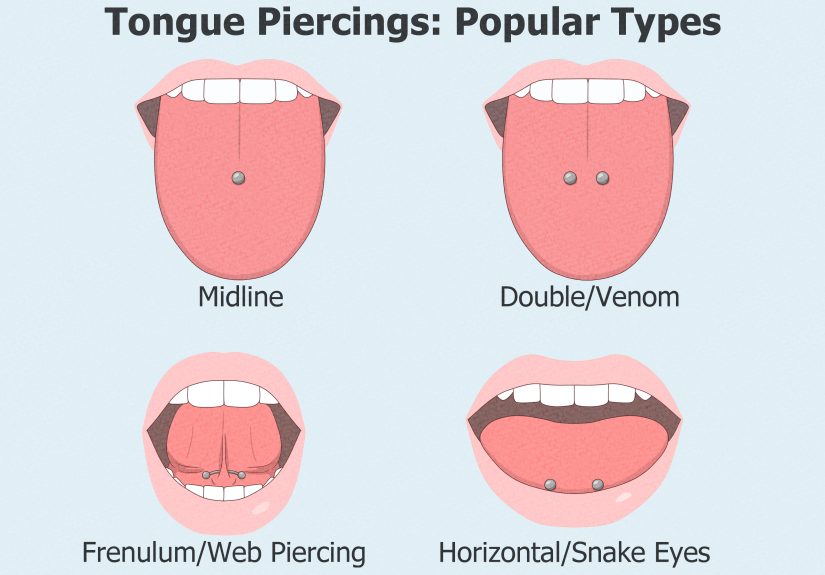
This is the standard, traditional tongue piercing and the one most professional guidance is built around. It is placed vertically near the center of the tongue, usually toward the front half but not right at the tip. The jewelry is typically a straight barbell, initially longer to allow for swelling and later shortened once the tissue settles.
Why it remains the go-to option is simple: when it suits the person’s anatomy, it is the most practical tongue piercing type. A well-placed midline piercing can reduce unnecessary rubbing against teeth and gums, make speech adjustment easier, and create a cleaner healing path than more experimental placements.
Best for: People who want the classic look and the most established option.
Jewelry: Straight barbell.
Reality check: It may be traditional, but it still demands smart aftercare and regular downsizing.
2. Venom Piercings
Venom piercings are essentially a pair of tongue piercings placed side by side, one on each side of the midline. Instead of one barbell in the center, you get two separate vertical piercings. Visually, they are bolder and more dramatic than the classic single piercing.
They can look striking, but they are not just “double the style.” They are also double the punctures, double the jewelry, and often a longer adjustment period when it comes to swelling, speech, and eating. Because the placement sits off center, anatomy matters even more. A professional piercer has to map the tongue carefully to avoid poor placement and reduce the chance of ongoing irritation.
Best for: People who want a more symmetrical, high-impact look.
Jewelry: Two separate barbells.
Reality check: More jewelry means more room for accidental tooth contact if you are careless.
3. Side Tongue Piercings
A side tongue piercing is a vertical piercing placed off the center line rather than directly through the middle. Some people choose this because they want something less expected than a classic midline piercing. Others simply have anatomy that makes another placement more flattering or more comfortable.
That said, side placements are not automatically better or safer. Once jewelry moves farther from a neutral position in the mouth, there can be more contact with teeth or soft tissue. A placement that looks artistic on paper can feel pretty chaotic when you are talking, chewing, or absentmindedly tapping the barbell against a molar. Your future dental bill may not appreciate the creativity.
Best for: People seeking a less traditional look.
Jewelry: Usually a straight barbell.
Reality check: Off-center placement can mean more comfort issues if anatomy is not ideal.
4. Frenulum or Tongue Web Piercing
This style is placed through the thin web of tissue beneath the tongue, sometimes called the lingual frenulum. It is technically part of the oral piercing family, though it is different from a piercing that goes through the muscular body of the tongue itself.
Because the tissue is smaller and more delicate, not everyone is a candidate. Some people simply do not have enough tissue there for stable placement. When it works, the look is subtler than a visible top-of-tongue barbell, which appeals to people who want something more discreet. It also tends to have its own healing behavior and jewelry limitations, so it should never be treated as a shortcut version of a regular tongue piercing.
Best for: People who want a less visible oral piercing.
Jewelry: Often a small curved barbell or ring depending on anatomy.
Reality check: Small tissue does not mean zero risk. Migration and irritation can still happen.
5. Surface Tongue Piercing
A surface tongue piercing sits more shallowly through the tongue tissue rather than traveling vertically through the tongue in the traditional way. It is one of the less common tongue piercing types, partly because it is often more temperamental.
Surface placements in general are known for being fussier. The tongue moves constantly, swells easily, and has to deal with friction from speech and food. That combination can make a surface style harder to heal and harder to keep happy over time. It may look sleek and unusual, but it is not usually the first option professionals recommend when someone wants a reliable long-term oral piercing.
Best for: Experienced piercing clients who understand the tradeoffs.
Jewelry: Usually a surface bar or curved style depending on placement.
Reality check: This is more “high maintenance art project” than “easy starter piercing.”
6. Horizontal Tongue Piercings and “Snake Eyes” Styles
These are the styles that get a lot of attention online because they look unusual and dramatic, especially near the tip of the tongue. In casual conversation, people often lump several tip-of-tongue looks together under names like snake eyes or similar trend labels.
Here is the expert insight that matters: trendy does not equal broadly recommended. Many experienced piercers and dental professionals view horizontal or tip-focused tongue piercings as controversial because they can create more tooth contact, interfere with natural tongue movement, and raise the odds of irritation and oral damage over time. In other words, they photograph well, but your mouth still has to live with them on a random Tuesday morning while you are eating cereal.
Best for: Very selective cases, if at all.
Jewelry: Varies by style.
Reality check: If a reputable piercer tries to talk you out of one, that is often a green flag, not a buzzkill.
How Professionals Decide Which Tongue Piercing Type Works
The best tongue piercing type is not chosen by trend boards or by whatever looks coolest in a close-up selfie. It is chosen by anatomy. A skilled piercer looks at tongue size, thickness, vein placement, frenulum structure, resting position in the mouth, and how your tongue naturally moves when you speak and swallow.
This is one of the biggest expert insights in the entire topic: oral piercings are anatomy-first decisions. A piercing that works beautifully for one person may be a terrible idea for another. That is why a responsible piercer will sometimes say no, suggest a safer placement, or recommend a different jewelry style. It is not them ruining your plan. It is them preventing your plan from ruining your enamel.
Jewelry Matters More Than Most People Think
When people talk about tongue piercings, they usually focus on placement and pain. Professionals often focus just as much on jewelry. Material quality, finish, length, threading style, and the size of the ball ends all affect healing and long-term comfort.
For an initial piercing, high-quality implant-grade materials are usually preferred. The initial bar is often longer to allow for swelling, but once swelling decreases, a shorter bar is typically needed. This process, often called downsizing, is not optional decoration. It is one of the smartest ways to reduce constant contact with teeth and gums.
Oversized jewelry may seem harmless at first, but it can become the mouth equivalent of leaving a shopping cart loose in a parking lot: sooner or later, something expensive gets hit.
Pain, Swelling, and Healing: What to Expect
Pain is subjective, so reviews vary wildly. One person says, “That was easy.” Another acts like they fought a dragon. In general, the piercing itself is fast, but the real challenge is the first several days afterward, when swelling, tenderness, extra saliva, and speech changes can make you feel like your tongue suddenly has a strong opinion about everything.
A straightforward tongue piercing is often described as healing in roughly 4 to 8 weeks, though the timeline depends on the exact placement, the jewelry, your anatomy, and how well you follow aftercare. Multiple piercings or more specialized placements may take longer or behave less predictably.
Swelling can be especially noticeable during the early phase. That is why professional aftercare advice often emphasizes cold drinks, gentle eating habits, not overusing the tongue, and returning for downsizing when appropriate. Trying to “tough it out” with poor aftercare is not brave. It is just a creative way to make soup feel complicated.
Oral Health Risks You Should Take Seriously
If you read professional dental guidance on tongue piercings, a clear theme appears quickly: the main issue is not that oral piercings are impossible to heal. The issue is that even healed oral piercings can still cause damage. That makes tongue piercing types worth comparing not only by appearance, but by their long-term behavior in the mouth.
Common concerns include chipped or cracked teeth, gum irritation or gum recession, swelling, bleeding, increased plaque retention on jewelry, speech interference, accidental biting, irritation to soft tissues, and infections. In more serious cases, swelling can become severe, and rare systemic complications have been reported in medical literature.
This does not mean every tongue piercing ends in disaster. It does mean the smart question is not “Can I get one?” but “Can I maintain one without constantly knocking metal into my teeth and ignoring warning signs?” That is a much less glamorous question, but it is the adult one.
Aftercare Tips That Actually Make Sense
Do This
Use alcohol-free oral rinse as directed, keep up normal toothbrushing and flossing, rinse gently with water after eating, and follow the specific aftercare plan given by your piercer. Use a clean, soft toothbrush and keep the jewelry area as undisturbed as possible.
Do Not Do This
Do not play with the jewelry, do not click it against your teeth, do not swap jewelry too early, and do not decide that a harsh homemade cleaning experiment is a sign of independence. Over-cleaning can irritate tissue just as under-cleaning can invite problems. Your mouth is not a chemistry lab.
Also, avoid treating internet myths like medical advice. A tongue piercing is never a do-it-yourself project, and persistent swelling, bad odor, pus, fever, increasing pain, or breathing difficulty deserves prompt professional attention.
Who Should Be Extra Cautious?
You should be especially cautious with any tongue piercing type if you have a habit of grinding your teeth, poor gum health, a history of dental fractures, oral hygiene challenges, or medical issues that raise the stakes for infection or delayed healing. People with extensive dental work may also want a conversation with a dentist before committing, because jewelry and restorations are not always a peaceful combination.
If you play contact sports, clench your jaw, or chew on pens, ice, or your own stress, your mouth may already be chaotic enough without adding a barbell to the group chat.
Expert Insights: How to Choose the Right Tongue Piercing Type
Across professional piercing and dental guidance, the same advice shows up again and again:
- Choose anatomy over trend.
- Choose a reputable professional over the cheapest studio.
- Choose quality jewelry over flashy low-cost metal.
- Choose downsizing over leaving long jewelry in place forever.
- Choose oral health over the fantasy that “it’ll probably be fine.”
That may not sound thrilling, but it is exactly why some people love their tongue piercing for years while others remove it after one miserable season of swelling, speech issues, and accidental tooth taps. The best-looking tongue piercing is usually the one that fits your mouth, heals smoothly, and does not turn every sandwich into a tactical exercise.
Final Thoughts
When comparing tongue piercing types, the classic midline style remains the most practical option for many people, while venom, side, frenulum, and more unusual placements can offer a different look with different tradeoffs. The smartest choice depends on your anatomy, pain tolerance, oral habits, and willingness to take aftercare seriously.
If there is one takeaway worth keeping, it is this: tongue piercings are not just fashion choices. They are oral piercings living in one of the busiest, bacteria-rich, tooth-filled neighborhoods in your body. Pick a style with your long-term comfort in mind, not just your next mirror selfie. Your mouth has enough to do already.
Real-Life Experiences With Tongue Piercing Types
One reason tongue piercing articles can feel confusing is that people often talk about the experience as if every style behaves the same way. It does not. Someone with a classic midline piercing may describe the process as annoying but manageable: a quick appointment, a few awkward days of talking like they are hiding marbles, and then a steady return to normal. Someone with a more complex setup, like venom piercings, may describe a stronger swelling phase, a longer adjustment period, and a steeper learning curve with eating and pronunciation. Same body part, very different week.
A common experience in the first few days is surprise. Not panic-level surprise, but the kind that says, “Wow, I did not expect my tongue to suddenly take up this much real estate.” People often notice extra saliva, slight lisping, tenderness, and a dramatic awareness of where the jewelry sits in the mouth. Cold drinks can feel soothing. Crunchy food can feel like betrayal. Talking a lot may go from harmless activity to poor life choice.
Another very real experience is the mental adjustment. A tongue piercing might look small in the mirror, but your mouth notices it constantly at first. Many people say the hardest part is not the piercing itself. It is remembering not to play with the jewelry. The moment the barbell becomes a built-in fidget toy, teeth and gums may start paying the price. That is why experienced piercers and dentists sound almost repetitive on this point. They are not being dramatic. They have seen what absentminded habits can do.
People who end up happiest with their piercing often describe the same pattern: they picked a placement that suited their anatomy, followed aftercare without improvising, returned for downsizing on time, and stopped treating the jewelry like a tiny mouth dumbbell. In contrast, people who regret the experience often mention one or more of the following: they chose a trendy style without understanding the tradeoffs, they delayed jewelry changes, they underestimated oral hygiene, or they got tired of the constant clicking against teeth and the way eating required more strategy than expected.
There is also a social side to the experience. Some people love the confidence boost and the sense of self-expression. Others discover that the “cool factor” fades faster than the responsibility. What felt rebellious and stylish on day one may feel less magical when you are carefully chewing soup ingredients one at a time during the swelling phase. That does not make the piercing a bad choice. It just means the lived experience is more practical than glamorous.
For many people, the turning point is downsizing. Once the initial swelling is over and the longer jewelry is replaced with a better-fitting piece, the piercing usually feels less clumsy and more like part of the mouth rather than an awkward houseguest. Speech often improves, tooth contact may decrease, and daily life becomes easier. That is why seasoned clients often talk about downsizing like it is the unsung hero of the whole process.
In the end, the real-world experience of tongue piercing types tends to reward patience and punish shortcuts. The people with the best stories are rarely the ones who chased the wildest trend. They are the ones who chose wisely, healed carefully, and respected the fact that style is great, but enamel is not replaceable by positive thinking.