Table of Contents >> Show >> Hide
- What Was the Original Trekulator?
- Why a Star Trek Calculator Made Sense in the 1970s
- How the Modern Trekulator Reproduction Brings It Back
- Authenticity vs. Improvement: The Delicate Nerd Balancing Act
- Why the Trekulator Still Matters
- What Makers, Collectors, and Star Trek Fans Can Learn From It
- The Experience of the Trekulator: Why This Kind of Object Gets Under Your Skin
- Conclusion
If you ever looked at a 1970s gadget and thought, “This is either a calculator or a prop stolen from a spaceship cafeteria,” congratulations: you already understand the vibe of the Trekulator. It was part calculator, part fan merch, part glowing monument to the era when the future was painted in bold colors and powered by batteries that probably died at the least dramatic moment possible.
The modern Trekulator reproduction takes that wonderfully oddball idea and gives it new life. Instead of treating the original as a punchline, this remake treats it like what it really is: a fascinating little artifact from the moment when handheld electronics, toy marketing, and science-fiction fandom all collided in one gloriously blue plastic object. And honestly, that collision was inevitable. If the 1970s loved anything, it was calculators. If the 1970s loved anything else, it was Star Trek. Put them together and you get a machine that feels like it was designed by an engineer with a tricorder in one hand and a toy catalog in the other.
This article explores what the original Trekulator was, why it mattered, how the new reproduction works, and why a Star Trek-themed calculator still charms collectors, makers, and retro-tech fans nearly fifty years later.
What Was the Original Trekulator?
The original Trekulator was a MEGO-branded Star Trek themed calculator sold during the late 1970s, often associated with 1976 in project writeups and with the 1977 MEGO catalog in collector references. That timeline wobble is very on-brand for vintage electronics, where the difference between “released,” “cataloged,” and “actually found in the wild” can feel like a minor temporal anomaly.
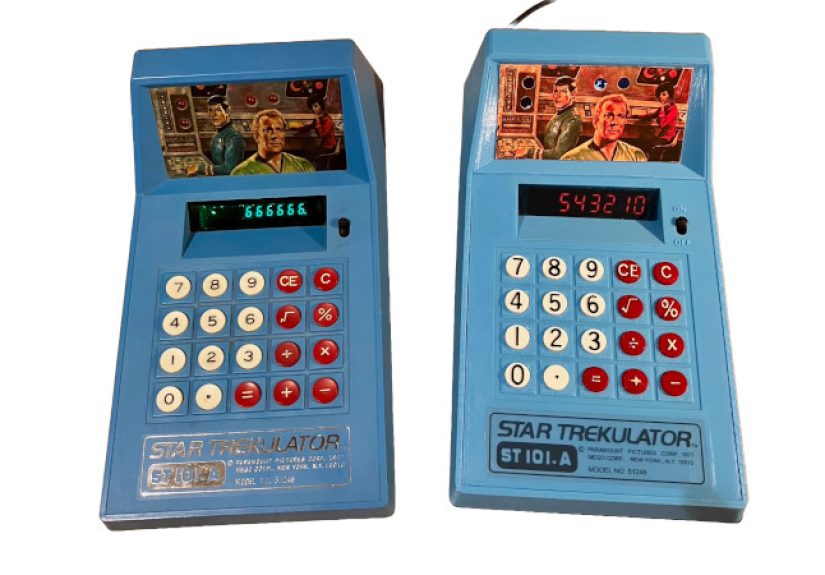
What matters more is the object itself. The vintage Trekulator was a working basic calculator, but it did not look like the sleek pocket devices people now associate with math class trauma. Instead, it leaned hard into sci-fi styling. It featured a seven-segment numeric display, a dramatic panel image of Kirk, Spock, and Uhura, and blinking red lights that made the whole thing feel less like office equipment and more like a command console from a low-budget but deeply lovable future.
That design choice is the whole point. The Trekulator was not trying to be the most advanced calculator on the market. It was trying to make arithmetic feel like a bridge operation aboard the Enterprise. Adding seven plus five? No, captain. You were computing mission-critical coordinates.
Collectors now regard the original as a scarce piece of Star Trek merchandise. That rarity adds to its mystique, but the bigger appeal is how perfectly it captures the retro-futurist imagination of the time. It is a machine built for a moment when electronics still felt magical, when blinking lights could sell almost anything, and when fandom merch had not yet been optimized into today’s polished, algorithm-approved sameness.
Why a Star Trek Calculator Made Sense in the 1970s
From a modern perspective, a themed calculator can sound oddly specific. But in the 1970s, calculators were a cultural event. Handheld electronic calculators had only recently emerged from a world of bulky, expensive machines. By the middle of the decade, the technology was becoming cheaper, smaller, and dramatically more common. That made calculators ideal status objects: useful, futuristic, and visible enough to show off.
In other words, calculators were not boring yet.
They were still symbols of progress. Museums and computing histories often describe calculators as one of the earliest mass-market success stories for integrated circuits and portable electronics. For students, engineers, and ordinary consumers, the calculator represented a shift from mechanical effort to digital convenience. Once prices began to drop, the calculator moved from specialty tool to everyday object, and from there it was only one commercial leap to novelty versions, educational versions, and yes, franchise versions.
That is where the Trekulator fits. It appeared right when electronics were becoming cheap enough to cross into toy and novelty territory. The same era that gave consumers blinking games, speaking toys, and educational gadgets also produced items that borrowed the language of advanced technology for pure delight. The Trekulator did not need to be screen-accurate to succeed as an idea. It just needed to feel futuristic enough to whisper, “Math, but make it spacey.”
And that is actually a key part of its charm. The original unit was not a prop replica from the TV series. It was more like a fan-imagined object, filtered through 1970s manufacturing, toy design, and merchandising instincts. It was less “official Starfleet hardware” and more “what if your local department store sold arithmetic equipment from an alternate universe?”
How the Modern Trekulator Reproduction Brings It Back
The new reproduction project, created by Michael Gardi, approaches the original with the exact kind of seriousness that great retro-tech deserves. Not grim seriousness. Fun seriousness. The kind that says, “Yes, I know this is a Star Trek calculator from the disco era. That is precisely why it deserves careful reverse engineering.”
Reverse Engineering the Look
One of the most impressive parts of the reproduction is its commitment to the original form. Gardi modeled the case, studied original hardware, and worked through the physical layout so the remake would preserve the Trekulator’s distinctive silhouette and panel arrangement. That matters because the Trekulator is not memorable because of raw computational power. It is memorable because it looks like the future as imagined by a toy company in 1977.
That means the reproduction had to preserve the visual theater: the keypad, the windowed display area, the color, the feeling that this thing should either solve equations or open a channel to Starfleet Command. Preferably both.
Modern Hardware Under a Retro Shell
Inside, though, this is not simply a museum-grade shell with dead nostalgia trapped inside it. The modern Trekulator uses contemporary electronics, including an ESP32-based setup, custom PCB work, and a TFT touch display with integrated SD support. In project logs and coverage, the build also includes sound support and a thoughtful internal packaging strategy to make the electronics fit inside the case without turning the whole project into a spaghetti western starring jumper wires.
One especially clever design decision involves the original light-up artwork panel. The vintage Trekulator had static character art with embedded LEDs. In the reproduction, a TFT display sits behind that panel area, allowing the builder to emulate the original glowing effects while also opening the door to richer visuals and a more animated experience. That is the sweet spot for retro reproduction: keep the old illusion, but let modern hardware quietly do the heavy lifting backstage.
The result is not just a replica. It is a respectful upgrade. It remembers that part of the Trekulator’s appeal was always performance, not just function. A calculator gives you answers. A Trekulator gives you answers with flair.
Authenticity vs. Improvement: The Delicate Nerd Balancing Act
Every reproduction project has to answer one dangerous question: how faithful is faithful enough? Go too strict, and you end up with a lifeless copy that proves a point but does not invite use. Go too modern, and you lose the weird soul that made the original worth reviving in the first place.
The Trekulator reproduction handles that balance well. It preserves the retro shell, the display drama, the seven-segment sensibility, and the overall late-1970s sci-fi flavor. At the same time, it accepts that modern makers have better tools and different expectations. Custom boards, 3D-printed parts, modern microcontrollers, and contemporary display components are not cheats. They are the reason a niche object like this can be recreated at all.
That tension is what makes the project interesting beyond the Star Trek fandom. It becomes a case study in design preservation. What exactly are you saving when you reproduce a vintage electronic object? The circuitry? The exterior? The user experience? The emotional effect?
In this case, the best answer is probably: all of the above, but especially the emotional effect. Because nobody is chasing a Trekulator in 2026 for raw mathematical superiority. Your phone can already calculate faster than the Enterprise computer ever dreamed. What the Trekulator offers instead is personality. It has more character than an app icon and more narrative than a generic keypad rectangle.
Why the Trekulator Still Matters
At first glance, the Trekulator looks like a novelty. At second glance, it still looks like a novelty, but now an important one.
It tells us something about how people once imagined the future. In the 1970s, the future was physical. It had buttons. It blinked. It beeped. It came in bright molded plastic and made everyday tasks feel theatrical. A calculator was not hidden in your phone. It sat on the table and announced its purpose like a tiny dashboard from a starship.
The Trekulator also reminds us that fandom and technology have long fed each other. Star Trek inspired generations of engineers and tinkerers, but it also inspired toy makers, merch designers, and gadget dreamers. That feedback loop matters. A kid who loved a sci-fi calculator could grow up to design real interfaces. A collector who buys a weird old Trek toy might become the maker who brings it back with better electronics. Culture and engineering are not separate lanes; they are constantly borrowing tools from each other.
There is also a design lesson here. Calculators may be practical devices, but the most memorable ones have always been aesthetic objects too. Even mainstream calculator design has influenced later consumer interfaces, from elegant Braun models to the visual language of smartphone apps. The Trekulator sits at the louder, campier end of that spectrum, but it belongs in the same conversation. It proves utility and theatrical design can coexist, sometimes gloriously.
What Makers, Collectors, and Star Trek Fans Can Learn From It
For makers, the Trekulator is proof that no object is too niche to deserve craftsmanship. Reproducing a vintage themed calculator is not the obvious path to internet fame. That is what makes it admirable. It is driven by fascination rather than trend-chasing.
For collectors, it is a reminder that rarity alone is not the whole story. The original Trekulator is compelling because it is weird, specific, and beautifully dated. It captures a moment when pop culture branding and consumer electronics were still experimenting with each other.
For Star Trek fans, it is one more example of the franchise’s strange and wonderful afterlife. Not every piece of Trek history comes in the form of a starship model or a phaser replica. Sometimes it comes disguised as a calculator that seems ready to compute warp factors, grocery totals, and your monthly budget with equal confidence.
The Experience of the Trekulator: Why This Kind of Object Gets Under Your Skin
What is the actual experience of a Trekulator-like device in the present day? Not the technical spec sheet. Not the collector value. The feeling.
It starts with scale and presence. Modern devices disappear into pockets, merge into black glass, and hide their magic behind touchscreens so smooth they can feel emotionally sealed off. A Trekulator does the opposite. It is visible. It asks to be picked up. It has a front face that behaves more like a stage set than a neutral tool. The buttons are not shy. The display is not shy. Even the artwork is not shy. The whole machine is essentially yelling, “Observe me doing math in the dumbest and most delightful way possible.”
Then there is the rhythm of use. Vintage-inspired electronics slow you down just enough to make each interaction memorable. Pressing keys on a device like this feels deliberate. Watching segmented numbers appear is strangely satisfying in a world of frictionless interfaces. The old limitations become part of the pleasure. You are not just getting an answer; you are watching a little ritual happen.
That experience matters because retro objects often restore something modern design has sanded away: ceremony. A Trekulator turns a tiny act of arithmetic into a performance. The lights suggest activity. The artwork suggests context. The shape suggests narrative. Suddenly, a simple calculation feels less like data entry and more like a mission briefing from a future imagined by somebody who thought more blinking lights were always the correct answer. In fairness, they were not entirely wrong.
There is also a social experience tied to an object like this. Show someone a phone calculator and you get exactly zero conversation. Show someone a Star Trek-themed calculator reproduction and you get questions, laughter, nostalgia, and usually one person saying, “Wait, that was a real thing?” That reaction is part of the appeal. The Trekulator is a conversation starter disguised as a calculator. Or maybe a calculator disguised as a conversation starter. Either way, it works.
For collectors, the emotional pull is different but just as strong. A Trekulator connects several forms of memory at once: old-school electronics, toy aisle imagination, and the long cultural shadow of Star Trek. It does not just remind people of a product. It reminds them of an era when technology still felt like an event. Even basic gadgets carried a sense of wonder. You bought a calculator, yes, but you also bought a little slice of tomorrow.
For makers, the experience becomes even richer. Recreating a device like this means engaging with two generations of problem-solving at once. You study how the original designers made sci-fi excitement out of limited hardware, then you decide how modern components can preserve that effect without flattening it. That is not mere imitation. It is a design conversation across decades.
And that is why the Trekulator sticks with people. It is funny, yes. It is impractical in the way all beloved niche objects are impractical. But it also represents something deeply human: the desire to make ordinary tools feel extraordinary. A plain calculator solves problems. The Trekulator makes problem-solving feel like part of an adventure. In a world overflowing with efficient devices, that kind of joyful unnecessary magic is not trivial. It is the whole point.
Conclusion
The Trekulator reproduction succeeds because it understands the original device better than a simple copy ever could. The vintage MEGO calculator was never just about arithmetic. It was about spectacle, fandom, and the retro-futurist optimism of the late 1970s. Michael Gardi’s remake keeps that spirit intact while using modern electronics to make the concept feel alive again.
In the end, the Trekulator is a perfect example of why retro-tech projects matter. They preserve objects, yes, but they also preserve moods, expectations, and design dreams. They remind us that the future once looked bright blue, had blinking red lights, and apparently wanted us to do long division with the confidence of a Starfleet officer.
That may not be the future we got. But it is absolutely one worth rebuilding.